1. Accueil
  2. IELTS
  3. Tests blancs
  4. Writing
  5. Making drinking water from the sea

IELTS Writing · Task 1

IELTS Academic Writing Task 1 : Making drinking water from the sea

  • Processus
  • 20 min
  • 150 mots
  • Academic

ACADEMIC WRITING TASK 1

You should spend about 20 minutes on this task.

The diagram below shows how drinking water is produced from seawater at a reverse osmosis desalination plant. Summarise the information by selecting and reporting the main features, and make comparisons where relevant.

Write at least 150 words.

The main stages at a typical seawater reverse osmosis plant
  1. Intake

    Seawater is drawn in through a pipe, and screens keep out seaweed and other large debris.

  2. Coagulation

    Chemicals are added so that very fine particles stick together in larger clumps.

  3. Filtration

    The water passes through sand filters and then finer cartridge filters, which protect the membranes.

  4. High-pressure pumping

    Powerful pumps raise the water to a very high pressure.

  5. Reverse osmosis

    The pressure forces water through semi-permeable membranes, and most of the salt stays behind. The flow now divides into two.

  6. Brine: energy recovery

    The very salty water left over, called brine, is still under pressure. This pressure is reused to help pressurise incoming seawater.

  7. Brine: return to the sea

    The brine is piped back to the sea and dispersed.

  8. Fresh water: minerals

    Minerals such as calcium are added, because water this low in minerals would corrode pipes.

  9. Fresh water: disinfection

    A small amount of chlorine is added to kill micro-organisms.

  10. Storage and supply

    The drinking water is stored in tanks and then piped to homes and businesses.

Les chiffres sont inventés pour l’entraînement.
20:00
0 / 150 mots

Notez votre réponse

Lisez d’abord les réponses modèles. Choisissez ensuite, pour chaque critère, le band qui correspond à votre réponse. Votre band est la moyenne, arrondie au demi-band le plus proche.

6,0Votre band estimé
Task achievement

Coherence and cohesion

Lexical resource

Grammatical range and accuracy

Chaque modèle est écrit comme l’écrirait un candidat différent, donc les détails et les opinions varient. Les bands sont notre estimation d’après les descripteurs publics, pas des notes officielles d’examinateur.

Réponses modèles à quatre bands

Chaque modèle est écrit comme l’écrirait un candidat différent. Les bands sont notre estimation d’après les descripteurs de band publics.

Modèle de band 5,5167 mots

This diagram shows how a plant makes drinking water from sea.

First, the seawater is taken in by a pipe and screens stop seaweed and other rubish. Next, chemicals are added, so small particles stick together. Then water goes through sand filters and cartridge filters, this protects the membranes. After that, strong pumps give very high pressure to the water.

The next stage is reverse osmosis. Water goes through membranes but most of salt stay behind. Now there are two kinds of water and they seperate. The first one is brine and it is very salty. It has still pressure, and this pressure is used for make energy. Then the brine goes back in the sea.

The second one is fresh water. Minerals like calcium are added, also a small amount of chlorine is added and it kills micro-organisms. Last, the water is kept in tanks and it goes to homes by pipes.

So at the end the salt is removed and people can drink the water.

Pourquoi ce band

  • There is no overview at the start. The general picture comes only in the last line: 'the salt is removed and people can drink the water'.
  • 'First', 'Next', 'Then' and 'After that' carry the sequence, so every stage gets one flat sentence.
  • One stage is misread: 'this pressure is used for make energy'. The diagram says the pressure is reused to help pressurise incoming seawater, and no new energy is made.

Critère par critère

Task achievement
Every stage appears in the right order and the two streams are kept apart. There is no grouping, though, and the energy recovery stage is wrong.
Coherence and cohesion
The diagram supplies the plan, and the paragraphs break sensibly at reverse osmosis. The links are mechanical, and 'The first one' and 'The second one' have to stand in for the names of the two streams.
Lexical resource
Most words come from the diagram. 'other rubish' and 'give very high pressure' show the limit of the writer's range, and 'seperate' and 'rubish' are misspelt.
Grammatical range and accuracy
About half of the sentences have an error, mostly small words and agreement: 'from sea', 'most of salt stay' and 'used for make'. Comma splices appear in 'cartridge filters, this protects' and 'are added, also', and the word order slips in 'It has still pressure'. Simple passives such as 'chemicals are added' are sound.

Pour atteindre le band suivant

Add one sentence after your introduction saying that the water is cleaned, pushed through membranes and then split into two. Then check the noun before each verb: 'most of the salt stays'.

Faites un plan avant d’écrire

Ce que demande la question

This is a sequence with a fork in it, and the fork is the trap. At the membranes one flow becomes two: brine, which goes back to the sea, and fresh water, which goes on to the taps. Candidates who keep writing in one straight line end up adding minerals to the brine. The topic is the other trap. Water shortage invites a comment on drought or cost, but the diagram says nothing about either, and any figure for pressure or salt would be invented. Plants differ in their details, so report this diagram and do not bring in others.

Votre vue d’ensemble

Seawater is cleared of solids and pushed through membranes at high pressure, and the flow then divides: the salty brine returns to the sea, while the fresh water is treated further and supplied to users.

Paragraphe par paragraphe

  1. IntroductionOne sentence in your own words: what goes in, what comes out, and where.
  2. OverviewThe cleaning before the membranes, and the split into two streams.
  3. Before the membranesIntake, coagulation and filtration, then the high-pressure pumps and reverse osmosis itself.
  4. After the membranesOne stream at a time: the brine, with its energy recovery and return to the sea, then the fresh water, with minerals, chlorine, storage and supply.

Erreurs fréquentes

  • Carrying on in a straight line after reverse osmosis. One flow becomes two at that point, so minerals and chlorine go only into the fresh water, never into the brine.
  • Saying that the filters remove the salt. Sand and cartridge filters take out solid particles. The salt is left behind only at the membranes.
  • Leaving out the pumps, or saying that the membranes simply filter the water. High pressure is what forces the water through, so pumping has to come before the membranes in your answer.
  • Saying that energy is produced at the energy recovery stage. No new power is made: the pressure left in the brine is reused to help pressurise incoming seawater.
  • Adding figures for pressure, salt or daily output, or comments on drought and cost. The diagram gives none of these, and the task is only to report what it shows.

Vocabulaire du thème

intake
the place where water is taken into a plant
debris
loose pieces of unwanted material
clump
a small group of things stuck together
semi-permeable
letting some substances pass through, but not others
membrane
a very thin sheet that acts as a barrier
reverse osmosis
using pressure to force water through a membrane, leaving dissolved salts behind
brine
water containing a lot of salt
to pressurise
to put a liquid or gas under high pressure
to corrode
to damage metal slowly through a chemical reaction
to disperse
to spread out over a wide area

Expressions utiles

  • The process falls into ... main parts: ..., ... and ...
  • ... is drawn in through ..., where ...
  • ... are added so that ...
  • ... is forced through ..., which hold back ...
  • At this point the flow divides into ... and ...
  • The ... left behind is ..., while the ... goes on to ...
  • ... is reused to help ...
  • Before reaching ..., the water is ...

Icône de l'application Fleydo IELTS Fleydo : Préparation IELTS

Emportez ces tests sur votre téléphone

Tous les tests de ces pages se trouvent aussi dans l’application Fleydo : Préparation IELTS pour iPhone, iPad et Android, avec en plus 2 000 mots IELTS et leur audio.

  • Fonctionne hors ligne une fois le test téléchargé sur votre téléphone
  • 2 000 mots IELTS avec audio, répétition espacée et exercices courts
  • Enregistrez vos réponses de Speaking et réécoutez-les
  • Un programme quotidien selon votre band visé et votre date d’examen
Télécharger dans l’App StoreDisponible sur Google Play
Scannez pour téléchargerOuvre l’App Store ou Google Play, selon votre téléphone.

Aucun compte nécessaire. En savoir plus sur l’application

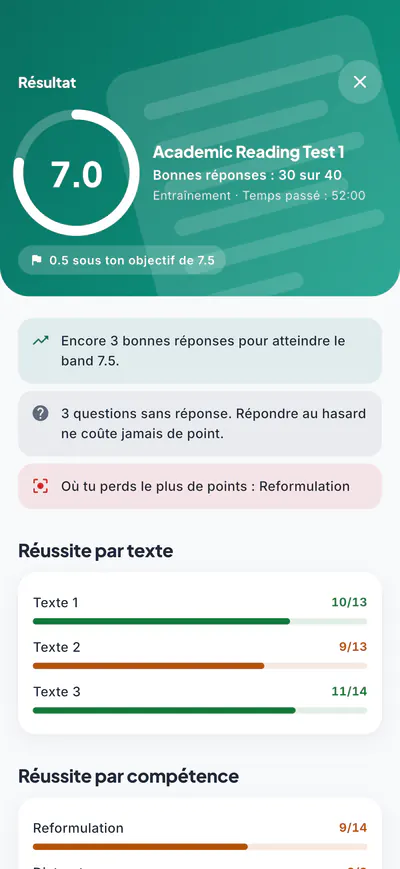
Résultat d’un test blanc IELTS dans l’application Fleydo : Préparation IELTS : band estimé et taux de réussite pour chaque partie
Cours d'essai gratuit

Découvrez votre vrai band IELTS avant l'examen

Un cours individuel en ligne gratuit avec un professeur anglophone natif, spécialiste IELTS certifié Band 8.5+. Vous obtenez un diagnostic Speaking au format réel, une estimation honnête de votre band et un plan ciblé sur les critères qui vous coûtent des points. Sans paiement, sans engagement.

En ligne · Individuel · Academic et General Training

IELTS est une marque déposée du British Council, d’IDP: IELTS Australia et de Cambridge University Press & Assessment. Ces tests blancs sont rédigés par Fleydo et ne sont ni approuvés ni cautionnés par ces organismes.

Application mobile

Fleydo English School dans votre poche

Cours, devoirs, messages et jeux pour les élèves de Fleydo et leurs parents. Gratuite sur iPhone et Android.

Télécharger dans l'App StoreDisponible sur Google Play
En savoir plus sur l'application
Code QR qui ouvre l'application Fleydo English School dans l'App Store ou sur Google PlayScannez pour téléchargerOuvre la boutique adaptée à votre téléphone.fleydo.com/app
Icône de l'application Fleydo IELTS
Fleydo : Préparation IELTS

Vous préparez l'IELTS ?

Fleydo : Préparation IELTS est une application distincte, avec des tests blancs pour les quatre compétences. Aucun compte Fleydo n'est nécessaire pour l'utiliser.

Voir l'application IELTS
Télécharger dans l'App StoreDisponible sur Google Play
Tests blancs IELTS

Entraînez-vous aux quatre compétences de l'IELTS

311 tests avec un band immédiat, des corrigés expliqués et des réponses modèles. Sans inscription.

Tous les tests blancs
Le FleyPath

La feuille de route personnelle de votre enfant — 3, 6 ou 12 mois

🚀Départ
👋Hello
😊Body
🦁Animals
🔢Numbers
🏆Anglais confiant
Entraînement d'anglais gamifié

Comme un jeu — sauf qu'ils apprennent vraiment