1. Strona główna
  2. IELTS
  3. Testy próbne
  4. Writing
  5. Making drinking water from the sea

IELTS Writing · Task 1

IELTS Academic Writing Task 1: Making drinking water from the sea

  • Proces
  • 20 min
  • Słowa: 150
  • Academic

ACADEMIC WRITING TASK 1

You should spend about 20 minutes on this task.

The diagram below shows how drinking water is produced from seawater at a reverse osmosis desalination plant. Summarise the information by selecting and reporting the main features, and make comparisons where relevant.

Write at least 150 words.

The main stages at a typical seawater reverse osmosis plant
  1. Intake

    Seawater is drawn in through a pipe, and screens keep out seaweed and other large debris.

  2. Coagulation

    Chemicals are added so that very fine particles stick together in larger clumps.

  3. Filtration

    The water passes through sand filters and then finer cartridge filters, which protect the membranes.

  4. High-pressure pumping

    Powerful pumps raise the water to a very high pressure.

  5. Reverse osmosis

    The pressure forces water through semi-permeable membranes, and most of the salt stays behind. The flow now divides into two.

  6. Brine: energy recovery

    The very salty water left over, called brine, is still under pressure. This pressure is reused to help pressurise incoming seawater.

  7. Brine: return to the sea

    The brine is piped back to the sea and dispersed.

  8. Fresh water: minerals

    Minerals such as calcium are added, because water this low in minerals would corrode pipes.

  9. Fresh water: disinfection

    A small amount of chlorine is added to kill micro-organisms.

  10. Storage and supply

    The drinking water is stored in tanks and then piped to homes and businesses.

Liczby są wymyślone na potrzeby ćwiczenia.
20:00
0 / 150 słów

Oceń swoją odpowiedź

Najpierw przeczytaj wzorcowe odpowiedzi. Potem w każdym kryterium wybierz band, który pasuje do Twojej odpowiedzi. Twój wynik to średnia zaokrąglona do najbliższej połowy band.

6,0Twój szacowany band
Task achievement

Coherence and cohesion

Lexical resource

Grammatical range and accuracy

Każdy wzór jest napisany tak, jak napisałby go inny kandydat, więc szczegóły i opinie się różnią. Bandy to nasz szacunek według publicznych deskryptorów, a nie oficjalne oceny egzaminatora.

Wzorcowe odpowiedzi na czterech poziomach band

Każdy wzór jest napisany tak, jak napisałby go inny kandydat. Wyniki band to nasz szacunek według publicznych deskryptorów band.

Wzór na band 5,5Słowa: 167

This diagram shows how a plant makes drinking water from sea.

First, the seawater is taken in by a pipe and screens stop seaweed and other rubish. Next, chemicals are added, so small particles stick together. Then water goes through sand filters and cartridge filters, this protects the membranes. After that, strong pumps give very high pressure to the water.

The next stage is reverse osmosis. Water goes through membranes but most of salt stay behind. Now there are two kinds of water and they seperate. The first one is brine and it is very salty. It has still pressure, and this pressure is used for make energy. Then the brine goes back in the sea.

The second one is fresh water. Minerals like calcium are added, also a small amount of chlorine is added and it kills micro-organisms. Last, the water is kept in tanks and it goes to homes by pipes.

So at the end the salt is removed and people can drink the water.

Dlaczego ten band

  • There is no overview at the start. The general picture comes only in the last line: 'the salt is removed and people can drink the water'.
  • 'First', 'Next', 'Then' and 'After that' carry the sequence, so every stage gets one flat sentence.
  • One stage is misread: 'this pressure is used for make energy'. The diagram says the pressure is reused to help pressurise incoming seawater, and no new energy is made.

Kryterium po kryterium

Task achievement
Every stage appears in the right order and the two streams are kept apart. There is no grouping, though, and the energy recovery stage is wrong.
Coherence and cohesion
The diagram supplies the plan, and the paragraphs break sensibly at reverse osmosis. The links are mechanical, and 'The first one' and 'The second one' have to stand in for the names of the two streams.
Lexical resource
Most words come from the diagram. 'other rubish' and 'give very high pressure' show the limit of the writer's range, and 'seperate' and 'rubish' are misspelt.
Grammatical range and accuracy
About half of the sentences have an error, mostly small words and agreement: 'from sea', 'most of salt stay' and 'used for make'. Comma splices appear in 'cartridge filters, this protects' and 'are added, also', and the word order slips in 'It has still pressure'. Simple passives such as 'chemicals are added' are sound.

Jak osiągnąć kolejny band

Add one sentence after your introduction saying that the water is cleaned, pushed through membranes and then split into two. Then check the noun before each verb: 'most of the salt stays'.

Zaplanuj, zanim zaczniesz pisać

Czego wymaga polecenie

This is a sequence with a fork in it, and the fork is the trap. At the membranes one flow becomes two: brine, which goes back to the sea, and fresh water, which goes on to the taps. Candidates who keep writing in one straight line end up adding minerals to the brine. The topic is the other trap. Water shortage invites a comment on drought or cost, but the diagram says nothing about either, and any figure for pressure or salt would be invented. Plants differ in their details, so report this diagram and do not bring in others.

Twoje podsumowanie

Seawater is cleared of solids and pushed through membranes at high pressure, and the flow then divides: the salty brine returns to the sea, while the fresh water is treated further and supplied to users.

Akapit po akapicie

  1. IntroductionOne sentence in your own words: what goes in, what comes out, and where.
  2. OverviewThe cleaning before the membranes, and the split into two streams.
  3. Before the membranesIntake, coagulation and filtration, then the high-pressure pumps and reverse osmosis itself.
  4. After the membranesOne stream at a time: the brine, with its energy recovery and return to the sea, then the fresh water, with minerals, chlorine, storage and supply.

Częste błędy

  • Carrying on in a straight line after reverse osmosis. One flow becomes two at that point, so minerals and chlorine go only into the fresh water, never into the brine.
  • Saying that the filters remove the salt. Sand and cartridge filters take out solid particles. The salt is left behind only at the membranes.
  • Leaving out the pumps, or saying that the membranes simply filter the water. High pressure is what forces the water through, so pumping has to come before the membranes in your answer.
  • Saying that energy is produced at the energy recovery stage. No new power is made: the pressure left in the brine is reused to help pressurise incoming seawater.
  • Adding figures for pressure, salt or daily output, or comments on drought and cost. The diagram gives none of these, and the task is only to report what it shows.

Słownictwo tematyczne

intake
the place where water is taken into a plant
debris
loose pieces of unwanted material
clump
a small group of things stuck together
semi-permeable
letting some substances pass through, but not others
membrane
a very thin sheet that acts as a barrier
reverse osmosis
using pressure to force water through a membrane, leaving dissolved salts behind
brine
water containing a lot of salt
to pressurise
to put a liquid or gas under high pressure
to corrode
to damage metal slowly through a chemical reaction
to disperse
to spread out over a wide area

Przydatne zwroty

  • The process falls into ... main parts: ..., ... and ...
  • ... is drawn in through ..., where ...
  • ... are added so that ...
  • ... is forced through ..., which hold back ...
  • At this point the flow divides into ... and ...
  • The ... left behind is ..., while the ... goes on to ...
  • ... is reused to help ...
  • Before reaching ..., the water is ...

Ikona aplikacji Fleydo IELTS Fleydo: Przygotowanie do IELTS

Zabierz te testy ze sobą na telefon

Każdy test z tych stron jest też w aplikacji Fleydo: Przygotowanie do IELTS na iPhone’a, iPada i Androida, razem z 2 000 słówek IELTS z nagraniami.

  • Działa offline, gdy test jest już na telefonie
  • 2 000 słówek IELTS z nagraniami, powtórki rozłożone w czasie i krótkie ćwiczenia
  • Nagrywaj swoje odpowiedzi w Speaking i odsłuchuj je
  • Plan na każdy dzień pod Twój docelowy band i datę egzaminu
Pobierz w App StorePobierz z Google Play
Zeskanuj, aby pobraćOtwiera App Store lub Google Play, zależnie od Twojego telefonu.

Konto nie jest potrzebne. O aplikacji

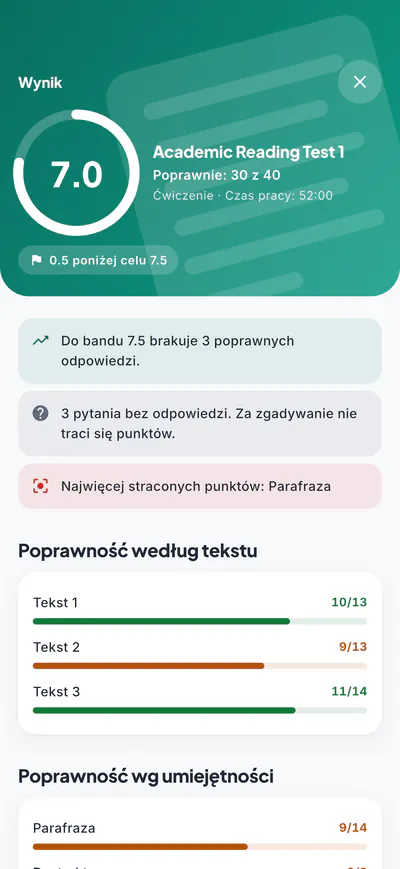
Wynik testu próbnego IELTS w aplikacji Fleydo: Przygotowanie do IELTS: szacowany band i poprawność w każdej części
Bezpłatna lekcja próbna

Poznaj swój prawdziwy wynik IELTS, zanim zrobi to egzamin

Bezpłatna indywidualna lekcja online z nauczycielem native speakerem, certyfikowanym specjalistą IELTS z wynikiem Band 8.5+. Otrzymasz diagnozę Speaking w prawdziwym formacie, uczciwą ocenę szacowanego wyniku i plan pracy nad dokładnie tymi kryteriami, które kosztują Cię punkty. Bez płatności, bez zobowiązań.

Online · Indywidualnie · Academic i General Training

IELTS jest zastrzeżonym znakiem towarowym British Council, IDP: IELTS Australia oraz Cambridge University Press & Assessment. Te testy próbne zostały przygotowane przez Fleydo i nie są przez te organizacje zatwierdzone ani rekomendowane.

Aplikacja mobilna

Fleydo English School w Twojej kieszeni

Lekcje, prace domowe, wiadomości i gry dla uczniów Fleydo i ich rodziców. Bezpłatna na iPhone’a i Androida.

Pobierz w App StorePobierz z Google Play
Więcej o aplikacji
Kod QR otwierający aplikację Fleydo English School w App Store lub Google PlayZeskanuj i pobierzOtwiera właściwy sklep dla Twojego telefonu.fleydo.com/app
Ikona aplikacji Fleydo IELTS
Fleydo: Przygotowanie do IELTS

Przygotowujesz się do IELTS?

Fleydo: Przygotowanie do IELTS to osobna aplikacja z testami próbnymi ze wszystkich czterech umiejętności. Nie potrzebujesz konta Fleydo, żeby z niej korzystać.

Zobacz aplikację IELTS
Pobierz w App StorePobierz z Google Play
Testy próbne IELTS

Ćwicz wszystkie cztery umiejętności IELTS

Wybieraj spośród 311 testów z natychmiastowym wynikiem band, wyjaśnieniami i wzorcowymi odpowiedziami. Bez rejestracji.

Wszystkie testy próbne
FleyPath

Osobista mapa drogowa Twojego dziecka — 3, 6 lub 12 miesięcy

🚀Start
👋Hello
😊Body
🦁Animals
🔢Numbers
🏆Pewny angielski
Zgrywalizowane ćwiczenie angielskiego

Jak gra — tylko że naprawdę się uczą