1. Accueil
  2. IELTS
  3. Tests blancs
  4. Speaking
  5. Test blanc IELTS Speaking 28 : Games

IELTS Speaking

Test blanc IELTS Speaking 28 : Games

Describe a game you played as a child that you rarely see children playing now.

  • 3 parties
  • 11–14 min
  • Examinateur
  • Quatre candidats, un test

Passez le test

Les questions de l’examinateur sont diffusées une par une. Répondez à voix haute, comme à l’examen. L’enregistrement est facultatif et reste dans cet onglet du navigateur.

Vos enregistrements restent uniquement dans cet onglet. Rien n’est envoyé. Téléchargez-les si vous voulez les garder.

Notez votre prestation

Comparez vos réponses à celles des candidats, puis choisissez pour chaque critère le band qui vous correspond.

6,0Votre band estimé
Fluency and coherence

Lexical resource

Grammatical range and accuracy

Pronunciation

Chaque candidat est une personne différente, donc les histoires et les opinions varient. Les bands sont notre estimation d’après les descripteurs publics, pas des notes officielles d’examinateur. Une transcription ne peut pas montrer la prononciation. Ces bands supposent qu’elle est au même niveau que les trois autres critères.

Questions, carte sujet et exemples de réponses

Partie 1 : entretien

Your home

  • Do you live in a house or a flat?
  • Is your home usually quiet or busy?
  • Do you spend more time at home now than you did a few years ago?
  • Would you like to live in a different kind of home one day?

Flowers

  • Do you ever buy flowers?
  • Is there a kind of flower you particularly like?
  • Did you ever pick flowers when you were a child?
  • Do you think flowers make a good present? (Why?)

Driving

  • Do you drive?
  • Did you enjoy long journeys by car or bus as a child?
  • Would you rather drive or be a passenger?

Conseils

  • For your home, a few concrete details say more than 'nice' or 'comfortable': which floor, who you live with, what you can hear in the evening. Living with your parents or renting one room is a normal answer, so say it plainly.
  • You do not need the names of flowers. 'The small white ones that smell very strong at night' is good speaking, because it shows you can describe something when the word is missing.
  • If you don't drive, the driving questions are still easy. Say so, then answer as a passenger, a cyclist or a learner: 'Not yet, I'm learning with my father' gives you plenty to say.

Partie 2 : monologue (carte sujet)

Describe a game you played as a child that you rarely see children playing now.

You should say:

  • what the game was and what you needed to play it
  • how you learned the rules
  • why you think fewer children play it today

and explain whether you think children today are missing anything by not playing it.

Question de relance

  • Have you played it at all since you grew up?
  • Were you a competitive child?

Les notes qu’un bon candidat pourrait prendre

  • cat's cradle, loop of wool
  • two players, take turns
  • shapes: cup, star, river
  • older cousin, rainy holidays
  • copied her hands, no words
  • now: tablets, less patience?
  • missing? slow, close together

Conseils

  • The card has a trap: the second half asks why fewer children play the game and whether they are missing anything. Keep the rules to a few sentences, so that you still have time for those two points, which is where your own opinion shows.
  • Rules are hard to explain in any language. Use a simple order: what you need, how many players, what you try to do, and how you win or go out. Sentences with 'if' do most of the work: 'If the ball touches you, you're out.'
  • If no game has completely disappeared where you live, choose one you see much less often, or one that has moved from the street to a screen. Saying 'children still play it, but not the way we did' is a perfectly good answer to the third point.

Partie 3 : discussion

Play and childhood

  • What do you think children learn from playing games with other children? Expliquer
  • How is the way children play now different from the way their grandparents played? Comparer
  • What kinds of games do you think children will be playing in twenty years' time? Faire des hypothèses sur l’avenir

Competition in games and sport

  • Is it good for children to lose at games sometimes? Peser les arguments
  • Do you think people take sport and games too seriously these days? Donner son avis
  • What could parents and coaches do to keep children's sport enjoyable? Suggérer

Conseils

  • Most of these questions are about children in general. Your own childhood is a good starting point, but put it next to something you see now, a nephew, a neighbour's children, a park you walk past, so that the answer is not only a memory.
  • For the future question, start from something you can already see happening and say how far you think it will go. 'I'm not sure' is fine as a first step, as long as a guess and a reason follow.
  • The questions on competition invite a 'yes, but'. You can agree and then say where the line is: 'It's fine until ...', 'The problem starts when ...'. You do not have to balance every answer, though. A clear view with one good example is enough.

Quatre candidats, un test

Comment des candidats de quatre bands différents ont répondu à chaque question.

Partie 1Do you live in a house or a flat?

A flat. It's quite small, er, two bedrooms, on the third floor, in Salerno. I live there with my wife and our son, he's ten months. We moved there, um, two years ago, before I live with my parents.

Partie 1Is your home usually quiet or busy?

Busy, because of the baby, he wakes up in the night, er, two or three times. But in the evening, when he's sleeping, I sit on the balcony and I look the street. It's the moment more quiet of the day.

Partie 1Do you spend more time at home now than you did a few years ago?

Much more. Before, after work I go always out with my friends, er, for a pizza or to see the match. Now I come home direct, because my wife, she's tired also, er... all day with him.

Partie 1Would you like to live in a different kind of home one day?

Yes, I like – I would like a house with a little garden, for my son, to play outside. But in Salerno the houses are very expensive, er, so maybe in a small town outside, um, near the city.

Partie 1Do you ever buy flowers?

Not so often. For my wife, on her birthday, and when our son was born I bring – I brought her a big bouquet in the hospital. Red roses, very expensive.

Partie 1Is there a kind of flower you particularly like?

Er... I don't know many names of flowers. The yellow one, the mimosa? In Italy we give it to the women on the eighth of March, so it remind me my mother, and my wife.

Partie 1Did you ever pick flowers when you were a child?

Yes, when I was little, um, in the park near our house. My mother don't – she didn't like it, because is not allowed, and one time the man who, er, who looks after the park, he shouted at us.

Partie 1Do you think flowers make a good present? (Why?)

Yes, for a woman, I think yes. For a man is a bit strange, no? And they die after one week, so... I prefer a present that remain, er, a watch, or something for the house.

Partie 1Do you drive?

Yes, every day, car and motorbike. I'm a mechanic, I repair motorbikes in a small garage with my cousin. In Salerno with the traffic, er, the motorbike is more fast, you pass between the cars.

Partie 1Did you enjoy long journeys by car or bus as a child?

Er, no. Every summer we went to my uncle in Calabria, five, six hours in the car, and... very hot. My brother and me, we fight all the time on the back seat, and my father is shouting, stop, stop.

Partie 1Would you rather drive or be a passenger?

Drive, always. When my wife drives I'm nervous, I say her, brake, brake, slow down, and she gets angry. It's better if I drive.

Partie 2Describe a game you played as a child that you rarely see children playing now.

OK, so the game is the biglie. They are small balls, er, plastic, and inside each one there is a little photo of a cyclist. When I was child we stayed at the beach all summer, and with the other children we make a track in the sand. Very long, with the curves, and a tunnel also. Then everybody put his ball at the start, and you hit it with the finger, like this, and it goes along the track. If it go out, you put it back, er, where it was before. The first one at the end, he win. Um... my father show me how to hit, and the rules I learned from the bigger boys, I watched them and then I try. Why the children don't play now... er, I think because they have the phone, also on the beach. And the families don't – before we stay all the summer at the sea, now the parents work more, they go one week, two weeks. And in the shops, er, I don't see the balls anymore. Do they miss something? Yes, I think... We were outside all the day, with children we don't know, and we make the track together, er, with the hands. It was – it was very nice.

Partie 2Have you played it at all since you grew up?

Er... maybe one time, with my nephew, on the beach. But after ten minutes he was bored, he want his phone.

Partie 2Were you a competitive child?

Yes, very. When I lose I was crying, and I don't want to play anymore.

Partie 3What do you think children learn from playing games with other children?

Er... to stay with the others, I think. To wait the turn, and when you lose, to accept it. And to make new friends, um, because at school you have always the same friends, but in the park or on the beach you meet new children. With the tablet at home, er, they don't learn this, they are alone.

Partie 3How is the way children play now different from the way their grandparents played?

Very different. My father told me, when he was child, they play in the street all day, only with a ball, nothing else. Now the children have, er, too much toys, the room is full, and they play ten minutes and then they want another thing. And they stay inside more, because the parents are afraid, of the cars, of... of everything.

Partie 3What kinds of games do you think children will be playing in twenty years' time?

More with the computer, I think. Maybe with the glasses, the – for the virtual reality, so you are inside the game. I don't like this idea so much. But I think the football remain. Er... the football is always the football, the children play it everywhere, in the street, in the school, also with a bottle if they don't have a ball.

Partie 3Is it good for children to lose at games sometimes?

Yes, I think is good. Because, er, in the life you don't win always. If a child wins every time, when he is older and he lose something important, like a job, um, he don't know how to – how to react. But not always losing, er, because then he is sad and he doesn't want to play anymore.

Partie 3Do you think people take sport and games too seriously these days?

Some people, yes. Er, sometimes I go to the matches of my nephew, he's nine, and the fathers there are shouting all the time, to the referee, to the children also. And the referee is a boy, er, seventeen, eighteen years. The children want only to play... is the parents who are too serious.

Partie 3What could parents and coaches do to keep children's sport enjoyable?

Er... the coach can change the players more, so everybody play, not only the best ones. Because if you are always on the bench, why you go? Better to stay home, er, with the phone. And for the small children, er, maybe the matches without the result, nobody count the goals. Then it's only for fun, and the parents also, they shout less, I think.

Mots pour ce test

take turns
do something one after another, not all at the same time
be out
be no longer allowed to play in this round, because you were caught, hit or made a mistake
pick teams
choose who plays on which side
make up the rules
invent the rules yourselves, often while you play
cheat
break the rules secretly so that you win
a bad loser
someone who gets angry or upset when they lose
unsupervised
with no adult watching or in charge
go out of fashion
stop being popular
let off steam
get rid of energy or strong feelings by doing something active
a back-seat driver
a passenger who keeps telling the driver what to do
car sick
feeling ill because of the movement of a car
a bunch of flowers
several flowers held or tied together, often as a present

Expressions utiles

  • The game I've chosen is ___, and all you needed was ___.
  • The basic idea is that ___, and if ___, you're out.
  • Nobody really taught me the rules. I just ___ until ___.
  • You hardly ever see children ___ these days, mainly because ___.
  • What I think they miss out on is ___.
  • When I was younger I used to ___, whereas now ___.
  • Losing is fine as long as ___.
  • I can imagine ___ in twenty years, but I doubt ___.
  • The problem starts when ___.

Icône de l'application Fleydo IELTS Fleydo : Préparation IELTS

Emportez ces tests sur votre téléphone

Tous les tests de ces pages se trouvent aussi dans l’application Fleydo : Préparation IELTS pour iPhone, iPad et Android, avec en plus 2 000 mots IELTS et leur audio.

  • Fonctionne hors ligne une fois le test téléchargé sur votre téléphone
  • 2 000 mots IELTS avec audio, répétition espacée et exercices courts
  • Enregistrez vos réponses de Speaking et réécoutez-les
  • Un programme quotidien selon votre band visé et votre date d’examen
Télécharger dans l’App StoreDisponible sur Google Play
Scannez pour téléchargerOuvre l’App Store ou Google Play, selon votre téléphone.

Aucun compte nécessaire. En savoir plus sur l’application

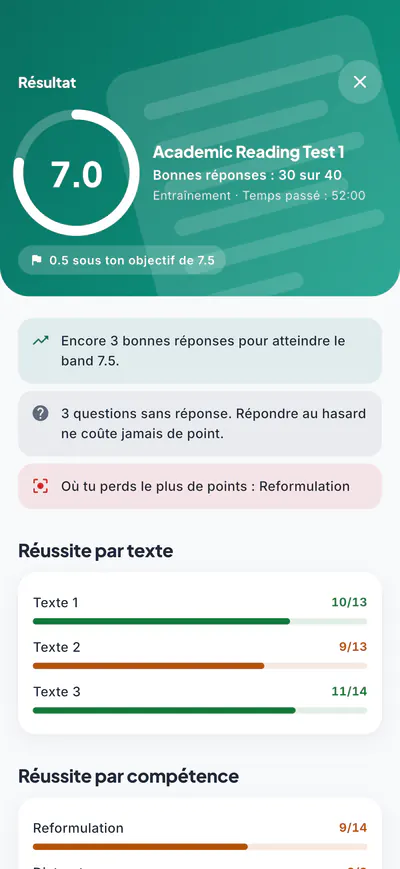
Résultat d’un test blanc IELTS dans l’application Fleydo : Préparation IELTS : band estimé et taux de réussite pour chaque partie
Cours d'essai gratuit

Découvrez votre vrai band IELTS avant l'examen

Un cours individuel en ligne gratuit avec un professeur anglophone natif, spécialiste IELTS certifié Band 8.5+. Vous obtenez un diagnostic Speaking au format réel, une estimation honnête de votre band et un plan ciblé sur les critères qui vous coûtent des points. Sans paiement, sans engagement.

En ligne · Individuel · Academic et General Training

IELTS est une marque déposée du British Council, d’IDP: IELTS Australia et de Cambridge University Press & Assessment. Ces tests blancs sont rédigés par Fleydo et ne sont ni approuvés ni cautionnés par ces organismes.

Application mobile

Fleydo English School dans votre poche

Cours, devoirs, messages et jeux pour les élèves de Fleydo et leurs parents. Gratuite sur iPhone et Android.

Télécharger dans l'App StoreDisponible sur Google Play
En savoir plus sur l'application
Code QR qui ouvre l'application Fleydo English School dans l'App Store ou sur Google PlayScannez pour téléchargerOuvre la boutique adaptée à votre téléphone.fleydo.com/app
Icône de l'application Fleydo IELTS
Fleydo : Préparation IELTS

Vous préparez l'IELTS ?

Fleydo : Préparation IELTS est une application distincte, avec des tests blancs pour les quatre compétences. Aucun compte Fleydo n'est nécessaire pour l'utiliser.

Voir l'application IELTS
Télécharger dans l'App StoreDisponible sur Google Play
Tests blancs IELTS

Entraînez-vous aux quatre compétences de l'IELTS

311 tests avec un band immédiat, des corrigés expliqués et des réponses modèles. Sans inscription.

Tous les tests blancs
Le FleyPath

La feuille de route personnelle de votre enfant — 3, 6 ou 12 mois

🚀Départ
👋Hello
😊Body
🦁Animals
🔢Numbers
🏆Anglais confiant
Entraînement d'anglais gamifié

Comme un jeu — sauf qu'ils apprennent vraiment