1. Αρχική
  2. IELTS
  3. Τεστ εξάσκησης
  4. Speaking
  5. Τεστ εξάσκησης IELTS Speaking 28: Games

IELTS Speaking

Τεστ εξάσκησης IELTS Speaking 28: Games

Describe a game you played as a child that you rarely see children playing now.

  • 3 μέρη
  • 11–14 λεπ.
  • Εξεταστής
  • Τέσσερις υποψήφιοι, ένα τεστ

Κάντε το τεστ

Οι ερωτήσεις του εξεταστή ακούγονται μία μία. Απαντήστε φωναχτά, όπως θα κάνατε στην εξέταση. Η ηχογράφηση είναι προαιρετική και μένει σε αυτή την καρτέλα του προγράμματος περιήγησης.

Οι ηχογραφήσεις σας μένουν μόνο σε αυτή την καρτέλα. Δεν ανεβαίνει τίποτα. Κατεβάστε τες αν θέλετε να τις κρατήσετε.

Βαθμολογήστε την απόδοσή σας

Συγκρίνετε τις απαντήσεις σας με τους υποψηφίους και μετά επιλέξτε για κάθε κριτήριο το band που σας ταιριάζει.

6,0Το εκτιμώμενο band σας
Fluency and coherence

Lexical resource

Grammatical range and accuracy

Pronunciation

Κάθε υποψήφιος είναι διαφορετικός ομιλητής, γι' αυτό οι ιστορίες και οι απόψεις διαφέρουν. Τα band είναι δική μας εκτίμηση με βάση τις δημόσιες περιγραφές, όχι επίσημη βαθμολογία εξεταστή. Μια απομαγνητοφώνηση δεν μπορεί να δείξει την προφορά. Αυτά τα band υποθέτουν ότι είναι στο ίδιο επίπεδο με τα άλλα τρία κριτήρια.

Ερωτήσεις, κάρτα θέματος και ενδεικτικές απαντήσεις

Part 1: συνέντευξη

Your home

  • Do you live in a house or a flat?
  • Is your home usually quiet or busy?
  • Do you spend more time at home now than you did a few years ago?
  • Would you like to live in a different kind of home one day?

Flowers

  • Do you ever buy flowers?
  • Is there a kind of flower you particularly like?
  • Did you ever pick flowers when you were a child?
  • Do you think flowers make a good present? (Why?)

Driving

  • Do you drive?
  • Did you enjoy long journeys by car or bus as a child?
  • Would you rather drive or be a passenger?

Συμβουλές

  • For your home, a few concrete details say more than 'nice' or 'comfortable': which floor, who you live with, what you can hear in the evening. Living with your parents or renting one room is a normal answer, so say it plainly.
  • You do not need the names of flowers. 'The small white ones that smell very strong at night' is good speaking, because it shows you can describe something when the word is missing.
  • If you don't drive, the driving questions are still easy. Say so, then answer as a passenger, a cyclist or a learner: 'Not yet, I'm learning with my father' gives you plenty to say.

Part 2: μακρά ομιλία (κάρτα θέματος)

Describe a game you played as a child that you rarely see children playing now.

You should say:

  • what the game was and what you needed to play it
  • how you learned the rules
  • why you think fewer children play it today

and explain whether you think children today are missing anything by not playing it.

Επιπλέον ερώτηση

  • Have you played it at all since you grew up?
  • Were you a competitive child?

Σημειώσεις που θα μπορούσε να κρατήσει ένας δυνατός υποψήφιος

  • cat's cradle, loop of wool
  • two players, take turns
  • shapes: cup, star, river
  • older cousin, rainy holidays
  • copied her hands, no words
  • now: tablets, less patience?
  • missing? slow, close together

Συμβουλές

  • The card has a trap: the second half asks why fewer children play the game and whether they are missing anything. Keep the rules to a few sentences, so that you still have time for those two points, which is where your own opinion shows.
  • Rules are hard to explain in any language. Use a simple order: what you need, how many players, what you try to do, and how you win or go out. Sentences with 'if' do most of the work: 'If the ball touches you, you're out.'
  • If no game has completely disappeared where you live, choose one you see much less often, or one that has moved from the street to a screen. Saying 'children still play it, but not the way we did' is a perfectly good answer to the third point.

Part 3: συζήτηση

Play and childhood

  • What do you think children learn from playing games with other children? Επεξήγηση
  • How is the way children play now different from the way their grandparents played? Σύγκριση
  • What kinds of games do you think children will be playing in twenty years' time? Υποθέσεις για το μέλλον

Competition in games and sport

  • Is it good for children to lose at games sometimes? Στάθμιση υπέρ και κατά
  • Do you think people take sport and games too seriously these days? Διατύπωση άποψης
  • What could parents and coaches do to keep children's sport enjoyable? Υποβολή προτάσεων

Συμβουλές

  • Most of these questions are about children in general. Your own childhood is a good starting point, but put it next to something you see now, a nephew, a neighbour's children, a park you walk past, so that the answer is not only a memory.
  • For the future question, start from something you can already see happening and say how far you think it will go. 'I'm not sure' is fine as a first step, as long as a guess and a reason follow.
  • The questions on competition invite a 'yes, but'. You can agree and then say where the line is: 'It's fine until ...', 'The problem starts when ...'. You do not have to balance every answer, though. A clear view with one good example is enough.

Τέσσερις υποψήφιοι, ένα τεστ

Πώς απάντησαν σε κάθε ερώτηση ομιλητές σε τέσσερα διαφορετικά band.

Part 1Do you live in a house or a flat?

A flat. It's quite small, er, two bedrooms, on the third floor, in Salerno. I live there with my wife and our son, he's ten months. We moved there, um, two years ago, before I live with my parents.

Part 1Is your home usually quiet or busy?

Busy, because of the baby, he wakes up in the night, er, two or three times. But in the evening, when he's sleeping, I sit on the balcony and I look the street. It's the moment more quiet of the day.

Part 1Do you spend more time at home now than you did a few years ago?

Much more. Before, after work I go always out with my friends, er, for a pizza or to see the match. Now I come home direct, because my wife, she's tired also, er... all day with him.

Part 1Would you like to live in a different kind of home one day?

Yes, I like – I would like a house with a little garden, for my son, to play outside. But in Salerno the houses are very expensive, er, so maybe in a small town outside, um, near the city.

Part 1Do you ever buy flowers?

Not so often. For my wife, on her birthday, and when our son was born I bring – I brought her a big bouquet in the hospital. Red roses, very expensive.

Part 1Is there a kind of flower you particularly like?

Er... I don't know many names of flowers. The yellow one, the mimosa? In Italy we give it to the women on the eighth of March, so it remind me my mother, and my wife.

Part 1Did you ever pick flowers when you were a child?

Yes, when I was little, um, in the park near our house. My mother don't – she didn't like it, because is not allowed, and one time the man who, er, who looks after the park, he shouted at us.

Part 1Do you think flowers make a good present? (Why?)

Yes, for a woman, I think yes. For a man is a bit strange, no? And they die after one week, so... I prefer a present that remain, er, a watch, or something for the house.

Part 1Do you drive?

Yes, every day, car and motorbike. I'm a mechanic, I repair motorbikes in a small garage with my cousin. In Salerno with the traffic, er, the motorbike is more fast, you pass between the cars.

Part 1Did you enjoy long journeys by car or bus as a child?

Er, no. Every summer we went to my uncle in Calabria, five, six hours in the car, and... very hot. My brother and me, we fight all the time on the back seat, and my father is shouting, stop, stop.

Part 1Would you rather drive or be a passenger?

Drive, always. When my wife drives I'm nervous, I say her, brake, brake, slow down, and she gets angry. It's better if I drive.

Part 2Describe a game you played as a child that you rarely see children playing now.

OK, so the game is the biglie. They are small balls, er, plastic, and inside each one there is a little photo of a cyclist. When I was child we stayed at the beach all summer, and with the other children we make a track in the sand. Very long, with the curves, and a tunnel also. Then everybody put his ball at the start, and you hit it with the finger, like this, and it goes along the track. If it go out, you put it back, er, where it was before. The first one at the end, he win. Um... my father show me how to hit, and the rules I learned from the bigger boys, I watched them and then I try. Why the children don't play now... er, I think because they have the phone, also on the beach. And the families don't – before we stay all the summer at the sea, now the parents work more, they go one week, two weeks. And in the shops, er, I don't see the balls anymore. Do they miss something? Yes, I think... We were outside all the day, with children we don't know, and we make the track together, er, with the hands. It was – it was very nice.

Part 2Have you played it at all since you grew up?

Er... maybe one time, with my nephew, on the beach. But after ten minutes he was bored, he want his phone.

Part 2Were you a competitive child?

Yes, very. When I lose I was crying, and I don't want to play anymore.

Part 3What do you think children learn from playing games with other children?

Er... to stay with the others, I think. To wait the turn, and when you lose, to accept it. And to make new friends, um, because at school you have always the same friends, but in the park or on the beach you meet new children. With the tablet at home, er, they don't learn this, they are alone.

Part 3How is the way children play now different from the way their grandparents played?

Very different. My father told me, when he was child, they play in the street all day, only with a ball, nothing else. Now the children have, er, too much toys, the room is full, and they play ten minutes and then they want another thing. And they stay inside more, because the parents are afraid, of the cars, of... of everything.

Part 3What kinds of games do you think children will be playing in twenty years' time?

More with the computer, I think. Maybe with the glasses, the – for the virtual reality, so you are inside the game. I don't like this idea so much. But I think the football remain. Er... the football is always the football, the children play it everywhere, in the street, in the school, also with a bottle if they don't have a ball.

Part 3Is it good for children to lose at games sometimes?

Yes, I think is good. Because, er, in the life you don't win always. If a child wins every time, when he is older and he lose something important, like a job, um, he don't know how to – how to react. But not always losing, er, because then he is sad and he doesn't want to play anymore.

Part 3Do you think people take sport and games too seriously these days?

Some people, yes. Er, sometimes I go to the matches of my nephew, he's nine, and the fathers there are shouting all the time, to the referee, to the children also. And the referee is a boy, er, seventeen, eighteen years. The children want only to play... is the parents who are too serious.

Part 3What could parents and coaches do to keep children's sport enjoyable?

Er... the coach can change the players more, so everybody play, not only the best ones. Because if you are always on the bench, why you go? Better to stay home, er, with the phone. And for the small children, er, maybe the matches without the result, nobody count the goals. Then it's only for fun, and the parents also, they shout less, I think.

Λέξεις για αυτό το τεστ

take turns
do something one after another, not all at the same time
be out
be no longer allowed to play in this round, because you were caught, hit or made a mistake
pick teams
choose who plays on which side
make up the rules
invent the rules yourselves, often while you play
cheat
break the rules secretly so that you win
a bad loser
someone who gets angry or upset when they lose
unsupervised
with no adult watching or in charge
go out of fashion
stop being popular
let off steam
get rid of energy or strong feelings by doing something active
a back-seat driver
a passenger who keeps telling the driver what to do
car sick
feeling ill because of the movement of a car
a bunch of flowers
several flowers held or tied together, often as a present

Χρήσιμες εκφράσεις

  • The game I've chosen is ___, and all you needed was ___.
  • The basic idea is that ___, and if ___, you're out.
  • Nobody really taught me the rules. I just ___ until ___.
  • You hardly ever see children ___ these days, mainly because ___.
  • What I think they miss out on is ___.
  • When I was younger I used to ___, whereas now ___.
  • Losing is fine as long as ___.
  • I can imagine ___ in twenty years, but I doubt ___.
  • The problem starts when ___.

Εικονίδιο της εφαρμογής Fleydo IELTS Fleydo: Προετοιμασία IELTS

Πάρτε αυτά τα τεστ μαζί σας στο κινητό

Κάθε τεστ αυτών των σελίδων υπάρχει και στην εφαρμογή Fleydo: Προετοιμασία IELTS για iPhone, iPad και Android, μαζί με 2.000 λέξεις IELTS με ήχο.

  • Λειτουργεί χωρίς σύνδεση μόλις ένα τεστ βρίσκεται στο κινητό σας
  • 2.000 λέξεις IELTS με ήχο, επανάληψη σε αυξανόμενα διαστήματα και σύντομες ασκήσεις
  • Ηχογραφήστε τις απαντήσεις σας στο Speaking και ακούστε τες ξανά
  • Καθημερινό πλάνο για το band-στόχο σας και την ημερομηνία της εξέτασης
Λήψη στο App StoreΑποκτήστε το στο Google Play
Σαρώστε για λήψηΑνοίγει το App Store ή το Google Play, ανάλογα με το κινητό σας.

Δεν χρειάζεται λογαριασμός. Σχετικά με την εφαρμογή

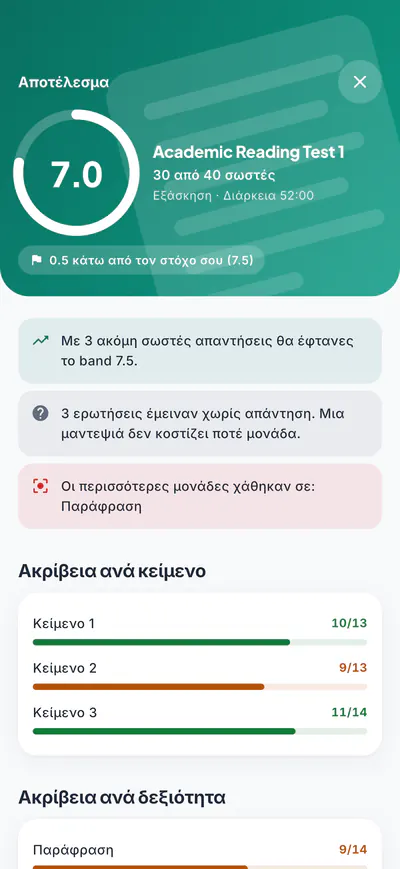
Αποτέλεσμα τεστ εξάσκησης IELTS στην εφαρμογή Fleydo: Προετοιμασία IELTS: εκτιμώμενο band και ακρίβεια για κάθε μέρος
Δωρεάν δοκιμαστικό μάθημα

Μάθετε το πραγματικό σας band στο IELTS πριν σας το πει η εξέταση

Ένα δωρεάν ατομικό διαδικτυακό μάθημα με καθηγητή με μητρική γλώσσα τα Αγγλικά, πιστοποιημένο ειδικό IELTS με Band 8.5+. Λαμβάνετε διαγνωστικό Speaking σε πραγματική μορφή εξέτασης, μια ειλικρινή εκτίμηση band και ένα πλάνο για τα ακριβή κριτήρια που σας κοστίζουν βαθμούς. Χωρίς πληρωμή, χωρίς δέσμευση.

Διαδικτυακά · Ατομικά · Academic και General Training

Το IELTS είναι σήμα κατατεθέν των British Council, IDP: IELTS Australia και Cambridge University Press & Assessment. Αυτά τα τεστ εξάσκησης είναι γραμμένα από τη Fleydo και δεν έχουν εγκριθεί ούτε υποστηριχθεί από τους οργανισμούς αυτούς.

Εφαρμογή για κινητά

Η Fleydo English School στην τσέπη σας

Μαθήματα, εργασίες, μηνύματα και παιχνίδια για τους μαθητές της Fleydo και τους γονείς τους. Δωρεάν σε iPhone και Android.

Λήψη στο App StoreΑποκτήστε το στο Google Play
Περισσότερα για την εφαρμογή
Κωδικός QR που ανοίγει την εφαρμογή Fleydo English School στο App Store ή στο Google PlayΣαρώστε για λήψηΑνοίγει το κατάλληλο κατάστημα για το κινητό σας.fleydo.com/app
Εικονίδιο της εφαρμογής Fleydo IELTS
Fleydo: Προετοιμασία IELTS

Προετοιμάζεστε για το IELTS;

Το Fleydo: Προετοιμασία IELTS είναι ξεχωριστή εφαρμογή με τεστ εξάσκησης και για τις τέσσερις δεξιότητες. Δεν χρειάζεστε λογαριασμό Fleydo για να τη χρησιμοποιήσετε.

Δείτε την εφαρμογή IELTS
Λήψη στο App StoreΑποκτήστε το στο Google Play
Τεστ εξάσκησης IELTS

Εξασκηθείτε και στις τέσσερις δεξιότητες του IELTS

311 τεστ με άμεσο band score, επεξηγήσεις στις απαντήσεις και πρότυπες απαντήσεις. Χωρίς εγγραφή.

Όλα τα τεστ εξάσκησης
Το FleyPath

Ο προσωπικός οδικός χάρτης του παιδιού σας — 3, 6 ή 12 μήνες

🚀Έναρξη
👋Hello
😊Body
🦁Animals
🔢Numbers
🏆Αγγλικά με Αυτοπεποίθηση
Παιχνιδοποιημένη εξάσκηση Αγγλικών

Σαν παιχνίδι — μόνο που μαθαίνουν πραγματικά