1. Home
  2. IELTS
  3. Test di esercitazione
  4. Speaking
  5. Test di esercitazione IELTS Speaking 28: Games

IELTS Speaking

Test di esercitazione IELTS Speaking 28: Games

Describe a game you played as a child that you rarely see children playing now.

  • 3 parti
  • 11–14 min
  • Esaminatore
  • Quattro candidati, un test

Fai il test

Le domande dell'esaminatore partono una alla volta. Rispondi ad alta voce come faresti all'esame. La registrazione è facoltativa e resta in questa scheda del browser.

Le tue registrazioni restano solo in questa scheda. Non viene caricato nulla. Scaricale se vuoi conservarle.

Valuta la tua prova

Confronta le tue risposte con quelle dei candidati, poi scegli per ogni criterio la band che ti corrisponde.

6,0La tua band stimata
Fluency and coherence

Lexical resource

Grammatical range and accuracy

Pronunciation

Ogni candidato è una persona diversa, quindi storie e opinioni cambiano. Le band sono una nostra stima basata sui descrittori pubblici, non voti ufficiali di un esaminatore. Una trascrizione non può mostrare la pronuncia. Queste band presuppongono che sia allo stesso livello degli altri tre criteri.

Domande, scheda argomento e risposte di esempio

Part 1: intervista

Your home

  • Do you live in a house or a flat?
  • Is your home usually quiet or busy?
  • Do you spend more time at home now than you did a few years ago?
  • Would you like to live in a different kind of home one day?

Flowers

  • Do you ever buy flowers?
  • Is there a kind of flower you particularly like?
  • Did you ever pick flowers when you were a child?
  • Do you think flowers make a good present? (Why?)

Driving

  • Do you drive?
  • Did you enjoy long journeys by car or bus as a child?
  • Would you rather drive or be a passenger?

Consigli

  • For your home, a few concrete details say more than 'nice' or 'comfortable': which floor, who you live with, what you can hear in the evening. Living with your parents or renting one room is a normal answer, so say it plainly.
  • You do not need the names of flowers. 'The small white ones that smell very strong at night' is good speaking, because it shows you can describe something when the word is missing.
  • If you don't drive, the driving questions are still easy. Say so, then answer as a passenger, a cyclist or a learner: 'Not yet, I'm learning with my father' gives you plenty to say.

Part 2: monologo (scheda argomento)

Describe a game you played as a child that you rarely see children playing now.

You should say:

  • what the game was and what you needed to play it
  • how you learned the rules
  • why you think fewer children play it today

and explain whether you think children today are missing anything by not playing it.

Domanda aggiuntiva

  • Have you played it at all since you grew up?
  • Were you a competitive child?

Appunti che potrebbe prendere un candidato forte

  • cat's cradle, loop of wool
  • two players, take turns
  • shapes: cup, star, river
  • older cousin, rainy holidays
  • copied her hands, no words
  • now: tablets, less patience?
  • missing? slow, close together

Consigli

  • The card has a trap: the second half asks why fewer children play the game and whether they are missing anything. Keep the rules to a few sentences, so that you still have time for those two points, which is where your own opinion shows.
  • Rules are hard to explain in any language. Use a simple order: what you need, how many players, what you try to do, and how you win or go out. Sentences with 'if' do most of the work: 'If the ball touches you, you're out.'
  • If no game has completely disappeared where you live, choose one you see much less often, or one that has moved from the street to a screen. Saying 'children still play it, but not the way we did' is a perfectly good answer to the third point.

Part 3: discussione

Play and childhood

  • What do you think children learn from playing games with other children? Spiegare
  • How is the way children play now different from the way their grandparents played? Confrontare
  • What kinds of games do you think children will be playing in twenty years' time? Fare ipotesi sul futuro

Competition in games and sport

  • Is it good for children to lose at games sometimes? Valutare pro e contro
  • Do you think people take sport and games too seriously these days? Esprimere un'opinione
  • What could parents and coaches do to keep children's sport enjoyable? Dare suggerimenti

Consigli

  • Most of these questions are about children in general. Your own childhood is a good starting point, but put it next to something you see now, a nephew, a neighbour's children, a park you walk past, so that the answer is not only a memory.
  • For the future question, start from something you can already see happening and say how far you think it will go. 'I'm not sure' is fine as a first step, as long as a guess and a reason follow.
  • The questions on competition invite a 'yes, but'. You can agree and then say where the line is: 'It's fine until ...', 'The problem starts when ...'. You do not have to balance every answer, though. A clear view with one good example is enough.

Quattro candidati, un test

Come hanno risposto a ogni domanda candidati di quattro band diverse.

Part 1Do you live in a house or a flat?

A flat. It's quite small, er, two bedrooms, on the third floor, in Salerno. I live there with my wife and our son, he's ten months. We moved there, um, two years ago, before I live with my parents.

Part 1Is your home usually quiet or busy?

Busy, because of the baby, he wakes up in the night, er, two or three times. But in the evening, when he's sleeping, I sit on the balcony and I look the street. It's the moment more quiet of the day.

Part 1Do you spend more time at home now than you did a few years ago?

Much more. Before, after work I go always out with my friends, er, for a pizza or to see the match. Now I come home direct, because my wife, she's tired also, er... all day with him.

Part 1Would you like to live in a different kind of home one day?

Yes, I like – I would like a house with a little garden, for my son, to play outside. But in Salerno the houses are very expensive, er, so maybe in a small town outside, um, near the city.

Part 1Do you ever buy flowers?

Not so often. For my wife, on her birthday, and when our son was born I bring – I brought her a big bouquet in the hospital. Red roses, very expensive.

Part 1Is there a kind of flower you particularly like?

Er... I don't know many names of flowers. The yellow one, the mimosa? In Italy we give it to the women on the eighth of March, so it remind me my mother, and my wife.

Part 1Did you ever pick flowers when you were a child?

Yes, when I was little, um, in the park near our house. My mother don't – she didn't like it, because is not allowed, and one time the man who, er, who looks after the park, he shouted at us.

Part 1Do you think flowers make a good present? (Why?)

Yes, for a woman, I think yes. For a man is a bit strange, no? And they die after one week, so... I prefer a present that remain, er, a watch, or something for the house.

Part 1Do you drive?

Yes, every day, car and motorbike. I'm a mechanic, I repair motorbikes in a small garage with my cousin. In Salerno with the traffic, er, the motorbike is more fast, you pass between the cars.

Part 1Did you enjoy long journeys by car or bus as a child?

Er, no. Every summer we went to my uncle in Calabria, five, six hours in the car, and... very hot. My brother and me, we fight all the time on the back seat, and my father is shouting, stop, stop.

Part 1Would you rather drive or be a passenger?

Drive, always. When my wife drives I'm nervous, I say her, brake, brake, slow down, and she gets angry. It's better if I drive.

Part 2Describe a game you played as a child that you rarely see children playing now.

OK, so the game is the biglie. They are small balls, er, plastic, and inside each one there is a little photo of a cyclist. When I was child we stayed at the beach all summer, and with the other children we make a track in the sand. Very long, with the curves, and a tunnel also. Then everybody put his ball at the start, and you hit it with the finger, like this, and it goes along the track. If it go out, you put it back, er, where it was before. The first one at the end, he win. Um... my father show me how to hit, and the rules I learned from the bigger boys, I watched them and then I try. Why the children don't play now... er, I think because they have the phone, also on the beach. And the families don't – before we stay all the summer at the sea, now the parents work more, they go one week, two weeks. And in the shops, er, I don't see the balls anymore. Do they miss something? Yes, I think... We were outside all the day, with children we don't know, and we make the track together, er, with the hands. It was – it was very nice.

Part 2Have you played it at all since you grew up?

Er... maybe one time, with my nephew, on the beach. But after ten minutes he was bored, he want his phone.

Part 2Were you a competitive child?

Yes, very. When I lose I was crying, and I don't want to play anymore.

Part 3What do you think children learn from playing games with other children?

Er... to stay with the others, I think. To wait the turn, and when you lose, to accept it. And to make new friends, um, because at school you have always the same friends, but in the park or on the beach you meet new children. With the tablet at home, er, they don't learn this, they are alone.

Part 3How is the way children play now different from the way their grandparents played?

Very different. My father told me, when he was child, they play in the street all day, only with a ball, nothing else. Now the children have, er, too much toys, the room is full, and they play ten minutes and then they want another thing. And they stay inside more, because the parents are afraid, of the cars, of... of everything.

Part 3What kinds of games do you think children will be playing in twenty years' time?

More with the computer, I think. Maybe with the glasses, the – for the virtual reality, so you are inside the game. I don't like this idea so much. But I think the football remain. Er... the football is always the football, the children play it everywhere, in the street, in the school, also with a bottle if they don't have a ball.

Part 3Is it good for children to lose at games sometimes?

Yes, I think is good. Because, er, in the life you don't win always. If a child wins every time, when he is older and he lose something important, like a job, um, he don't know how to – how to react. But not always losing, er, because then he is sad and he doesn't want to play anymore.

Part 3Do you think people take sport and games too seriously these days?

Some people, yes. Er, sometimes I go to the matches of my nephew, he's nine, and the fathers there are shouting all the time, to the referee, to the children also. And the referee is a boy, er, seventeen, eighteen years. The children want only to play... is the parents who are too serious.

Part 3What could parents and coaches do to keep children's sport enjoyable?

Er... the coach can change the players more, so everybody play, not only the best ones. Because if you are always on the bench, why you go? Better to stay home, er, with the phone. And for the small children, er, maybe the matches without the result, nobody count the goals. Then it's only for fun, and the parents also, they shout less, I think.

Parole per questo test

take turns
do something one after another, not all at the same time
be out
be no longer allowed to play in this round, because you were caught, hit or made a mistake
pick teams
choose who plays on which side
make up the rules
invent the rules yourselves, often while you play
cheat
break the rules secretly so that you win
a bad loser
someone who gets angry or upset when they lose
unsupervised
with no adult watching or in charge
go out of fashion
stop being popular
let off steam
get rid of energy or strong feelings by doing something active
a back-seat driver
a passenger who keeps telling the driver what to do
car sick
feeling ill because of the movement of a car
a bunch of flowers
several flowers held or tied together, often as a present

Espressioni utili

  • The game I've chosen is ___, and all you needed was ___.
  • The basic idea is that ___, and if ___, you're out.
  • Nobody really taught me the rules. I just ___ until ___.
  • You hardly ever see children ___ these days, mainly because ___.
  • What I think they miss out on is ___.
  • When I was younger I used to ___, whereas now ___.
  • Losing is fine as long as ___.
  • I can imagine ___ in twenty years, but I doubt ___.
  • The problem starts when ___.

Icona dell'app Fleydo IELTS Fleydo: Preparazione IELTS

Porta questi test con te sul telefono

Tutti i test di queste pagine sono anche nell'app Fleydo: Preparazione IELTS per iPhone, iPad e Android, insieme a 2.000 parole IELTS con audio.

  • Funziona offline una volta scaricato il test sul telefono
  • 2.000 parole IELTS con audio, ripetizione spaziata ed esercizi brevi
  • Registra le tue risposte di Speaking e riascoltale
  • Un piano giornaliero per la tua band obiettivo e la data dell'esame
Scarica su App StoreDisponibile su Google Play
Inquadra per scaricareApre App Store o Google Play, a seconda del telefono.

Non serve un account. Scopri l'app

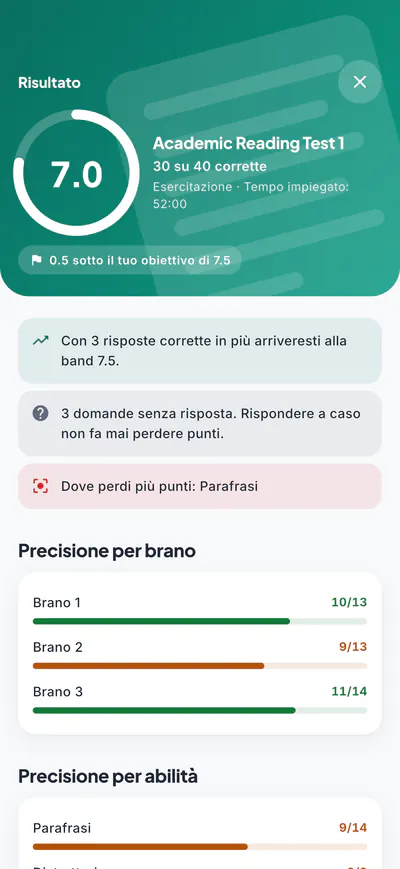
Risultato di un test di esercitazione IELTS nell'app Fleydo: Preparazione IELTS: band stimata e precisione per ogni parte
Lezione di prova gratuita

Scopri il tuo vero band IELTS prima dell'esame

Una lezione individuale online gratuita con un insegnante madrelingua inglese, specialista IELTS certificato Band 8.5+. Ricevi una diagnosi dello Speaking nel formato reale, una stima onesta del tuo band e un piano mirato ai criteri che ti costano punti. Nessun pagamento, nessun impegno.

Online · Individuale · Academic e General Training

IELTS è un marchio registrato del British Council, di IDP: IELTS Australia e di Cambridge University Press & Assessment. Questi test di esercitazione sono scritti da Fleydo e non sono approvati né sostenuti da queste organizzazioni.

App mobile

Fleydo English School in tasca

Lezioni, compiti, messaggi e giochi per gli studenti Fleydo e i loro genitori. Gratuita su iPhone e Android.

Scarica su App StoreDisponibile su Google Play
Scopri di più sull'app
Codice QR che apre l'app Fleydo English School su App Store o Google PlayInquadra per scaricareApre lo store giusto per il tuo telefono.fleydo.com/app
Icona dell'app Fleydo IELTS
Fleydo: Preparazione IELTS

Ti prepari all'IELTS?

Fleydo: Preparazione IELTS è un'app separata con simulazioni per tutte e quattro le abilità. Per usarla non ti serve un account Fleydo.

Scopri l'app IELTS
Scarica su App StoreDisponibile su Google Play
Test di esercitazione IELTS

Esercitati in tutte e quattro le abilità IELTS

311 test con band immediata, soluzioni spiegate e risposte modello. Senza registrazione.

Tutti i test di esercitazione
Il FleyPath

La roadmap personale di tuo figlio — 3, 6 o 12 mesi

🚀Partenza
👋Hello
😊Body
🦁Animals
🔢Numbers
🏆Inglese sicuro
Pratica di inglese gamificata

Come un gioco — solo che stanno davvero imparando