1. Главная
  2. IELTS
  3. Пробные тесты
  4. Writing
  5. Social media by age

IELTS Writing · Task 1

IELTS Academic Writing Task 1: Social media by age

  • Смешанные графики
  • 20 мин
  • Слов: 150
  • Academic

ACADEMIC WRITING TASK 1

You should spend about 20 minutes on this task.

The table below shows the percentage of people in four age groups who used four social media platforms at least once a week in one country in 2025, and the bar chart shows the average number of minutes a day that each age group spent on social media in 2019 and 2025. Summarise the information by selecting and reporting the main features, and make comparisons where relevant.

Write at least 150 words.

Percentage of each age group using four social media platforms at least once a week, one country, 2025
Platform16-⁠2425-⁠3940-⁠5960+
Platform A8761289
Platform B74583314
Platform C41677253
Platform D1246376
Average minutes a day spent on social media, by age group, 2019 and 2025
  • 2019
  • 2025
Minutes a day025507510012515017516-2425-3940-5960+Age groupMinutes a day025507510012515017516-2425-3940-5960+Age group
Цифры придуманы для тренировки.
20:00
0 / 150 слов

Оцените свой ответ

Сначала прочитайте образцы ответов. Затем по каждому критерию выберите band, который соответствует вашему ответу. Ваш band — среднее значение, округлённое до ближайшей половины балла.

6,0Ваш примерный band
Task achievement

Coherence and cohesion

Lexical resource

Grammatical range and accuracy

Каждый образец написан так, как написал бы другой кандидат, поэтому детали и мнения различаются. Указанные band — наша оценка по открытым критериям, а не официальные оценки экзаменаторов.

Образцы ответов на четырёх уровнях band

Каждый образец написан так, как написал бы другой кандидат. Band указан по нашей оценке на основе открытых критериев оценки.

Образец на Band 5,5Слов: 172

The table shows how many people use four platforms and the bar chart shows how many minutes they spend in a day. When people are young they spend more time on social media and evrybody spend more time in 2025 than 2019.

About the table, for Platform A the group aged 16-24 was the highest with 87%. After that 25-39 was 61%, 40-59 was 28% and 60+ was only 9%. Platform B was simillar, 74% of users was young people and only 14% was old people. Platform C was not like this because the most users were 40-59 with 72%, also 53% of old people used it. Platform D was not comon in young and old people, it was 12% and 6%. The highest was 46% from the 25-39 group.

About the bar chart, in 2019 young people spent 148 minutes a day and in 2025 it was 171. The 40-59 group was 58 and then 83. The old people spent the lowest, only 19 minutes in 2019 and 42 in 2025.

Почему такой band

  • The figures are read out with little comment and sometimes no unit: 'The 40-59 group was 58 and then 83'.
  • The general picture comes early: 'When people are young they spend more time on social media'. The table and the bar chart are never linked, and nothing closes the answer.
  • Sentences are joined by a comma, as in 'Platform B was simillar, 74% of users was young people', and a few of the writer's own words are misspelt: 'simillar', 'comon' and 'evrybody'.

По каждому критерию

Task achievement
Both visuals are covered, but almost everything is listed, and the Platform B figures are read backwards: '74% of users was young people' should say that 74% of the youngest group used it. 'Platform C was not like this' is the strongest moment, because it notices the one pattern that breaks the rule, but it has no follow-up.
Coherence and cohesion
A simple plan marked by 'About the table' and 'About the bar chart', with the general point placed before them. The sentences follow the rows, and 'young people' and 'old people' are the only other names for the groups.
Lexical resource
A small range: 'the highest', 'the lowest', 'was'. 'not comon in young and old people' and 'spent the lowest' show how few words the writer has for comparing.
Grammatical range and accuracy
Mostly short sentences, about half with an error. Besides the comma splices, '74% of users was' and 'evrybody spend' show agreement problems, though the meaning stays clear.

Чтобы выйти на следующий band

Add Platform C to your opening sentence as the one platform popular with older people, and read each percentage as a share of the age group at the top of its column. Then check the verb after 'evrybody' and 'users', and put a full stop where two sentences now meet at a comma.

Сначала план, потом текст

Что требуется в задании

The table and the chart share the same four age groups, so that is where to connect them. The trap is the base of the percentages: 87% means 87% of people aged 16-24 used Platform A, not that 87% of its users were young. The columns are not slices of one total either: three of them add up to well over 100, because people use several platforms. The chart gives total time on social media, not time on any one platform, and neither visual says why the age groups differ.

Ваш общий обзор

Time spent on social media fell with age but rose in every age group between 2019 and 2025. Platforms A and B were far more common among younger people, while Platform C was the only one used by a majority of the over-60s.

Абзац за абзацем

  1. IntroductionOne sentence in your own words saying what each visual measures, and for which years.
  2. OverviewTwo sentences: the age pattern with the rise over time, and the difference between Platforms A and B on one side and Platform C on the other.
  3. Youngest and oldestTake the 16-24 and 60+ groups across both visuals: minutes a day in 2019 and 2025, then the platforms each group used most.
  4. The middle groupsThe rise in minutes for the 25-39 and 40-59 groups, then their high use of Platform C and of Platform D, which few others used.

Частые ошибки

  • Reading the percentages backwards. '87% of Platform A users were aged 16-24' is wrong. The figure is the share of that age group who used Platform A.
  • Adding down a column. People can use several platforms, so the column for the 16-24 group adds up to well over 100, and the figures cannot be read as slices of one total.
  • Joining the visuals too closely, as in 'people aged 16-24 spent 171 minutes on Platform A'. The chart gives time on all social media together.
  • Giving reasons, such as saying that older people find new platforms difficult or that young people prefer short videos. Neither visual says this.
  • Reporting the table and the chart as two separate summaries, when the shared age groups make a direct comparison possible.

Лексика по теме

age group
the people between two particular ages
heavy user
someone who uses something a lot
a majority
more than half of a group
the over-60s
people older than 60
to skew towards
to be more common in one group than in others
to taper off
to become gradually smaller
little-used
used by very few people
the former, the latter
the first and the second of two things just mentioned

Полезные фразы

  • The former gives ..., and the latter ...
  • ... were clearly the heaviest users, yet ...
  • ... skewed sharply towards ..., whereas ... was favoured by ...
  • ... spent ... minutes a day in ..., up from ...
  • Use of ... tapered off with age, to ...% and ...% among ...
  • ... was the only ... used by a majority of ...
  • ... reached its highest levels in ..., at ...% and ...%

Значок приложения Fleydo IELTS Fleydo: подготовка к IELTS

Эти тесты всегда с вами — в телефоне

Все тесты с этих страниц есть и в приложении «Fleydo: подготовка к IELTS» для iPhone, iPad и Android, а вместе с ними — 2 000 слов для IELTS с озвучкой.

  • Работает офлайн, когда тест уже загружен на телефон
  • 2 000 слов для IELTS с озвучкой, интервальным повторением и короткими упражнениями
  • Записывайте ответы Speaking и прослушивайте их
  • План на каждый день под ваш целевой band и дату экзамена
Загрузите в App StoreСкачать из Google Play
Отсканируйте, чтобы скачатьОткроет App Store или Google Play в зависимости от вашего телефона.

Аккаунт не нужен. О приложении

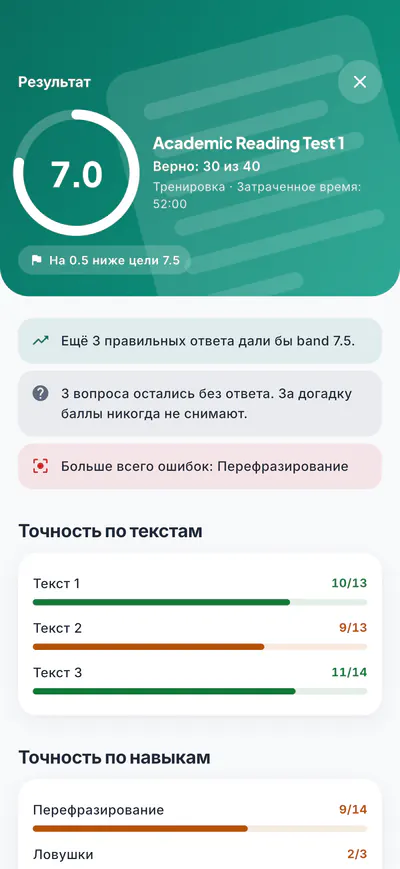
Результат пробного теста IELTS в приложении «Fleydo: подготовка к IELTS»: примерный band и точность по каждой части
Бесплатный пробный урок

Узнайте свой реальный балл IELTS до экзамена

Бесплатный индивидуальный онлайн-урок с преподавателем — носителем английского, сертифицированным специалистом по IELTS с баллом 8.5+. Вы получите диагностику Speaking в реальном формате экзамена, честную оценку вашего band и план работы именно над теми критериями, которые отнимают у вас баллы. Без оплаты и обязательств.

Онлайн · Индивидуально · Academic и General Training

IELTS — зарегистрированный товарный знак British Council, IDP: IELTS Australia и Cambridge University Press & Assessment. Эти пробные тесты составлены командой Fleydo; названные организации их не утверждали и не одобряли.

Мобильное приложение

Fleydo English School у вас в кармане

Уроки, домашние задания, сообщения и игры для учеников Fleydo и их родителей. Бесплатно на iPhone и Android.

Загрузите в App StoreСкачать из Google Play
Подробнее о приложении
QR-код, открывающий приложение Fleydo English School в App Store или Google PlayОтсканируйте и скачайтеОткроет нужный магазин для вашего телефона.fleydo.com/app
Значок приложения Fleydo IELTS
Fleydo: подготовка к IELTS

Готовитесь к IELTS?

«Fleydo: подготовка к IELTS» — отдельное приложение с пробными тестами по всем четырём навыкам. Аккаунт Fleydo для него не нужен.

Подробнее о приложении IELTS
Загрузите в App StoreСкачать из Google Play
Пробные тесты IELTS

Тренируйте все четыре навыка IELTS

Всего тестов: 311. Балл сразу после теста, разбор каждого ответа и образцы для Writing и Speaking. Без регистрации.

Все пробные тесты
FleyPath

Персональная карта вашего ребёнка — 3, 6 или 12 месяцев

🚀Старт
👋Hello
😊Body
🦁Animals
🔢Numbers
🏆Уверенный английский
Геймифицированная практика английского

Как игра — только они действительно учатся