1. Strona główna
  2. IELTS
  3. Testy próbne
  4. Writing
  5. Social media by age

IELTS Writing · Task 1

IELTS Academic Writing Task 1: Social media by age

  • Wykresy łączone
  • 20 min
  • Słowa: 150
  • Academic

ACADEMIC WRITING TASK 1

You should spend about 20 minutes on this task.

The table below shows the percentage of people in four age groups who used four social media platforms at least once a week in one country in 2025, and the bar chart shows the average number of minutes a day that each age group spent on social media in 2019 and 2025. Summarise the information by selecting and reporting the main features, and make comparisons where relevant.

Write at least 150 words.

Percentage of each age group using four social media platforms at least once a week, one country, 2025
Platform16-⁠2425-⁠3940-⁠5960+
Platform A8761289
Platform B74583314
Platform C41677253
Platform D1246376
Average minutes a day spent on social media, by age group, 2019 and 2025
  • 2019
  • 2025
Minutes a day025507510012515017516-2425-3940-5960+Age groupMinutes a day025507510012515017516-2425-3940-5960+Age group
Liczby są wymyślone na potrzeby ćwiczenia.
20:00
0 / 150 słów

Oceń swoją odpowiedź

Najpierw przeczytaj wzorcowe odpowiedzi. Potem w każdym kryterium wybierz band, który pasuje do Twojej odpowiedzi. Twój wynik to średnia zaokrąglona do najbliższej połowy band.

6,0Twój szacowany band
Task achievement

Coherence and cohesion

Lexical resource

Grammatical range and accuracy

Każdy wzór jest napisany tak, jak napisałby go inny kandydat, więc szczegóły i opinie się różnią. Bandy to nasz szacunek według publicznych deskryptorów, a nie oficjalne oceny egzaminatora.

Wzorcowe odpowiedzi na czterech poziomach band

Każdy wzór jest napisany tak, jak napisałby go inny kandydat. Wyniki band to nasz szacunek według publicznych deskryptorów band.

Wzór na band 5,5Słowa: 172

The table shows how many people use four platforms and the bar chart shows how many minutes they spend in a day. When people are young they spend more time on social media and evrybody spend more time in 2025 than 2019.

About the table, for Platform A the group aged 16-24 was the highest with 87%. After that 25-39 was 61%, 40-59 was 28% and 60+ was only 9%. Platform B was simillar, 74% of users was young people and only 14% was old people. Platform C was not like this because the most users were 40-59 with 72%, also 53% of old people used it. Platform D was not comon in young and old people, it was 12% and 6%. The highest was 46% from the 25-39 group.

About the bar chart, in 2019 young people spent 148 minutes a day and in 2025 it was 171. The 40-59 group was 58 and then 83. The old people spent the lowest, only 19 minutes in 2019 and 42 in 2025.

Dlaczego ten band

  • The figures are read out with little comment and sometimes no unit: 'The 40-59 group was 58 and then 83'.
  • The general picture comes early: 'When people are young they spend more time on social media'. The table and the bar chart are never linked, and nothing closes the answer.
  • Sentences are joined by a comma, as in 'Platform B was simillar, 74% of users was young people', and a few of the writer's own words are misspelt: 'simillar', 'comon' and 'evrybody'.

Kryterium po kryterium

Task achievement
Both visuals are covered, but almost everything is listed, and the Platform B figures are read backwards: '74% of users was young people' should say that 74% of the youngest group used it. 'Platform C was not like this' is the strongest moment, because it notices the one pattern that breaks the rule, but it has no follow-up.
Coherence and cohesion
A simple plan marked by 'About the table' and 'About the bar chart', with the general point placed before them. The sentences follow the rows, and 'young people' and 'old people' are the only other names for the groups.
Lexical resource
A small range: 'the highest', 'the lowest', 'was'. 'not comon in young and old people' and 'spent the lowest' show how few words the writer has for comparing.
Grammatical range and accuracy
Mostly short sentences, about half with an error. Besides the comma splices, '74% of users was' and 'evrybody spend' show agreement problems, though the meaning stays clear.

Jak osiągnąć kolejny band

Add Platform C to your opening sentence as the one platform popular with older people, and read each percentage as a share of the age group at the top of its column. Then check the verb after 'evrybody' and 'users', and put a full stop where two sentences now meet at a comma.

Zaplanuj, zanim zaczniesz pisać

Czego wymaga polecenie

The table and the chart share the same four age groups, so that is where to connect them. The trap is the base of the percentages: 87% means 87% of people aged 16-24 used Platform A, not that 87% of its users were young. The columns are not slices of one total either: three of them add up to well over 100, because people use several platforms. The chart gives total time on social media, not time on any one platform, and neither visual says why the age groups differ.

Twoje podsumowanie

Time spent on social media fell with age but rose in every age group between 2019 and 2025. Platforms A and B were far more common among younger people, while Platform C was the only one used by a majority of the over-60s.

Akapit po akapicie

  1. IntroductionOne sentence in your own words saying what each visual measures, and for which years.
  2. OverviewTwo sentences: the age pattern with the rise over time, and the difference between Platforms A and B on one side and Platform C on the other.
  3. Youngest and oldestTake the 16-24 and 60+ groups across both visuals: minutes a day in 2019 and 2025, then the platforms each group used most.
  4. The middle groupsThe rise in minutes for the 25-39 and 40-59 groups, then their high use of Platform C and of Platform D, which few others used.

Częste błędy

  • Reading the percentages backwards. '87% of Platform A users were aged 16-24' is wrong. The figure is the share of that age group who used Platform A.
  • Adding down a column. People can use several platforms, so the column for the 16-24 group adds up to well over 100, and the figures cannot be read as slices of one total.
  • Joining the visuals too closely, as in 'people aged 16-24 spent 171 minutes on Platform A'. The chart gives time on all social media together.
  • Giving reasons, such as saying that older people find new platforms difficult or that young people prefer short videos. Neither visual says this.
  • Reporting the table and the chart as two separate summaries, when the shared age groups make a direct comparison possible.

Słownictwo tematyczne

age group
the people between two particular ages
heavy user
someone who uses something a lot
a majority
more than half of a group
the over-60s
people older than 60
to skew towards
to be more common in one group than in others
to taper off
to become gradually smaller
little-used
used by very few people
the former, the latter
the first and the second of two things just mentioned

Przydatne zwroty

  • The former gives ..., and the latter ...
  • ... were clearly the heaviest users, yet ...
  • ... skewed sharply towards ..., whereas ... was favoured by ...
  • ... spent ... minutes a day in ..., up from ...
  • Use of ... tapered off with age, to ...% and ...% among ...
  • ... was the only ... used by a majority of ...
  • ... reached its highest levels in ..., at ...% and ...%

Ikona aplikacji Fleydo IELTS Fleydo: Przygotowanie do IELTS

Zabierz te testy ze sobą na telefon

Każdy test z tych stron jest też w aplikacji Fleydo: Przygotowanie do IELTS na iPhone’a, iPada i Androida, razem z 2 000 słówek IELTS z nagraniami.

  • Działa offline, gdy test jest już na telefonie
  • 2 000 słówek IELTS z nagraniami, powtórki rozłożone w czasie i krótkie ćwiczenia
  • Nagrywaj swoje odpowiedzi w Speaking i odsłuchuj je
  • Plan na każdy dzień pod Twój docelowy band i datę egzaminu
Pobierz w App StorePobierz z Google Play
Zeskanuj, aby pobraćOtwiera App Store lub Google Play, zależnie od Twojego telefonu.

Konto nie jest potrzebne. O aplikacji

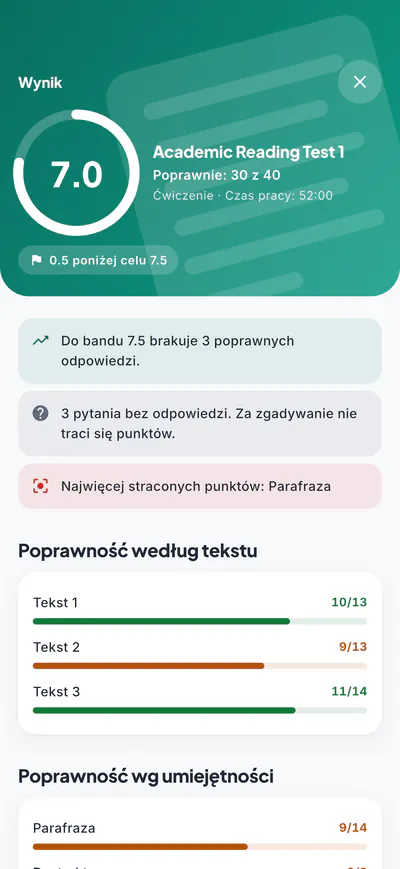
Wynik testu próbnego IELTS w aplikacji Fleydo: Przygotowanie do IELTS: szacowany band i poprawność w każdej części
Bezpłatna lekcja próbna

Poznaj swój prawdziwy wynik IELTS, zanim zrobi to egzamin

Bezpłatna indywidualna lekcja online z nauczycielem native speakerem, certyfikowanym specjalistą IELTS z wynikiem Band 8.5+. Otrzymasz diagnozę Speaking w prawdziwym formacie, uczciwą ocenę szacowanego wyniku i plan pracy nad dokładnie tymi kryteriami, które kosztują Cię punkty. Bez płatności, bez zobowiązań.

Online · Indywidualnie · Academic i General Training

IELTS jest zastrzeżonym znakiem towarowym British Council, IDP: IELTS Australia oraz Cambridge University Press & Assessment. Te testy próbne zostały przygotowane przez Fleydo i nie są przez te organizacje zatwierdzone ani rekomendowane.

Aplikacja mobilna

Fleydo English School w Twojej kieszeni

Lekcje, prace domowe, wiadomości i gry dla uczniów Fleydo i ich rodziców. Bezpłatna na iPhone’a i Androida.

Pobierz w App StorePobierz z Google Play
Więcej o aplikacji
Kod QR otwierający aplikację Fleydo English School w App Store lub Google PlayZeskanuj i pobierzOtwiera właściwy sklep dla Twojego telefonu.fleydo.com/app
Ikona aplikacji Fleydo IELTS
Fleydo: Przygotowanie do IELTS

Przygotowujesz się do IELTS?

Fleydo: Przygotowanie do IELTS to osobna aplikacja z testami próbnymi ze wszystkich czterech umiejętności. Nie potrzebujesz konta Fleydo, żeby z niej korzystać.

Zobacz aplikację IELTS
Pobierz w App StorePobierz z Google Play
Testy próbne IELTS

Ćwicz wszystkie cztery umiejętności IELTS

Wybieraj spośród 311 testów z natychmiastowym wynikiem band, wyjaśnieniami i wzorcowymi odpowiedziami. Bez rejestracji.

Wszystkie testy próbne
FleyPath

Osobista mapa drogowa Twojego dziecka — 3, 6 lub 12 miesięcy

🚀Start
👋Hello
😊Body
🦁Animals
🔢Numbers
🏆Pewny angielski
Zgrywalizowane ćwiczenie angielskiego

Jak gra — tylko że naprawdę się uczą