1. Головна
  2. IELTS
  3. Пробні тести
  4. Writing
  5. Social media by age

IELTS Writing · Task 1

IELTS Academic Writing Task 1: Social media by age

  • Комбіновані діаграми
  • 20 хв
  • Слів: 150
  • Academic

ACADEMIC WRITING TASK 1

You should spend about 20 minutes on this task.

The table below shows the percentage of people in four age groups who used four social media platforms at least once a week in one country in 2025, and the bar chart shows the average number of minutes a day that each age group spent on social media in 2019 and 2025. Summarise the information by selecting and reporting the main features, and make comparisons where relevant.

Write at least 150 words.

Percentage of each age group using four social media platforms at least once a week, one country, 2025
Platform16-⁠2425-⁠3940-⁠5960+
Platform A8761289
Platform B74583314
Platform C41677253
Platform D1246376
Average minutes a day spent on social media, by age group, 2019 and 2025
  • 2019
  • 2025
Minutes a day025507510012515017516-2425-3940-5960+Age groupMinutes a day025507510012515017516-2425-3940-5960+Age group
Цифри вигадані для тренування.
20:00
0 / 150 слів

Оцініть свою відповідь

Спершу прочитайте зразкові відповіді. Потім за кожним критерієм оберіть band, який відповідає вашій відповіді. Ваш band — це середнє значення, округлене до найближчої половини балу.

6,0Ваш орієнтовний band
Task achievement

Coherence and cohesion

Lexical resource

Grammatical range and accuracy

Кожен зразок написано так, як написав би інший кандидат, тому деталі й думки різняться. Значення band — це наша оцінка за відкритими дескрипторами, а не офіційна оцінка екзаменатора.

Зразкові відповіді на чотирьох рівнях band

Кожен зразок написано так, як написав би інший кандидат. Band указано за нашою оцінкою на основі відкритих дескрипторів band.

Зразок на band 5,5Слів: 172

The table shows how many people use four platforms and the bar chart shows how many minutes they spend in a day. When people are young they spend more time on social media and evrybody spend more time in 2025 than 2019.

About the table, for Platform A the group aged 16-24 was the highest with 87%. After that 25-39 was 61%, 40-59 was 28% and 60+ was only 9%. Platform B was simillar, 74% of users was young people and only 14% was old people. Platform C was not like this because the most users were 40-59 with 72%, also 53% of old people used it. Platform D was not comon in young and old people, it was 12% and 6%. The highest was 46% from the 25-39 group.

About the bar chart, in 2019 young people spent 148 minutes a day and in 2025 it was 171. The 40-59 group was 58 and then 83. The old people spent the lowest, only 19 minutes in 2019 and 42 in 2025.

Чому саме цей band

  • The figures are read out with little comment and sometimes no unit: 'The 40-59 group was 58 and then 83'.
  • The general picture comes early: 'When people are young they spend more time on social media'. The table and the bar chart are never linked, and nothing closes the answer.
  • Sentences are joined by a comma, as in 'Platform B was simillar, 74% of users was young people', and a few of the writer's own words are misspelt: 'simillar', 'comon' and 'evrybody'.

Критерій за критерієм

Task achievement
Both visuals are covered, but almost everything is listed, and the Platform B figures are read backwards: '74% of users was young people' should say that 74% of the youngest group used it. 'Platform C was not like this' is the strongest moment, because it notices the one pattern that breaks the rule, but it has no follow-up.
Coherence and cohesion
A simple plan marked by 'About the table' and 'About the bar chart', with the general point placed before them. The sentences follow the rows, and 'young people' and 'old people' are the only other names for the groups.
Lexical resource
A small range: 'the highest', 'the lowest', 'was'. 'not comon in young and old people' and 'spent the lowest' show how few words the writer has for comparing.
Grammatical range and accuracy
Mostly short sentences, about half with an error. Besides the comma splices, '74% of users was' and 'evrybody spend' show agreement problems, though the meaning stays clear.

Щоб досягти наступного band

Add Platform C to your opening sentence as the one platform popular with older people, and read each percentage as a share of the age group at the top of its column. Then check the verb after 'evrybody' and 'users', and put a full stop where two sentences now meet at a comma.

Сплануйте, перш ніж писати

Чого вимагає завдання

The table and the chart share the same four age groups, so that is where to connect them. The trap is the base of the percentages: 87% means 87% of people aged 16-24 used Platform A, not that 87% of its users were young. The columns are not slices of one total either: three of them add up to well over 100, because people use several platforms. The chart gives total time on social media, not time on any one platform, and neither visual says why the age groups differ.

Ваш загальний огляд

Time spent on social media fell with age but rose in every age group between 2019 and 2025. Platforms A and B were far more common among younger people, while Platform C was the only one used by a majority of the over-60s.

Абзац за абзацом

  1. IntroductionOne sentence in your own words saying what each visual measures, and for which years.
  2. OverviewTwo sentences: the age pattern with the rise over time, and the difference between Platforms A and B on one side and Platform C on the other.
  3. Youngest and oldestTake the 16-24 and 60+ groups across both visuals: minutes a day in 2019 and 2025, then the platforms each group used most.
  4. The middle groupsThe rise in minutes for the 25-39 and 40-59 groups, then their high use of Platform C and of Platform D, which few others used.

Типові помилки

  • Reading the percentages backwards. '87% of Platform A users were aged 16-24' is wrong. The figure is the share of that age group who used Platform A.
  • Adding down a column. People can use several platforms, so the column for the 16-24 group adds up to well over 100, and the figures cannot be read as slices of one total.
  • Joining the visuals too closely, as in 'people aged 16-24 spent 171 minutes on Platform A'. The chart gives time on all social media together.
  • Giving reasons, such as saying that older people find new platforms difficult or that young people prefer short videos. Neither visual says this.
  • Reporting the table and the chart as two separate summaries, when the shared age groups make a direct comparison possible.

Тематична лексика

age group
the people between two particular ages
heavy user
someone who uses something a lot
a majority
more than half of a group
the over-60s
people older than 60
to skew towards
to be more common in one group than in others
to taper off
to become gradually smaller
little-used
used by very few people
the former, the latter
the first and the second of two things just mentioned

Корисні вирази

  • The former gives ..., and the latter ...
  • ... were clearly the heaviest users, yet ...
  • ... skewed sharply towards ..., whereas ... was favoured by ...
  • ... spent ... minutes a day in ..., up from ...
  • Use of ... tapered off with age, to ...% and ...% among ...
  • ... was the only ... used by a majority of ...
  • ... reached its highest levels in ..., at ...% and ...%

Значок застосунку Fleydo IELTS Fleydo: підготовка до IELTS

Ці тести завжди з вами — у телефоні

Усі тести з цих сторінок є й у застосунку «Fleydo: підготовка до IELTS» для iPhone, iPad і Android, а разом із ними — 2 000 слів для IELTS з озвученням.

  • Працює офлайн, коли тест уже завантажено на телефон
  • 2 000 слів для IELTS з озвученням, інтервальним повторенням і короткими вправами
  • Записуйте відповіді Speaking і прослуховуйте їх
  • План на кожен день під ваш цільовий band і дату іспиту
Завантажте в App StoreЗавантажити з Google Play
Відскануйте, щоб завантажитиВідкриє App Store або Google Play залежно від вашого телефона.

Акаунт не потрібен. Про застосунок

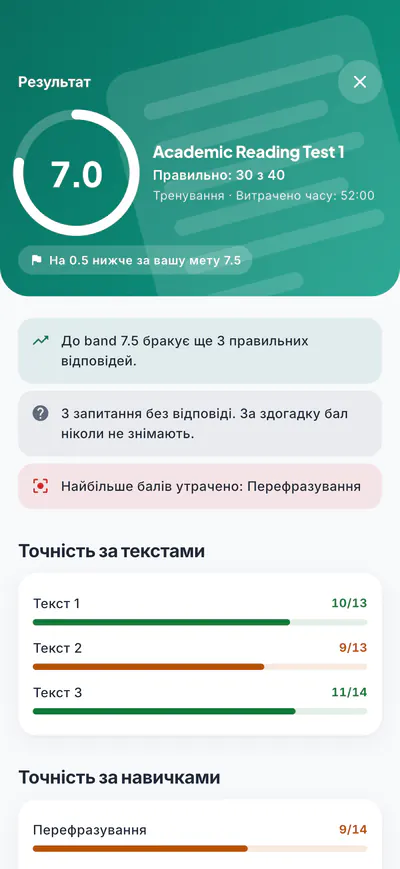
Результат пробного тесту IELTS у застосунку «Fleydo: підготовка до IELTS»: орієнтовний band і точність за кожною частиною
Безкоштовний пробний урок

Дізнайтеся свій реальний бал IELTS раніше, ніж це зробить іспит

Безкоштовний індивідуальний онлайн-урок з учителем — носієм англійської, сертифікованим фахівцем з IELTS із балом 8.5+. Ви отримаєте діагностику Speaking у реальному форматі, чесну оцінку балу та план роботи над саме тими критеріями, які коштують вам балів. Без оплати, без зобов'язань.

Онлайн · Індивідуально · Academic і General Training

IELTS — зареєстрована торговельна марка British Council, IDP: IELTS Australia та Cambridge University Press & Assessment. Ці пробні тести склала команда Fleydo; зазначені організації їх не затверджували й не схвалювали.

Мобільний застосунок

Fleydo English School у вашій кишені

Уроки, домашні завдання, повідомлення та ігри для учнів Fleydo та їхніх батьків. Безкоштовно на iPhone та Android.

Завантажте в App StoreЗавантажити з Google Play
Докладніше про застосунок
QR-код, що відкриває застосунок Fleydo English School в App Store або Google PlayСкануйте й завантажуйтеВідкриє потрібний магазин для вашого телефона.fleydo.com/app
Значок застосунку Fleydo IELTS
Fleydo: підготовка до IELTS

Готуєтеся до IELTS?

«Fleydo: підготовка до IELTS» — окремий застосунок із пробними тестами з усіх чотирьох навичок. Акаунт Fleydo для нього не потрібен.

Детальніше про застосунок IELTS
Завантажте в App StoreЗавантажити з Google Play
Пробні тести IELTS

Тренуйте всі чотири навички IELTS

Усього тестів: 311. Бал одразу після тесту, розбір кожної відповіді та зразки для Writing і Speaking. Без реєстрації.

Усі пробні тести
FleyPath

Персональна дорожня карта вашої дитини — 3, 6 або 12 місяців

🚀Старт
👋Hello
😊Body
🦁Animals
🔢Numbers
🏆Упевнена англійська
Гейміфікована практика англійської

Як гра — тільки вони справді вчаться