1. Accueil
  2. IELTS
  3. Tests blancs
  4. Writing
  5. Online courses and who finishes them

IELTS Writing · Task 1

IELTS Academic Writing Task 1 : Online courses and who finishes them

  • Tableau
  • 20 min
  • 150 mots
  • Academic

ACADEMIC WRITING TASK 1

You should spend about 20 minutes on this task.

The table below shows the number of enrolments on online courses in six subjects in one country, and the percentage of learners who completed those courses, in 2017 and 2025. Summarise the information by selecting and reporting the main features, and make comparisons where relevant.

Write at least 150 words.

Enrolments on online courses and completion rates by subject in one country, 2017 and 2025
SubjectEnrolments 2017Enrolments 2025Completion rate 2017 (%)Completion rate 2025 (%)
Computing184,000612,000149
Business143,000327,0001713
Languages96,000268,000118
Arts and humanities72,00089,0001918
Health and medicine38,000121,0002831
Teacher training27,00064,0003337
Les chiffres sont inventés pour l’entraînement.
20:00
0 / 150 mots

Notez votre réponse

Lisez d’abord les réponses modèles. Choisissez ensuite, pour chaque critère, le band qui correspond à votre réponse. Votre band est la moyenne, arrondie au demi-band le plus proche.

6,0Votre band estimé
Task achievement

Coherence and cohesion

Lexical resource

Grammatical range and accuracy

Chaque modèle est écrit comme l’écrirait un candidat différent, donc les détails et les opinions varient. Les bands sont notre estimation d’après les descripteurs publics, pas des notes officielles d’examinateur.

Réponses modèles à quatre bands

Chaque modèle est écrit comme l’écrirait un candidat différent. Les bands sont notre estimation d’après les descripteurs de band publics.

Modèle de band 5,5179 mots

The table is about online courses in six subject and how many learners finished them in 2017 and 2025.

Firstly, I will talk about enrolments. Computing had 184,000 enrolments in 2017 and it increase to 612,000 in 2025, this is the bigest number in the table. Business was about 140,000 and latter more than 300,000. Languages also went up from 96,000 to 268,000. Arts and humanities had 72,000 and 89,000, so it not change so much. Health and medicine was 38,000 and then 121,000.

Secondly, about the completion rate. In computing it was 14% in 2017 but in 2025 it was only 9%. Business also decresed from 17% to 13% and languages from 11% to 8%. Arts was 19% and 18% it is almost same. However health and medicine increase to 31% and teacher training increase to 37% and it is the highest percentage.

In conclusion, more people take online courses in all subjects but in most subjects the percentage who finish goes down. Only two subject are better.

Pourquoi ce band

  • Most figures are read out row by row, and some only roughly, as in 'Business was about 140,000 and latter more than 300,000', so the main changes are hard to see, and teacher training is missing from the enrolments.
  • The only general statement comes at the end: 'more people take online courses in all subjects'. It is the right idea, but nothing leads up to it and no figure supports it.
  • The same faults come back: the base verb for the past ('it increase', 'it not change'), a missing plural ('six subject', 'Only two subject') and some shaky spelling ('bigest', 'decresed', and 'latter' for later).

Critère par critère

Task achievement
Both measures are covered and the figures given are correct, though business is only rounded, and they are listed, not selected. Teacher training never appears for enrolments. There is no overview near the start, and the contrast between rising enrolments and falling completion appears only in the last two sentences.
Coherence and cohesion
The plan is easy to see, 'Firstly' for enrolments and 'Secondly' for completion, but the sentences inside each part simply follow the rows of the table. 'Arts was 19% and 18% it is almost same' runs two sentences together.
Lexical resource
Simple words are repeated: 'was', 'had', 'increase'. 'Business was about 140,000' and 'Only two subject are better' show that the writer lacks words for saying what the numbers refer to, and three words are misspelt.
Grammatical range and accuracy
Mostly short simple sentences, and about half have an error. Comma splices such as 'in 2025, this is the bigest number' and verb forms such as 'it increase' are the most common. The meaning stays clear.

Pour atteindre le band suivant

Move your last sentence up to become a second paragraph, and add one figure from each measure to support it. Then choose only the largest changes instead of reading every row, copy each figure you keep exactly, and check each past verb: 'increased', 'did not change'.

Faites un plan avant d’écrire

Ce que demande la question

The two measures in this table pull in different directions, and that is its whole point. Enrolments rose everywhere, but a rise in enrolments says nothing about how many people finished. The trap is to report the two measures as separate lists, or to read a falling rate as a falling number of people: computing's rate fell while its enrolments more than tripled. The table gives no reasons, so do not suggest why learners give up or why some courses do better.

Votre vue d’ensemble

Enrolments rose in all six subjects, most of all in computing, but completion rates stayed low and fell in four subjects. Health and medicine and teacher training, among the smaller subjects, had the highest rates, and these were the only two to improve.

Paragraphe par paragraphe

  1. IntroductionOne sentence in your own words: what was measured, for how many subjects, and in which two years.
  2. OverviewTwo sentences with no detailed figures. Enrolments up everywhere, completion down in four subjects and up in two, and the largest subjects tending to have the lowest rates.
  3. The three largest subjectsComputing, business and languages together: their growth in enrolments, then their falling completion rates, with the lowest figures picked out.
  4. The three smaller subjectsHealth and medicine and teacher training, whose rates were the highest and rose further. Finish with arts and humanities, which changed least on both measures.

Erreurs fréquentes

  • Writing about enrolments and completion as two separate lists and never joining them. The comparison that matters runs across the columns: computing led on enrolments, with 612,000 in 2025, yet only 9% finished.
  • Reading a falling rate as falling numbers. Computing's rate dropped from 14% to 9%, but enrolments more than tripled, so 'fewer people finished computing courses' does not follow from the table.
  • Confusing 'to' and 'by'. Teacher training rose to 37%, from 33%. Writing 'rose by 37%' makes a very different claim.
  • Giving reasons, such as saying that health students finish because their course leads to a job, or that computing courses are too difficult. Nothing in the table says so.
  • Giving the move in arts and humanities from 19% to 18% the same weight as the fall in computing. A one-point change is better described as almost no change.

Vocabulaire du thème

enrolment
one person officially joining one course
to enrol
to join a course officially
completion rate
the percentage of people who finish something they started
intake
the number of people who join a course in a given period
vocational
training people for a particular job
to triple
to become three times as large
to edge up
to rise by a small amount
across the board
in every group, with no exceptions
to widen a lead
to get further ahead of the one in second place

Expressions utiles

  • The table sets out ... across ... subjects, together with the proportion of ...
  • ... grew in every subject, most sharply in ...
  • ... more than tripled, from ... to ...
  • By ..., fewer than one in ten learners ...
  • The subjects with the largest ... generally had the lowest ...
  • Although ... remained comparatively small, ... rose further, from ...% to ...%
  • ... showed the least change, with ... edging up from ... to ...

Icône de l'application Fleydo IELTS Fleydo : Préparation IELTS

Emportez ces tests sur votre téléphone

Tous les tests de ces pages se trouvent aussi dans l’application Fleydo : Préparation IELTS pour iPhone, iPad et Android, avec en plus 2 000 mots IELTS et leur audio.

  • Fonctionne hors ligne une fois le test téléchargé sur votre téléphone
  • 2 000 mots IELTS avec audio, répétition espacée et exercices courts
  • Enregistrez vos réponses de Speaking et réécoutez-les
  • Un programme quotidien selon votre band visé et votre date d’examen
Télécharger dans l’App StoreDisponible sur Google Play
Scannez pour téléchargerOuvre l’App Store ou Google Play, selon votre téléphone.

Aucun compte nécessaire. En savoir plus sur l’application

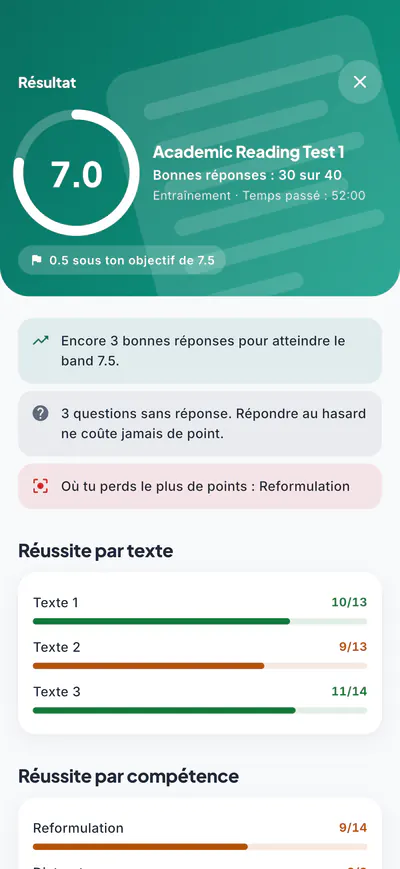
Résultat d’un test blanc IELTS dans l’application Fleydo : Préparation IELTS : band estimé et taux de réussite pour chaque partie
Cours d'essai gratuit

Découvrez votre vrai band IELTS avant l'examen

Un cours individuel en ligne gratuit avec un professeur anglophone natif, spécialiste IELTS certifié Band 8.5+. Vous obtenez un diagnostic Speaking au format réel, une estimation honnête de votre band et un plan ciblé sur les critères qui vous coûtent des points. Sans paiement, sans engagement.

En ligne · Individuel · Academic et General Training

IELTS est une marque déposée du British Council, d’IDP: IELTS Australia et de Cambridge University Press & Assessment. Ces tests blancs sont rédigés par Fleydo et ne sont ni approuvés ni cautionnés par ces organismes.

Application mobile

Fleydo English School dans votre poche

Cours, devoirs, messages et jeux pour les élèves de Fleydo et leurs parents. Gratuite sur iPhone et Android.

Télécharger dans l'App StoreDisponible sur Google Play
En savoir plus sur l'application
Code QR qui ouvre l'application Fleydo English School dans l'App Store ou sur Google PlayScannez pour téléchargerOuvre la boutique adaptée à votre téléphone.fleydo.com/app
Icône de l'application Fleydo IELTS
Fleydo : Préparation IELTS

Vous préparez l'IELTS ?

Fleydo : Préparation IELTS est une application distincte, avec des tests blancs pour les quatre compétences. Aucun compte Fleydo n'est nécessaire pour l'utiliser.

Voir l'application IELTS
Télécharger dans l'App StoreDisponible sur Google Play
Tests blancs IELTS

Entraînez-vous aux quatre compétences de l'IELTS

311 tests avec un band immédiat, des corrigés expliqués et des réponses modèles. Sans inscription.

Tous les tests blancs
Le FleyPath

La feuille de route personnelle de votre enfant — 3, 6 ou 12 mois

🚀Départ
👋Hello
😊Body
🦁Animals
🔢Numbers
🏆Anglais confiant
Entraînement d'anglais gamifié

Comme un jeu — sauf qu'ils apprennent vraiment