1. Strona główna
  2. IELTS
  3. Testy próbne
  4. Writing
  5. Online courses and who finishes them

IELTS Writing · Task 1

IELTS Academic Writing Task 1: Online courses and who finishes them

  • Tabela
  • 20 min
  • Słowa: 150
  • Academic

ACADEMIC WRITING TASK 1

You should spend about 20 minutes on this task.

The table below shows the number of enrolments on online courses in six subjects in one country, and the percentage of learners who completed those courses, in 2017 and 2025. Summarise the information by selecting and reporting the main features, and make comparisons where relevant.

Write at least 150 words.

Enrolments on online courses and completion rates by subject in one country, 2017 and 2025
SubjectEnrolments 2017Enrolments 2025Completion rate 2017 (%)Completion rate 2025 (%)
Computing184,000612,000149
Business143,000327,0001713
Languages96,000268,000118
Arts and humanities72,00089,0001918
Health and medicine38,000121,0002831
Teacher training27,00064,0003337
Liczby są wymyślone na potrzeby ćwiczenia.
20:00
0 / 150 słów

Oceń swoją odpowiedź

Najpierw przeczytaj wzorcowe odpowiedzi. Potem w każdym kryterium wybierz band, który pasuje do Twojej odpowiedzi. Twój wynik to średnia zaokrąglona do najbliższej połowy band.

6,0Twój szacowany band
Task achievement

Coherence and cohesion

Lexical resource

Grammatical range and accuracy

Każdy wzór jest napisany tak, jak napisałby go inny kandydat, więc szczegóły i opinie się różnią. Bandy to nasz szacunek według publicznych deskryptorów, a nie oficjalne oceny egzaminatora.

Wzorcowe odpowiedzi na czterech poziomach band

Każdy wzór jest napisany tak, jak napisałby go inny kandydat. Wyniki band to nasz szacunek według publicznych deskryptorów band.

Wzór na band 5,5Słowa: 179

The table is about online courses in six subject and how many learners finished them in 2017 and 2025.

Firstly, I will talk about enrolments. Computing had 184,000 enrolments in 2017 and it increase to 612,000 in 2025, this is the bigest number in the table. Business was about 140,000 and latter more than 300,000. Languages also went up from 96,000 to 268,000. Arts and humanities had 72,000 and 89,000, so it not change so much. Health and medicine was 38,000 and then 121,000.

Secondly, about the completion rate. In computing it was 14% in 2017 but in 2025 it was only 9%. Business also decresed from 17% to 13% and languages from 11% to 8%. Arts was 19% and 18% it is almost same. However health and medicine increase to 31% and teacher training increase to 37% and it is the highest percentage.

In conclusion, more people take online courses in all subjects but in most subjects the percentage who finish goes down. Only two subject are better.

Dlaczego ten band

  • Most figures are read out row by row, and some only roughly, as in 'Business was about 140,000 and latter more than 300,000', so the main changes are hard to see, and teacher training is missing from the enrolments.
  • The only general statement comes at the end: 'more people take online courses in all subjects'. It is the right idea, but nothing leads up to it and no figure supports it.
  • The same faults come back: the base verb for the past ('it increase', 'it not change'), a missing plural ('six subject', 'Only two subject') and some shaky spelling ('bigest', 'decresed', and 'latter' for later).

Kryterium po kryterium

Task achievement
Both measures are covered and the figures given are correct, though business is only rounded, and they are listed, not selected. Teacher training never appears for enrolments. There is no overview near the start, and the contrast between rising enrolments and falling completion appears only in the last two sentences.
Coherence and cohesion
The plan is easy to see, 'Firstly' for enrolments and 'Secondly' for completion, but the sentences inside each part simply follow the rows of the table. 'Arts was 19% and 18% it is almost same' runs two sentences together.
Lexical resource
Simple words are repeated: 'was', 'had', 'increase'. 'Business was about 140,000' and 'Only two subject are better' show that the writer lacks words for saying what the numbers refer to, and three words are misspelt.
Grammatical range and accuracy
Mostly short simple sentences, and about half have an error. Comma splices such as 'in 2025, this is the bigest number' and verb forms such as 'it increase' are the most common. The meaning stays clear.

Jak osiągnąć kolejny band

Move your last sentence up to become a second paragraph, and add one figure from each measure to support it. Then choose only the largest changes instead of reading every row, copy each figure you keep exactly, and check each past verb: 'increased', 'did not change'.

Zaplanuj, zanim zaczniesz pisać

Czego wymaga polecenie

The two measures in this table pull in different directions, and that is its whole point. Enrolments rose everywhere, but a rise in enrolments says nothing about how many people finished. The trap is to report the two measures as separate lists, or to read a falling rate as a falling number of people: computing's rate fell while its enrolments more than tripled. The table gives no reasons, so do not suggest why learners give up or why some courses do better.

Twoje podsumowanie

Enrolments rose in all six subjects, most of all in computing, but completion rates stayed low and fell in four subjects. Health and medicine and teacher training, among the smaller subjects, had the highest rates, and these were the only two to improve.

Akapit po akapicie

  1. IntroductionOne sentence in your own words: what was measured, for how many subjects, and in which two years.
  2. OverviewTwo sentences with no detailed figures. Enrolments up everywhere, completion down in four subjects and up in two, and the largest subjects tending to have the lowest rates.
  3. The three largest subjectsComputing, business and languages together: their growth in enrolments, then their falling completion rates, with the lowest figures picked out.
  4. The three smaller subjectsHealth and medicine and teacher training, whose rates were the highest and rose further. Finish with arts and humanities, which changed least on both measures.

Częste błędy

  • Writing about enrolments and completion as two separate lists and never joining them. The comparison that matters runs across the columns: computing led on enrolments, with 612,000 in 2025, yet only 9% finished.
  • Reading a falling rate as falling numbers. Computing's rate dropped from 14% to 9%, but enrolments more than tripled, so 'fewer people finished computing courses' does not follow from the table.
  • Confusing 'to' and 'by'. Teacher training rose to 37%, from 33%. Writing 'rose by 37%' makes a very different claim.
  • Giving reasons, such as saying that health students finish because their course leads to a job, or that computing courses are too difficult. Nothing in the table says so.
  • Giving the move in arts and humanities from 19% to 18% the same weight as the fall in computing. A one-point change is better described as almost no change.

Słownictwo tematyczne

enrolment
one person officially joining one course
to enrol
to join a course officially
completion rate
the percentage of people who finish something they started
intake
the number of people who join a course in a given period
vocational
training people for a particular job
to triple
to become three times as large
to edge up
to rise by a small amount
across the board
in every group, with no exceptions
to widen a lead
to get further ahead of the one in second place

Przydatne zwroty

  • The table sets out ... across ... subjects, together with the proportion of ...
  • ... grew in every subject, most sharply in ...
  • ... more than tripled, from ... to ...
  • By ..., fewer than one in ten learners ...
  • The subjects with the largest ... generally had the lowest ...
  • Although ... remained comparatively small, ... rose further, from ...% to ...%
  • ... showed the least change, with ... edging up from ... to ...

Ikona aplikacji Fleydo IELTS Fleydo: Przygotowanie do IELTS

Zabierz te testy ze sobą na telefon

Każdy test z tych stron jest też w aplikacji Fleydo: Przygotowanie do IELTS na iPhone’a, iPada i Androida, razem z 2 000 słówek IELTS z nagraniami.

  • Działa offline, gdy test jest już na telefonie
  • 2 000 słówek IELTS z nagraniami, powtórki rozłożone w czasie i krótkie ćwiczenia
  • Nagrywaj swoje odpowiedzi w Speaking i odsłuchuj je
  • Plan na każdy dzień pod Twój docelowy band i datę egzaminu
Pobierz w App StorePobierz z Google Play
Zeskanuj, aby pobraćOtwiera App Store lub Google Play, zależnie od Twojego telefonu.

Konto nie jest potrzebne. O aplikacji

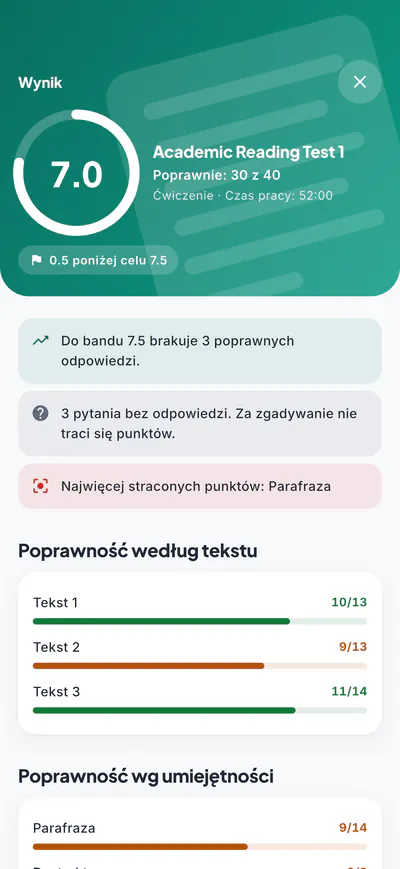
Wynik testu próbnego IELTS w aplikacji Fleydo: Przygotowanie do IELTS: szacowany band i poprawność w każdej części
Bezpłatna lekcja próbna

Poznaj swój prawdziwy wynik IELTS, zanim zrobi to egzamin

Bezpłatna indywidualna lekcja online z nauczycielem native speakerem, certyfikowanym specjalistą IELTS z wynikiem Band 8.5+. Otrzymasz diagnozę Speaking w prawdziwym formacie, uczciwą ocenę szacowanego wyniku i plan pracy nad dokładnie tymi kryteriami, które kosztują Cię punkty. Bez płatności, bez zobowiązań.

Online · Indywidualnie · Academic i General Training

IELTS jest zastrzeżonym znakiem towarowym British Council, IDP: IELTS Australia oraz Cambridge University Press & Assessment. Te testy próbne zostały przygotowane przez Fleydo i nie są przez te organizacje zatwierdzone ani rekomendowane.

Aplikacja mobilna

Fleydo English School w Twojej kieszeni

Lekcje, prace domowe, wiadomości i gry dla uczniów Fleydo i ich rodziców. Bezpłatna na iPhone’a i Androida.

Pobierz w App StorePobierz z Google Play
Więcej o aplikacji
Kod QR otwierający aplikację Fleydo English School w App Store lub Google PlayZeskanuj i pobierzOtwiera właściwy sklep dla Twojego telefonu.fleydo.com/app
Ikona aplikacji Fleydo IELTS
Fleydo: Przygotowanie do IELTS

Przygotowujesz się do IELTS?

Fleydo: Przygotowanie do IELTS to osobna aplikacja z testami próbnymi ze wszystkich czterech umiejętności. Nie potrzebujesz konta Fleydo, żeby z niej korzystać.

Zobacz aplikację IELTS
Pobierz w App StorePobierz z Google Play
Testy próbne IELTS

Ćwicz wszystkie cztery umiejętności IELTS

Wybieraj spośród 311 testów z natychmiastowym wynikiem band, wyjaśnieniami i wzorcowymi odpowiedziami. Bez rejestracji.

Wszystkie testy próbne
FleyPath

Osobista mapa drogowa Twojego dziecka — 3, 6 lub 12 miesięcy

🚀Start
👋Hello
😊Body
🦁Animals
🔢Numbers
🏆Pewny angielski
Zgrywalizowane ćwiczenie angielskiego

Jak gra — tylko że naprawdę się uczą