1. Accueil
  2. IELTS
  3. Tests blancs
  4. Speaking
  5. Test blanc IELTS Speaking 38 : A changing neighbourhood

IELTS Speaking

Test blanc IELTS Speaking 38 : A changing neighbourhood

Describe a recent change in a neighbourhood you know well that not everyone there was happy about.

  • 3 parties
  • 11–14 min
  • Examinateur
  • Quatre candidats, un test

Passez le test

Les questions de l’examinateur sont diffusées une par une. Répondez à voix haute, comme à l’examen. L’enregistrement est facultatif et reste dans cet onglet du navigateur.

Vos enregistrements restent uniquement dans cet onglet. Rien n’est envoyé. Téléchargez-les si vous voulez les garder.

Notez votre prestation

Comparez vos réponses à celles des candidats, puis choisissez pour chaque critère le band qui vous correspond.

6,0Votre band estimé
Fluency and coherence

Lexical resource

Grammatical range and accuracy

Pronunciation

Chaque candidat est une personne différente, donc les histoires et les opinions varient. Les bands sont notre estimation d’après les descripteurs publics, pas des notes officielles d’examinateur. Une transcription ne peut pas montrer la prononciation. Ces bands supposent qu’elle est au même niveau que les trois autres critères.

Questions, carte sujet et exemples de réponses

Partie 1 : entretien

The area where you live

  • Whereabouts do you live?
  • What's it like there at the weekend?
  • Is there somewhere nearby that you like to go for a walk?
  • If you moved away, what would you miss most about it?

Toys

  • What was your favourite toy when you were a child?
  • Did you usually play with toys on your own, or with other children?
  • Have you kept any of the toys you had when you were young?
  • Would you ever buy a toy for yourself now, as an adult?

Science

  • Did you like science lessons at school? (Why?/Why not?)
  • Do you ever watch or read anything about science these days?
  • Is there anything in science you wish you understood better?

Conseils

  • 'Whereabouts do you live?' only needs the town or city, the part of it, and one detail about what it is like. Leave out population figures and history.
  • Most of the toy questions are about your childhood, so you need past forms: 'I had', 'I used to', 'my father bought'. The last one, about buying a toy for yourself now, moves to the present and to would, so listen for the change.
  • You do not need to be good at science to answer the science questions. One lesson or teacher you remember, or one everyday thing you find puzzling, is enough for a natural answer.

Partie 2 : monologue (carte sujet)

Describe a recent change in a neighbourhood you know well that not everyone there was happy about.

You should say:

  • what the change was
  • who welcomed it and who didn't
  • what people said or did about it

and explain whether your own view of it has changed over time.

Question de relance

  • Have most people there got used to it by now?
  • Do you generally prefer things to stay the same, or do you enjoy change?

Les notes qu’un bon candidat pourrait prendre

  • road by primary school closed to cars
  • school times only, since last spring
  • for: parents, children walking
  • against: shop owners, taxi drivers
  • petition, signs moved twice
  • me then: annoyed, longer drive
  • me now: quieter mornings, used to it

Conseils

  • Small changes are fine: a new crossing, a tree cut down, one shop replaced by another, new parking rules, a fence or a gate. A change you saw close up is much easier to talk about than a big project you only know from the news.
  • The second point is where the card gets interesting. Name the people who were for it and against it, and give each side a reason. You do not need to have asked them: 'I heard the shop owners complaining' is enough.
  • The explain line is about time, so give two moments: what you thought when it happened and what you think now. If your view has not changed, that is a fine answer, as long as you say what has kept it the same.

Partie 3 : discussion

How neighbourhoods change

  • Why do you think some neighbourhoods change a lot, while others hardly change at all? Expliquer
  • Do neighbourhoods change faster today than they did when your parents were young? Comparer
  • How much say should local people have when something in their area is going to change? Peser les arguments

Long-time residents and newcomers

  • Why might people who have lived in an area for a long time feel uneasy when a lot of new people move in? Expliquer
  • What do you think newcomers can bring to a neighbourhood? Donner son avis
  • Do you think people in the future will stay in one neighbourhood for as long as people did in the past? Faire des hypothèses sur l’avenir

Conseils

  • These questions are about neighbourhoods in general, not only yours. Start from a place you know, then say whether you think the same happens elsewhere, and why.
  • For the question about how much say local people should have, you do not need to know how planning works. Think about who is affected and argue from that: the people right next door, the ones who are busy when meetings happen, the area as a whole.
  • For the question about the future, choose a direction and base it on something you can already see, such as rents, jobs or working from home. 'It's hard to say' can start an answer, but it cannot be the whole answer.

Quatre candidats, un test

Comment des candidats de quatre bands différents ont répondu à chaque question.

Partie 1Whereabouts do you live?

In Shenyang, it's in the north-east of China. I live in a old xiaoqu... er, it's like many buildings together, with a wall around and one gate. It's near my factory, so for me it's very convenient.

Partie 1What's it like there at the weekend?

More noisy than on weekdays. Many old people sit outside, they play cards, and children are running between the buildings. I work on Saturday, er, sometimes, so I'm not always there. On Sunday I can rest.

Partie 1Is there somewhere nearby that you like to go for a walk?

Yes, there is a small park near my home. After dinner I go there with my husband and my son, he rides his bicycle and we walk behind. In summer, in the evening, many people are dancing there, with music.

Partie 1If you moved away, what would you miss most about it?

The food, I think. Near the gate there is a small restaurant, they make dumplings, very cheap and delicious. And my neighbours, some are very kind, they help me take care my son when I – when I work late.

Partie 1What was your favourite toy when you were a child?

A doll. My father brought it from Beijing, er, when I was six. She had long yellow hair. I loved her so much, but one day I cut her hair with scissor, and after that she was very ugly.

Partie 1Did you usually play with toys on your own, or with other children?

With other children. In our old building there were many children the same age, so we played outside all afternoon, until our mothers called us for dinner. We didn't need toys so much, we just run and play games.

Partie 1Have you kept any of the toys you had when you were young?

No, I don't think so. When we moved to a new flat, my mother gave many old things to other people. Maybe in my parents' home, er, there is still some small things... I'm not sure.

Partie 1Would you ever buy a toy for yourself now, as an adult?

No, I don't think so. I buy many toys, but all for my son, he wants everything he see in the shop. For me... maybe a puzzle, a big one. For adult it's OK, I think.

Partie 1Did you like science lessons at school? (Why?/Why not?)

Not really. Physics was very difficult for me, too many formula, I can't remember them. But biology I like a little, because we could look at small things with the... the machine, er, microscope. That was interesting.

Partie 1Do you ever watch or read anything about science these days?

Sometimes, on my phone. Short videos about the space, how big is the sun, things like this. I watch them in bed. My son likes them too, he always asks me questions and I don't know the answer.

Partie 1Is there anything in science you wish you understood better?

Um... the weather, maybe. Every morning the app say it's sunny, and then in the afternoon it's raining, and I don't have umbrella with me. How they – how do they know it? I really want to understand.

Partie 2Describe a recent change in a neighbourhood you know well that not everyone there was happy about.

Er, the change is in my building. It's a old building, six floor, and before there was no lift, only stairs. We live on the sixth floor, so every day I carry the shopping up, and sometimes also my son, when he's tired and he don't – he refuse to walk. Last year the people in our building decided to put a lift, er, outside, next to the stairs. Everybody need to pay some money, high floor more, low floor less. People on high floor, and old people, of course they are very happy. But one family on the second floor, they don't agree. Because the lift is just in front of their window, so the kitchen become dark, and also, um, the noise. They say, we don't need it, why we must pay? For three month... people argue in the group on our phones, every night, and some neighbours go to, um, knock their door. In the end they agree, er... I don't know why exactly. Now the lift is working, since this summer. Before, I think this family is selfish. But now, er, when I walk past their window, I see it's really dark inside. So I understand them, a little. If the lift is in front of my window... I also don't want it.

Partie 2Have most people there got used to it by now?

Yes, I think so. Now, um, nobody talk about it in the group.

Partie 2Do you generally prefer things to stay the same, or do you enjoy change?

Er... same, I think. Change is tiring for me. Small change is OK.

Partie 3Why do you think some neighbourhoods change a lot, while others hardly change at all?

Because of money, I think. If the area is – if it's near the city centre, or there is new subway, um... many companies want to build there, so it changes very fast. But if the area is far and the people are old, er, nobody is interested to build there. So it stay the same, for many years.

Partie 3Do neighbourhoods change faster today than they did when your parents were young?

Yes, much faster. My parents, when they are young, er, they live in one place twenty, thirty years, and nothing change. Now in Shenyang every year there is new building, new shop, new road. Sometimes I go to one place, after one year I go again, er, I can't find it, everything is different.

Partie 3How much say should local people have when something in their area is going to change?

I think the government should, er, ask everybody first. Like in my building, if nobody ask the second floor family, the problem is more big. But also, um, not everybody can decide, because always somebody says no, and then nothing happens. So... I don't know. The city should listen first, and after that decide.

Partie 3Why might people who have lived in an area for a long time feel uneasy when a lot of new people move in?

Because they don't know them. Before, everybody know each other, er, they say hello, they know who is who. Now new people come, they don't say hello, they just close the door. So the old people feel, um, not so safe, a little. And they miss the old time, when, er... when everybody is friend.

Partie 3What do you think newcomers can bring to a neighbourhood?

New shops, maybe, and, er... new ideas. When young people come, they open, um, coffee shop, milk tea shop, things like that, and the street is more alive, not only old people. I think it's good. But the price also go up, so for old people it's... not so good.

Partie 3Do you think people in the future will stay in one neighbourhood for as long as people did in the past?

No, I don't think so. Now young people must go, um, where is the job. Like my cousin, now he works in Shenzhen, but maybe next year he go to Shanghai, because there the salary is better, he says. So in the future, er... people move more and more, they don't stay long in one place.

Mots pour ce test

a long-time resident
someone who has lived in a place for many years
a newcomer
someone who has recently moved to a place
welcome (a change)
be pleased about something new and support it
have a say
have the right to give your opinion and be listened to
a petition
a document many people sign to ask for something to change or stop
get used to something
stop finding something new strange or difficult
put up with something
accept something unpleasant without complaining much
priced out
forced to leave an area because it has become too expensive to live in
put down roots
settle in a place and start to feel part of it
a mixed reaction
some people like something and others do not
the character of a place
the things that make a place feel the way it does

Expressions utiles

  • Not everyone was happy about ___, especially ___.
  • The people who were most against it were ___, because ___.
  • At first I thought ___, but since then ___.
  • It took a while for people to get used to ___.
  • I can see why ___ felt that way, because ___.
  • For people who've lived there for years ___, whereas for newcomers ___.
  • It depends a lot on whether ___.
  • In twenty years' time I imagine ___, mainly because ___.

Icône de l'application Fleydo IELTS Fleydo : Préparation IELTS

Emportez ces tests sur votre téléphone

Tous les tests de ces pages se trouvent aussi dans l’application Fleydo : Préparation IELTS pour iPhone, iPad et Android, avec en plus 2 000 mots IELTS et leur audio.

  • Fonctionne hors ligne une fois le test téléchargé sur votre téléphone
  • 2 000 mots IELTS avec audio, répétition espacée et exercices courts
  • Enregistrez vos réponses de Speaking et réécoutez-les
  • Un programme quotidien selon votre band visé et votre date d’examen
Télécharger dans l’App StoreDisponible sur Google Play
Scannez pour téléchargerOuvre l’App Store ou Google Play, selon votre téléphone.

Aucun compte nécessaire. En savoir plus sur l’application

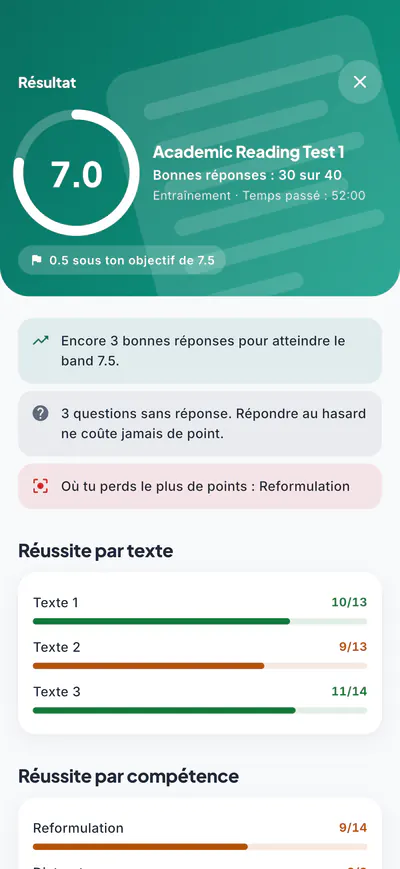
Résultat d’un test blanc IELTS dans l’application Fleydo : Préparation IELTS : band estimé et taux de réussite pour chaque partie
Cours d'essai gratuit

Découvrez votre vrai band IELTS avant l'examen

Un cours individuel en ligne gratuit avec un professeur anglophone natif, spécialiste IELTS certifié Band 8.5+. Vous obtenez un diagnostic Speaking au format réel, une estimation honnête de votre band et un plan ciblé sur les critères qui vous coûtent des points. Sans paiement, sans engagement.

En ligne · Individuel · Academic et General Training

IELTS est une marque déposée du British Council, d’IDP: IELTS Australia et de Cambridge University Press & Assessment. Ces tests blancs sont rédigés par Fleydo et ne sont ni approuvés ni cautionnés par ces organismes.

Application mobile

Fleydo English School dans votre poche

Cours, devoirs, messages et jeux pour les élèves de Fleydo et leurs parents. Gratuite sur iPhone et Android.

Télécharger dans l'App StoreDisponible sur Google Play
En savoir plus sur l'application
Code QR qui ouvre l'application Fleydo English School dans l'App Store ou sur Google PlayScannez pour téléchargerOuvre la boutique adaptée à votre téléphone.fleydo.com/app
Icône de l'application Fleydo IELTS
Fleydo : Préparation IELTS

Vous préparez l'IELTS ?

Fleydo : Préparation IELTS est une application distincte, avec des tests blancs pour les quatre compétences. Aucun compte Fleydo n'est nécessaire pour l'utiliser.

Voir l'application IELTS
Télécharger dans l'App StoreDisponible sur Google Play
Tests blancs IELTS

Entraînez-vous aux quatre compétences de l'IELTS

311 tests avec un band immédiat, des corrigés expliqués et des réponses modèles. Sans inscription.

Tous les tests blancs
Le FleyPath

La feuille de route personnelle de votre enfant — 3, 6 ou 12 mois

🚀Départ
👋Hello
😊Body
🦁Animals
🔢Numbers
🏆Anglais confiant
Entraînement d'anglais gamifié

Comme un jeu — sauf qu'ils apprennent vraiment