1. Αρχική
  2. IELTS
  3. Τεστ εξάσκησης
  4. Speaking
  5. Τεστ εξάσκησης IELTS Speaking 38: A changing neighbourhood

IELTS Speaking

Τεστ εξάσκησης IELTS Speaking 38: A changing neighbourhood

Describe a recent change in a neighbourhood you know well that not everyone there was happy about.

  • 3 μέρη
  • 11–14 λεπ.
  • Εξεταστής
  • Τέσσερις υποψήφιοι, ένα τεστ

Κάντε το τεστ

Οι ερωτήσεις του εξεταστή ακούγονται μία μία. Απαντήστε φωναχτά, όπως θα κάνατε στην εξέταση. Η ηχογράφηση είναι προαιρετική και μένει σε αυτή την καρτέλα του προγράμματος περιήγησης.

Οι ηχογραφήσεις σας μένουν μόνο σε αυτή την καρτέλα. Δεν ανεβαίνει τίποτα. Κατεβάστε τες αν θέλετε να τις κρατήσετε.

Βαθμολογήστε την απόδοσή σας

Συγκρίνετε τις απαντήσεις σας με τους υποψηφίους και μετά επιλέξτε για κάθε κριτήριο το band που σας ταιριάζει.

6,0Το εκτιμώμενο band σας
Fluency and coherence

Lexical resource

Grammatical range and accuracy

Pronunciation

Κάθε υποψήφιος είναι διαφορετικός ομιλητής, γι' αυτό οι ιστορίες και οι απόψεις διαφέρουν. Τα band είναι δική μας εκτίμηση με βάση τις δημόσιες περιγραφές, όχι επίσημη βαθμολογία εξεταστή. Μια απομαγνητοφώνηση δεν μπορεί να δείξει την προφορά. Αυτά τα band υποθέτουν ότι είναι στο ίδιο επίπεδο με τα άλλα τρία κριτήρια.

Ερωτήσεις, κάρτα θέματος και ενδεικτικές απαντήσεις

Part 1: συνέντευξη

The area where you live

  • Whereabouts do you live?
  • What's it like there at the weekend?
  • Is there somewhere nearby that you like to go for a walk?
  • If you moved away, what would you miss most about it?

Toys

  • What was your favourite toy when you were a child?
  • Did you usually play with toys on your own, or with other children?
  • Have you kept any of the toys you had when you were young?
  • Would you ever buy a toy for yourself now, as an adult?

Science

  • Did you like science lessons at school? (Why?/Why not?)
  • Do you ever watch or read anything about science these days?
  • Is there anything in science you wish you understood better?

Συμβουλές

  • 'Whereabouts do you live?' only needs the town or city, the part of it, and one detail about what it is like. Leave out population figures and history.
  • Most of the toy questions are about your childhood, so you need past forms: 'I had', 'I used to', 'my father bought'. The last one, about buying a toy for yourself now, moves to the present and to would, so listen for the change.
  • You do not need to be good at science to answer the science questions. One lesson or teacher you remember, or one everyday thing you find puzzling, is enough for a natural answer.

Part 2: μακρά ομιλία (κάρτα θέματος)

Describe a recent change in a neighbourhood you know well that not everyone there was happy about.

You should say:

  • what the change was
  • who welcomed it and who didn't
  • what people said or did about it

and explain whether your own view of it has changed over time.

Επιπλέον ερώτηση

  • Have most people there got used to it by now?
  • Do you generally prefer things to stay the same, or do you enjoy change?

Σημειώσεις που θα μπορούσε να κρατήσει ένας δυνατός υποψήφιος

  • road by primary school closed to cars
  • school times only, since last spring
  • for: parents, children walking
  • against: shop owners, taxi drivers
  • petition, signs moved twice
  • me then: annoyed, longer drive
  • me now: quieter mornings, used to it

Συμβουλές

  • Small changes are fine: a new crossing, a tree cut down, one shop replaced by another, new parking rules, a fence or a gate. A change you saw close up is much easier to talk about than a big project you only know from the news.
  • The second point is where the card gets interesting. Name the people who were for it and against it, and give each side a reason. You do not need to have asked them: 'I heard the shop owners complaining' is enough.
  • The explain line is about time, so give two moments: what you thought when it happened and what you think now. If your view has not changed, that is a fine answer, as long as you say what has kept it the same.

Part 3: συζήτηση

How neighbourhoods change

  • Why do you think some neighbourhoods change a lot, while others hardly change at all? Επεξήγηση
  • Do neighbourhoods change faster today than they did when your parents were young? Σύγκριση
  • How much say should local people have when something in their area is going to change? Στάθμιση υπέρ και κατά

Long-time residents and newcomers

  • Why might people who have lived in an area for a long time feel uneasy when a lot of new people move in? Επεξήγηση
  • What do you think newcomers can bring to a neighbourhood? Διατύπωση άποψης
  • Do you think people in the future will stay in one neighbourhood for as long as people did in the past? Υποθέσεις για το μέλλον

Συμβουλές

  • These questions are about neighbourhoods in general, not only yours. Start from a place you know, then say whether you think the same happens elsewhere, and why.
  • For the question about how much say local people should have, you do not need to know how planning works. Think about who is affected and argue from that: the people right next door, the ones who are busy when meetings happen, the area as a whole.
  • For the question about the future, choose a direction and base it on something you can already see, such as rents, jobs or working from home. 'It's hard to say' can start an answer, but it cannot be the whole answer.

Τέσσερις υποψήφιοι, ένα τεστ

Πώς απάντησαν σε κάθε ερώτηση ομιλητές σε τέσσερα διαφορετικά band.

Part 1Whereabouts do you live?

In Shenyang, it's in the north-east of China. I live in a old xiaoqu... er, it's like many buildings together, with a wall around and one gate. It's near my factory, so for me it's very convenient.

Part 1What's it like there at the weekend?

More noisy than on weekdays. Many old people sit outside, they play cards, and children are running between the buildings. I work on Saturday, er, sometimes, so I'm not always there. On Sunday I can rest.

Part 1Is there somewhere nearby that you like to go for a walk?

Yes, there is a small park near my home. After dinner I go there with my husband and my son, he rides his bicycle and we walk behind. In summer, in the evening, many people are dancing there, with music.

Part 1If you moved away, what would you miss most about it?

The food, I think. Near the gate there is a small restaurant, they make dumplings, very cheap and delicious. And my neighbours, some are very kind, they help me take care my son when I – when I work late.

Part 1What was your favourite toy when you were a child?

A doll. My father brought it from Beijing, er, when I was six. She had long yellow hair. I loved her so much, but one day I cut her hair with scissor, and after that she was very ugly.

Part 1Did you usually play with toys on your own, or with other children?

With other children. In our old building there were many children the same age, so we played outside all afternoon, until our mothers called us for dinner. We didn't need toys so much, we just run and play games.

Part 1Have you kept any of the toys you had when you were young?

No, I don't think so. When we moved to a new flat, my mother gave many old things to other people. Maybe in my parents' home, er, there is still some small things... I'm not sure.

Part 1Would you ever buy a toy for yourself now, as an adult?

No, I don't think so. I buy many toys, but all for my son, he wants everything he see in the shop. For me... maybe a puzzle, a big one. For adult it's OK, I think.

Part 1Did you like science lessons at school? (Why?/Why not?)

Not really. Physics was very difficult for me, too many formula, I can't remember them. But biology I like a little, because we could look at small things with the... the machine, er, microscope. That was interesting.

Part 1Do you ever watch or read anything about science these days?

Sometimes, on my phone. Short videos about the space, how big is the sun, things like this. I watch them in bed. My son likes them too, he always asks me questions and I don't know the answer.

Part 1Is there anything in science you wish you understood better?

Um... the weather, maybe. Every morning the app say it's sunny, and then in the afternoon it's raining, and I don't have umbrella with me. How they – how do they know it? I really want to understand.

Part 2Describe a recent change in a neighbourhood you know well that not everyone there was happy about.

Er, the change is in my building. It's a old building, six floor, and before there was no lift, only stairs. We live on the sixth floor, so every day I carry the shopping up, and sometimes also my son, when he's tired and he don't – he refuse to walk. Last year the people in our building decided to put a lift, er, outside, next to the stairs. Everybody need to pay some money, high floor more, low floor less. People on high floor, and old people, of course they are very happy. But one family on the second floor, they don't agree. Because the lift is just in front of their window, so the kitchen become dark, and also, um, the noise. They say, we don't need it, why we must pay? For three month... people argue in the group on our phones, every night, and some neighbours go to, um, knock their door. In the end they agree, er... I don't know why exactly. Now the lift is working, since this summer. Before, I think this family is selfish. But now, er, when I walk past their window, I see it's really dark inside. So I understand them, a little. If the lift is in front of my window... I also don't want it.

Part 2Have most people there got used to it by now?

Yes, I think so. Now, um, nobody talk about it in the group.

Part 2Do you generally prefer things to stay the same, or do you enjoy change?

Er... same, I think. Change is tiring for me. Small change is OK.

Part 3Why do you think some neighbourhoods change a lot, while others hardly change at all?

Because of money, I think. If the area is – if it's near the city centre, or there is new subway, um... many companies want to build there, so it changes very fast. But if the area is far and the people are old, er, nobody is interested to build there. So it stay the same, for many years.

Part 3Do neighbourhoods change faster today than they did when your parents were young?

Yes, much faster. My parents, when they are young, er, they live in one place twenty, thirty years, and nothing change. Now in Shenyang every year there is new building, new shop, new road. Sometimes I go to one place, after one year I go again, er, I can't find it, everything is different.

Part 3How much say should local people have when something in their area is going to change?

I think the government should, er, ask everybody first. Like in my building, if nobody ask the second floor family, the problem is more big. But also, um, not everybody can decide, because always somebody says no, and then nothing happens. So... I don't know. The city should listen first, and after that decide.

Part 3Why might people who have lived in an area for a long time feel uneasy when a lot of new people move in?

Because they don't know them. Before, everybody know each other, er, they say hello, they know who is who. Now new people come, they don't say hello, they just close the door. So the old people feel, um, not so safe, a little. And they miss the old time, when, er... when everybody is friend.

Part 3What do you think newcomers can bring to a neighbourhood?

New shops, maybe, and, er... new ideas. When young people come, they open, um, coffee shop, milk tea shop, things like that, and the street is more alive, not only old people. I think it's good. But the price also go up, so for old people it's... not so good.

Part 3Do you think people in the future will stay in one neighbourhood for as long as people did in the past?

No, I don't think so. Now young people must go, um, where is the job. Like my cousin, now he works in Shenzhen, but maybe next year he go to Shanghai, because there the salary is better, he says. So in the future, er... people move more and more, they don't stay long in one place.

Λέξεις για αυτό το τεστ

a long-time resident
someone who has lived in a place for many years
a newcomer
someone who has recently moved to a place
welcome (a change)
be pleased about something new and support it
have a say
have the right to give your opinion and be listened to
a petition
a document many people sign to ask for something to change or stop
get used to something
stop finding something new strange or difficult
put up with something
accept something unpleasant without complaining much
priced out
forced to leave an area because it has become too expensive to live in
put down roots
settle in a place and start to feel part of it
a mixed reaction
some people like something and others do not
the character of a place
the things that make a place feel the way it does

Χρήσιμες εκφράσεις

  • Not everyone was happy about ___, especially ___.
  • The people who were most against it were ___, because ___.
  • At first I thought ___, but since then ___.
  • It took a while for people to get used to ___.
  • I can see why ___ felt that way, because ___.
  • For people who've lived there for years ___, whereas for newcomers ___.
  • It depends a lot on whether ___.
  • In twenty years' time I imagine ___, mainly because ___.

Εικονίδιο της εφαρμογής Fleydo IELTS Fleydo: Προετοιμασία IELTS

Πάρτε αυτά τα τεστ μαζί σας στο κινητό

Κάθε τεστ αυτών των σελίδων υπάρχει και στην εφαρμογή Fleydo: Προετοιμασία IELTS για iPhone, iPad και Android, μαζί με 2.000 λέξεις IELTS με ήχο.

  • Λειτουργεί χωρίς σύνδεση μόλις ένα τεστ βρίσκεται στο κινητό σας
  • 2.000 λέξεις IELTS με ήχο, επανάληψη σε αυξανόμενα διαστήματα και σύντομες ασκήσεις
  • Ηχογραφήστε τις απαντήσεις σας στο Speaking και ακούστε τες ξανά
  • Καθημερινό πλάνο για το band-στόχο σας και την ημερομηνία της εξέτασης
Λήψη στο App StoreΑποκτήστε το στο Google Play
Σαρώστε για λήψηΑνοίγει το App Store ή το Google Play, ανάλογα με το κινητό σας.

Δεν χρειάζεται λογαριασμός. Σχετικά με την εφαρμογή

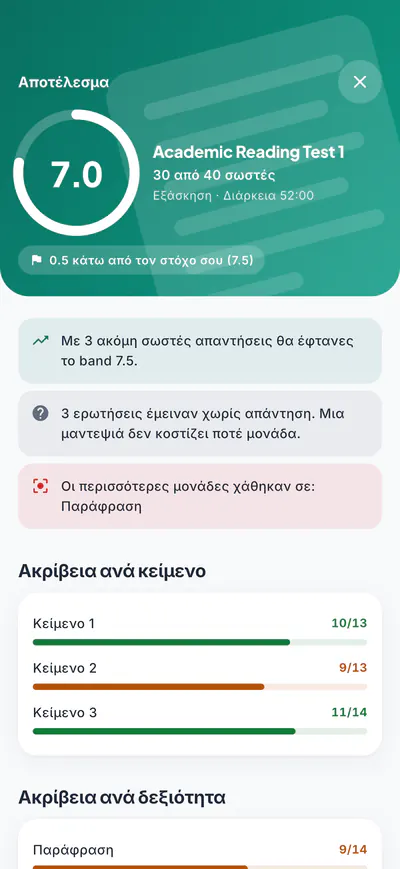
Αποτέλεσμα τεστ εξάσκησης IELTS στην εφαρμογή Fleydo: Προετοιμασία IELTS: εκτιμώμενο band και ακρίβεια για κάθε μέρος
Δωρεάν δοκιμαστικό μάθημα

Μάθετε το πραγματικό σας band στο IELTS πριν σας το πει η εξέταση

Ένα δωρεάν ατομικό διαδικτυακό μάθημα με καθηγητή με μητρική γλώσσα τα Αγγλικά, πιστοποιημένο ειδικό IELTS με Band 8.5+. Λαμβάνετε διαγνωστικό Speaking σε πραγματική μορφή εξέτασης, μια ειλικρινή εκτίμηση band και ένα πλάνο για τα ακριβή κριτήρια που σας κοστίζουν βαθμούς. Χωρίς πληρωμή, χωρίς δέσμευση.

Διαδικτυακά · Ατομικά · Academic και General Training

Το IELTS είναι σήμα κατατεθέν των British Council, IDP: IELTS Australia και Cambridge University Press & Assessment. Αυτά τα τεστ εξάσκησης είναι γραμμένα από τη Fleydo και δεν έχουν εγκριθεί ούτε υποστηριχθεί από τους οργανισμούς αυτούς.

Εφαρμογή για κινητά

Η Fleydo English School στην τσέπη σας

Μαθήματα, εργασίες, μηνύματα και παιχνίδια για τους μαθητές της Fleydo και τους γονείς τους. Δωρεάν σε iPhone και Android.

Λήψη στο App StoreΑποκτήστε το στο Google Play
Περισσότερα για την εφαρμογή
Κωδικός QR που ανοίγει την εφαρμογή Fleydo English School στο App Store ή στο Google PlayΣαρώστε για λήψηΑνοίγει το κατάλληλο κατάστημα για το κινητό σας.fleydo.com/app
Εικονίδιο της εφαρμογής Fleydo IELTS
Fleydo: Προετοιμασία IELTS

Προετοιμάζεστε για το IELTS;

Το Fleydo: Προετοιμασία IELTS είναι ξεχωριστή εφαρμογή με τεστ εξάσκησης και για τις τέσσερις δεξιότητες. Δεν χρειάζεστε λογαριασμό Fleydo για να τη χρησιμοποιήσετε.

Δείτε την εφαρμογή IELTS
Λήψη στο App StoreΑποκτήστε το στο Google Play
Τεστ εξάσκησης IELTS

Εξασκηθείτε και στις τέσσερις δεξιότητες του IELTS

311 τεστ με άμεσο band score, επεξηγήσεις στις απαντήσεις και πρότυπες απαντήσεις. Χωρίς εγγραφή.

Όλα τα τεστ εξάσκησης
Το FleyPath

Ο προσωπικός οδικός χάρτης του παιδιού σας — 3, 6 ή 12 μήνες

🚀Έναρξη
👋Hello
😊Body
🦁Animals
🔢Numbers
🏆Αγγλικά με Αυτοπεποίθηση
Παιχνιδοποιημένη εξάσκηση Αγγλικών

Σαν παιχνίδι — μόνο που μαθαίνουν πραγματικά