1. Accueil
  2. IELTS
  3. Tests blancs
  4. Speaking
  5. Test blanc IELTS Speaking 26 : Housework

IELTS Speaking

Test blanc IELTS Speaking 26 : Housework

Describe a job in the home that you used to dislike but don't mind doing now.

  • 3 parties
  • 11–14 min
  • Examinateur
  • Quatre candidats, un test

Passez le test

Les questions de l’examinateur sont diffusées une par une. Répondez à voix haute, comme à l’examen. L’enregistrement est facultatif et reste dans cet onglet du navigateur.

Vos enregistrements restent uniquement dans cet onglet. Rien n’est envoyé. Téléchargez-les si vous voulez les garder.

Notez votre prestation

Comparez vos réponses à celles des candidats, puis choisissez pour chaque critère le band qui vous correspond.

6,0Votre band estimé
Fluency and coherence

Lexical resource

Grammatical range and accuracy

Pronunciation

Chaque candidat est une personne différente, donc les histoires et les opinions varient. Les bands sont notre estimation d’après les descripteurs publics, pas des notes officielles d’examinateur. Une transcription ne peut pas montrer la prononciation. Ces bands supposent qu’elle est au même niveau que les trois autres critères.

Questions, carte sujet et exemples de réponses

Partie 1 : entretien

The area where you live

  • What's the area like where you live?
  • What do you like most about living there?
  • Do you spend much of your free time in your area, or do you usually go somewhere else?
  • What would a visitor notice first about your area?

Concerts

  • Do you go to concerts much?
  • Do you remember the first time you heard live music?
  • At a concert, would you rather be near the stage or further back? (Why?)
  • Do you ever watch concerts online?

Sunshine

  • Do you enjoy sunny weather?
  • What did you like doing on sunny days when you were a child?
  • Does a sunny day change your mood at all?

Conseils

  • For the area where you live, say what it is like to live there day to day: the noise, the shops, the hill you walk up, where you go at the weekend. Leave out facts and figures about the city.
  • If you hardly ever go to concerts, say so and talk about any live music you have heard: a band at a wedding or a school party, a street musician, a show you watched on your phone. 'Not really' is a fine start if a reason follows.
  • The sunshine questions change tense. 'What did you like doing ... as a child' wants past forms such as 'we used to' or 'we'd', and 'Does a sunny day change your mood' is about how you are now, so stay in the present.

Partie 2 : monologue (carte sujet)

Describe a job in the home that you used to dislike but don't mind doing now.

You should say:

  • what the job is and how often it needs doing
  • why you disliked it before
  • what changed your feelings about it

and explain whether you would hand it over to someone else if you could.

Question de relance

  • Is there a job at home that you still can't stand?
  • Do you prefer doing jobs like that on your own or with someone else?

Les notes qu’un bon candidat pourrait prendre

  • washing up, every evening
  • teenager: me, never my brother
  • unfair, not the dishes
  • no dishwasher, tiny kitchen
  • partner cooks, my half
  • translation never finished, dishes are
  • hand over? probably not

Conseils

  • Any small job counts: making the bed, taking out the rubbish, cleaning your shoes, watering plants. If you have never really disliked a job, choose one you avoided as a child and now do without thinking.
  • The card is about a change, so keep the dislike short and give most of your time to what changed: a new home, a new routine, a person, a quicker way of doing it. Past forms for then ('I used to hate it', 'I'd leave it for days') and present forms for now.
  • The explain line is imaginary, so answer it with would: 'If someone offered, I'd probably still ...'. Then give your reason, or admit that you would hand it over, and say why.

Partie 3 : discussion

Sharing housework

  • How do people usually decide who does which jobs in a home? Expliquer
  • Is housework shared differently now from the way it was when your parents were young? Comparer
  • What can people who live together do to stop housework causing arguments? Suggérer

Children and household jobs

  • Should children have to help at home, or is it better to let them focus on school? Donner son avis
  • Is it worth letting young children help at home, even if it makes the job take longer? Peser les arguments
  • Do you think children in the future will do more or less work at home than children do today? Faire des hypothèses sur l’avenir

Conseils

  • For the question about your parents' time, say what has changed and also what has not. An answer that finds one thing that stayed the same sounds thought through, not just 'things are more equal now'.
  • These questions are about people in general. One example from your own home is fine, but then widen it with 'in a lot of families' or 'people my age', and keep some answers general.
  • When you are asked whether something is worth doing, take a side. You can say when the other side has a point, but finish by saying where you stand and why.

Quatre candidats, un test

Comment des candidats de quatre bands différents ont répondu à chaque question.

Partie 1What's the area like where you live?

It's a, er, a normal neighbourhood in Fortaleza, quite far from the beach. Have a lot of small shops, a bakery, a supermarket, and the main street is very noisy, because of the buses and the motorbikes, all day.

Partie 1What do you like most about living there?

It's near of my work. I work in a travel agency, at the counter, and I go walking, ten minutes. So I don't need the bus, which is good, because the bus in my city is... always full, always late.

Partie 1Do you spend much of your free time in your area, or do you usually go somewhere else?

Er, somewhere else. On Sunday I go to the beach with my friends, two buses, it's far. Or the mall. In my area there is not much to do, only the – the bars, and I don't like them so much.

Partie 1What would a visitor notice first about your area?

The heat, I think. And the noise. Everybody puts the music very loud, in the car, in the house... For me it's normal, but my cousin from São Paulo, when he came, he can't sleep, er, the first nights.

Partie 1Do you go to concerts much?

Not so much, because the tickets are expensive. But sometimes, yes, with my friends we go in a show of forró, er, it's a music from here, for dancing. There is one place near the beach with, um, shows on Friday.

Partie 1Do you remember the first time you heard live music?

Yes... I think it was a party in my school, in June. I was, um, six or seven. There was a band with accordion and the... the triangle, and all the children danced with special clothes, like people from the countryside.

Partie 1At a concert, would you rather be near the stage or further back? (Why?)

Near the stage, always. I'm short, so if I stay in the back I see nothing, only heads. In the front I can see the singer, and, er, dance, jump... it's more fun.

Partie 1Do you ever watch concerts online?

Yes, sometimes, on my phone, in bed before I sleep. Only small pieces, not the – not the whole concert. It's not the same thing, but... it's free.

Partie 1Do you enjoy sunny weather?

Yes, I like it, but in Fortaleza we have sun all the year, every day, so... sometimes it's too much. In the afternoon it's very hot, er, I try to walk where there are trees.

Partie 1What did you like doing on sunny days when you were a child?

Go to the beach on Sunday, with my mother and my brother. We stayed all the day, er, making castles of sand, and my mother was always calling us for put more sunscreen, but we didn't listen.

Partie 1Does a sunny day change your mood at all?

Yes. When it's sunny I stay more happy, I want to go out. When it's raining, er, I stay in the house and I feel... lazy. Sad, a little bit.

Partie 2Describe a job in the home that you used to dislike but don't mind doing now.

Er... ironing. Ironing clothes. When I was fourteen, my mother start to work in a restaurant in the night, so she told me, now you do the ironing, for everybody, on Saturday. I hated it. Fortaleza is very hot, and the iron is hot, and I was all – I was sweating, all the morning, with a big... a big mountain of clothes. And one time I burned the shirt of my brother, er, the shirt of school, it got a brown mark. He was very angry with me. So for many years I really hate this job. Now is different. In the agency we have to use a uniform, er, a blue blouse, and it must be perfect, because my manager is very – she looks every morning. So I pass – I iron my blouses on Sunday night, only my clothes, not my brother, he's twenty now, he do his. And one day my manager said, your blouse is always perfect, the others must learn with you. I was very happy, very proud. So now I don't hate it. It's OK. If I have money to pay somebody... maybe yes, I don't know. No, I think I keep it, because other people don't do it the same, er... they don't care so much.

Partie 2Is there a job at home that you still can't stand?

Yes, clean the fridge. Inside always have old food, er, with bad smell.

Partie 2Do you prefer doing jobs like that on your own or with someone else?

Alone. With my brother we fight, er, always.

Partie 3How do people usually decide who does which jobs in a home?

Er... in my house, my mother decide everything. She says, you do this, you do that, and finish, no discussion. In other families I think is... who has more time. If the husband works until late, er, the wife do more, or the opposite. Each family is different.

Partie 3Is housework shared differently now from the way it was when your parents were young?

Different, yes. My grandmother, um, she did everything in the house, alone, and she have nine children. The men don't – they didn't do nothing, only work outside. Now it's more... more equal? My brother washes the dishes sometimes, when my mother asks. So it's a little bit better.

Partie 3What can people who live together do to stop housework causing arguments?

Um... talk before. Make a list, with the days, like Monday is you, Tuesday is me. And when the other person don't do it, you need to – to say in a calm way, not shouting. In my house we shout, er, every week, and nothing changes.

Partie 3Should children have to help at home, or is it better to let them focus on school?

Help, yes, but small things. Put the clothes in the – in the basket, er, make the bed. School is more important, of course, but if – I think if the child never helps, when he grows up he don't know how to do anything. I know people like this, twenty-five years old and can't make rice.

Partie 3Is it worth letting young children help at home, even if it makes the job take longer?

Hmm... worth it, I think. My mother never let me – she said I make more mess, so I learn very late, when she start to work. If she teach me before, it's easier for me now. It's slow, yes, but... the child learn. Next time is faster.

Partie 3Do you think children in the future will do more or less work at home than children do today?

Hmm... more, maybe. Because now the mothers work, like my mother, and the fathers also, so in the day have nobody in the house. The children must do something, er, heat the food, wash the – the dishes. My cousin is ten and she already cook rice alone. Before, the mother was at home and she did everything. So I think more. But I'm not sure, er, with the machines maybe is less.

Mots pour ce test

a chore
a routine job at home, usually not an enjoyable one
do the washing-up
wash the plates, pans and cutlery after a meal
fold the laundry
fold clean, dry clothes so they can be put away
tidy up
put things back where they belong
pile up
grow into a large amount because nobody deals with it
put something off
delay doing something you do not want to do
take turns
do something one after the other, so each person has a go
your fair share
the part of the work that it is right for you to do
pull your weight
do as much work as the others in a group
get into a routine
start doing something regularly, at the same time
it grew on me
I started to like it slowly, over time

Expressions utiles

  • I used to hate ___, mainly because ___.
  • These days I don't mind it, because ___.
  • What really changed things was ___.
  • It only takes ___ if you ___.
  • If someone offered to do it, I'd probably ___.
  • In a lot of homes, ___ still ends up doing ___.
  • Compared with when my parents were young, ___.
  • It's slower when children help, but ___.
  • I can imagine children in the future ___, because ___.

Icône de l'application Fleydo IELTS Fleydo : Préparation IELTS

Emportez ces tests sur votre téléphone

Tous les tests de ces pages se trouvent aussi dans l’application Fleydo : Préparation IELTS pour iPhone, iPad et Android, avec en plus 2 000 mots IELTS et leur audio.

  • Fonctionne hors ligne une fois le test téléchargé sur votre téléphone
  • 2 000 mots IELTS avec audio, répétition espacée et exercices courts
  • Enregistrez vos réponses de Speaking et réécoutez-les
  • Un programme quotidien selon votre band visé et votre date d’examen
Télécharger dans l’App StoreDisponible sur Google Play
Scannez pour téléchargerOuvre l’App Store ou Google Play, selon votre téléphone.

Aucun compte nécessaire. En savoir plus sur l’application

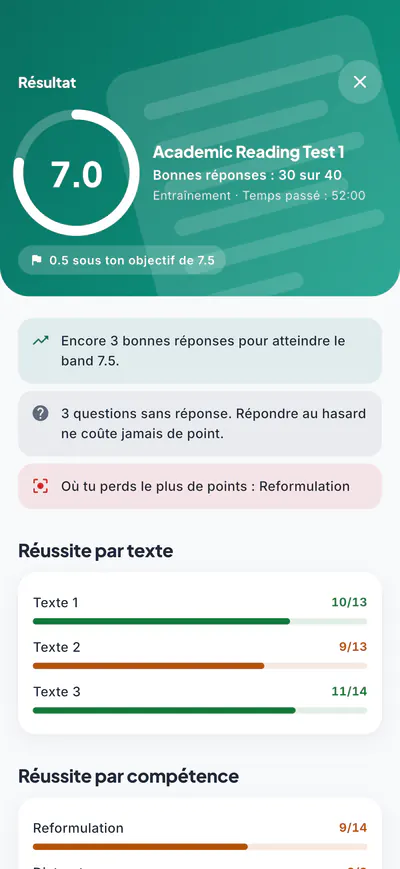
Résultat d’un test blanc IELTS dans l’application Fleydo : Préparation IELTS : band estimé et taux de réussite pour chaque partie
Cours d'essai gratuit

Découvrez votre vrai band IELTS avant l'examen

Un cours individuel en ligne gratuit avec un professeur anglophone natif, spécialiste IELTS certifié Band 8.5+. Vous obtenez un diagnostic Speaking au format réel, une estimation honnête de votre band et un plan ciblé sur les critères qui vous coûtent des points. Sans paiement, sans engagement.

En ligne · Individuel · Academic et General Training

IELTS est une marque déposée du British Council, d’IDP: IELTS Australia et de Cambridge University Press & Assessment. Ces tests blancs sont rédigés par Fleydo et ne sont ni approuvés ni cautionnés par ces organismes.

Application mobile

Fleydo English School dans votre poche

Cours, devoirs, messages et jeux pour les élèves de Fleydo et leurs parents. Gratuite sur iPhone et Android.

Télécharger dans l'App StoreDisponible sur Google Play
En savoir plus sur l'application
Code QR qui ouvre l'application Fleydo English School dans l'App Store ou sur Google PlayScannez pour téléchargerOuvre la boutique adaptée à votre téléphone.fleydo.com/app
Icône de l'application Fleydo IELTS
Fleydo : Préparation IELTS

Vous préparez l'IELTS ?

Fleydo : Préparation IELTS est une application distincte, avec des tests blancs pour les quatre compétences. Aucun compte Fleydo n'est nécessaire pour l'utiliser.

Voir l'application IELTS
Télécharger dans l'App StoreDisponible sur Google Play
Tests blancs IELTS

Entraînez-vous aux quatre compétences de l'IELTS

311 tests avec un band immédiat, des corrigés expliqués et des réponses modèles. Sans inscription.

Tous les tests blancs
Le FleyPath

La feuille de route personnelle de votre enfant — 3, 6 ou 12 mois

🚀Départ
👋Hello
😊Body
🦁Animals
🔢Numbers
🏆Anglais confiant
Entraînement d'anglais gamifié

Comme un jeu — sauf qu'ils apprennent vraiment