1. Accueil
  2. IELTS
  3. Tests blancs
  4. Speaking
  5. Test blanc IELTS Speaking 25 : Words

IELTS Speaking

Test blanc IELTS Speaking 25 : Words

Describe a word or phrase in your first language, or one your family uses, that is hard to translate into English.

  • 3 parties
  • 11–14 min
  • Examinateur
  • Quatre candidats, un test

Passez le test

Les questions de l’examinateur sont diffusées une par une. Répondez à voix haute, comme à l’examen. L’enregistrement est facultatif et reste dans cet onglet du navigateur.

Vos enregistrements restent uniquement dans cet onglet. Rien n’est envoyé. Téléchargez-les si vous voulez les garder.

Notez votre prestation

Comparez vos réponses à celles des candidats, puis choisissez pour chaque critère le band qui vous correspond.

6,0Votre band estimé
Fluency and coherence

Lexical resource

Grammatical range and accuracy

Pronunciation

Chaque candidat est une personne différente, donc les histoires et les opinions varient. Les bands sont notre estimation d’après les descripteurs publics, pas des notes officielles d’examinateur. Une transcription ne peut pas montrer la prononciation. Ces bands supposent qu’elle est au même niveau que les trois autres critères.

Questions, carte sujet et exemples de réponses

Partie 1 : entretien

Home town

  • Where is your home town?
  • What do people from other parts of your country usually think of it?
  • What's your home town like in the evenings?
  • Is there a place there where you like to go to be on your own?

Wind

  • Is it often windy where you live?
  • Do you mind going out when it's very windy?
  • Did you ever fly a kite when you were a child?
  • Would you rather have a windy day or a hot day with no wind at all?

Shoes

  • What sort of shoes do you wear most days?
  • Do you enjoy shopping for shoes, or is it a chore?
  • When you were a child, who chose your shoes?

Conseils

  • The second home town question asks what other people think of your town, not what you think. Start with their view ('People usually think it's ...') and then add your own if it is different. Nobody expects facts or numbers about the place.
  • Wind and shoes are small, concrete topics. One real detail, such as a particular stormy day or the shoes you are wearing now, makes a better answer than a general sentence about the weather or fashion.
  • Two questions are about your childhood: the kite and who chose your shoes. Use past forms, and 'used to' or 'would' for things that happened again and again. 'Would you rather' needs a choice and a reason.

Partie 2 : monologue (carte sujet)

Describe a word or phrase in your first language, or one your family uses, that is hard to translate into English.

You should say:

  • what it is and roughly what it means
  • when people use it
  • whether you have ever tried to explain it to someone

and explain why you think it is hard to put into English.

Question de relance

  • Do younger people still use it?
  • Is there an English word you wish your language had?

Les notes qu’un bon candidat pourrait prendre

  • word: quiet, tired feeling after guests leave
  • aunt says it, everyone over forty
  • Sunday evening after a family lunch
  • tried with flatmate: hangover? no
  • no drink, no illness, just the quiet
  • English needs a whole sentence
  • feeling + situation in one word

Conseils

  • If no famous untranslatable word comes to mind, think smaller: a greeting, something people say before a meal, a word for a relative, a family joke that has turned into a word. Any of these works, as long as you can say when it is used.
  • A dictionary definition will last twenty seconds. What fills the two minutes is one real moment: who said it, what had just happened, and how the person you explained it to reacted.
  • For the explain line, compare: say what the nearest English word is and what it misses, such as the feeling, the humour or who you can say it to. Do not guess at the history of the word unless you are sure.

Partie 3 : discussion

Learning foreign languages

  • Why do some people find it much easier than others to learn a new language? Expliquer
  • How is learning a language in a classroom different from learning it through films, games or social media? Comparer
  • Translation apps keep getting better. Do you think people will still bother to learn foreign languages in twenty years' time? Faire des hypothèses sur l’avenir

How languages change

  • Why do you think young people so often invent their own words and expressions? Expliquer
  • Many languages now borrow a lot of words from English. Is that something to worry about? Peser les arguments
  • What should schools do when pupils use slang or text-message spelling in their written work? Suggérer

Conseils

  • Your own experience as a learner is a good place to start, but these questions are about people in general. After your example, widen it: 'and I think that's true for most people who ...'.
  • For the question about translation apps, take a position. Say what an app can already do well and what it cannot do, and let that decide your answer, rather than stopping at 'maybe yes, maybe no'.
  • When you talk about how languages change, one real example helps, such as a borrowed word you hear every day or a piece of slang. Do not make claims about where words come from unless you are sure.

Quatre candidats, un test

Comment des candidats de quatre bands différents ont répondu à chaque question.

Partie 1Where is your home town?

Koszalin. It's in the north of Poland, not far from the sea. Not big city, not small, just... normal. I was born there and I still live there, I never moved anywhere.

Partie 1What do people from other parts of your country usually think of it?

Hmm. I think they don't think about it much. In summer they only drive through, er, to the beach. They say, ah, Koszalin, nothing happens there. And it's – yes, it's a little bit true.

Partie 1What's your home town like in the evenings?

I don't know so well, er, because I go to sleep very early, I work in a bakery, we start at three o'clock in the night. But in summer it's nice, people sit outside in the centre, with ice cream, beer...

Partie 1Is there a place there where you like to go to be on your own?

Yes, there is a forest near my house, ten minutes walking. When I finish work it's early morning, people only go to work, and in the forest is... nobody. Only birds. I like this very much.

Partie 1Is it often windy where you live?

Yes, very often. The wind come from the sea, so... in autumn sometimes it's so strong that the trees fall on the road. And the rubbish bins, they – they fly on the street.

Partie 1Do you mind going out when it's very windy?

Er, a little. For a walk it's OK, I like it. But I go to work by bicycle, and when the wind is against me, er... it's terrible, I'm late. Then my brother drives me with his car.

Partie 1Did you ever fly a kite when you were a child?

Yes! My father made one, from newspaper and some wood sticks. We went on the beach and it flew very high. But one time the string broke and it flew away, er, to the sea. I was crying all day.

Partie 1Would you rather have a windy day or a hot day with no wind at all?

Windy. I work near big ovens, so all night I'm hot, er, very hot. I don't want a hot day also after work. Wind is better, it's fresh.

Partie 1What sort of shoes do you wear most days?

At work, special shoes, white, and the... the bottom is like, er, rubber, so you don't slip. Because there is always flour and water on the floor. After work, normal sport shoes.

Partie 1Do you enjoy shopping for shoes, or is it a chore?

No, I don't enjoy. I go to the shop, I take the first shoes what are, er, comfortable, I pay, finish. Fifteen minutes. My sister, she can look the whole day.

Partie 1When you were a child, who chose your shoes?

My mother, always. And she bought always one number bigger, so I can wear them two years. The first year my feet were... were swimming inside.

Partie 2Describe a word or phrase in your first language, or one your family uses, that is hard to translate into English.

OK, so... the phrase I choose is jakoś to będzie. It means, er, something like, it will be... somehow OK. We say it when there is a problem but we don't have a plan. You don't know what to do, but you are not worry, you think, er, it will be fine, I don't know how. Everybody say it. My father says it all the time. Something is broken in the house, or no money before salary, he says jakoś to będzie and goes to watch TV. Er... last year I tried to explain it to my colleague in the bakery. She is from Philippines, very nice woman, but she worry about everything. One night the big oven was broken, many orders for the morning, so I said, er, jakoś to będzie. She ask what it means, and I try – I tried to explain, but... She said, ah, like don't worry, be happy. And I said no, not exactly. Because it's not only happy, it's also a little bit... lazy? We don't make plan, we just wait and... hope. So in English you have the words, but not the – not the same feeling. And the oven... in the end the technician came at five, so...

Partie 2Do younger people still use it?

Yes, young people also. Maybe more like a joke, but they say it.

Partie 2Is there an English word you wish your language had?

Hmm... I don't know. Maybe sorry? English people say it all the time, for everything. It's useful.

Partie 3Why do some people find it much easier than others to learn a new language?

Er, I think some people have talent for languages. Like my sister, she learned German in one year, very fast. For me it's very hard, I need – I need many years. And also if you are shy it's more, er, difficult, because you are afraid to make mistake, so you don't speak.

Partie 3How is learning a language in a classroom different from learning it through films, games or social media?

In school we learned only grammar, er, the tables with verbs, and test, test, test. It was boring. From films and games you hear how people really speak, it's more fun. I learned many words from songs when I was teenager, er, rap songs, but also... bad words, not only good. So the class is more correct, but the films is more, er... real.

Partie 3Translation apps keep getting better. Do you think people will still bother to learn foreign languages in twenty years' time?

Maybe less people, yes. Because now the app is very good, you speak to the phone and it translate. My father used it in Germany when he was working there, er, in a fabric. But for work, or for friends... I think you still need to learn. With the phone you can't – it's slow, everybody waits. So some people yes, some people... no.

Partie 3Why do you think young people so often invent their own words and expressions?

Because they want to be different from the old people. From parents. If parents understand everything, it's not, er, cool. And they copy the words from internet, from the... the people who make videos, er, for young people. Half of what teenagers say now, I don't understand... really.

Partie 3Many languages now borrow a lot of words from English. Is that something to worry about?

A little bit, yes. People use many English words now, like weekend, or cringe, er, my younger cousin says cringe all the time. Sometimes we have our word, but people still... they take English one. My grandmother, she just asks me, what is this? I think it's not big problem, but... it's a little bit sad, I don't know.

Partie 3What should schools do when pupils use slang or text-message spelling in their written work?

Er, the teacher must correct it, I think. And maybe give lower mark, because if there is no... no punishment, they don't care. In my school the teacher was very strict for spelling, and I didn't like her, but now I write without mistakes. Er... more or less. In message to friends, OK, write how you want. But not in school.

Mots pour ce test

there's no direct equivalent
no word in the other language means exactly the same
it loses something in translation
part of the meaning or feeling disappears when you translate it
roughly means
means something close to, but not exactly
a loanword
a word one language has taken from another
slang
very informal words, often used by one group or generation
pick up a language
learn it gradually by hearing and using it, not only by studying
get by
manage with just enough of a language for simple situations
a gust of wind
a sudden, strong rush of wind
blustery
with strong wind that comes and goes
a breeze
a light, pleasant wind
comfy
comfortable (informal), often said of shoes or clothes

Expressions utiles

  • The closest English gets is ___, but that misses ___.
  • Literally it means ___, but really it's about ___.
  • We tend to say it when ___.
  • I once tried to explain it to ___, and ___.
  • It's a bit like ___, only ___.
  • Where I grew up, ___.
  • When I was a kid, ___ would ___.
  • It depends what kind of ___. If ___, then ___.
  • I can see ___ happening, but I doubt ___.
  • What would worry me more than ___ is ___.

Icône de l'application Fleydo IELTS Fleydo : Préparation IELTS

Emportez ces tests sur votre téléphone

Tous les tests de ces pages se trouvent aussi dans l’application Fleydo : Préparation IELTS pour iPhone, iPad et Android, avec en plus 2 000 mots IELTS et leur audio.

  • Fonctionne hors ligne une fois le test téléchargé sur votre téléphone
  • 2 000 mots IELTS avec audio, répétition espacée et exercices courts
  • Enregistrez vos réponses de Speaking et réécoutez-les
  • Un programme quotidien selon votre band visé et votre date d’examen
Télécharger dans l’App StoreDisponible sur Google Play
Scannez pour téléchargerOuvre l’App Store ou Google Play, selon votre téléphone.

Aucun compte nécessaire. En savoir plus sur l’application

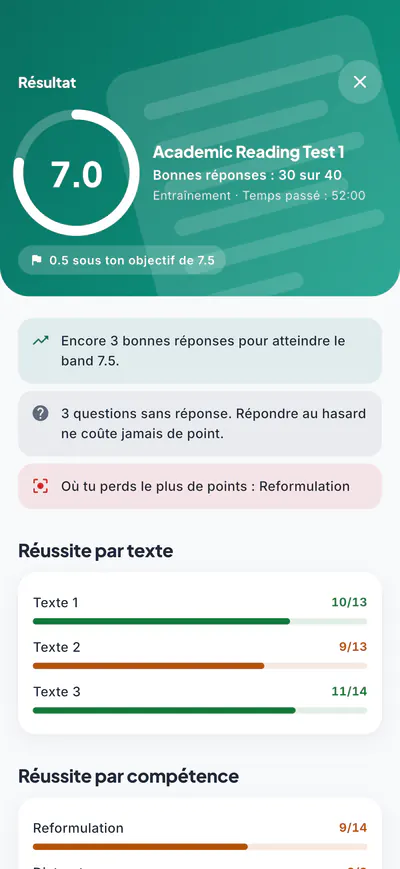
Résultat d’un test blanc IELTS dans l’application Fleydo : Préparation IELTS : band estimé et taux de réussite pour chaque partie
Cours d'essai gratuit

Découvrez votre vrai band IELTS avant l'examen

Un cours individuel en ligne gratuit avec un professeur anglophone natif, spécialiste IELTS certifié Band 8.5+. Vous obtenez un diagnostic Speaking au format réel, une estimation honnête de votre band et un plan ciblé sur les critères qui vous coûtent des points. Sans paiement, sans engagement.

En ligne · Individuel · Academic et General Training

IELTS est une marque déposée du British Council, d’IDP: IELTS Australia et de Cambridge University Press & Assessment. Ces tests blancs sont rédigés par Fleydo et ne sont ni approuvés ni cautionnés par ces organismes.

Application mobile

Fleydo English School dans votre poche

Cours, devoirs, messages et jeux pour les élèves de Fleydo et leurs parents. Gratuite sur iPhone et Android.

Télécharger dans l'App StoreDisponible sur Google Play
En savoir plus sur l'application
Code QR qui ouvre l'application Fleydo English School dans l'App Store ou sur Google PlayScannez pour téléchargerOuvre la boutique adaptée à votre téléphone.fleydo.com/app
Icône de l'application Fleydo IELTS
Fleydo : Préparation IELTS

Vous préparez l'IELTS ?

Fleydo : Préparation IELTS est une application distincte, avec des tests blancs pour les quatre compétences. Aucun compte Fleydo n'est nécessaire pour l'utiliser.

Voir l'application IELTS
Télécharger dans l'App StoreDisponible sur Google Play
Tests blancs IELTS

Entraînez-vous aux quatre compétences de l'IELTS

311 tests avec un band immédiat, des corrigés expliqués et des réponses modèles. Sans inscription.

Tous les tests blancs
Le FleyPath

La feuille de route personnelle de votre enfant — 3, 6 ou 12 mois

🚀Départ
👋Hello
😊Body
🦁Animals
🔢Numbers
🏆Anglais confiant
Entraînement d'anglais gamifié

Comme un jeu — sauf qu'ils apprennent vraiment