1. Главная
  2. IELTS
  3. Пробные тесты
  4. Speaking
  5. Пробный тест IELTS Speaking 18: Animals nearby

IELTS Speaking

Пробный тест IELTS Speaking 18: Animals nearby

Describe a kind of animal or bird, not a pet, that lives close to people in a place you know well.

  • Частей: 3
  • 11–14 мин
  • Экзаменатор
  • Четыре кандидата, один тест

Пройдите тест

Вопросы экзаменатора звучат по одному. Отвечайте вслух, как на экзамене. Запись необязательна и остаётся только в этой вкладке браузера.

Ваши записи хранятся только в этой вкладке. На сервер ничего не загружается. Скачайте их, если хотите сохранить.

Оцените своё выступление

Сравните свои ответы с ответами кандидатов, а затем по каждому критерию выберите band, который вам соответствует.

6,0Ваш примерный band
Fluency and coherence

Lexical resource

Grammatical range and accuracy

Pronunciation

Каждый кандидат — отдельный человек, поэтому истории и мнения различаются. Указанные band — наша оценка по открытым критериям, а не официальные оценки экзаменаторов. Расшифровка не передаёт произношение. Эти band исходят из того, что оно на том же уровне, что и три других критерия.

Вопросы, карточка с заданием и примеры ответов

Часть 1: интервью

The area where you live

  • Which part of your town or city do you live in?
  • Are there many places to eat out near where you live?
  • What time of day do you like your area best?
  • Would you recommend your area to a friend who was looking for somewhere to live?

Music

  • What kind of music do you listen to most these days?
  • Do you prefer listening to music on your own or with other people? (Why?)
  • Did you learn to play a musical instrument when you were at school?
  • Is there a song that always reminds you of a particular time in your life?

Cakes and desserts

  • Do you usually have something sweet after a meal?
  • Did anyone in your family bake cakes when you were growing up?
  • Have you ever tried a dessert from another country that you really liked?

Советы

  • 'Eat out' means having a meal at a restaurant, café or food stall, not eating outdoors. Name one or two real places near you and say what kind of food they serve. You do not need to review them.
  • Music and desserts are personal topics, so you do not need to know anything about music or baking. Name the actual thing, a kind of song, a cake, a dish you tried once, and say one thing about it. If you have forgotten a name, describe it and move on.
  • Two questions look back: an instrument at school and baking when you were growing up. Use past forms and 'used to'. If nobody in your family baked, say so and say what happened instead, such as buying a cake for birthdays.

Часть 2: монолог (карточка с заданием)

Describe a kind of animal or bird, not a pet, that lives close to people in a place you know well.

You should say:

  • what it is and where you usually see it
  • how it manages to live among people
  • how the people around it feel about it

and explain whether you would like to see more of them there, or fewer.

Уточняющий вопрос

  • Did you notice this animal when you were a child?
  • Do you ever feed animals or birds yourself?

Заметки, которые мог бы сделать сильный кандидат

  • monkeys, hill road near campus
  • food: bins, snacks from tourists
  • steal bags, open car doors
  • students: funny, photos
  • stall owners: angry, nets over fruit
  • fewer near the road
  • danger for them and drivers

Советы

  • Any creature counts: pigeons on a station roof, lizards on a kitchen wall, monkeys at a car park, ducks in a city pond. Choose the one you see most often, not the most exciting one, because you will have more to say about it.
  • The third point is about other people. Give at least two different reactions, who likes it and who complains, and save your own view for the explain line.
  • The explain line asks you to choose: more or fewer. Pick one and give a reason. 'Fewer in one place but not another' is also a real answer, as long as you say why.

Часть 3: обсуждение

Animals in towns and cities

  • Why do you think some wild animals and birds manage to live so well in towns and cities? Объяснение
  • Do children who grow up in a city see animals differently from children who grow up in the countryside? Сравнение
  • What can towns and cities do to reduce problems between people and the animals that live there? Предложение идей

Zoos and protecting wildlife

  • Do you think zoos still have an important role today? Взвешивание доводов
  • Why do you think people care more about some animals, such as pandas or tigers, than about others? Объяснение
  • Do you think people will do more to protect wild animals in the future than they do now? Предположения о будущем

Советы

  • These questions are about animals and people in general, not about your animal. Your Part 2 example can help once, but build most answers on reasons that would be true in many places.
  • Before you judge zoos, say what you think a zoo is for: a day out, teaching children, saving animals in danger. Your answer then has something to measure against.
  • For the question about the future, start from a change you can already see, such as what young people talk about or how fast towns are growing, and use will, might or could to say where it leads.

Четыре кандидата, один тест

Как кандидаты с четырьмя разными band ответили на каждый вопрос.

Часть 1Which part of your town or city do you live in?

In the north of Rosario, in Argentina, not far from the river. Is a quiet neighbourhood, mostly houses, with big trees in the street. I live there with my mother and my brother.

Часть 1Are there many places to eat out near where you live?

Eat out... outside? Ah, no, restaurants. Not many. There is a pizzeria on the corner and a small bar for coffee. For the good restaurants you need go to the centre, almost one hour by bus.

Часть 1What time of day do you like your area best?

In the afternoon, er, late, like seven, when the sun is going down. The neighbours take a chair and sit in the door of the house, and the kids play football in the street. It's very tranquil.

Часть 1Would you recommend your area to a friend who was looking for somewhere to live?

Yes, if they have children. It's safe, and the houses are not so expensive like in the centre. But to go out at night, er... no. Everything is far.

Часть 1What kind of music do you listen to most these days?

Er, a bit of everything. Cumbia for dance, and in the bus I listen rock nacional, er, Argentinian rock, the old bands. My mother listened this all the time when I was small, so... I know all the songs.

Часть 1Do you prefer listening to music on your own or with other people? (Why?)

With other people. With my friends, in a party, everybody sing together, everybody dance... is more fun. Alone I only listen with the earphones, in the bus, because the bus is very noisy.

Часть 1Did you learn to play a musical instrument when you were at school?

Yes, the flute, the small one, er, of plastic? In my school everybody have to play it. I was terrible. My mother says I sound like a kettle.

Часть 1Is there a song that always reminds you of a particular time in your life?

Yes, er... there is one cumbia song, very old, they played it in my party when I finish the school. When I hear it I remember all my friends from that time, dancing, very happy... very young also.

Часть 1Do you usually have something sweet after a meal?

Yes, always. After the dinner there is always something in my house, a fruit, or a spoon of dulce de leche from the jar. My brother eats it directly from the jar.

Часть 1Did anyone in your family bake cakes when you were growing up?

My mother, yes. Every Sunday she made a cake, a simple one, with orange, and the house was smelling very good. Now only for the birthdays.

Часть 1Have you ever tried a dessert from another country that you really liked?

Er... I never travel to other countries. But near my work there is a Peruvian restaurant, and one time I tried a dessert there, purple, with corn I think... I don't remember the name. It was very good.

Часть 2Describe a kind of animal or bird, not a pet, that lives close to people in a place you know well.

OK, er, I want to talk about some birds, the cotorras. I don't know the name in English... they are like small parrots, green, with the, um, the chest grey. They live in the tree in front of my house, a very big tree, and they make a nest enormous, with sticks, like a – like a building of apartments for birds, many families together. How they live with the people... they eat everything. Seeds, the bread that people throw, the fruits from the trees. And they are clever, er, they are not afraid. The people in my street, some love them, some hate them. The children from the, er, kindergarten where I work, they love them, because they are green and they make noise like they are talking. But my neighbour, the man next door, he hate them. At six in the morning is impossible to sleep. And one time a part of the nest fall on the cables, er, of the electricity, and all the street stay without light, all the night. Um... more or fewer? Fewer, I think. Less. Now there are too many, every year more and more. But I don't want that they... kill them, no. Maybe they can, er, move the nest to other place... I don't know. Yes, fewer.

Часть 2Did you notice this animal when you were a child?

No, when I was small there was not so many. Only pigeons, er, and some sparrows.

Часть 2Do you ever feed animals or birds yourself?

Sometimes. With the kids from the kindergarten we give old bread to the pigeons in the park.

Часть 3Why do you think some wild animals and birds manage to live so well in towns and cities?

Er, because in the city there is food everywhere. The people throw food in the street, in the garbage, so it's easy for them. And in the countryside the farmers... they don't – they don't want the birds, because they eat... how is it, the crops? The plants. In the city nobody chase them. So the city is more safe.

Часть 3Do children who grow up in a city see animals differently from children who grow up in the countryside?

Yes, I think it's very different. My cousins live in a small town in the countryside, and they are not afraid of nothing, they touch the cows, the horses, everything. The children in my kindergarten, some of them, er, cry if they see a bee. They know the animals from the TV, er, from the phone, but not in real.

Часть 3What can towns and cities do to reduce problems between people and the animals that live there?

Hmm... I don't know very well. Maybe, er, the city can put more – the bins for the garbage, but closed, with a – with a cover, so the animals cannot open them. And for the dogs of the street, they can take them to, um... a place, er, where they take care of them and find a family. That's all I can think.

Часть 3Do you think zoos still have an important role today?

Er... I'm not sure. When I was small, the school took us to the zoo one time and I was so happy, I saw the hippo, the giraffe... But now, I don't know, the animals look very sad in the cages. The lion walk, walk, all the day the same. So for me, no. Is better they live in the nature.

Часть 3Why do you think people care more about some animals, such as pandas or tigers, than about others?

Er... because they are beautiful, and big. The panda is like a toy, everybody loves it. Nobody wants a, er, a photo with a rat, or with a frog. The ugly animals, nobody care about them, but they are important also, for the nature, I think. The frogs eat the mosquitoes, for example.

Часть 3Do you think people will do more to protect wild animals in the future than they do now?

I hope yes. The young people now, they care more about the animals, about the planet. In my work we teach the children, um, to not throw plastic, to take care of the plants... So maybe, er, in the future more. But the big companies, they only think in the money, so... I don't know.

Слова для этого теста

wildlife
wild animals and birds in general
a pest
an animal that damages food, buildings or crops, or is a nuisance to people
a stray
a dog or cat with no owner that lives on the streets
scraps
small pieces of food that are left over or thrown away
put up with something
accept something annoying because you cannot change it
a nuisance
something or someone that keeps causing small problems
habitat
the natural place where an animal lives
endangered
at risk of disappearing completely
in captivity
kept in a zoo, cage or enclosure rather than living free
keep numbers down
stop a group of animals from growing too large
get used to people
stop being afraid of people after living near them
mixed feelings
liking and disliking something at the same time

Полезные фразы

  • You see them everywhere, especially ___.
  • They get by mainly by ___.
  • Some people ___, while others can't stand ___.
  • I'd like to see fewer of them, but not if it means ___.
  • When I was a child ___, but these days ___.
  • Children who grow up ___ tend to ___, because ___.
  • A zoo is only worth it if ___.
  • People seem to care more about animals that ___.
  • My guess is that in twenty years ___, because ___.

Значок приложения Fleydo IELTS Fleydo: подготовка к IELTS

Эти тесты всегда с вами — в телефоне

Все тесты с этих страниц есть и в приложении «Fleydo: подготовка к IELTS» для iPhone, iPad и Android, а вместе с ними — 2 000 слов для IELTS с озвучкой.

  • Работает офлайн, когда тест уже загружен на телефон
  • 2 000 слов для IELTS с озвучкой, интервальным повторением и короткими упражнениями
  • Записывайте ответы Speaking и прослушивайте их
  • План на каждый день под ваш целевой band и дату экзамена
Загрузите в App StoreСкачать из Google Play
Отсканируйте, чтобы скачатьОткроет App Store или Google Play в зависимости от вашего телефона.

Аккаунт не нужен. О приложении

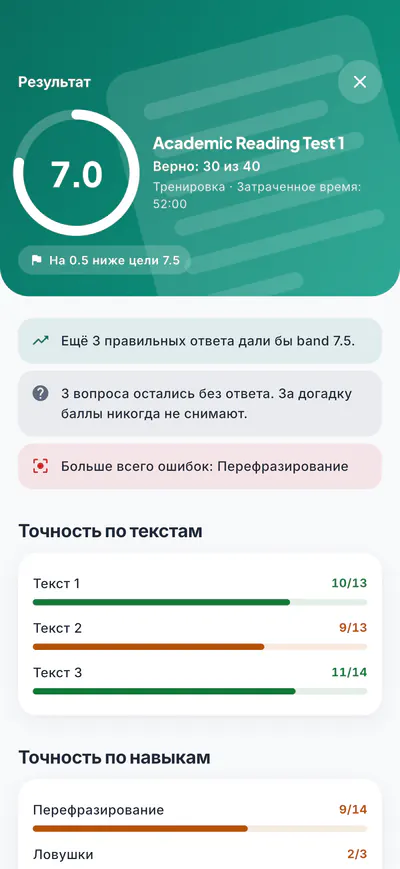
Результат пробного теста IELTS в приложении «Fleydo: подготовка к IELTS»: примерный band и точность по каждой части
Бесплатный пробный урок

Узнайте свой реальный балл IELTS до экзамена

Бесплатный индивидуальный онлайн-урок с преподавателем — носителем английского, сертифицированным специалистом по IELTS с баллом 8.5+. Вы получите диагностику Speaking в реальном формате экзамена, честную оценку вашего band и план работы именно над теми критериями, которые отнимают у вас баллы. Без оплаты и обязательств.

Онлайн · Индивидуально · Academic и General Training

IELTS — зарегистрированный товарный знак British Council, IDP: IELTS Australia и Cambridge University Press & Assessment. Эти пробные тесты составлены командой Fleydo; названные организации их не утверждали и не одобряли.

Мобильное приложение

Fleydo English School у вас в кармане

Уроки, домашние задания, сообщения и игры для учеников Fleydo и их родителей. Бесплатно на iPhone и Android.

Загрузите в App StoreСкачать из Google Play
Подробнее о приложении
QR-код, открывающий приложение Fleydo English School в App Store или Google PlayОтсканируйте и скачайтеОткроет нужный магазин для вашего телефона.fleydo.com/app
Значок приложения Fleydo IELTS
Fleydo: подготовка к IELTS

Готовитесь к IELTS?

«Fleydo: подготовка к IELTS» — отдельное приложение с пробными тестами по всем четырём навыкам. Аккаунт Fleydo для него не нужен.

Подробнее о приложении IELTS
Загрузите в App StoreСкачать из Google Play
Пробные тесты IELTS

Тренируйте все четыре навыка IELTS

Всего тестов: 311. Балл сразу после теста, разбор каждого ответа и образцы для Writing и Speaking. Без регистрации.

Все пробные тесты
FleyPath

Персональная карта вашего ребёнка — 3, 6 или 12 месяцев

🚀Старт
👋Hello
😊Body
🦁Animals
🔢Numbers
🏆Уверенный английский
Геймифицированная практика английского

Как игра — только они действительно учатся