1. होम
  2. IELTS
  3. प्रैक्टिस टेस्ट
  4. Speaking
  5. Speaking प्रैक्टिस टेस्ट 18: Animals nearby

IELTS Speaking

IELTS Speaking प्रैक्टिस टेस्ट 18: Animals nearby

Describe a kind of animal or bird, not a pet, that lives close to people in a place you know well.

  • 3 भाग
  • 11–14 मिनट
  • परीक्षक
  • चार उम्मीदवार, एक टेस्ट

टेस्ट दें

परीक्षक के प्रश्न एक-एक करके चलते हैं। परीक्षा की तरह ज़ोर से उत्तर दें। रिकॉर्डिंग वैकल्पिक है और इसी ब्राउज़र टैब में रहती है।

आपकी रिकॉर्डिंग सिर्फ़ इसी टैब में रहती हैं। कुछ भी अपलोड नहीं होता। रखना चाहें तो उन्हें डाउनलोड कर लें।

अपने प्रदर्शन को अंक दें

अपने उत्तरों की तुलना उम्मीदवारों से करें, फिर हर मानदंड के लिए वह बैंड चुनें जो आप पर सही बैठता है।

6.0आपका अनुमानित बैंड
Fluency and coherence

Lexical resource

Grammatical range and accuracy

Pronunciation

हर उम्मीदवार एक अलग वक्ता है, इसलिए कहानियाँ और राय अलग-अलग हैं। बैंड सार्वजनिक डिस्क्रिप्टर के आधार पर हमारा अनुमान हैं, परीक्षक के आधिकारिक अंक नहीं। ट्रांसक्रिप्ट उच्चारण नहीं दिखा सकती। ये बैंड मानकर चलते हैं कि उच्चारण बाक़ी तीन मानदंडों के स्तर का ही है।

प्रश्न, क्यू कार्ड और नमूना उत्तर

Part 1: इंटरव्यू

The area where you live

  • Which part of your town or city do you live in?
  • Are there many places to eat out near where you live?
  • What time of day do you like your area best?
  • Would you recommend your area to a friend who was looking for somewhere to live?

Music

  • What kind of music do you listen to most these days?
  • Do you prefer listening to music on your own or with other people? (Why?)
  • Did you learn to play a musical instrument when you were at school?
  • Is there a song that always reminds you of a particular time in your life?

Cakes and desserts

  • Do you usually have something sweet after a meal?
  • Did anyone in your family bake cakes when you were growing up?
  • Have you ever tried a dessert from another country that you really liked?

सुझाव

  • 'Eat out' means having a meal at a restaurant, café or food stall, not eating outdoors. Name one or two real places near you and say what kind of food they serve. You do not need to review them.
  • Music and desserts are personal topics, so you do not need to know anything about music or baking. Name the actual thing, a kind of song, a cake, a dish you tried once, and say one thing about it. If you have forgotten a name, describe it and move on.
  • Two questions look back: an instrument at school and baking when you were growing up. Use past forms and 'used to'. If nobody in your family baked, say so and say what happened instead, such as buying a cake for birthdays.

Part 2: लंबा उत्तर (क्यू कार्ड)

Describe a kind of animal or bird, not a pet, that lives close to people in a place you know well.

You should say:

  • what it is and where you usually see it
  • how it manages to live among people
  • how the people around it feel about it

and explain whether you would like to see more of them there, or fewer.

अनुवर्ती प्रश्न

  • Did you notice this animal when you were a child?
  • Do you ever feed animals or birds yourself?

एक मज़बूत उम्मीदवार ऐसे नोट्स बना सकता है

  • monkeys, hill road near campus
  • food: bins, snacks from tourists
  • steal bags, open car doors
  • students: funny, photos
  • stall owners: angry, nets over fruit
  • fewer near the road
  • danger for them and drivers

सुझाव

  • Any creature counts: pigeons on a station roof, lizards on a kitchen wall, monkeys at a car park, ducks in a city pond. Choose the one you see most often, not the most exciting one, because you will have more to say about it.
  • The third point is about other people. Give at least two different reactions, who likes it and who complains, and save your own view for the explain line.
  • The explain line asks you to choose: more or fewer. Pick one and give a reason. 'Fewer in one place but not another' is also a real answer, as long as you say why.

Part 3: चर्चा

Animals in towns and cities

  • Why do you think some wild animals and birds manage to live so well in towns and cities? समझाना
  • Do children who grow up in a city see animals differently from children who grow up in the countryside? तुलना करना
  • What can towns and cities do to reduce problems between people and the animals that live there? सुझाव देना

Zoos and protecting wildlife

  • Do you think zoos still have an important role today? फ़ायदे-नुकसान तौलना
  • Why do you think people care more about some animals, such as pandas or tigers, than about others? समझाना
  • Do you think people will do more to protect wild animals in the future than they do now? भविष्य के बारे में अनुमान लगाना

सुझाव

  • These questions are about animals and people in general, not about your animal. Your Part 2 example can help once, but build most answers on reasons that would be true in many places.
  • Before you judge zoos, say what you think a zoo is for: a day out, teaching children, saving animals in danger. Your answer then has something to measure against.
  • For the question about the future, start from a change you can already see, such as what young people talk about or how fast towns are growing, and use will, might or could to say where it leads.

चार उम्मीदवार, एक टेस्ट

चार अलग-अलग बैंड के वक्ताओं ने हर प्रश्न का उत्तर कैसे दिया।

Part 1Which part of your town or city do you live in?

In the north of Rosario, in Argentina, not far from the river. Is a quiet neighbourhood, mostly houses, with big trees in the street. I live there with my mother and my brother.

Part 1Are there many places to eat out near where you live?

Eat out... outside? Ah, no, restaurants. Not many. There is a pizzeria on the corner and a small bar for coffee. For the good restaurants you need go to the centre, almost one hour by bus.

Part 1What time of day do you like your area best?

In the afternoon, er, late, like seven, when the sun is going down. The neighbours take a chair and sit in the door of the house, and the kids play football in the street. It's very tranquil.

Part 1Would you recommend your area to a friend who was looking for somewhere to live?

Yes, if they have children. It's safe, and the houses are not so expensive like in the centre. But to go out at night, er... no. Everything is far.

Part 1What kind of music do you listen to most these days?

Er, a bit of everything. Cumbia for dance, and in the bus I listen rock nacional, er, Argentinian rock, the old bands. My mother listened this all the time when I was small, so... I know all the songs.

Part 1Do you prefer listening to music on your own or with other people? (Why?)

With other people. With my friends, in a party, everybody sing together, everybody dance... is more fun. Alone I only listen with the earphones, in the bus, because the bus is very noisy.

Part 1Did you learn to play a musical instrument when you were at school?

Yes, the flute, the small one, er, of plastic? In my school everybody have to play it. I was terrible. My mother says I sound like a kettle.

Part 1Is there a song that always reminds you of a particular time in your life?

Yes, er... there is one cumbia song, very old, they played it in my party when I finish the school. When I hear it I remember all my friends from that time, dancing, very happy... very young also.

Part 1Do you usually have something sweet after a meal?

Yes, always. After the dinner there is always something in my house, a fruit, or a spoon of dulce de leche from the jar. My brother eats it directly from the jar.

Part 1Did anyone in your family bake cakes when you were growing up?

My mother, yes. Every Sunday she made a cake, a simple one, with orange, and the house was smelling very good. Now only for the birthdays.

Part 1Have you ever tried a dessert from another country that you really liked?

Er... I never travel to other countries. But near my work there is a Peruvian restaurant, and one time I tried a dessert there, purple, with corn I think... I don't remember the name. It was very good.

Part 2Describe a kind of animal or bird, not a pet, that lives close to people in a place you know well.

OK, er, I want to talk about some birds, the cotorras. I don't know the name in English... they are like small parrots, green, with the, um, the chest grey. They live in the tree in front of my house, a very big tree, and they make a nest enormous, with sticks, like a – like a building of apartments for birds, many families together. How they live with the people... they eat everything. Seeds, the bread that people throw, the fruits from the trees. And they are clever, er, they are not afraid. The people in my street, some love them, some hate them. The children from the, er, kindergarten where I work, they love them, because they are green and they make noise like they are talking. But my neighbour, the man next door, he hate them. At six in the morning is impossible to sleep. And one time a part of the nest fall on the cables, er, of the electricity, and all the street stay without light, all the night. Um... more or fewer? Fewer, I think. Less. Now there are too many, every year more and more. But I don't want that they... kill them, no. Maybe they can, er, move the nest to other place... I don't know. Yes, fewer.

Part 2Did you notice this animal when you were a child?

No, when I was small there was not so many. Only pigeons, er, and some sparrows.

Part 2Do you ever feed animals or birds yourself?

Sometimes. With the kids from the kindergarten we give old bread to the pigeons in the park.

Part 3Why do you think some wild animals and birds manage to live so well in towns and cities?

Er, because in the city there is food everywhere. The people throw food in the street, in the garbage, so it's easy for them. And in the countryside the farmers... they don't – they don't want the birds, because they eat... how is it, the crops? The plants. In the city nobody chase them. So the city is more safe.

Part 3Do children who grow up in a city see animals differently from children who grow up in the countryside?

Yes, I think it's very different. My cousins live in a small town in the countryside, and they are not afraid of nothing, they touch the cows, the horses, everything. The children in my kindergarten, some of them, er, cry if they see a bee. They know the animals from the TV, er, from the phone, but not in real.

Part 3What can towns and cities do to reduce problems between people and the animals that live there?

Hmm... I don't know very well. Maybe, er, the city can put more – the bins for the garbage, but closed, with a – with a cover, so the animals cannot open them. And for the dogs of the street, they can take them to, um... a place, er, where they take care of them and find a family. That's all I can think.

Part 3Do you think zoos still have an important role today?

Er... I'm not sure. When I was small, the school took us to the zoo one time and I was so happy, I saw the hippo, the giraffe... But now, I don't know, the animals look very sad in the cages. The lion walk, walk, all the day the same. So for me, no. Is better they live in the nature.

Part 3Why do you think people care more about some animals, such as pandas or tigers, than about others?

Er... because they are beautiful, and big. The panda is like a toy, everybody loves it. Nobody wants a, er, a photo with a rat, or with a frog. The ugly animals, nobody care about them, but they are important also, for the nature, I think. The frogs eat the mosquitoes, for example.

Part 3Do you think people will do more to protect wild animals in the future than they do now?

I hope yes. The young people now, they care more about the animals, about the planet. In my work we teach the children, um, to not throw plastic, to take care of the plants... So maybe, er, in the future more. But the big companies, they only think in the money, so... I don't know.

इस टेस्ट के शब्द

wildlife
wild animals and birds in general
a pest
an animal that damages food, buildings or crops, or is a nuisance to people
a stray
a dog or cat with no owner that lives on the streets
scraps
small pieces of food that are left over or thrown away
put up with something
accept something annoying because you cannot change it
a nuisance
something or someone that keeps causing small problems
habitat
the natural place where an animal lives
endangered
at risk of disappearing completely
in captivity
kept in a zoo, cage or enclosure rather than living free
keep numbers down
stop a group of animals from growing too large
get used to people
stop being afraid of people after living near them
mixed feelings
liking and disliking something at the same time

उपयोगी वाक्यांश

  • You see them everywhere, especially ___.
  • They get by mainly by ___.
  • Some people ___, while others can't stand ___.
  • I'd like to see fewer of them, but not if it means ___.
  • When I was a child ___, but these days ___.
  • Children who grow up ___ tend to ___, because ___.
  • A zoo is only worth it if ___.
  • People seem to care more about animals that ___.
  • My guess is that in twenty years ___, because ___.

Fleydo IELTS ऐप का आइकन Fleydo: IELTS की तैयारी

ये टेस्ट अपने फ़ोन पर साथ ले जाएँ

इन पेजों का हर टेस्ट iPhone, iPad और Android के लिए Fleydo: IELTS की तैयारी ऐप में भी है, साथ में ऑडियो वाले 2,000 IELTS शब्द।

  • कोई टेस्ट फ़ोन पर आ जाने के बाद ऑफ़लाइन चलता है
  • ऑडियो वाले 2,000 IELTS शब्द, बढ़ते अंतराल पर दोहराव और छोटे अभ्यास
  • अपने Speaking उत्तर रिकॉर्ड करें और फिर से सुनें
  • आपके लक्ष्य बैंड और परीक्षा की तारीख़ के हिसाब से रोज़ की योजना
App Store से डाउनलोड करेंइसे Google Play पर पाएं
डाउनलोड करने के लिए स्कैन करेंआपके फ़ोन के अनुसार App Store या Google Play खोलता है।

अकाउंट की ज़रूरत नहीं। ऐप के बारे में

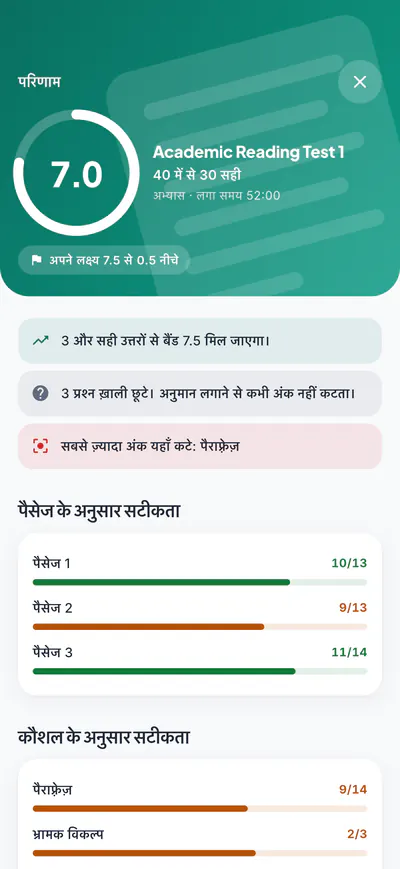
Fleydo: IELTS की तैयारी ऐप में IELTS प्रैक्टिस टेस्ट का परिणाम: अनुमानित बैंड और हर भाग की सटीकता
मुफ़्त ट्रायल लेसन

परीक्षा से पहले अपना असली IELTS बैंड जानें

एक मूल अंग्रेज़ी-भाषी शिक्षक के साथ मुफ़्त वन-टू-वन ऑनलाइन लेसन, जो Band 8.5+ प्रमाणित IELTS विशेषज्ञ हैं। आपको असली परीक्षा फ़ॉर्मैट में Speaking डायग्नोस्टिक, ईमानदार बैंड अनुमान और ठीक उन मानदंडों के लिए योजना मिलती है जो आपके अंक काट रहे हैं। कोई भुगतान नहीं, कोई प्रतिबद्धता नहीं।

ऑनलाइन · वन-टू-वन · Academic और General Training

IELTS, British Council, IDP: IELTS Australia और Cambridge University Press & Assessment का पंजीकृत ट्रेडमार्क है। ये प्रैक्टिस टेस्ट Fleydo ने तैयार किए हैं; इन संस्थाओं ने न तो इन्हें अनुमोदित किया है और न ही इनका समर्थन किया है।

मोबाइल ऐप

Fleydo English School आपकी जेब में

Fleydo के छात्रों और पैरेंट्स के लिए लेसन, होमवर्क, मैसेज और गेम्स। iPhone और Android पर मुफ़्त।

App Store से डाउनलोड करेंइसे Google Play पर पाएं
ऐप के बारे में और जानें
QR कोड जो App Store या Google Play में Fleydo English School ऐप खोलता हैडाउनलोड करने के लिए स्कैन करेंआपके फ़ोन के लिए सही स्टोर खोलता है।fleydo.com/app
Fleydo IELTS ऐप का आइकन
Fleydo: IELTS की तैयारी

IELTS की तैयारी कर रहे हैं?

Fleydo: IELTS की तैयारी एक अलग ऐप है, जिसमें चारों कौशल के मॉक टेस्ट हैं। इसे इस्तेमाल करने के लिए Fleydo अकाउंट की ज़रूरत नहीं है।

IELTS ऐप देखें
App Store से डाउनलोड करेंइसे Google Play पर पाएं
IELTS प्रैक्टिस टेस्ट

IELTS के चारों कौशलों का अभ्यास करें

तुरंत बैंड स्कोर, व्याख्या सहित उत्तरों और मॉडल उत्तरों के साथ 311 टेस्ट। साइन-अप की ज़रूरत नहीं।

सभी प्रैक्टिस टेस्ट
FleyPath

आपके बच्चे का व्यक्तिगत रोडमैप — 3, 6 या 12 महीने

🚀शुरुआत
👋Hello
😊Body
🦁Animals
🔢Numbers
🏆आत्मविश्वासी अंग्रेज़ी
गेमिफाइड अंग्रेज़ी अभ्यास

गेम जैसा — बस फ़र्क इतना कि वे सच में सीख रहे हैं