1. Accueil
  2. IELTS
  3. Tests blancs
  4. Speaking
  5. Test blanc IELTS Speaking 16 : Uniforms

IELTS Speaking

Test blanc IELTS Speaking 16 : Uniforms

Describe a time when a uniform or special clothes you had to wear changed the way people treated you.

  • 3 parties
  • 11–14 min
  • Examinateur
  • Quatre candidats, un test

Passez le test

Les questions de l’examinateur sont diffusées une par une. Répondez à voix haute, comme à l’examen. L’enregistrement est facultatif et reste dans cet onglet du navigateur.

Vos enregistrements restent uniquement dans cet onglet. Rien n’est envoyé. Téléchargez-les si vous voulez les garder.

Notez votre prestation

Comparez vos réponses à celles des candidats, puis choisissez pour chaque critère le band qui vous correspond.

6,0Votre band estimé
Fluency and coherence

Lexical resource

Grammatical range and accuracy

Pronunciation

Chaque candidat est une personne différente, donc les histoires et les opinions varient. Les bands sont notre estimation d’après les descripteurs publics, pas des notes officielles d’examinateur. Une transcription ne peut pas montrer la prononciation. Ces bands supposent qu’elle est au même niveau que les trois autres critères.

Questions, carte sujet et exemples de réponses

Partie 1 : entretien

Your home

  • What kind of home do you live in?
  • What do you like most about it?
  • How is it different from the place you grew up in?
  • Do you often invite people to your home?

Quiet places

  • Where do you go when you want some peace and quiet?
  • Are there many quiet places near where you live?
  • When you were at school, was it easy to find somewhere quiet to study?
  • Would you like to spend a few days somewhere with no noise at all? (Why?)

Colours

  • Do you have a favourite colour?
  • Has your taste in colours changed since you were a child?
  • Do you think colours can change the way people feel?

Conseils

  • For your home, choose one thing you can describe properly, such as a room, a view or the noise from the street, rather than listing every room. The question about where you grew up wants a contrast between then and now.
  • Quiet places is easy to make personal: name the actual place, a park, a library, even your car, and say when you go there. If you have nowhere quiet, say so and say what you do instead. That is still a full answer.
  • Listen for the tense. 'When you were at school' needs past forms such as 'used to' and 'would', and 'Has your taste in colours changed' needs the present perfect, then a contrast with now.

Partie 2 : monologue (carte sujet)

Describe a time when a uniform or special clothes you had to wear changed the way people treated you.

You should say:

  • what you were wearing and why you had to wear it
  • where you were and what you were doing
  • how people treated you differently

and explain how you felt about being treated that way.

Question de relance

  • Do you still have those clothes?
  • Do you usually notice what people around you are wearing?

Les notes qu’un bon candidat pourrait prendre

  • orange vest, volunteer, 10 km city run
  • why: marshals must be seen
  • corner by the bridge, four hours
  • strangers asked about toilets, buses
  • drivers stopped when I raised a hand
  • vest off afterwards, nobody looked twice
  • felt useful, but odd: trusted by strangers

Conseils

  • You do not need a job uniform. A school uniform, a sports kit, a costume, a volunteer's vest or smart clothes you were told to wear for an event all count.
  • The card is about other people's behaviour, not about what the clothes looked like. Describe the clothes in a sentence or two, then spend most of your time on one or two moments when someone reacted to you, and what they actually said or did.
  • For the explain line, a mixed feeling gives you more to say than 'I liked it'. Many people feel proud and uncomfortable at the same time, or enjoy it at first and get tired of it later.

Partie 3 : discussion

Uniforms at school and at work

  • Why do you think many schools ask pupils to wear a uniform? Expliquer
  • Are uniforms more important in some jobs than in others? Comparer
  • Is it a good thing when a company lets its staff wear their own clothes instead of a uniform? Peser les arguments

Clothes, fashion and the environment

  • Why do you think some people buy new clothes so often? Expliquer
  • Do you think buying second-hand clothes will become more common in the future? Faire des hypothèses sur l’avenir
  • What could be done to stop so many clothes being thrown away? Suggérer

Conseils

  • Questions about jobs and schools are about people in general. Name two or three real jobs or kinds of school and say what the uniform does there, rather than stopping at 'it depends'.
  • When you are asked whether something is a good thing, look at it from more than one side, such as the staff and the customers, or the pupils and the parents. Then say which side you come down on.
  • For 'What could be done', say who should act (shops, schools, families or ordinary buyers) and how. One idea explained properly is better than a list of five.

Quatre candidats, un test

Comment des candidats de quatre bands différents ont répondu à chaque question.

Partie 1What kind of home do you live in?

It's a house, er, an old house, two floors. We are living in joint family, my parents, my two sisters, and my uncle's family upstairs. So it's always full, er, many children, many noise.

Partie 1What do you like most about it?

The roof. After sunset, er, when the heat is less, I go up there with my cousin brother and we talk, or I study. From there you can see all the street, the – the people, the shops.

Partie 1How is it different from the place you grew up in?

It's the same house. I was born in this house, and we never moved. Only, er... before it was one floor, then my uncle got married and my father and him build the second floor for his family.

Partie 1Do you often invite people to your home?

Yes, very often, because in our family it's normal. Every Sunday some relatives come, and my mother cooks a lot, er, too much. If somebody come and we don't give him food, it's, er, shame for us.

Partie 1Where do you go when you want some peace and quiet?

Er... the roof, again. But in daytime it's like oven up there, so... no place, really. Sometimes the library in my college, it's quiet, but the AC is not working, er, half the time.

Partie 1Are there many quiet places near where you live?

No, not at all. Our area is very busy, er, the market is near, motorbikes, the horns, all day. There is one small park, but in the evening it's full of families and children.

Partie 1When you were at school, was it easy to find somewhere quiet to study?

No, it was difficult. I was sharing room with my two cousins, and they were always making noise, er, watching videos. So I was studying late in the night, after everybody... after everybody sleep.

Partie 1Would you like to spend a few days somewhere with no noise at all? (Why?)

Yes, for two, three days, it will be nice. Maybe in the north, er, in the mountains. I have seen pictures, it's very beautiful and... quiet. But more than three days, I will get bored, I think.

Partie 1Do you have a favourite colour?

White, I think. Most of my clothes are white, er, and in summer white is the best, it's not hot. It's a clean colour.

Partie 1Has your taste in colours changed since you were a child?

Little bit. When I was small I want everything green, er, like the cricket shirt, the Pakistan team. Now I like more simple colours, white, grey.

Partie 1Do you think colours can change the way people feel?

Yes, I think. In the hospital the walls are white and light green, er, it make people more calm. If the room is dark, brown or black, you feel sad, I think.

Partie 2Describe a time when a uniform or special clothes you had to wear changed the way people treated you.

OK. Er, my story is about the uniform for the hospital. I am doing nursing, I am in third year now, and two days in a week we have training in a big hospital. All the students must wear the uniform, white trousers, white shirt, er, with the name of the college on the – here, on the pocket. The first time I wore it, I was walking in the corridor and a man stopped me. He say, doctor sahib, doctor sahib, please, my father needs help. I told him I'm not doctor, I'm student, but he don't listen, he think I'm just, er... shy. So I go with him and I call the nurse. It happened many times. The families of the patients, they see the white clothes and they think I know everything. They ask me about the medicine, um, the reports, when they can go home. Some old women put the hand on my head and say thank you, son, and I did nothing. In the beginning I felt very proud, because in the street nobody look at me like this. But also I was scared, er, little bit, because if I say something wrong... it's a big problem. So now I study more, er, the medicine names, everything.

Partie 2Do you still have those clothes?

Yes, of course, I wear it two times in a week. I have two, er, two sets.

Partie 2Do you usually notice what people around you are wearing?

Not so much. Only if it's very strange, er, or very expensive.

Partie 3Why do you think many schools ask pupils to wear a uniform?

Er, because, er... so all the students look the same, the rich one and the poor one. If everybody wear his own clothes, maybe some students feel bad because their clothes are cheap. Also it's more easy for the parents, they don't need to think every morning what the child will wear.

Partie 3Are uniforms more important in some jobs than in others?

Yes, of course. Police, doctors, er, the people who work in the airport, you need to know quickly who is working there and who is not. In my training, if I don't wear the uniform, the patients will not let me touch them, er, they will be afraid. But the shopkeeper, the farmer... no need, I think, everybody know them already.

Partie 3Is it a good thing when a company lets its staff wear their own clothes instead of a uniform?

Er... for the staff, yes, it's good, they feel more free, more comfortable. But for the company... I'm not sure. Because the customer, he come to the shop and he don't know who is the worker, who is customer. In some restaurants here the waiters wear normal clothes, and you wait and you wait, and, um, you don't know who to ask. So I think uniform is better.

Partie 3Why do you think some people buy new clothes so often?

Because of Instagram, er, YouTube. Every day they see the – the influencers who wear new clothes in every video, and they want the same. And the clothes now very cheap, online, you can buy, er, five T-shirt for the price of one before. So people keep buying... and they wear it one time, maybe two.

Partie 3Do you think buying second-hand clothes will become more common in the future?

Er... in my country, it's already common. We have landa bazaar, er, the market for the used clothes, jackets, sweaters, they come from abroad, very cheap. Students and poor people buy there in winter, I also bought my jacket from there. But the rich people, they don't go, they buy new from the big shops. In future... maybe more, because everything is getting expensive.

Partie 3What could be done to stop so many clothes being thrown away?

Um... maybe the shops can take the old clothes back and give you, er, small discount. Like this, people bring them, not throw. And the clothes you don't need, you can give for the families who need, er, we do this at home, my mother collect the clothes in a big bag every year. It's better than the rubbish.

Mots pour ce test

dress code
rules about what you may and may not wear, at work or at an event
stand out
be easy to notice because you look different from the people around you
blend in
look like everyone else, so that nobody notices you
look the part
look right for a particular job or role
take someone seriously
treat someone as important or worth listening to
second-hand
owned and used by someone else before you
hand-me-downs
clothes passed down to you from an older brother, sister or relative
fast fashion
cheap clothes made quickly to follow the latest trends, often worn only a few times
grow out of
become too big for clothes, as children do
scruffy
untidy and a bit worn, the opposite of smart
peace and quiet
a calm situation without noise or interruptions

Expressions utiles

  • As soon as I put on the ___, people started ___.
  • What surprised me most was that ___.
  • I didn't expect ___ to make such a difference to ___.
  • At first I felt ___, but after a while ___.
  • In some jobs a uniform is mainly about ___, while in others it's more about ___.
  • I can see the point of ___, but I'm not sure it ___.
  • Whether ___ becomes more common probably depends on ___.
  • If ___ were cheaper or easier, more people would ___.

Icône de l'application Fleydo IELTS Fleydo : Préparation IELTS

Emportez ces tests sur votre téléphone

Tous les tests de ces pages se trouvent aussi dans l’application Fleydo : Préparation IELTS pour iPhone, iPad et Android, avec en plus 2 000 mots IELTS et leur audio.

  • Fonctionne hors ligne une fois le test téléchargé sur votre téléphone
  • 2 000 mots IELTS avec audio, répétition espacée et exercices courts
  • Enregistrez vos réponses de Speaking et réécoutez-les
  • Un programme quotidien selon votre band visé et votre date d’examen
Télécharger dans l’App StoreDisponible sur Google Play
Scannez pour téléchargerOuvre l’App Store ou Google Play, selon votre téléphone.

Aucun compte nécessaire. En savoir plus sur l’application

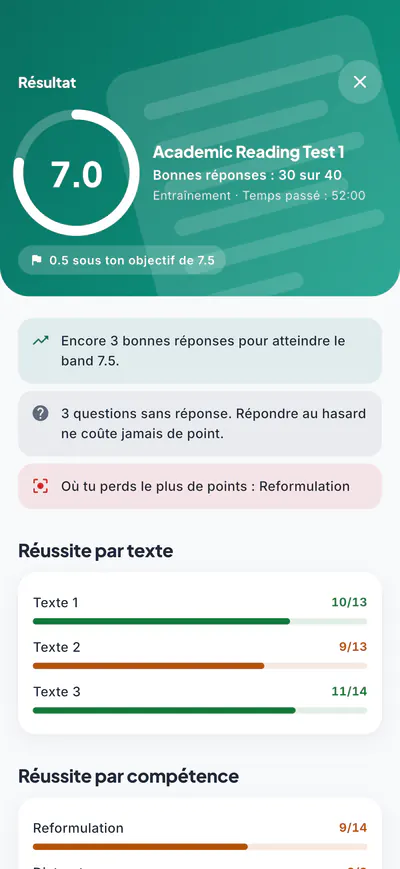
Résultat d’un test blanc IELTS dans l’application Fleydo : Préparation IELTS : band estimé et taux de réussite pour chaque partie
Cours d'essai gratuit

Découvrez votre vrai band IELTS avant l'examen

Un cours individuel en ligne gratuit avec un professeur anglophone natif, spécialiste IELTS certifié Band 8.5+. Vous obtenez un diagnostic Speaking au format réel, une estimation honnête de votre band et un plan ciblé sur les critères qui vous coûtent des points. Sans paiement, sans engagement.

En ligne · Individuel · Academic et General Training

IELTS est une marque déposée du British Council, d’IDP: IELTS Australia et de Cambridge University Press & Assessment. Ces tests blancs sont rédigés par Fleydo et ne sont ni approuvés ni cautionnés par ces organismes.

Application mobile

Fleydo English School dans votre poche

Cours, devoirs, messages et jeux pour les élèves de Fleydo et leurs parents. Gratuite sur iPhone et Android.

Télécharger dans l'App StoreDisponible sur Google Play
En savoir plus sur l'application
Code QR qui ouvre l'application Fleydo English School dans l'App Store ou sur Google PlayScannez pour téléchargerOuvre la boutique adaptée à votre téléphone.fleydo.com/app
Icône de l'application Fleydo IELTS
Fleydo : Préparation IELTS

Vous préparez l'IELTS ?

Fleydo : Préparation IELTS est une application distincte, avec des tests blancs pour les quatre compétences. Aucun compte Fleydo n'est nécessaire pour l'utiliser.

Voir l'application IELTS
Télécharger dans l'App StoreDisponible sur Google Play
Tests blancs IELTS

Entraînez-vous aux quatre compétences de l'IELTS

311 tests avec un band immédiat, des corrigés expliqués et des réponses modèles. Sans inscription.

Tous les tests blancs
Le FleyPath

La feuille de route personnelle de votre enfant — 3, 6 ou 12 mois

🚀Départ
👋Hello
😊Body
🦁Animals
🔢Numbers
🏆Anglais confiant
Entraînement d'anglais gamifié

Comme un jeu — sauf qu'ils apprennent vraiment