1. Accueil
  2. IELTS
  3. Tests blancs
  4. Reading
  5. Reading Summary Completion : exercice 1

IELTS Reading · Compléter un résumé

IELTS Reading Summary Completion : exercice 1

African lungfish

  • 11 questions
  • 15 min
  • Academic

Contenu de ce test

  1. PassageQuestions 1–11Sealed in until the rains

Types de questions

  • Compléter un résumé
ReadingIELTS Reading Summary Completion : exercice 1
Temps restant15:00

Passage

Sealed in until the rains

A Across tropical Africa, the dry season can leave lungfish without water for months. The four African species, all in the genus Protopterus, are obligate air breathers: their gills are too reduced to take in enough oxygen, so they depend on their lungs. As the water disappears, the West African lungfish burrows into the mud, curls up and secretes large quantities of mucus, which hardens into a paper-thin cocoon. This is closed except at the mouth, which is linked to the surface by a narrow channel. The dormancy, called aestivation, usually lasts seven or eight months in the wild, depending on the length of the dry season, but African lungfish can remain in it for as long as four years, neither moving nor feeding.

B Burial brings a problem with waste. In water, these fish get rid of the nitrogen from broken-down proteins mostly as ammonia, which simply passes into the surrounding water. Ammonia is toxic, however, and without water to carry it away it cannot easily be removed. Laboratory studies show that aestivating lungfish respond by making more urea, a less toxic compound, and by producing less ammonia in the first place. The urea builds up in the body until water returns; the fish then excretes it, and starts to feed again some seven to ten days later.

C In the laboratory, lungfish can be made to aestivate in plastic tanks without mud, and a 2008 study compared this with aestivation in mud. West African lungfish spent 12 or 46 days aestivating either in air or in mud. After 46 days in air, urea had risen in every tissue examined. Fish in mud showed only a minor rise in urea at 12 days, and after 46 days there was no change at all. By then, urea synthesis had fallen to 2.6 per cent of its starting level and ammonia production to 1.2 per cent: possibly, the authors suggested, the greatest reduction in ammonia production known in any animal. They proposed that the buried fish may have been exposed to low levels of oxygen, which reduced their metabolic rate.

D The cocoon has been looked at afresh too. It had been described as dried mucus, but in 2021 a team based at the University of New Mexico, working with another species, the slender lungfish, reported that it is a living tissue. It contained several kinds of cells, among them immune cells known as granulocytes, which seem to travel from stores in the gut and kidneys to the skin and on into the cocoon. There they release extracellular traps, structures made of DNA and proteins that catch bacteria. When the team sprayed fish daily with an enzyme that breaks down DNA, the animals developed skin wounds and bleeding, and large numbers of bacteria turned up in their blood, although the cocoon looked intact. Their study, however, covered only the first two weeks of aestivation.

E A report posted online in 2024, before peer review, struck a more cautious note. It came from an undergraduate research course at the University of California, Berkeley, where the authors developed what they called a more natural laboratory method for inducing aestivation in the West African lungfish. They found that its cocoon, too, consists mainly of living cells. Yet in trials over three years, mould grew on the cocoon of every aestivating fish, usually within two or three weeks, and pieces of cocoon showed no sign of holding back the growth of E. coli bacteria in laboratory tests. Since no mould was found on the fish underneath once the cocoon was removed, the authors suggested that it may still act as a barrier. The two teams studied different species, and how well the cocoon protects its owner remains unclear.

Glossaire
genus
a group of closely related species of animals or plants
urea synthesis
the making of urea, a waste substance, inside the body
metabolic rate
the speed at which a living thing uses energy
enzyme
a substance made by living things that causes or speeds up a chemical change
peer review
the checking of a research paper by other experts before it is published in a journal
E. coli
a common type of bacterium, often used in laboratory tests
PassageQuestions 1–11
Questions 1–11 2 mots max.

Complete the summary below. Choose NO MORE THAN TWO WORDS AND/OR A NUMBER from the passage for each answer.

When its home dries out, the West African lungfish digs into mud and produces enough 1 to form a thin cocoon around itself. It breathes through a 2 that runs from its mouth up to the ground above, and African lungfish can survive in this state for up to 3. The cocoon was once thought to be lifeless, but in 2021 researchers showed it to be a living 4. Immune cells called 5 pass into it and release DNA traps which capture bacteria; when these traps were destroyed with an enzyme, the fish developed wounds and bacteria invaded their 6. A 2024 report, however, found that cocoons were soon overgrown with 7. Burial also creates a waste problem. In water, the fish removes nitrogen mainly in the form of 8, but during aestivation it makes more 9, which accumulates until the rains return. In a 2008 study, fish kept in mud, unlike those kept in air, showed no rise in this substance in their tissues after 10, possibly because a lack of 11 had slowed their metabolism.

Corrigé et explications

Faites d’abord le test : le corrigé est bien plus utile une fois que vous avez répondu.

Afficher le corrigé et les explications
  1. 1
    mucus

    Paragraph A says the fish 'secretes large quantities of mucus, which hardens into a paper-thin cocoon'. Produces enough means secretes large quantities. Mud is wrong: the fish burrows into mud but does not produce it.

  2. 2
    narrow channel / channel

    Paragraph A says the mouth 'is linked to the surface by a narrow channel'. The ground above means the surface. Channel is enough, but narrow channel also fits the gap and stays within the limit.

  3. 3
    four years / 4 years

    Paragraph A says African lungfish 'can remain in it for as long as four years'. Up to means as long as. Seven or eight months is only the usual length in the wild, and it is too many words.

  4. 4
    tissue

    Paragraph D says the 2021 team 'reported that it is a living tissue'. The gap follows a, so it needs a singular noun. Cells, from paragraph E, is plural and cannot fit.

  5. 5
    granulocytes

    Paragraph D names 'immune cells known as granulocytes', which travel into the cocoon. Called means known as. Copy this long word exactly as the passage spells it, with the plural ending.

  6. 6
    blood

    Paragraph D says that after the spraying 'large numbers of bacteria turned up in their blood'. Invaded matches turned up in. Skin is a trap: the passage mentions skin wounds, but it does not say bacteria entered the skin.

  7. 7
    mould / mold

    Paragraph E says that in the 2024 trials 'mould grew on the cocoon of every aestivating fish'. Overgrown with means that mould grew on them. Bacteria appear in paragraph E only in the laboratory tests, not growing on cocoons.

  8. 8
    ammonia

    Paragraph B says that in water these fish 'get rid of the nitrogen from broken-down proteins mostly as ammonia'. Mainly means mostly. Urea is the trap: the fish makes more of it only during aestivation.

  9. 9
    urea

    Paragraph B says 'aestivating lungfish respond by making more urea', and that it 'builds up in the body until water returns'. Ammonia cannot fit, because the fish produce less of it at this time.

  10. 10
    46 days / forty-six days

    Paragraph C says that in fish in mud, 'after 46 days there was no change at all' in urea. At 12 days there was 'only a minor rise', so 12 days does not match no rise. Include the unit, days.

  11. 11
    oxygen

    Paragraph C says the buried fish 'may have been exposed to low levels of oxygen, which reduced their metabolic rate'. A lack of matches low levels, and slowed their metabolism matches reduced their metabolic rate.

Mots clés de ce test

Passage

dormancy
a period when an animal or plant is alive but not active or growing
secretes
produces a liquid and lets it out from the body
toxic
poisonous
intact
complete and not damaged
barrier
something that stops things from getting through
Comment répondre aux questions de type « Compléter un résumé »Understand the summary first, then find each missing word in the text.

What the task looks like

The instruction says 'Complete the summary below.' You get a short paragraph that rewords ideas from the text, with gaps in it, and a limit such as ONE WORD ONLY. The answers are words from the text. Some Academic summaries work differently: you choose each word from a list instead, and the list often uses different words from the text, so you match the meaning.

The task tests details and main ideas, and whether you can tell what type of word each gap needs.

A method to try

1. Read the whole summary first, ignoring the gaps. What is it about? Which part of the text does it seem to cover?

2. Find that part of the text, using what you learned when you skimmed.

3. For each gap, decide the type of word and guess the general meaning. 'Rose by ____' needs an amount, for example.

4. Compare the summary with the text, idea by idea. A summary can join ideas from different sentences or change their order, so do not rely on the gaps following the order of the text.

5. Read the finished summary from start to finish. It should make sense as a whole.

The traps

Linking words: 'but', 'although', 'instead of' and 'rather than' show how ideas relate. A gap after 'rather than' needs the thing that was not chosen.

Size words: 'most', 'a small part', 'mainly' and 'the rest' tell you which of two facts the gap wants.

The likely answer: a word can fit the gap and sound sensible, yet not be what the text says at this point.

Worked example

Text: The museum's new roof was paid for mainly by local businesses. A small grant from the council covered the rest. Ticket prices, which some visitors had expected to rise, stayed the same.

Summary: Most of the money for the new roof came from ____. Visitors did not have to pay more to enter. (NO MORE THAN TWO WORDS)

Faiblethe council. A grant is money, and it sounds likely that a council would pay for a museum roof.
Meilleurlocal businesses. 'Most of' is a paraphrase of 'mainly', and the text says businesses 'mainly' paid. The council's grant was 'small' and only 'covered the rest'.

Both answers fit the grammar, so grammar cannot decide. Follow the size words to see which fact the summary wants.

Icône de l'application Fleydo IELTS Fleydo : Préparation IELTS

Emportez ces tests sur votre téléphone

Tous les tests de ces pages se trouvent aussi dans l’application Fleydo : Préparation IELTS pour iPhone, iPad et Android, avec en plus 2 000 mots IELTS et leur audio.

  • Fonctionne hors ligne une fois le test téléchargé sur votre téléphone
  • 2 000 mots IELTS avec audio, répétition espacée et exercices courts
  • Enregistrez vos réponses de Speaking et réécoutez-les
  • Un programme quotidien selon votre band visé et votre date d’examen
Télécharger dans l’App StoreDisponible sur Google Play
Scannez pour téléchargerOuvre l’App Store ou Google Play, selon votre téléphone.

Aucun compte nécessaire. En savoir plus sur l’application

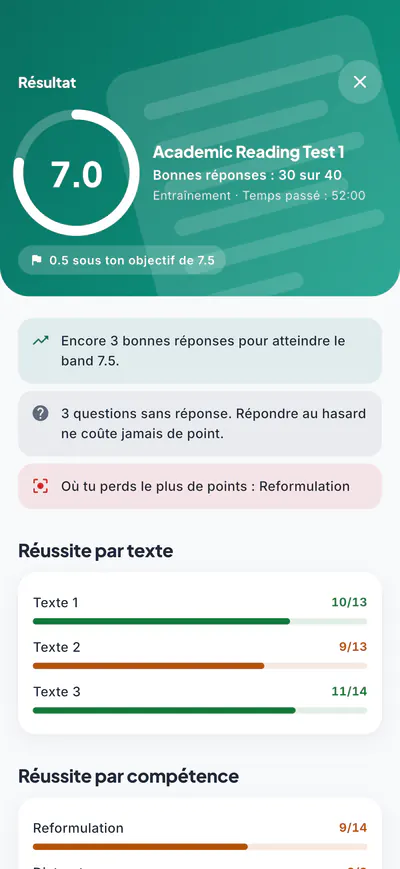
Résultat d’un test blanc IELTS dans l’application Fleydo : Préparation IELTS : band estimé et taux de réussite pour chaque partie
Cours d'essai gratuit

Découvrez votre vrai band IELTS avant l'examen

Un cours individuel en ligne gratuit avec un professeur anglophone natif, spécialiste IELTS certifié Band 8.5+. Vous obtenez un diagnostic Speaking au format réel, une estimation honnête de votre band et un plan ciblé sur les critères qui vous coûtent des points. Sans paiement, sans engagement.

En ligne · Individuel · Academic et General Training

IELTS est une marque déposée du British Council, d’IDP: IELTS Australia et de Cambridge University Press & Assessment. Ces tests blancs sont rédigés par Fleydo et ne sont ni approuvés ni cautionnés par ces organismes.

Application mobile

Fleydo English School dans votre poche

Cours, devoirs, messages et jeux pour les élèves de Fleydo et leurs parents. Gratuite sur iPhone et Android.

Télécharger dans l'App StoreDisponible sur Google Play
En savoir plus sur l'application
Code QR qui ouvre l'application Fleydo English School dans l'App Store ou sur Google PlayScannez pour téléchargerOuvre la boutique adaptée à votre téléphone.fleydo.com/app
Icône de l'application Fleydo IELTS
Fleydo : Préparation IELTS

Vous préparez l'IELTS ?

Fleydo : Préparation IELTS est une application distincte, avec des tests blancs pour les quatre compétences. Aucun compte Fleydo n'est nécessaire pour l'utiliser.

Voir l'application IELTS
Télécharger dans l'App StoreDisponible sur Google Play
Tests blancs IELTS

Entraînez-vous aux quatre compétences de l'IELTS

311 tests avec un band immédiat, des corrigés expliqués et des réponses modèles. Sans inscription.

Tous les tests blancs
Le FleyPath

La feuille de route personnelle de votre enfant — 3, 6 ou 12 mois

🚀Départ
👋Hello
😊Body
🦁Animals
🔢Numbers
🏆Anglais confiant
Entraînement d'anglais gamifié

Comme un jeu — sauf qu'ils apprennent vraiment