1. Accueil
  2. IELTS
  3. Tests blancs
  4. Reading
  5. Reading Sentence Completion : exercice 3

IELTS Reading · Compléter des phrases

IELTS Reading Sentence Completion : exercice 3

Stained glass

  • 13 questions
  • 15 min
  • Academic

Contenu de ce test

  1. PassageQuestions 1–13Sand, ash and lead

Types de questions

  • Compléter des phrases
ReadingIELTS Reading Sentence Completion : exercice 3
Temps restant15:00

Passage

Sand, ash and lead

A Scholars' picture of how a medieval window was made has long been dominated by one twelfth-century text, De Diversis Artibus, whose author, a priest and monk, wrote under the name Theophilus. His account covers both glass-making and window-making, yet these were separate trades. Glaziers generally bought in their main raw material and relied on a supplier for the qualities and colours they could work with.

B Typical medieval window glass was made from sand and wood ash. Modern analysis has shown how wide a range of colours came from very few ingredients. In the art historian Sarah Brown's summary, copper was the metal oxide added deliberately for colour, while manganese and iron, also key, arrived by chance, as natural components of the sand and the ash. Laboratory studies of blue window glass, however, point to a further colourant, cobalt. Though makers could not control the manganese and iron, they may have influenced the outcome by managing oxidation during melting. Red brought a particular difficulty, since ruby glass coloured all the way through was too dark to let much light pass. One answer was to dip white glass into molten red, which left a thin skin of colour over a clear base. This is known as flashed glass, although a 2014 study found that much twelfth- to fourteenth-century red glass in England, France and Spain was made differently, by incompletely mixing two glasses.

C The design was drawn full size on a whitened table, and pale glass could simply be laid over its lines. Dark glass needed an extra step: the outlines were first marked on a piece of white glass, and the two were held up together against the light. To divide a sheet, the glazier used a heavy iron whose large head held its red heat through the cut. This did not slice through the material. Heat stress opened a crack, and the skill lay in coaxing that crack across the sheet behind the head of the iron. Edges were then nibbled back with a notched tool, the grozing iron.

D For lines and shading, Theophilus describes a paint of burnt copper filings finely ground with green and blue glass, one-third copper to two-thirds glass. Wine or urine acted as the binder, but such binders burnt away during firing, so they leave nothing for modern laboratories to test. From the fourteenth century, silver stain on the back of the glass gave tones from pale lemon to deep orange.

E The pieces were then joined with H-shaped lead strips called cames, soldered at each intersection. Lead suited the job because it is malleable and can be cast in moulds to different thicknesses. Medieval strips, often just 4 to 6 millimetres across, could be bent around intricate shapes. According to Brown, glass and lead fitted so closely that windows were watertight with no putty, a material that became universal only after lead milling was adopted from the later sixteenth century. The Victoria and Albert Museum's account of the craft, by contrast, has putty rubbed into the gaps to waterproof a panel.

F Low in silicon and high in potassium and calcium, medieval glass is among the least durable of pre-modern glasses. Rainwater is the worst threat, drawing ions out of the surface and producing crusts, cracks and pits. Condensation does harm as well, because corrosion quickens when the glass stays wet for long periods. One response is protective glazing: a layer of new glass outside the window, with vents at the top and bottom of the gap. Sometimes the old panel is moved inwards on a metal support and the new glazing takes over its original grooves in the tracery. Lead, too, is handled with caution. A 2002 article calls the belief that leadwork needs replacing after about a century a common misconception in the trade, and the Society for the Protection of Ancient Buildings advises releading only for severe deterioration that cannot be treated otherwise.

Glossaire
glazier
a person who cuts and fits the glass in windows
binder
a liquid that holds a powder together so that it can be painted on
oxidation
a chemical change in which a substance combines with oxygen
firing
heating something in a very hot oven (a kiln) to harden or fix it
tracery
the stone framework that holds the glass in a window
releading
replacing the lead strips that hold a window together
PassageQuestions 1–13
Questions 1–13 2 mots max.

Complete the sentences below. Choose NO MORE THAN TWO WORDS from the passage for each answer.

1The colours glaziers could use depended on what they obtained from a .
2Sarah Brown names as the metal oxide that was put into glass on purpose to give it colour.
3Glass-makers may have affected the colours they obtained by regulating as the materials melted.
4Glass that has been given a thin surface layer of red by dipping is referred to as glass.
5Before dark glass could be cut, the outlines were first drawn on a piece of glass.
6The glass parted because high temperature created a that the worker then guided across it.
7Medieval glaziers trimmed the edges of pieces of glass with a tool called the .
8Laboratory tests cannot identify the binders used in the paint, as these disappeared during .
9Lead was well suited to glazing partly because it is .
10According to Sarah Brown, the tight fit of glass and lead kept medieval windows dry without the use of .
11Besides rain, long periods of contact with moisture from make the glass corrode faster.
12In some protective schemes, the historic panel is shifted towards the inside of the building on a .
13A conservation society advises that a window should be given new lead only if there is serious .

Corrigé et explications

Faites d’abord le test : le corrigé est bien plus utile une fois que vous avez répondu.

Afficher le corrigé et les explications
  1. 1
    supplier

    Paragraph A says glaziers 'relied on a supplier' for the colours they could work with. 'Priest' and 'monk' describe Theophilus, who wrote about the craft, so neither fits here.

  2. 2
    copper

    Paragraph B says that in Brown's summary 'copper was the metal oxide added deliberately for colour'. Manganese and iron 'arrived by chance', and cobalt comes from other laboratory studies, not from Brown.

  3. 3
    oxidation

    Paragraph B says makers may have influenced the outcome 'by managing oxidation during melting'. Regulating means managing. They could not control manganese or iron, so those words do not fit.

  4. 4
    flashed

    Paragraph B describes white glass dipped into molten red and says 'This is known as flashed glass'. The gap comes before 'glass', so only flashed is needed. 'Ruby' glass is the darker kind coloured all the way through.

  5. 5
    white

    Paragraph C says the outlines were 'first marked on a piece of white glass'. 'Glass' already follows the gap, so white is enough. Dark glass is what is about to be cut, so dark does not fit.

  6. 6
    crack

    Paragraph C says heat stress 'opened a crack' and the worker coaxed it across the sheet. Guided means coaxed. The iron did not cut a line: the text says it 'did not slice through the material'.

  7. 7
    grozing iron

    Paragraph C says edges were 'nibbled back with a notched tool, the grozing iron'. Trimmed means nibbled back. The 'heavy iron' is a different tool, used to divide a sheet and not to shape its edges.

  8. 8
    firing

    Paragraph D says binders 'burnt away during firing'. Disappeared means burnt away, and the gap follows 'during', so it needs the name of a process. Firing is that process.

  9. 9
    malleable

    Paragraph E says lead suited the job 'because it is malleable'. The gap needs an adjective describing the metal. 'Intricate' describes the shapes the strips were bent around, not the lead, so it does not fit.

  10. 10
    putty

    Paragraph E says windows were 'watertight with no putty'. Kept dry means watertight, and without the use of means with no. Cames are the lead strips themselves, so that word does not fit.

  11. 11
    condensation

    Paragraph F names 'Rainwater' as the worst threat and then says 'Condensation does harm as well'. The sentence to complete has already dealt with rain, so condensation is the other source of moisture.

  12. 12
    metal support / support

    Paragraph F says the old panel is 'moved inwards on a metal support'. Either metal support or support is correct. 'Grooves' are where the new glazing goes, so that word does not fit.

  13. 13
    deterioration

    Paragraph F says the society advises releading 'only for severe deterioration'. Serious means severe. 'Misconception' is the belief about replacing lead after a century, not a reason for doing it.

Mots clés de ce test

Passage

raw material
a basic substance from which something is made
deliberate
done on purpose
intricate
having many small parts or details
durable
able to last a long time without damage
misconception
a wrong idea that many people hold
Comment répondre aux questions de type « Compléter des phrases »Complete a sentence with exact words from the text, and read the result.

What the task looks like

You get sentences with a gap in each, and an instruction such as: Choose NO MORE THAN TWO WORDS from the passage for each answer.

The sentence rewords the text, and your answer is the missing word or words, taken from the text. The task tests whether you can find a specific detail.

In our papers, the sentences follow the order of the text, and the answer appears word for word in the text.

A method to try

1. Check the limit. NO MORE THAN TWO WORDS allows one word or two. It is a limit, not a target.

2. Read the whole sentence and decide what the gap needs. A noun, a verb, an adjective or a number? Singular or plural? The words on each side of the gap are your clues.

3. Work out what the sentence means, then find the same idea in the text. Expect different words.

4. Copy the answer as it is written in the text. You should not need to change its form. If you feel you must, for example from 'decided' to 'decision', you may be reading the wrong sentence.

5. Read the finished sentence. It should be correct English, and it should say what the text says.

The traps

Too many words: you copy a whole phrase when the sentence needs only part of it.

Good grammar, wrong meaning: a word from the right paragraph can fit the gap and still make the sentence untrue.

The nearest word: the word next to your clue may not be the answer. Read to the end of the sentence in the text.

Words already printed: do not repeat a word that is already there just before or after the gap.

Worked example

Text: The bakery began as a market stall selling only bread. Its owners later opened a small café in the same street, and the profits paid for a second oven. Today, customers often queue for its cakes.

Sentence: Money earned by the café allowed the owners to buy an additional ____. (NO MORE THAN TWO WORDS)

Faiblesecond oven. These words come straight after 'paid for a', and the limit allows two words.
Meilleuroven. 'Additional' already does the work of 'second', so the gap needs only one word. 'An additional oven' is correct English and says what the text says.

'An additional second oven' repeats itself. Reading the finished sentence shows you this, and you do not have to use every word the limit allows.

Icône de l'application Fleydo IELTS Fleydo : Préparation IELTS

Emportez ces tests sur votre téléphone

Tous les tests de ces pages se trouvent aussi dans l’application Fleydo : Préparation IELTS pour iPhone, iPad et Android, avec en plus 2 000 mots IELTS et leur audio.

  • Fonctionne hors ligne une fois le test téléchargé sur votre téléphone
  • 2 000 mots IELTS avec audio, répétition espacée et exercices courts
  • Enregistrez vos réponses de Speaking et réécoutez-les
  • Un programme quotidien selon votre band visé et votre date d’examen
Télécharger dans l’App StoreDisponible sur Google Play
Scannez pour téléchargerOuvre l’App Store ou Google Play, selon votre téléphone.

Aucun compte nécessaire. En savoir plus sur l’application

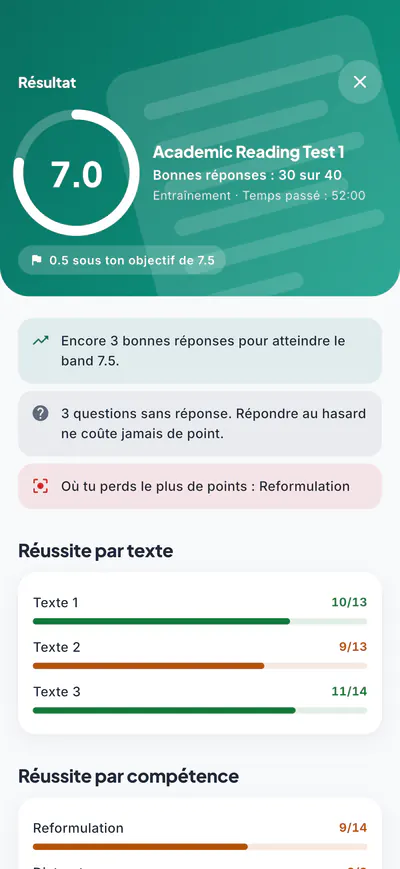
Résultat d’un test blanc IELTS dans l’application Fleydo : Préparation IELTS : band estimé et taux de réussite pour chaque partie
Cours d'essai gratuit

Découvrez votre vrai band IELTS avant l'examen

Un cours individuel en ligne gratuit avec un professeur anglophone natif, spécialiste IELTS certifié Band 8.5+. Vous obtenez un diagnostic Speaking au format réel, une estimation honnête de votre band et un plan ciblé sur les critères qui vous coûtent des points. Sans paiement, sans engagement.

En ligne · Individuel · Academic et General Training

IELTS est une marque déposée du British Council, d’IDP: IELTS Australia et de Cambridge University Press & Assessment. Ces tests blancs sont rédigés par Fleydo et ne sont ni approuvés ni cautionnés par ces organismes.

Application mobile

Fleydo English School dans votre poche

Cours, devoirs, messages et jeux pour les élèves de Fleydo et leurs parents. Gratuite sur iPhone et Android.

Télécharger dans l'App StoreDisponible sur Google Play
En savoir plus sur l'application
Code QR qui ouvre l'application Fleydo English School dans l'App Store ou sur Google PlayScannez pour téléchargerOuvre la boutique adaptée à votre téléphone.fleydo.com/app
Icône de l'application Fleydo IELTS
Fleydo : Préparation IELTS

Vous préparez l'IELTS ?

Fleydo : Préparation IELTS est une application distincte, avec des tests blancs pour les quatre compétences. Aucun compte Fleydo n'est nécessaire pour l'utiliser.

Voir l'application IELTS
Télécharger dans l'App StoreDisponible sur Google Play
Tests blancs IELTS

Entraînez-vous aux quatre compétences de l'IELTS

311 tests avec un band immédiat, des corrigés expliqués et des réponses modèles. Sans inscription.

Tous les tests blancs
Le FleyPath

La feuille de route personnelle de votre enfant — 3, 6 ou 12 mois

🚀Départ
👋Hello
😊Body
🦁Animals
🔢Numbers
🏆Anglais confiant
Entraînement d'anglais gamifié

Comme un jeu — sauf qu'ils apprennent vraiment