1. Accueil
  2. IELTS
  3. Tests blancs
  4. Reading
  5. Reading Diagram Labelling : exercice 1

IELTS Reading · Légender un schéma

IELTS Reading Diagram Labelling : exercice 1

A beaver lodge

  • 7 questions
  • 15 min
  • Academic

Contenu de ce test

  1. PassageQuestions 1–7A front door under water

Types de questions

  • Légender un schéma
ReadingIELTS Reading Diagram Labelling : exercice 1
Temps restant15:00

Passage

A front door under water

A A beaver's front door lies under water, and the dam it builds helps to keep things that way. Where winters are hard, the animal needs water that will not freeze solid from top to bottom, and where a stream is too shallow the level has to be raised before a home can be built. On deeper rivers and lakes a beaver will often have no lodge at all, only a den dug into the bank.

B Building starts at the stream bed, with branches and logs driven into it. Over these the animals work a thick blend of mud and gravel, weaving in more branches, and the pond gathers behind the barrier. The job is never really finished: the beavers keep up their repairs so that the water stays at a steady level, and some dams have been enlarged by generation after generation. What prompts the building is less settled. The Swedish biologist Lars Wilsson's experiments on European beavers pointed to the sound of running water as a trigger, yet a Polish study published in 1992 reported that reintroduced beavers of the same species usually built dams without any such sound, and it proposed threat as their main motive.

C The lodge goes up once the water is deep enough. According to the US National Park Service, the first layer is a platform of sticks, mud and rocks. More sticks and mud are heaped on top until a large dome has taken shape, and only then do the animals gnaw out a hollow inside it, with a floor that stays above the water. A typical finished lodge, the same account says, measures about 4.5 metres across and 1.8 metres high.

D Usually two tunnels climb from below the surface. The Park Service describes two separate spaces inside, a feeding room and a living room (or nesting room), and a Canadian wildlife guide draws the feeding room as the lower of the two. The occupants thus enter below the water yet live high and dry. A University of Michigan account says that the floor is spread with bark, grass and wood chips, although it describes a single central chamber rather than two rooms, so descriptions differ.

E Mud goes over the outside, and in freezing weather it sets so hard that even a bear can barely force a way in. The very top stays clear of it, because an airway always runs up through the dome, and on a bitter day a wisp of vapour from the occupants' breath and bodies can sometimes be seen rising there. Measurements in south-eastern Manitoba between June 1988 and March 1989 recorded chamber temperatures of 0 to 35.6°C in occupied lodges, while the air at the study sites ranged from −41.4 to 32.4°C.

F Beavers do not hibernate, so the winter's food has to be within reach. In autumn, in cold regions, they assemble a food cache, piling fresh branches in the pond a short distance from the lodge, where the top of the heap may poke above the surface or freeze into the ice. Through the dark months the animals swim out beneath the ice at intervals to collect what they need, then carry it back inside to eat.

Glossaire
food cache
a store of food kept hidden or put aside for later
reintroduced
brought back to an area where the species had disappeared
PassageQuestions 1–7
Questions 1–7 2 mots max.

Label the diagram below. Choose NO MORE THAN TWO WORDS from the passage for each answer.

Simplified side view of a two-room beaver lodge, its pond and a dam (not to scale)
1
2
3
4
5
6
7
feeding room
pond
dome
dam

Corrigé et explications

Faites d’abord le test : le corrigé est bien plus utile une fois que vous avez répondu.

Afficher le corrigé et les explications
  1. 1
    an airway / airway / the airway

    Paragraph E says an airway always runs up through the dome and the very top stays clear of mud. The label points to the narrow shaft that rises from the room to the top.

  2. 2
    the mud / mud

    Paragraph E says mud goes over the outside of the lodge. The label points to the outer coat of the dome above the water, not to the sticks underneath it.

  3. 3
    living room / nesting room

    Paragraph D names two separate spaces. The diagram already shows the feeding room, so the other room is the living room, which the passage also calls the nesting room. Either name is accepted.

  4. 4
    a tunnel / tunnel / the tunnels / the tunnel / tunnels

    Paragraph D says two tunnels climb from below the surface. The label points to one of the sloping passages that runs from under the water up to a room.

  5. 5
    a platform / platform / the platform / first layer

    Paragraph C says the first layer is a platform of sticks, mud and rocks, with the dome heaped on top. The label points to the layer under the dome. Sticks and rocks are only its materials.

  6. 6
    food cache / cache / a cache / the cache / fresh branches / branches / the branches / a heap / heap / the heap

    Paragraph F says beavers make a food cache by piling fresh branches in the pond near the lodge. The label points to this heap, whose top can poke above the water.

  7. 7
    stream bed / bed / the bed / streambed / the streambed

    Paragraph B says dam building starts at the stream bed, with branches and logs driven into it. The label points to the ground under the dam, where they go in, not to the mud and gravel above.

Mots clés de ce test

Passage

gnaw
to bite something again and again with the front teeth
hollow
an empty space inside something
occupants
the people or animals living in a place
hibernate
to spend the winter in a kind of deep sleep
prompts
causes something to start happening
Comment répondre aux questions de type « Légender un schéma »Match a written description to a drawing, and name each part with the text's words.

What the task looks like

The instruction says 'Label the diagram below.' You get a drawing with some labels missing, and a word limit.

The task tests whether you can relate a written description to a diagram. You do not need to know the subject, because the answers are words from the text.

A method to try

1. Study the drawing first. What does it show? Read the labels that are already there, because they are your anchors.

2. Scan the text for those labels to find where the description is.

3. Follow the description across the drawing, part by part, and mark the position and movement words: 'above', 'below', 'beside', 'at the base of', 'inside', 'enters', 'passes through', 'leads to'.

4. For each gap, ask two questions. What is this part next to? What does it do?

5. A label names a thing, so you are usually looking for a noun. Take its exact words from the text.

6. Read the description again with your labels in place. Does the drawing now match it?

The traps

Where it is, or what it is: in 'a tap on the side', 'side' tells you the position and 'tap' is the name of the part.

The neighbour: the text may name the part next to your gap in the same sentence.

The order: the text does not have to describe the parts in the order of the label numbers.

Unknown words: you can label a part correctly without knowing exactly what the word means, as long as you copy it correctly.

Worked example

Text: The garden's rain barrel stands on a low brick base. Rain runs down a pipe from the shed roof and enters through a mesh screen on the lid, which keeps out leaves. Near the bottom of the barrel, a brass tap lets gardeners fill their cans.

Diagram: imagine a side view of a barrel with a pipe coming down to its lid. Label 1 points to the small part of the lid where the pipe ends.

Label 1: ____ (NO MORE THAN TWO WORDS)

Faiblelid. The label points to the top of the barrel, and the text says the lid is on top.
Meilleurmesh screen. The water 'enters through a mesh screen on the lid', so the screen is the part where the pipe ends. The lid is only where it sits.

'On the lid' tells you where the part is. The words before 'on' tell you what it is. You do not even need to know the word 'mesh': you only need to place it and copy it.

Icône de l'application Fleydo IELTS Fleydo : Préparation IELTS

Emportez ces tests sur votre téléphone

Tous les tests de ces pages se trouvent aussi dans l’application Fleydo : Préparation IELTS pour iPhone, iPad et Android, avec en plus 2 000 mots IELTS et leur audio.

  • Fonctionne hors ligne une fois le test téléchargé sur votre téléphone
  • 2 000 mots IELTS avec audio, répétition espacée et exercices courts
  • Enregistrez vos réponses de Speaking et réécoutez-les
  • Un programme quotidien selon votre band visé et votre date d’examen
Télécharger dans l’App StoreDisponible sur Google Play
Scannez pour téléchargerOuvre l’App Store ou Google Play, selon votre téléphone.

Aucun compte nécessaire. En savoir plus sur l’application

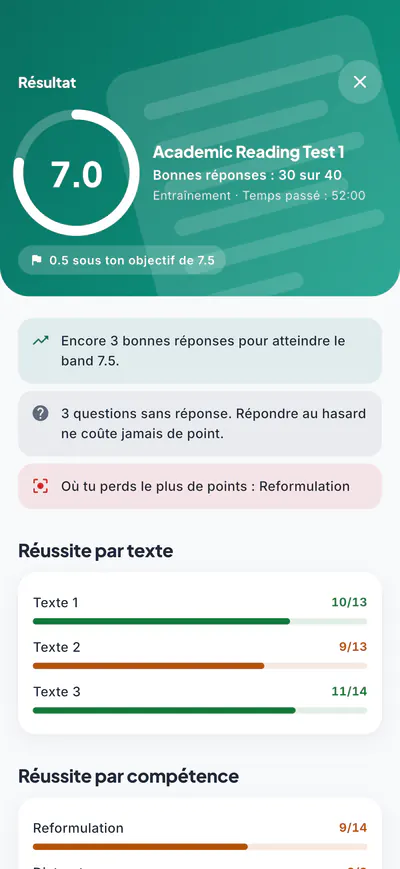
Résultat d’un test blanc IELTS dans l’application Fleydo : Préparation IELTS : band estimé et taux de réussite pour chaque partie
Cours d'essai gratuit

Découvrez votre vrai band IELTS avant l'examen

Un cours individuel en ligne gratuit avec un professeur anglophone natif, spécialiste IELTS certifié Band 8.5+. Vous obtenez un diagnostic Speaking au format réel, une estimation honnête de votre band et un plan ciblé sur les critères qui vous coûtent des points. Sans paiement, sans engagement.

En ligne · Individuel · Academic et General Training

IELTS est une marque déposée du British Council, d’IDP: IELTS Australia et de Cambridge University Press & Assessment. Ces tests blancs sont rédigés par Fleydo et ne sont ni approuvés ni cautionnés par ces organismes.

Application mobile

Fleydo English School dans votre poche

Cours, devoirs, messages et jeux pour les élèves de Fleydo et leurs parents. Gratuite sur iPhone et Android.

Télécharger dans l'App StoreDisponible sur Google Play
En savoir plus sur l'application
Code QR qui ouvre l'application Fleydo English School dans l'App Store ou sur Google PlayScannez pour téléchargerOuvre la boutique adaptée à votre téléphone.fleydo.com/app
Icône de l'application Fleydo IELTS
Fleydo : Préparation IELTS

Vous préparez l'IELTS ?

Fleydo : Préparation IELTS est une application distincte, avec des tests blancs pour les quatre compétences. Aucun compte Fleydo n'est nécessaire pour l'utiliser.

Voir l'application IELTS
Télécharger dans l'App StoreDisponible sur Google Play
Tests blancs IELTS

Entraînez-vous aux quatre compétences de l'IELTS

311 tests avec un band immédiat, des corrigés expliqués et des réponses modèles. Sans inscription.

Tous les tests blancs
Le FleyPath

La feuille de route personnelle de votre enfant — 3, 6 ou 12 mois

🚀Départ
👋Hello
😊Body
🦁Animals
🔢Numbers
🏆Anglais confiant
Entraînement d'anglais gamifié

Comme un jeu — sauf qu'ils apprennent vraiment