1. Головна
  2. IELTS
  3. Пробні тести
  4. Writing
  5. Who should explain science

IELTS Writing · Task 2

IELTS Writing Task 2: Who should explain science

  • Обговорення
  • 40 хв
  • Слів: 250
  • Academic і General Training

WRITING TASK 2

You should spend about 40 minutes on this task.

Some people think scientists should explain their discoveries to the public themselves. Others believe this job is better left to journalists. Discuss both these views and give your own opinion. Give reasons for your answer and include any relevant examples from your own knowledge or experience.

Write at least 250 words.

40:00
0 / 250 слів

Оцініть свою відповідь

Спершу прочитайте зразкові відповіді. Потім за кожним критерієм оберіть band, який відповідає вашій відповіді. Ваш band — це середнє значення, округлене до найближчої половини балу.

6,0Ваш орієнтовний band
Task response

Coherence and cohesion

Lexical resource

Grammatical range and accuracy

Кожен зразок написано так, як написав би інший кандидат, тому деталі й думки різняться. Значення band — це наша оцінка за відкритими дескрипторами, а не офіційна оцінка екзаменатора.

Зразкові відповіді на чотирьох рівнях band

Кожен зразок написано так, як написав би інший кандидат. Band указано за нашою оцінкою на основі відкритих дескрипторів band.

Зразок на band 5,5Слів: 255

Today science change very fast and every week we hear about new discovery. Some people say the scientist must speak to the public by himself, but others say this is the work of journalists. I will write about the two sides.

First, the scientist know his work better than anyone because he spent many years in the laboratry. When he is speaking on television people believe him and they feel the information is correct. A journalist did not study science so he can make mistake, and some journalists want only a big title for the newspaper, they change the meaning of the news for this reason. This is not fair for the reader.

Secondly, journalists also have good points. Most scientists are very busy and they use diffecult words, nobody can understand them. Scientists also do not like to speak on television. My father was watching a program about stars and after five minutes he changed the channel because the man used only numbers and long words. A journalist knows how to talk with normal people. He use simple words and pictures, and he can make the subject more interesting for people who never studied this things.

In my opinion journalist is better for this job because most of people are not experts and they need easy explaination. But he should ask the scientist before he write the story, then the news will be true and everybody will be happy. Also the scientist can check it, it will not take a long time for him.

Чому саме цей band

  • Both views and an opinion are there, but points stop early, as in 'people believe him and they feel the information is correct'.
  • The father gives one real example of the problem: 'after five minutes he changed the channel'.
  • Missing articles and verb endings come back again and again: 'new discovery', 'the scientist know', 'He use'. Spelling follows the sound in 'laboratry' and 'diffecult'.

Критерій за критерієм

Task response
Each side gets a paragraph and the writer chooses journalists. The reasons are short and rather obvious, and 'This is not fair for the reader' says little about why it matters.
Coherence and cohesion
A plain plan with 'First', 'Secondly' and 'In my opinion', and the paragraphs are easy to find. 'scientist', 'journalist' and 'people' are repeated because the writer has few other ways to refer to them.
Lexical resource
Everyday words, enough for the ideas. 'a big title' is the wrong word for a headline, and 'normal people' stands in for a more exact phrase.
Grammatical range and accuracy
Mostly simple sentences, with an error in about half. 'most of people' and 'this things' are typical, and 'they use diffecult words, nobody can understand them' is a comma splice.

Щоб досягти наступного band

Check the end of every verb after he, she or it, and put 'a' or 'the' before singular nouns such as 'discovery'. Then give each reason one more sentence saying what actually happens to the reader.

Сплануйте, перш ніж писати

Чого вимагає завдання

The question is about who should do the explaining, not about whether science is useful. You need a fair reason for each side and then a view of your own, and that view can be a shared arrangement if you say who does what. The trap is writing a general essay on why science matters. Another is reaching for a famous name or a study you half remember, when ordinary reasons and everyday examples are all the task asks for.

Ваша головна думка

Say what each group does well and what follows for the job. One workable message: scientists know how far a result can be trusted, and journalists know how to reach people and how to question a claim, so the public is best served when each does the part it is good at.

Абзац за абзацом

  1. IntroductionSay in your own words why this choice matters to ordinary people, set out the two views and, if you can, give your position.
  2. The case for scientistsTake one or two reasons, such as knowing the limits of a result or public money paying for the work, and show one with an example of what goes wrong or right.
  3. The case for journalistsTake one or two different reasons, such as clear writing, a large audience or independence from the research, and explain them just as fairly.
  4. Your opinionSay who you think should do the work and why, in fresh words. If you want both groups involved, say what each would actually do.

Типові помилки

  • Writing about whether science deserves money or respect. The question only asks who should explain it.
  • Being unfair to one side, as if all journalists told lies or all scientists were poor speakers. Each view needs a real reason.
  • Saying 'both are important' and stopping. If you want them to work together, say who does which job.
  • Inventing evidence, such as a study or a famous researcher. A reason and an everyday example, like a flood warning or a space mission on television, are enough.
  • Giving the opinion only in the final line, with no reason attached to it.

Тематична лексика

finding
something that has been discovered through investigation
caveat
a warning that something is true only in certain conditions
headline
the title of a news story, in large print
deadline
the latest time by which work must be finished
jargon
special words used by one profession that others find hard to understand
to exaggerate
to make something seem bigger or more important than it really is
scrutiny
careful and critical examination
funding
money given for a particular purpose, such as research

Корисні вирази

  • Those who favour ... point out that ...
  • Only the person who ... really knows ...
  • When a result passes through ..., ... tends to ...
  • A strength of ... is that they can ...
  • ... has obvious reasons to ..., whereas ...
  • This argument assumes that ..., which is not always the case.
  • The first responsibility should lie with ..., since ...
  • ... should then ..., so that ...

Значок застосунку Fleydo IELTS Fleydo: підготовка до IELTS

Ці тести завжди з вами — у телефоні

Усі тести з цих сторінок є й у застосунку «Fleydo: підготовка до IELTS» для iPhone, iPad і Android, а разом із ними — 2 000 слів для IELTS з озвученням.

  • Працює офлайн, коли тест уже завантажено на телефон
  • 2 000 слів для IELTS з озвученням, інтервальним повторенням і короткими вправами
  • Записуйте відповіді Speaking і прослуховуйте їх
  • План на кожен день під ваш цільовий band і дату іспиту
Завантажте в App StoreЗавантажити з Google Play
Відскануйте, щоб завантажитиВідкриє App Store або Google Play залежно від вашого телефона.

Акаунт не потрібен. Про застосунок

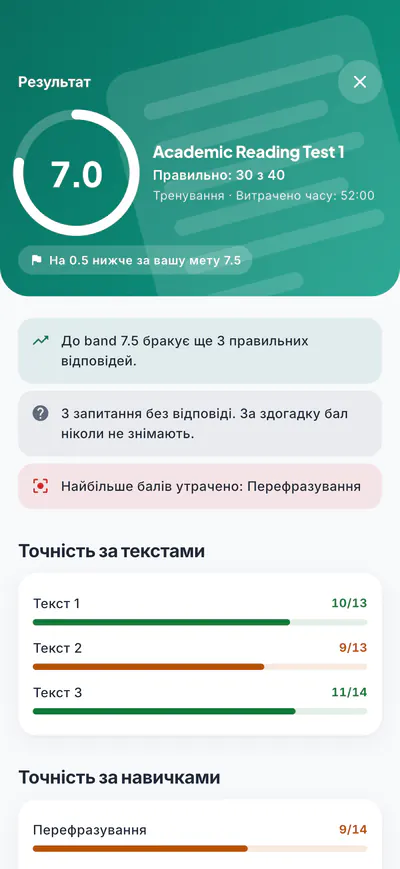
Результат пробного тесту IELTS у застосунку «Fleydo: підготовка до IELTS»: орієнтовний band і точність за кожною частиною
Безкоштовний пробний урок

Дізнайтеся свій реальний бал IELTS раніше, ніж це зробить іспит

Безкоштовний індивідуальний онлайн-урок з учителем — носієм англійської, сертифікованим фахівцем з IELTS із балом 8.5+. Ви отримаєте діагностику Speaking у реальному форматі, чесну оцінку балу та план роботи над саме тими критеріями, які коштують вам балів. Без оплати, без зобов'язань.

Онлайн · Індивідуально · Academic і General Training

IELTS — зареєстрована торговельна марка British Council, IDP: IELTS Australia та Cambridge University Press & Assessment. Ці пробні тести склала команда Fleydo; зазначені організації їх не затверджували й не схвалювали.

Мобільний застосунок

Fleydo English School у вашій кишені

Уроки, домашні завдання, повідомлення та ігри для учнів Fleydo та їхніх батьків. Безкоштовно на iPhone та Android.

Завантажте в App StoreЗавантажити з Google Play
Докладніше про застосунок
QR-код, що відкриває застосунок Fleydo English School в App Store або Google PlayСкануйте й завантажуйтеВідкриє потрібний магазин для вашого телефона.fleydo.com/app
Значок застосунку Fleydo IELTS
Fleydo: підготовка до IELTS

Готуєтеся до IELTS?

«Fleydo: підготовка до IELTS» — окремий застосунок із пробними тестами з усіх чотирьох навичок. Акаунт Fleydo для нього не потрібен.

Детальніше про застосунок IELTS
Завантажте в App StoreЗавантажити з Google Play
Пробні тести IELTS

Тренуйте всі чотири навички IELTS

Усього тестів: 311. Бал одразу після тесту, розбір кожної відповіді та зразки для Writing і Speaking. Без реєстрації.

Усі пробні тести
FleyPath

Персональна дорожня карта вашої дитини — 3, 6 або 12 місяців

🚀Старт
👋Hello
😊Body
🦁Animals
🔢Numbers
🏆Упевнена англійська
Гейміфікована практика англійської

Як гра — тільки вони справді вчаться