1. Home
  2. IELTS
  3. Test di esercitazione
  4. Writing
  5. Who should explain science

IELTS Writing · Task 2

IELTS Writing Task 2: Who should explain science

  • Discussione
  • 40 min
  • 250 parole
  • Academic e General Training

WRITING TASK 2

You should spend about 40 minutes on this task.

Some people think scientists should explain their discoveries to the public themselves. Others believe this job is better left to journalists. Discuss both these views and give your own opinion. Give reasons for your answer and include any relevant examples from your own knowledge or experience.

Write at least 250 words.

40:00
0 / 250 parole

Valuta la tua risposta

Leggi prima le risposte modello. Poi, per ogni criterio, scegli la band che corrisponde alla tua risposta. La tua band è la media, arrotondata alla mezza band più vicina.

6,0La tua band stimata
Task response

Coherence and cohesion

Lexical resource

Grammatical range and accuracy

Ogni modello è scritto come lo scriverebbe un candidato diverso, quindi dettagli e opinioni cambiano. Le band sono una nostra stima basata sui descrittori pubblici, non voti ufficiali di un esaminatore.

Risposte modello a quattro livelli di band

Ogni modello è scritto come lo scriverebbe un candidato diverso. Le band sono una nostra stima basata sui descrittori pubblici delle band.

Modello da band 5,5255 parole

Today science change very fast and every week we hear about new discovery. Some people say the scientist must speak to the public by himself, but others say this is the work of journalists. I will write about the two sides.

First, the scientist know his work better than anyone because he spent many years in the laboratry. When he is speaking on television people believe him and they feel the information is correct. A journalist did not study science so he can make mistake, and some journalists want only a big title for the newspaper, they change the meaning of the news for this reason. This is not fair for the reader.

Secondly, journalists also have good points. Most scientists are very busy and they use diffecult words, nobody can understand them. Scientists also do not like to speak on television. My father was watching a program about stars and after five minutes he changed the channel because the man used only numbers and long words. A journalist knows how to talk with normal people. He use simple words and pictures, and he can make the subject more interesting for people who never studied this things.

In my opinion journalist is better for this job because most of people are not experts and they need easy explaination. But he should ask the scientist before he write the story, then the news will be true and everybody will be happy. Also the scientist can check it, it will not take a long time for him.

Perché questa band

  • Both views and an opinion are there, but points stop early, as in 'people believe him and they feel the information is correct'.
  • The father gives one real example of the problem: 'after five minutes he changed the channel'.
  • Missing articles and verb endings come back again and again: 'new discovery', 'the scientist know', 'He use'. Spelling follows the sound in 'laboratry' and 'diffecult'.

Criterio per criterio

Task response
Each side gets a paragraph and the writer chooses journalists. The reasons are short and rather obvious, and 'This is not fair for the reader' says little about why it matters.
Coherence and cohesion
A plain plan with 'First', 'Secondly' and 'In my opinion', and the paragraphs are easy to find. 'scientist', 'journalist' and 'people' are repeated because the writer has few other ways to refer to them.
Lexical resource
Everyday words, enough for the ideas. 'a big title' is the wrong word for a headline, and 'normal people' stands in for a more exact phrase.
Grammatical range and accuracy
Mostly simple sentences, with an error in about half. 'most of people' and 'this things' are typical, and 'they use diffecult words, nobody can understand them' is a comma splice.

Per arrivare alla band successiva

Check the end of every verb after he, she or it, and put 'a' or 'the' before singular nouns such as 'discovery'. Then give each reason one more sentence saying what actually happens to the reader.

Fai una scaletta prima di scrivere

Cosa chiede la traccia

The question is about who should do the explaining, not about whether science is useful. You need a fair reason for each side and then a view of your own, and that view can be a shared arrangement if you say who does what. The trap is writing a general essay on why science matters. Another is reaching for a famous name or a study you half remember, when ordinary reasons and everyday examples are all the task asks for.

Il tuo messaggio principale

Say what each group does well and what follows for the job. One workable message: scientists know how far a result can be trusted, and journalists know how to reach people and how to question a claim, so the public is best served when each does the part it is good at.

Paragrafo per paragrafo

  1. IntroductionSay in your own words why this choice matters to ordinary people, set out the two views and, if you can, give your position.
  2. The case for scientistsTake one or two reasons, such as knowing the limits of a result or public money paying for the work, and show one with an example of what goes wrong or right.
  3. The case for journalistsTake one or two different reasons, such as clear writing, a large audience or independence from the research, and explain them just as fairly.
  4. Your opinionSay who you think should do the work and why, in fresh words. If you want both groups involved, say what each would actually do.

Errori comuni

  • Writing about whether science deserves money or respect. The question only asks who should explain it.
  • Being unfair to one side, as if all journalists told lies or all scientists were poor speakers. Each view needs a real reason.
  • Saying 'both are important' and stopping. If you want them to work together, say who does which job.
  • Inventing evidence, such as a study or a famous researcher. A reason and an everyday example, like a flood warning or a space mission on television, are enough.
  • Giving the opinion only in the final line, with no reason attached to it.

Lessico dell'argomento

finding
something that has been discovered through investigation
caveat
a warning that something is true only in certain conditions
headline
the title of a news story, in large print
deadline
the latest time by which work must be finished
jargon
special words used by one profession that others find hard to understand
to exaggerate
to make something seem bigger or more important than it really is
scrutiny
careful and critical examination
funding
money given for a particular purpose, such as research

Espressioni utili

  • Those who favour ... point out that ...
  • Only the person who ... really knows ...
  • When a result passes through ..., ... tends to ...
  • A strength of ... is that they can ...
  • ... has obvious reasons to ..., whereas ...
  • This argument assumes that ..., which is not always the case.
  • The first responsibility should lie with ..., since ...
  • ... should then ..., so that ...

Icona dell'app Fleydo IELTS Fleydo: Preparazione IELTS

Porta questi test con te sul telefono

Tutti i test di queste pagine sono anche nell'app Fleydo: Preparazione IELTS per iPhone, iPad e Android, insieme a 2.000 parole IELTS con audio.

  • Funziona offline una volta scaricato il test sul telefono
  • 2.000 parole IELTS con audio, ripetizione spaziata ed esercizi brevi
  • Registra le tue risposte di Speaking e riascoltale
  • Un piano giornaliero per la tua band obiettivo e la data dell'esame
Scarica su App StoreDisponibile su Google Play
Inquadra per scaricareApre App Store o Google Play, a seconda del telefono.

Non serve un account. Scopri l'app

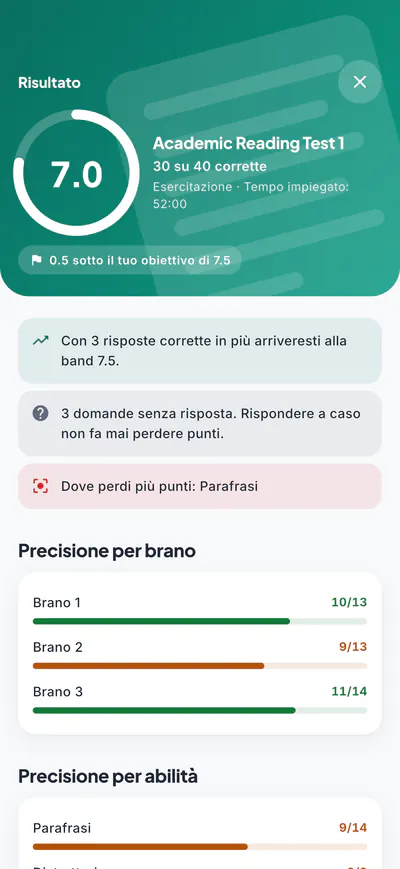
Risultato di un test di esercitazione IELTS nell'app Fleydo: Preparazione IELTS: band stimata e precisione per ogni parte
Lezione di prova gratuita

Scopri il tuo vero band IELTS prima dell'esame

Una lezione individuale online gratuita con un insegnante madrelingua inglese, specialista IELTS certificato Band 8.5+. Ricevi una diagnosi dello Speaking nel formato reale, una stima onesta del tuo band e un piano mirato ai criteri che ti costano punti. Nessun pagamento, nessun impegno.

Online · Individuale · Academic e General Training

IELTS è un marchio registrato del British Council, di IDP: IELTS Australia e di Cambridge University Press & Assessment. Questi test di esercitazione sono scritti da Fleydo e non sono approvati né sostenuti da queste organizzazioni.

App mobile

Fleydo English School in tasca

Lezioni, compiti, messaggi e giochi per gli studenti Fleydo e i loro genitori. Gratuita su iPhone e Android.

Scarica su App StoreDisponibile su Google Play
Scopri di più sull'app
Codice QR che apre l'app Fleydo English School su App Store o Google PlayInquadra per scaricareApre lo store giusto per il tuo telefono.fleydo.com/app
Icona dell'app Fleydo IELTS
Fleydo: Preparazione IELTS

Ti prepari all'IELTS?

Fleydo: Preparazione IELTS è un'app separata con simulazioni per tutte e quattro le abilità. Per usarla non ti serve un account Fleydo.

Scopri l'app IELTS
Scarica su App StoreDisponibile su Google Play
Test di esercitazione IELTS

Esercitati in tutte e quattro le abilità IELTS

311 test con band immediata, soluzioni spiegate e risposte modello. Senza registrazione.

Tutti i test di esercitazione
Il FleyPath

La roadmap personale di tuo figlio — 3, 6 o 12 mesi

🚀Partenza
👋Hello
😊Body
🦁Animals
🔢Numbers
🏆Inglese sicuro
Pratica di inglese gamificata

Come un gioco — solo che stanno davvero imparando