1. Головна
  2. IELTS
  3. Пробні тести
  4. Speaking
  5. Пробний тест IELTS Speaking 3: Everyday sounds

IELTS Speaking

Пробний тест IELTS Speaking 3: Everyday sounds

Describe a sound you often hear, at home or somewhere else, that most people would hardly notice.

  • Частин: 3
  • 11–14 хв
  • Екзаменатор
  • Чотири кандидати, один тест

Пройдіть тест

Запитання екзаменатора звучать по одному. Відповідайте вголос, як на іспиті. Запис необов'язковий і залишається лише в цій вкладці браузера.

Ваші записи зберігаються лише в цій вкладці. Нічого не надсилається на сервер. Збережіть записи на пристрій, якщо хочете їх залишити.

Оцініть свій виступ

Порівняйте свої відповіді з відповідями кандидатів, а потім за кожним критерієм оберіть band, який вам відповідає.

6,0Ваш орієнтовний band
Fluency and coherence

Lexical resource

Grammatical range and accuracy

Pronunciation

Кожен кандидат — інший мовець, тому історії й думки різняться. Значення band — це наша оцінка за відкритими дескрипторами, а не офіційна оцінка екзаменатора. Транскрипт не передає вимови. Ці оцінки band виходять із того, що вимова на тому ж рівні, що й інші три критерії.

Запитання, картка із завданням і приклади відповідей

Частина 1: інтерв'ю

Your home

  • Do you live in a house or a flat?
  • Which room do you spend the most time in?
  • Is there anything you'd like to change about your home?
  • Did you have a room of your own when you were a child?

Clocks and watches

  • Do you usually wear a watch? (Why?/Why not?)
  • How many clocks are there in your home?
  • How did you learn to tell the time when you were a child?
  • Would you ever give someone a watch as a present?

Vegetables

  • Do you eat a lot of vegetables?
  • Were there any vegetables you didn't like when you were a child?
  • Would you like to grow your own vegetables one day?

Поради

  • Questions about your home can be answered in two words ('A flat'). Add one detail that only you could give, such as which floor you live on or who you share with, and then stop.
  • Clocks and vegetables are small topics, and it is fine to say you never wear a watch or hardly eat vegetables. Say what you do instead, or why not: a short, honest answer with a reason is better than inventing a habit.
  • Listen for the tense: 'How did you learn ...' and 'Were there any vegetables you didn't like ...' need past forms, while 'Would you ever ...' and 'Would you like to ...' need would.

Частина 2: монолог (картка із завданням)

Describe a sound you often hear, at home or somewhere else, that most people would hardly notice.

You should say:

  • what the sound is and where it comes from
  • when you usually hear it
  • why you notice it when other people don't

and explain how you would feel if you stopped hearing it.

Додаткове запитання

  • Do you think you notice small sounds more than most people?
  • Do you find it easy to sleep when there's some noise around you?

Нотатки, які міг би зробити сильний кандидат

  • fridge, kitchen, hum + click
  • switches on every half hour
  • loudest at night, flat silent
  • flatmate sleeps through it
  • first noticed it working from home
  • stopped? worry, food in freezer
  • later, kitchen feels dead

Поради

  • Most candidates reach for a sound they love or hate, but this card asks for one that goes unnoticed. If nothing comes to mind, think of a machine (a fridge, a lift, a boiler), your street at a certain hour, or a sound at work that only you are close enough to hear.
  • The third point is where the talk can grow. Say what makes you the one who notices: where you sleep or sit, when you are awake, or what the sound tells you, for example that someone has come home or that it is nearly time to stop work.
  • The explain line is hypothetical, so use would: 'At first I'd ..., but after a while I think I'd ...'. A first reaction and a later one give you twice as much to say as a single feeling.

Частина 3: дискусія

Noise and quiet in towns and cities

  • Why do some people enjoy the noise of a busy city while others can't stand it? Пояснення
  • Are towns and cities noisier today than they were when your parents were young? Порівняння
  • How might the sounds of a busy street be different in twenty years' time? Припущення про майбутнє

Music and sound in public places

  • Why do you think so many shops and cafés play music? Пояснення
  • Is music in places like stations and shopping centres more of a pleasure or a nuisance for most people? Зважування аргументів
  • What could be done to make public places more comfortable for people who are sensitive to noise? Пропозиції

Поради

  • Two questions have two sides built in: people who love city noise and people who hate it, music as a pleasure or a nuisance. Give each side a real reason before you say where you stand. You do not have to choose one side completely.
  • For the question about twenty years from now, start from something you can already hear changing in your own town and say where it might lead. 'I could imagine ...' and 'Maybe ...' are fine; the reason is what counts.
  • The last question asks for suggestions. Two ideas you explain properly, with who would do them (shop owners, the city, ordinary people), are better than a quick list of five.

Чотири кандидати, один тест

Як кандидати чотирьох різних band відповіли на кожне запитання.

Частина 1Do you live in a house or a flat?

In a flat. It's on the eleventh floor, in a big building, quite old, built in seventies. I live there with my husband and my daughter, she is fifteen.

Частина 1Which room do you spend the most time in?

Kitchen, I think. Our kitchen is small, but everybody is there all the time. We eat there, my daughter makes her homework at the table, and in the evening I drink tea and, um, watch serials on my phone.

Частина 1Is there anything you'd like to change about your home?

Yes, the, er... how it's called... the place near the door. The hall. It's very narrow, and all our coats and shoes are there. In winter it's big mess. If we have more space, I would put a bigger wardrobe there.

Частина 1Did you have a room of your own when you were a child?

No. I shared with my sister, she is older than me, um, on four years. We always argued about the light, because she liked to read in the night and I want to sleep.

Частина 1Do you usually wear a watch? (Why?/Why not?)

Yes, every day. It's a present from my husband, er, for our tenth anniversary. Also I don't like to take out my phone every time when I need to know the time. Always it is somewhere in my bag.

Частина 1How many clocks are there in your home?

Er... let me think. One in the kitchen, on the wall, and one in the living room. Also in my daughter's room, er, small clock on the table, for wake up in the morning. So three.

Частина 1How did you learn to tell the time when you were a child?

In school, in the first year. The teacher had a big clock from paper, and we moved the, er, arrows – no, hands – to the right time. At home my father also asked me every evening, what time is it now?

Частина 1Would you ever give someone a watch as a present?

Maybe for my husband, um, for a special birthday, like forty. But a good watch costs a lot of money, so not every year, er, only for big birthday.

Частина 1Do you eat a lot of vegetables?

Yes, quite a lot. In winter mostly potatoes, cabbage, carrots, because they are cheap and, er, they keep long time. In summer we eat fresh salad every day, tomatoes, cucumbers.

Частина 1Were there any vegetables you didn't like when you were a child?

Boiled onion. My grandmother always put it in soup, big pieces, and I took them out on the side of the plate. She was, um, angry with me. Now also I don't eat it.

Частина 1Would you like to grow your own vegetables one day?

Maybe when I'm on pension. My mother has a big garden in the village, and every August we go there, er, to help her with potatoes. It's very hard for the back, so... not now.

Частина 2Describe a sound you often hear, at home or somewhere else, that most people would hardly notice.

OK. So, the sound is our lift. Our flat is on the eleventh floor, and the lift is, er, just behind the wall of our bedroom. So every time when somebody use it, I hear it. First a click, then the motor, a low sound, and then the doors, er, open and close. It's not loud, but I hear everything. Mostly in the night, because I sleep very bad, I wake up from, er, small things. Eleven, twelve o'clock, people come home, and I lie there and I think, who is it? Maybe the neighbour from seventh floor, he is taxi driver, he works in the night. My husband never hear it. When I tell him, he says, what lift? He sleeps very... very deep. Also my daughter doesn't hear, her room is far. I think I notice because my bed is near the wall, and also because I'm, um, a little bit nervous person. If it stops... first I think, good, finally quiet. But no. It means the lift is broken, and we live on eleventh floor, with shopping bags, with my daughter's bicycle, it's – no. One time it was broken for one week, it was terrible. So I prefer the sound. Yes, er, I prefer to hear it. It's OK.

Частина 2Do you think you notice small sounds more than most people?

Yes, I think so. Water in the pipes, the fridge, er, the TV of neighbours... I hear everything. It's my problem.

Частина 2Do you find it easy to sleep when there's some noise around you?

Not easy. Sometimes I use earplugs, but they are not comfortable, so in the night I take them out.

Частина 3Why do some people enjoy the noise of a busy city while others can't stand it?

Er... I think it's about the age. Young people like when there is, um, many people, cars, music, they feel the city is, er, alive. Old people want quiet, they are tired from noise. For example my mother, she lives in a village now, and when she visits us in Novosibirsk, after two days she says, I want home, it's too noisy for me.

Частина 3Are towns and cities noisier today than they were when your parents were young?

Yes, of course. When my parents were young, er, not so many people have cars. Now every family has one car, or two, and the roads are full all day. Also there is building everywhere, er, new houses, and it's very noisy. I work in construction company, in the office, er, and we get complaints, how to say, from the people who are living near, about this all the time.

Частина 3How might the sounds of a busy street be different in twenty years' time?

Hmm... it's difficult to say. Maybe the cars will be, erm, electric, so no noise from, er, engine. But maybe there will be more drones, for delivery... they are very annoying, like a big fly. So I think not quiet, only different noise.

Частина 3Why do you think so many shops and cafés play music?

I think for the... for the atmosphere. When there is no music in shop, it's strange, you feel that everybody look at you. With music you relax, and, er, you stay longer, and maybe you buy more things. I think this is the main reason, money.

Частина 3Is music in places like stations and shopping centres more of a pleasure or a nuisance for most people?

Sorry, what is nuisance? ... Ah, like annoying. OK. For me, in the station it's annoying, because you need to hear the, er, the announcements, which train, which platform, and the music is on top, too loud. But in a shopping centre, er, it's OK, nobody really listens.

Частина 3What could be done to make public places more comfortable for people who are sensitive to noise?

Maybe the shops can make the music, er, not so loud, or no music in the morning. And in the city, er, more trees and parks, because trees, they stop the noise a little bit. Also people can buy headphones with noise... cancelling? I don't know exactly the name. But they are expensive.

Слова для цього тесту

background noise
sounds that are there all the time, which you hear without paying attention to them
hum
a low, steady sound, like the one a fridge or a machine makes
tune something out
stop noticing a sound, often without trying
get used to something
become so familiar with something that it no longer seems strange or annoying
a light sleeper
someone who wakes up easily when there is a small noise
drown something out
be so loud that another sound cannot be heard
soothing
making you feel calm and relaxed
get on someone's nerves
annoy someone, especially again and again
a racket
a loud, unpleasant noise (informal)
peace and quiet
a calm situation without noise or interruptions
a fussy eater
someone, often a child, who refuses to eat many kinds of food

Корисні вирази

  • It's the kind of sound you only notice when ___.
  • I've got so used to ___ that I hardly ___ any more.
  • The reason I notice it is that ___.
  • If it suddenly stopped, I think I'd ___, at least at first.
  • I don't mind ___, but I can't stand ___.
  • It depends where you are. In ___ it's fine, but in ___ it ___.
  • Compared with when my parents were young, ___.
  • I could imagine ___ getting ___, because ___.
  • One thing that might help is ___, so that ___.

Значок застосунку Fleydo IELTS Fleydo: підготовка до IELTS

Ці тести завжди з вами — у телефоні

Усі тести з цих сторінок є й у застосунку «Fleydo: підготовка до IELTS» для iPhone, iPad і Android, а разом із ними — 2 000 слів для IELTS з озвученням.

  • Працює офлайн, коли тест уже завантажено на телефон
  • 2 000 слів для IELTS з озвученням, інтервальним повторенням і короткими вправами
  • Записуйте відповіді Speaking і прослуховуйте їх
  • План на кожен день під ваш цільовий band і дату іспиту
Завантажте в App StoreЗавантажити з Google Play
Відскануйте, щоб завантажитиВідкриє App Store або Google Play залежно від вашого телефона.

Акаунт не потрібен. Про застосунок

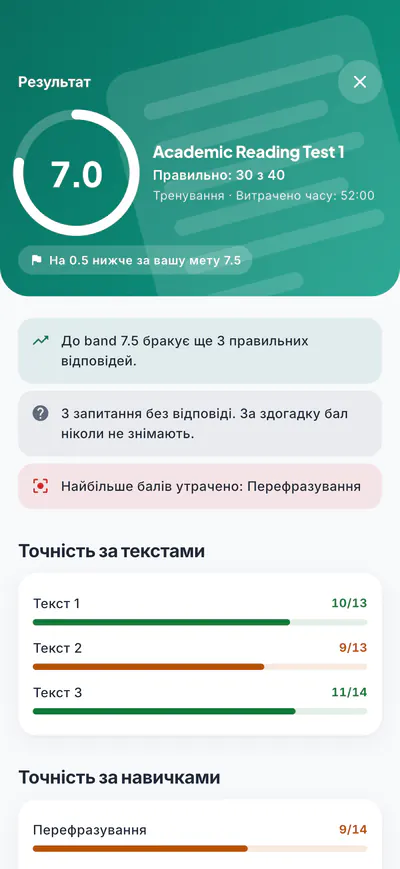
Результат пробного тесту IELTS у застосунку «Fleydo: підготовка до IELTS»: орієнтовний band і точність за кожною частиною
Безкоштовний пробний урок

Дізнайтеся свій реальний бал IELTS раніше, ніж це зробить іспит

Безкоштовний індивідуальний онлайн-урок з учителем — носієм англійської, сертифікованим фахівцем з IELTS із балом 8.5+. Ви отримаєте діагностику Speaking у реальному форматі, чесну оцінку балу та план роботи над саме тими критеріями, які коштують вам балів. Без оплати, без зобов'язань.

Онлайн · Індивідуально · Academic і General Training

IELTS — зареєстрована торговельна марка British Council, IDP: IELTS Australia та Cambridge University Press & Assessment. Ці пробні тести склала команда Fleydo; зазначені організації їх не затверджували й не схвалювали.

Мобільний застосунок

Fleydo English School у вашій кишені

Уроки, домашні завдання, повідомлення та ігри для учнів Fleydo та їхніх батьків. Безкоштовно на iPhone та Android.

Завантажте в App StoreЗавантажити з Google Play
Докладніше про застосунок
QR-код, що відкриває застосунок Fleydo English School в App Store або Google PlayСкануйте й завантажуйтеВідкриє потрібний магазин для вашого телефона.fleydo.com/app
Значок застосунку Fleydo IELTS
Fleydo: підготовка до IELTS

Готуєтеся до IELTS?

«Fleydo: підготовка до IELTS» — окремий застосунок із пробними тестами з усіх чотирьох навичок. Акаунт Fleydo для нього не потрібен.

Детальніше про застосунок IELTS
Завантажте в App StoreЗавантажити з Google Play
Пробні тести IELTS

Тренуйте всі чотири навички IELTS

Усього тестів: 311. Бал одразу після тесту, розбір кожної відповіді та зразки для Writing і Speaking. Без реєстрації.

Усі пробні тести
FleyPath

Персональна дорожня карта вашої дитини — 3, 6 або 12 місяців

🚀Старт
👋Hello
😊Body
🦁Animals
🔢Numbers
🏆Упевнена англійська
Гейміфікована практика англійської

Як гра — тільки вони справді вчаться