1. होम
  2. IELTS
  3. प्रैक्टिस टेस्ट
  4. Speaking
  5. Speaking प्रैक्टिस टेस्ट 3: Everyday sounds

IELTS Speaking

IELTS Speaking प्रैक्टिस टेस्ट 3: Everyday sounds

Describe a sound you often hear, at home or somewhere else, that most people would hardly notice.

  • 3 भाग
  • 11–14 मिनट
  • परीक्षक
  • चार उम्मीदवार, एक टेस्ट

टेस्ट दें

परीक्षक के प्रश्न एक-एक करके चलते हैं। परीक्षा की तरह ज़ोर से उत्तर दें। रिकॉर्डिंग वैकल्पिक है और इसी ब्राउज़र टैब में रहती है।

आपकी रिकॉर्डिंग सिर्फ़ इसी टैब में रहती हैं। कुछ भी अपलोड नहीं होता। रखना चाहें तो उन्हें डाउनलोड कर लें।

अपने प्रदर्शन को अंक दें

अपने उत्तरों की तुलना उम्मीदवारों से करें, फिर हर मानदंड के लिए वह बैंड चुनें जो आप पर सही बैठता है।

6.0आपका अनुमानित बैंड
Fluency and coherence

Lexical resource

Grammatical range and accuracy

Pronunciation

हर उम्मीदवार एक अलग वक्ता है, इसलिए कहानियाँ और राय अलग-अलग हैं। बैंड सार्वजनिक डिस्क्रिप्टर के आधार पर हमारा अनुमान हैं, परीक्षक के आधिकारिक अंक नहीं। ट्रांसक्रिप्ट उच्चारण नहीं दिखा सकती। ये बैंड मानकर चलते हैं कि उच्चारण बाक़ी तीन मानदंडों के स्तर का ही है।

प्रश्न, क्यू कार्ड और नमूना उत्तर

Part 1: इंटरव्यू

Your home

  • Do you live in a house or a flat?
  • Which room do you spend the most time in?
  • Is there anything you'd like to change about your home?
  • Did you have a room of your own when you were a child?

Clocks and watches

  • Do you usually wear a watch? (Why?/Why not?)
  • How many clocks are there in your home?
  • How did you learn to tell the time when you were a child?
  • Would you ever give someone a watch as a present?

Vegetables

  • Do you eat a lot of vegetables?
  • Were there any vegetables you didn't like when you were a child?
  • Would you like to grow your own vegetables one day?

सुझाव

  • Questions about your home can be answered in two words ('A flat'). Add one detail that only you could give, such as which floor you live on or who you share with, and then stop.
  • Clocks and vegetables are small topics, and it is fine to say you never wear a watch or hardly eat vegetables. Say what you do instead, or why not: a short, honest answer with a reason is better than inventing a habit.
  • Listen for the tense: 'How did you learn ...' and 'Were there any vegetables you didn't like ...' need past forms, while 'Would you ever ...' and 'Would you like to ...' need would.

Part 2: लंबा उत्तर (क्यू कार्ड)

Describe a sound you often hear, at home or somewhere else, that most people would hardly notice.

You should say:

  • what the sound is and where it comes from
  • when you usually hear it
  • why you notice it when other people don't

and explain how you would feel if you stopped hearing it.

अनुवर्ती प्रश्न

  • Do you think you notice small sounds more than most people?
  • Do you find it easy to sleep when there's some noise around you?

एक मज़बूत उम्मीदवार ऐसे नोट्स बना सकता है

  • fridge, kitchen, hum + click
  • switches on every half hour
  • loudest at night, flat silent
  • flatmate sleeps through it
  • first noticed it working from home
  • stopped? worry, food in freezer
  • later, kitchen feels dead

सुझाव

  • Most candidates reach for a sound they love or hate, but this card asks for one that goes unnoticed. If nothing comes to mind, think of a machine (a fridge, a lift, a boiler), your street at a certain hour, or a sound at work that only you are close enough to hear.
  • The third point is where the talk can grow. Say what makes you the one who notices: where you sleep or sit, when you are awake, or what the sound tells you, for example that someone has come home or that it is nearly time to stop work.
  • The explain line is hypothetical, so use would: 'At first I'd ..., but after a while I think I'd ...'. A first reaction and a later one give you twice as much to say as a single feeling.

Part 3: चर्चा

Noise and quiet in towns and cities

  • Why do some people enjoy the noise of a busy city while others can't stand it? समझाना
  • Are towns and cities noisier today than they were when your parents were young? तुलना करना
  • How might the sounds of a busy street be different in twenty years' time? भविष्य के बारे में अनुमान लगाना

Music and sound in public places

  • Why do you think so many shops and cafés play music? समझाना
  • Is music in places like stations and shopping centres more of a pleasure or a nuisance for most people? फ़ायदे-नुकसान तौलना
  • What could be done to make public places more comfortable for people who are sensitive to noise? सुझाव देना

सुझाव

  • Two questions have two sides built in: people who love city noise and people who hate it, music as a pleasure or a nuisance. Give each side a real reason before you say where you stand. You do not have to choose one side completely.
  • For the question about twenty years from now, start from something you can already hear changing in your own town and say where it might lead. 'I could imagine ...' and 'Maybe ...' are fine; the reason is what counts.
  • The last question asks for suggestions. Two ideas you explain properly, with who would do them (shop owners, the city, ordinary people), are better than a quick list of five.

चार उम्मीदवार, एक टेस्ट

चार अलग-अलग बैंड के वक्ताओं ने हर प्रश्न का उत्तर कैसे दिया।

Part 1Do you live in a house or a flat?

In a flat. It's on the eleventh floor, in a big building, quite old, built in seventies. I live there with my husband and my daughter, she is fifteen.

Part 1Which room do you spend the most time in?

Kitchen, I think. Our kitchen is small, but everybody is there all the time. We eat there, my daughter makes her homework at the table, and in the evening I drink tea and, um, watch serials on my phone.

Part 1Is there anything you'd like to change about your home?

Yes, the, er... how it's called... the place near the door. The hall. It's very narrow, and all our coats and shoes are there. In winter it's big mess. If we have more space, I would put a bigger wardrobe there.

Part 1Did you have a room of your own when you were a child?

No. I shared with my sister, she is older than me, um, on four years. We always argued about the light, because she liked to read in the night and I want to sleep.

Part 1Do you usually wear a watch? (Why?/Why not?)

Yes, every day. It's a present from my husband, er, for our tenth anniversary. Also I don't like to take out my phone every time when I need to know the time. Always it is somewhere in my bag.

Part 1How many clocks are there in your home?

Er... let me think. One in the kitchen, on the wall, and one in the living room. Also in my daughter's room, er, small clock on the table, for wake up in the morning. So three.

Part 1How did you learn to tell the time when you were a child?

In school, in the first year. The teacher had a big clock from paper, and we moved the, er, arrows – no, hands – to the right time. At home my father also asked me every evening, what time is it now?

Part 1Would you ever give someone a watch as a present?

Maybe for my husband, um, for a special birthday, like forty. But a good watch costs a lot of money, so not every year, er, only for big birthday.

Part 1Do you eat a lot of vegetables?

Yes, quite a lot. In winter mostly potatoes, cabbage, carrots, because they are cheap and, er, they keep long time. In summer we eat fresh salad every day, tomatoes, cucumbers.

Part 1Were there any vegetables you didn't like when you were a child?

Boiled onion. My grandmother always put it in soup, big pieces, and I took them out on the side of the plate. She was, um, angry with me. Now also I don't eat it.

Part 1Would you like to grow your own vegetables one day?

Maybe when I'm on pension. My mother has a big garden in the village, and every August we go there, er, to help her with potatoes. It's very hard for the back, so... not now.

Part 2Describe a sound you often hear, at home or somewhere else, that most people would hardly notice.

OK. So, the sound is our lift. Our flat is on the eleventh floor, and the lift is, er, just behind the wall of our bedroom. So every time when somebody use it, I hear it. First a click, then the motor, a low sound, and then the doors, er, open and close. It's not loud, but I hear everything. Mostly in the night, because I sleep very bad, I wake up from, er, small things. Eleven, twelve o'clock, people come home, and I lie there and I think, who is it? Maybe the neighbour from seventh floor, he is taxi driver, he works in the night. My husband never hear it. When I tell him, he says, what lift? He sleeps very... very deep. Also my daughter doesn't hear, her room is far. I think I notice because my bed is near the wall, and also because I'm, um, a little bit nervous person. If it stops... first I think, good, finally quiet. But no. It means the lift is broken, and we live on eleventh floor, with shopping bags, with my daughter's bicycle, it's – no. One time it was broken for one week, it was terrible. So I prefer the sound. Yes, er, I prefer to hear it. It's OK.

Part 2Do you think you notice small sounds more than most people?

Yes, I think so. Water in the pipes, the fridge, er, the TV of neighbours... I hear everything. It's my problem.

Part 2Do you find it easy to sleep when there's some noise around you?

Not easy. Sometimes I use earplugs, but they are not comfortable, so in the night I take them out.

Part 3Why do some people enjoy the noise of a busy city while others can't stand it?

Er... I think it's about the age. Young people like when there is, um, many people, cars, music, they feel the city is, er, alive. Old people want quiet, they are tired from noise. For example my mother, she lives in a village now, and when she visits us in Novosibirsk, after two days she says, I want home, it's too noisy for me.

Part 3Are towns and cities noisier today than they were when your parents were young?

Yes, of course. When my parents were young, er, not so many people have cars. Now every family has one car, or two, and the roads are full all day. Also there is building everywhere, er, new houses, and it's very noisy. I work in construction company, in the office, er, and we get complaints, how to say, from the people who are living near, about this all the time.

Part 3How might the sounds of a busy street be different in twenty years' time?

Hmm... it's difficult to say. Maybe the cars will be, erm, electric, so no noise from, er, engine. But maybe there will be more drones, for delivery... they are very annoying, like a big fly. So I think not quiet, only different noise.

Part 3Why do you think so many shops and cafés play music?

I think for the... for the atmosphere. When there is no music in shop, it's strange, you feel that everybody look at you. With music you relax, and, er, you stay longer, and maybe you buy more things. I think this is the main reason, money.

Part 3Is music in places like stations and shopping centres more of a pleasure or a nuisance for most people?

Sorry, what is nuisance? ... Ah, like annoying. OK. For me, in the station it's annoying, because you need to hear the, er, the announcements, which train, which platform, and the music is on top, too loud. But in a shopping centre, er, it's OK, nobody really listens.

Part 3What could be done to make public places more comfortable for people who are sensitive to noise?

Maybe the shops can make the music, er, not so loud, or no music in the morning. And in the city, er, more trees and parks, because trees, they stop the noise a little bit. Also people can buy headphones with noise... cancelling? I don't know exactly the name. But they are expensive.

इस टेस्ट के शब्द

background noise
sounds that are there all the time, which you hear without paying attention to them
hum
a low, steady sound, like the one a fridge or a machine makes
tune something out
stop noticing a sound, often without trying
get used to something
become so familiar with something that it no longer seems strange or annoying
a light sleeper
someone who wakes up easily when there is a small noise
drown something out
be so loud that another sound cannot be heard
soothing
making you feel calm and relaxed
get on someone's nerves
annoy someone, especially again and again
a racket
a loud, unpleasant noise (informal)
peace and quiet
a calm situation without noise or interruptions
a fussy eater
someone, often a child, who refuses to eat many kinds of food

उपयोगी वाक्यांश

  • It's the kind of sound you only notice when ___.
  • I've got so used to ___ that I hardly ___ any more.
  • The reason I notice it is that ___.
  • If it suddenly stopped, I think I'd ___, at least at first.
  • I don't mind ___, but I can't stand ___.
  • It depends where you are. In ___ it's fine, but in ___ it ___.
  • Compared with when my parents were young, ___.
  • I could imagine ___ getting ___, because ___.
  • One thing that might help is ___, so that ___.

Fleydo IELTS ऐप का आइकन Fleydo: IELTS की तैयारी

ये टेस्ट अपने फ़ोन पर साथ ले जाएँ

इन पेजों का हर टेस्ट iPhone, iPad और Android के लिए Fleydo: IELTS की तैयारी ऐप में भी है, साथ में ऑडियो वाले 2,000 IELTS शब्द।

  • कोई टेस्ट फ़ोन पर आ जाने के बाद ऑफ़लाइन चलता है
  • ऑडियो वाले 2,000 IELTS शब्द, बढ़ते अंतराल पर दोहराव और छोटे अभ्यास
  • अपने Speaking उत्तर रिकॉर्ड करें और फिर से सुनें
  • आपके लक्ष्य बैंड और परीक्षा की तारीख़ के हिसाब से रोज़ की योजना
App Store से डाउनलोड करेंइसे Google Play पर पाएं
डाउनलोड करने के लिए स्कैन करेंआपके फ़ोन के अनुसार App Store या Google Play खोलता है।

अकाउंट की ज़रूरत नहीं। ऐप के बारे में

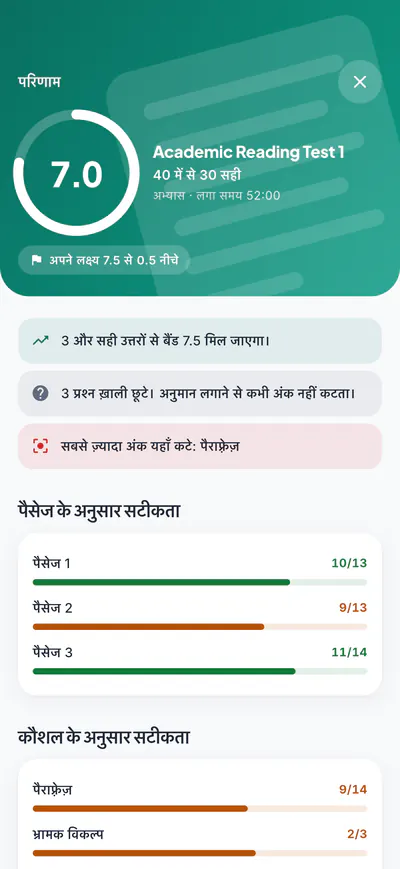
Fleydo: IELTS की तैयारी ऐप में IELTS प्रैक्टिस टेस्ट का परिणाम: अनुमानित बैंड और हर भाग की सटीकता
मुफ़्त ट्रायल लेसन

परीक्षा से पहले अपना असली IELTS बैंड जानें

एक मूल अंग्रेज़ी-भाषी शिक्षक के साथ मुफ़्त वन-टू-वन ऑनलाइन लेसन, जो Band 8.5+ प्रमाणित IELTS विशेषज्ञ हैं। आपको असली परीक्षा फ़ॉर्मैट में Speaking डायग्नोस्टिक, ईमानदार बैंड अनुमान और ठीक उन मानदंडों के लिए योजना मिलती है जो आपके अंक काट रहे हैं। कोई भुगतान नहीं, कोई प्रतिबद्धता नहीं।

ऑनलाइन · वन-टू-वन · Academic और General Training

IELTS, British Council, IDP: IELTS Australia और Cambridge University Press & Assessment का पंजीकृत ट्रेडमार्क है। ये प्रैक्टिस टेस्ट Fleydo ने तैयार किए हैं; इन संस्थाओं ने न तो इन्हें अनुमोदित किया है और न ही इनका समर्थन किया है।

मोबाइल ऐप

Fleydo English School आपकी जेब में

Fleydo के छात्रों और पैरेंट्स के लिए लेसन, होमवर्क, मैसेज और गेम्स। iPhone और Android पर मुफ़्त।

App Store से डाउनलोड करेंइसे Google Play पर पाएं
ऐप के बारे में और जानें
QR कोड जो App Store या Google Play में Fleydo English School ऐप खोलता हैडाउनलोड करने के लिए स्कैन करेंआपके फ़ोन के लिए सही स्टोर खोलता है।fleydo.com/app
Fleydo IELTS ऐप का आइकन
Fleydo: IELTS की तैयारी

IELTS की तैयारी कर रहे हैं?

Fleydo: IELTS की तैयारी एक अलग ऐप है, जिसमें चारों कौशल के मॉक टेस्ट हैं। इसे इस्तेमाल करने के लिए Fleydo अकाउंट की ज़रूरत नहीं है।

IELTS ऐप देखें
App Store से डाउनलोड करेंइसे Google Play पर पाएं
IELTS प्रैक्टिस टेस्ट

IELTS के चारों कौशलों का अभ्यास करें

तुरंत बैंड स्कोर, व्याख्या सहित उत्तरों और मॉडल उत्तरों के साथ 311 टेस्ट। साइन-अप की ज़रूरत नहीं।

सभी प्रैक्टिस टेस्ट
FleyPath

आपके बच्चे का व्यक्तिगत रोडमैप — 3, 6 या 12 महीने

🚀शुरुआत
👋Hello
😊Body
🦁Animals
🔢Numbers
🏆आत्मविश्वासी अंग्रेज़ी
गेमिफाइड अंग्रेज़ी अभ्यास

गेम जैसा — बस फ़र्क इतना कि वे सच में सीख रहे हैं