1. Головна
  2. IELTS
  3. Пробні тести
  4. Reading
  5. Reading Summary Completion: тренування 2

IELTS Reading · Доповнення короткого змісту

IELTS Reading Summary Completion: тренування 2

Canal locks

  • 10 запитань
  • 15 хв
  • Academic

Що в цьому тесті

  1. PassageЗапитання 1–10How boats learned to climb

Типи запитань

  • Доповнення короткого змісту
ReadingIELTS Reading Summary Completion: тренування 2
Залишилося часу15:00

Passage

How boats learned to climb

A A boat cannot sail up a slope, so a waterway that changes height needs some way of passing vessels from one level to the next. The earliest locks, known as flash locks, were barriers across a river or canal that could be opened or removed, often no more than a gap in a weir closed with boards. They were in use in China by the first century BC.

B The name describes the method. With its boards in place, the barrier kept the water upstream deep enough for boats. Taking them out released a sudden rush, and a vessel heading downstream rode through on it. One travelling the other way had to be hauled against the current by a winch or by towing. Both the timing and the steering demanded real skill, and the men aboard risked serious injury or death.

C Water and time were the price. Each passage lowered the level above the barrier, and restoring it could take a day or longer. Because many of these weirs also supplied mills, whose owners wanted a full head of water, the arrangement bred long-running disputes with boat operators, some of them legal and some physical.

D On China's Grand Canal, a different approach had been tried: slipways built into dams, up and down which teams of workers dragged the boats. The practice damaged boats and left cargoes open to theft. The remedy is credited to Qiao Weiyue, a Song-dynasty official, who is said to have set two gates a short distance apart in 983 or 984, the date varying by account. Between them lay a short stretch of water, the pound, whose level could be raised or lowered to match the canal on either side. A boat going downhill entered when the pound was full, the upper gate closed behind it, and water was let out until the lower gate could open. Only one chamberful of water was spent on each move, far less than a flash lock consumed.

E European builders reached the idea later, and accounts disagree over who was first. One reference work names Vreeswijk in the Netherlands in 1373; another account reserves the title for Damme, near Bruges, in 1396. At Vreeswijk, according to the first, the gates slid up and down like a guillotine, and lifting gates were still being fitted in the 1560s on the Exeter Canal, which had Britain's first pound locks.

F The gates themselves were improved too. By about 1500 a different kind was in use in Italy, made of two leaves that swung apart like a pair of doors and met in a shallow V pointing upstream. Water on the higher side pressed them more firmly together, yet they parted easily once the levels matched. These mitre gates coped with water pressure better than guillotine gates, which allowed locks to be made wider, and they remain the commonest lock gate on the world's canals. They are often credited to Leonardo da Vinci, because the earliest known drawings of them are in his notebooks. Drawings do not prove that the idea was his, however. Flash locks, meanwhile, were slow to disappear: the last on the River Thames survived into the 1930s.

Глосарій
weir
a low wall built across a river to control the flow of water
winch
a machine that pulls things with a rope or chain wound around a drum
head of water
the height of stored water, which gives it its force
slipways
slopes along which boats are moved from one level to another
Song-dynasty
from the period when the Song family ruled China, 960 to 1279
chamberful
enough water to fill the pound once
guillotine
a device with a blade that slides up and down between two posts
PassageЗапитання 1–10
Запитання 1–10

Complete the summary using the list of words, A-P, below. Choose the correct letter, A-P, for each answer.

Flash locks were removable 1 in rivers and canals. Opening one produced a sudden current that carried boats downstream, while boats going the other way needed 2 against the flow. The slow 3 of the water level upstream after each opening, and the needs of mills, kept boat operators and millers in 4. On China's Grand Canal, slipways caused 5 to boats, and the pound lock that followed used two gates to enclose a small section of water, so that only a modest 6 of water was needed to move each boat. Some early European pound locks had gates that moved 7. Mitre gates, by contrast, made use of the 8 of water on their upstream side to stay shut, and this design made 9 locks possible. Leonardo da Vinci's part in inventing them remains 10.
  • Aharm
  • Bvertically
  • Cpartnership
  • Dbroader
  • Echambers
  • Frecovery
  • Gunproven
  • Hpulling
  • Idelay
  • Jpressure
  • Kdeeper
  • Lobstructions
  • Mconfirmed
  • Nconflict
  • Osideways
  • Pvolume

Відповіді й пояснення

Спершу пройдіть тест: ключі корисніші, коли ви вже відповіли.

Показати ключі й пояснення
  1. 1
    L

    Paragraph A says flash locks 'were barriers across a river or canal'. Obstructions is another word for barriers, so L is right. Chambers (E) are closed spaces, which does not describe a barrier or a gap in a weir.

  2. 2
    H

    Paragraph B says a boat going the other way 'had to be hauled against the current'. To haul something is to pull it hard, so pulling (H) fits. Pressure (J) belongs later, to the mitre gates.

  3. 3
    F

    Paragraph C says of the water level that 'restoring it could take a day or longer'. A level that is restored has recovered, so recovery (F) fits. Delay (I) fails, because a slow delay of the level makes no sense.

  4. 4
    N

    Paragraph C says the arrangement 'bred long-running disputes with boat operators'. Disputes are a kind of conflict, so N is right. Partnership (C) means working together, which is the opposite of what the text describes.

  5. 5
    A

    Paragraph D says the slipway method 'damaged boats'. Damage is harm, so A is right. Delay (I) is tempting, but the waiting described in paragraph C belongs to flash locks, and the passage does not say slipways caused delay.

  6. 6
    P

    Paragraph D says 'Only one chamberful of water was spent on each move'. A chamberful is an amount of water, and a small one by comparison, so volume (P) fits. Pressure (J) is about force, not quantity.

  7. 7
    B

    Paragraph E says the gates at Vreeswijk 'slid up and down like a guillotine'. Up and down means vertically, so B is right. Sideways (O) would describe a different movement, which the text does not give for these gates.

  8. 8
    J

    Paragraph F says 'Water on the higher side pressed them more firmly together', so the force of the water keeps the gates shut. That force is pressure (J). Volume (P) means an amount, and the text is about force here.

  9. 9
    D

    Paragraph F says these gates 'allowed locks to be made wider'. Broader means wider, so D is right. Deeper (K) is a trap, as the passage says nothing about mitre gates making locks deeper.

  10. 10
    G

    Paragraph F says 'Drawings do not prove that the idea was his'. Something not proved is unproven, so G is right. Confirmed (M) is the opposite: being 'often credited' with an idea does not confirm it.

Ключові слова з цього тесту

Passage

vessel
a boat or ship
disputes
serious disagreements
consumed
used up
credited
said to be responsible for something, such as an invention
Як відповідати на запитання типу «Доповнення короткого змісту»Understand the summary first, then find each missing word in the text.

What the task looks like

The instruction says 'Complete the summary below.' You get a short paragraph that rewords ideas from the text, with gaps in it, and a limit such as ONE WORD ONLY. The answers are words from the text. Some Academic summaries work differently: you choose each word from a list instead, and the list often uses different words from the text, so you match the meaning.

The task tests details and main ideas, and whether you can tell what type of word each gap needs.

A method to try

1. Read the whole summary first, ignoring the gaps. What is it about? Which part of the text does it seem to cover?

2. Find that part of the text, using what you learned when you skimmed.

3. For each gap, decide the type of word and guess the general meaning. 'Rose by ____' needs an amount, for example.

4. Compare the summary with the text, idea by idea. A summary can join ideas from different sentences or change their order, so do not rely on the gaps following the order of the text.

5. Read the finished summary from start to finish. It should make sense as a whole.

The traps

Linking words: 'but', 'although', 'instead of' and 'rather than' show how ideas relate. A gap after 'rather than' needs the thing that was not chosen.

Size words: 'most', 'a small part', 'mainly' and 'the rest' tell you which of two facts the gap wants.

The likely answer: a word can fit the gap and sound sensible, yet not be what the text says at this point.

Worked example

Text: The museum's new roof was paid for mainly by local businesses. A small grant from the council covered the rest. Ticket prices, which some visitors had expected to rise, stayed the same.

Summary: Most of the money for the new roof came from ____. Visitors did not have to pay more to enter. (NO MORE THAN TWO WORDS)

Слабшеthe council. A grant is money, and it sounds likely that a council would pay for a museum roof.
Кращеlocal businesses. 'Most of' is a paraphrase of 'mainly', and the text says businesses 'mainly' paid. The council's grant was 'small' and only 'covered the rest'.

Both answers fit the grammar, so grammar cannot decide. Follow the size words to see which fact the summary wants.

Значок застосунку Fleydo IELTS Fleydo: підготовка до IELTS

Ці тести завжди з вами — у телефоні

Усі тести з цих сторінок є й у застосунку «Fleydo: підготовка до IELTS» для iPhone, iPad і Android, а разом із ними — 2 000 слів для IELTS з озвученням.

  • Працює офлайн, коли тест уже завантажено на телефон
  • 2 000 слів для IELTS з озвученням, інтервальним повторенням і короткими вправами
  • Записуйте відповіді Speaking і прослуховуйте їх
  • План на кожен день під ваш цільовий band і дату іспиту
Завантажте в App StoreЗавантажити з Google Play
Відскануйте, щоб завантажитиВідкриє App Store або Google Play залежно від вашого телефона.

Акаунт не потрібен. Про застосунок

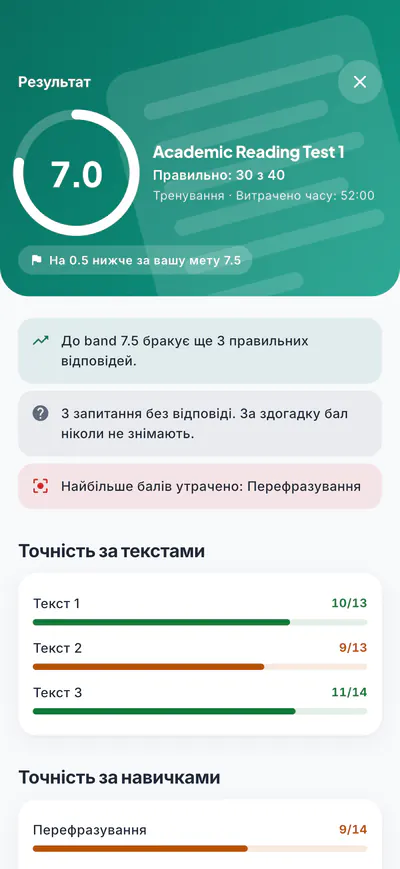
Результат пробного тесту IELTS у застосунку «Fleydo: підготовка до IELTS»: орієнтовний band і точність за кожною частиною
Безкоштовний пробний урок

Дізнайтеся свій реальний бал IELTS раніше, ніж це зробить іспит

Безкоштовний індивідуальний онлайн-урок з учителем — носієм англійської, сертифікованим фахівцем з IELTS із балом 8.5+. Ви отримаєте діагностику Speaking у реальному форматі, чесну оцінку балу та план роботи над саме тими критеріями, які коштують вам балів. Без оплати, без зобов'язань.

Онлайн · Індивідуально · Academic і General Training

IELTS — зареєстрована торговельна марка British Council, IDP: IELTS Australia та Cambridge University Press & Assessment. Ці пробні тести склала команда Fleydo; зазначені організації їх не затверджували й не схвалювали.

Мобільний застосунок

Fleydo English School у вашій кишені

Уроки, домашні завдання, повідомлення та ігри для учнів Fleydo та їхніх батьків. Безкоштовно на iPhone та Android.

Завантажте в App StoreЗавантажити з Google Play
Докладніше про застосунок
QR-код, що відкриває застосунок Fleydo English School в App Store або Google PlayСкануйте й завантажуйтеВідкриє потрібний магазин для вашого телефона.fleydo.com/app
Значок застосунку Fleydo IELTS
Fleydo: підготовка до IELTS

Готуєтеся до IELTS?

«Fleydo: підготовка до IELTS» — окремий застосунок із пробними тестами з усіх чотирьох навичок. Акаунт Fleydo для нього не потрібен.

Детальніше про застосунок IELTS
Завантажте в App StoreЗавантажити з Google Play
Пробні тести IELTS

Тренуйте всі чотири навички IELTS

Усього тестів: 311. Бал одразу після тесту, розбір кожної відповіді та зразки для Writing і Speaking. Без реєстрації.

Усі пробні тести
FleyPath

Персональна дорожня карта вашої дитини — 3, 6 або 12 місяців

🚀Старт
👋Hello
😊Body
🦁Animals
🔢Numbers
🏆Упевнена англійська
Гейміфікована практика англійської

Як гра — тільки вони справді вчаться