1. Strona główna
  2. IELTS
  3. Testy próbne
  4. Reading
  5. Reading Summary Completion: ćwiczenie 2

IELTS Reading · Uzupełnianie streszczenia

IELTS Reading Summary Completion: ćwiczenie 2

Canal locks

  • 10 pytań
  • 15 min
  • Academic

Co jest w tym teście

  1. PassagePytania 1–10How boats learned to climb

Typy pytań

  • Uzupełnianie streszczenia
ReadingIELTS Reading Summary Completion: ćwiczenie 2
Pozostały czas15:00

Passage

How boats learned to climb

A A boat cannot sail up a slope, so a waterway that changes height needs some way of passing vessels from one level to the next. The earliest locks, known as flash locks, were barriers across a river or canal that could be opened or removed, often no more than a gap in a weir closed with boards. They were in use in China by the first century BC.

B The name describes the method. With its boards in place, the barrier kept the water upstream deep enough for boats. Taking them out released a sudden rush, and a vessel heading downstream rode through on it. One travelling the other way had to be hauled against the current by a winch or by towing. Both the timing and the steering demanded real skill, and the men aboard risked serious injury or death.

C Water and time were the price. Each passage lowered the level above the barrier, and restoring it could take a day or longer. Because many of these weirs also supplied mills, whose owners wanted a full head of water, the arrangement bred long-running disputes with boat operators, some of them legal and some physical.

D On China's Grand Canal, a different approach had been tried: slipways built into dams, up and down which teams of workers dragged the boats. The practice damaged boats and left cargoes open to theft. The remedy is credited to Qiao Weiyue, a Song-dynasty official, who is said to have set two gates a short distance apart in 983 or 984, the date varying by account. Between them lay a short stretch of water, the pound, whose level could be raised or lowered to match the canal on either side. A boat going downhill entered when the pound was full, the upper gate closed behind it, and water was let out until the lower gate could open. Only one chamberful of water was spent on each move, far less than a flash lock consumed.

E European builders reached the idea later, and accounts disagree over who was first. One reference work names Vreeswijk in the Netherlands in 1373; another account reserves the title for Damme, near Bruges, in 1396. At Vreeswijk, according to the first, the gates slid up and down like a guillotine, and lifting gates were still being fitted in the 1560s on the Exeter Canal, which had Britain's first pound locks.

F The gates themselves were improved too. By about 1500 a different kind was in use in Italy, made of two leaves that swung apart like a pair of doors and met in a shallow V pointing upstream. Water on the higher side pressed them more firmly together, yet they parted easily once the levels matched. These mitre gates coped with water pressure better than guillotine gates, which allowed locks to be made wider, and they remain the commonest lock gate on the world's canals. They are often credited to Leonardo da Vinci, because the earliest known drawings of them are in his notebooks. Drawings do not prove that the idea was his, however. Flash locks, meanwhile, were slow to disappear: the last on the River Thames survived into the 1930s.

Słowniczek
weir
a low wall built across a river to control the flow of water
winch
a machine that pulls things with a rope or chain wound around a drum
head of water
the height of stored water, which gives it its force
slipways
slopes along which boats are moved from one level to another
Song-dynasty
from the period when the Song family ruled China, 960 to 1279
chamberful
enough water to fill the pound once
guillotine
a device with a blade that slides up and down between two posts
PassagePytania 1–10
Pytania 1–10

Complete the summary using the list of words, A-P, below. Choose the correct letter, A-P, for each answer.

Flash locks were removable 1 in rivers and canals. Opening one produced a sudden current that carried boats downstream, while boats going the other way needed 2 against the flow. The slow 3 of the water level upstream after each opening, and the needs of mills, kept boat operators and millers in 4. On China's Grand Canal, slipways caused 5 to boats, and the pound lock that followed used two gates to enclose a small section of water, so that only a modest 6 of water was needed to move each boat. Some early European pound locks had gates that moved 7. Mitre gates, by contrast, made use of the 8 of water on their upstream side to stay shut, and this design made 9 locks possible. Leonardo da Vinci's part in inventing them remains 10.
  • Aharm
  • Bvertically
  • Cpartnership
  • Dbroader
  • Echambers
  • Frecovery
  • Gunproven
  • Hpulling
  • Idelay
  • Jpressure
  • Kdeeper
  • Lobstructions
  • Mconfirmed
  • Nconflict
  • Osideways
  • Pvolume

Odpowiedzi i wyjaśnienia

Najpierw rozwiąż test: klucz bardziej się przyda, gdy masz już swoje odpowiedzi.

Pokaż klucz odpowiedzi i wyjaśnienia
  1. 1
    L

    Paragraph A says flash locks 'were barriers across a river or canal'. Obstructions is another word for barriers, so L is right. Chambers (E) are closed spaces, which does not describe a barrier or a gap in a weir.

  2. 2
    H

    Paragraph B says a boat going the other way 'had to be hauled against the current'. To haul something is to pull it hard, so pulling (H) fits. Pressure (J) belongs later, to the mitre gates.

  3. 3
    F

    Paragraph C says of the water level that 'restoring it could take a day or longer'. A level that is restored has recovered, so recovery (F) fits. Delay (I) fails, because a slow delay of the level makes no sense.

  4. 4
    N

    Paragraph C says the arrangement 'bred long-running disputes with boat operators'. Disputes are a kind of conflict, so N is right. Partnership (C) means working together, which is the opposite of what the text describes.

  5. 5
    A

    Paragraph D says the slipway method 'damaged boats'. Damage is harm, so A is right. Delay (I) is tempting, but the waiting described in paragraph C belongs to flash locks, and the passage does not say slipways caused delay.

  6. 6
    P

    Paragraph D says 'Only one chamberful of water was spent on each move'. A chamberful is an amount of water, and a small one by comparison, so volume (P) fits. Pressure (J) is about force, not quantity.

  7. 7
    B

    Paragraph E says the gates at Vreeswijk 'slid up and down like a guillotine'. Up and down means vertically, so B is right. Sideways (O) would describe a different movement, which the text does not give for these gates.

  8. 8
    J

    Paragraph F says 'Water on the higher side pressed them more firmly together', so the force of the water keeps the gates shut. That force is pressure (J). Volume (P) means an amount, and the text is about force here.

  9. 9
    D

    Paragraph F says these gates 'allowed locks to be made wider'. Broader means wider, so D is right. Deeper (K) is a trap, as the passage says nothing about mitre gates making locks deeper.

  10. 10
    G

    Paragraph F says 'Drawings do not prove that the idea was his'. Something not proved is unproven, so G is right. Confirmed (M) is the opposite: being 'often credited' with an idea does not confirm it.

Słowa kluczowe z tego testu

Passage

vessel
a boat or ship
disputes
serious disagreements
consumed
used up
credited
said to be responsible for something, such as an invention
Uzupełnianie streszczenia: jak odpowiadać na te pytaniaUnderstand the summary first, then find each missing word in the text.

What the task looks like

The instruction says 'Complete the summary below.' You get a short paragraph that rewords ideas from the text, with gaps in it, and a limit such as ONE WORD ONLY. The answers are words from the text. Some Academic summaries work differently: you choose each word from a list instead, and the list often uses different words from the text, so you match the meaning.

The task tests details and main ideas, and whether you can tell what type of word each gap needs.

A method to try

1. Read the whole summary first, ignoring the gaps. What is it about? Which part of the text does it seem to cover?

2. Find that part of the text, using what you learned when you skimmed.

3. For each gap, decide the type of word and guess the general meaning. 'Rose by ____' needs an amount, for example.

4. Compare the summary with the text, idea by idea. A summary can join ideas from different sentences or change their order, so do not rely on the gaps following the order of the text.

5. Read the finished summary from start to finish. It should make sense as a whole.

The traps

Linking words: 'but', 'although', 'instead of' and 'rather than' show how ideas relate. A gap after 'rather than' needs the thing that was not chosen.

Size words: 'most', 'a small part', 'mainly' and 'the rest' tell you which of two facts the gap wants.

The likely answer: a word can fit the gap and sound sensible, yet not be what the text says at this point.

Worked example

Text: The museum's new roof was paid for mainly by local businesses. A small grant from the council covered the rest. Ticket prices, which some visitors had expected to rise, stayed the same.

Summary: Most of the money for the new roof came from ____. Visitors did not have to pay more to enter. (NO MORE THAN TWO WORDS)

Słabothe council. A grant is money, and it sounds likely that a council would pay for a museum roof.
Lepiejlocal businesses. 'Most of' is a paraphrase of 'mainly', and the text says businesses 'mainly' paid. The council's grant was 'small' and only 'covered the rest'.

Both answers fit the grammar, so grammar cannot decide. Follow the size words to see which fact the summary wants.

Ikona aplikacji Fleydo IELTS Fleydo: Przygotowanie do IELTS

Zabierz te testy ze sobą na telefon

Każdy test z tych stron jest też w aplikacji Fleydo: Przygotowanie do IELTS na iPhone’a, iPada i Androida, razem z 2 000 słówek IELTS z nagraniami.

  • Działa offline, gdy test jest już na telefonie
  • 2 000 słówek IELTS z nagraniami, powtórki rozłożone w czasie i krótkie ćwiczenia
  • Nagrywaj swoje odpowiedzi w Speaking i odsłuchuj je
  • Plan na każdy dzień pod Twój docelowy band i datę egzaminu
Pobierz w App StorePobierz z Google Play
Zeskanuj, aby pobraćOtwiera App Store lub Google Play, zależnie od Twojego telefonu.

Konto nie jest potrzebne. O aplikacji

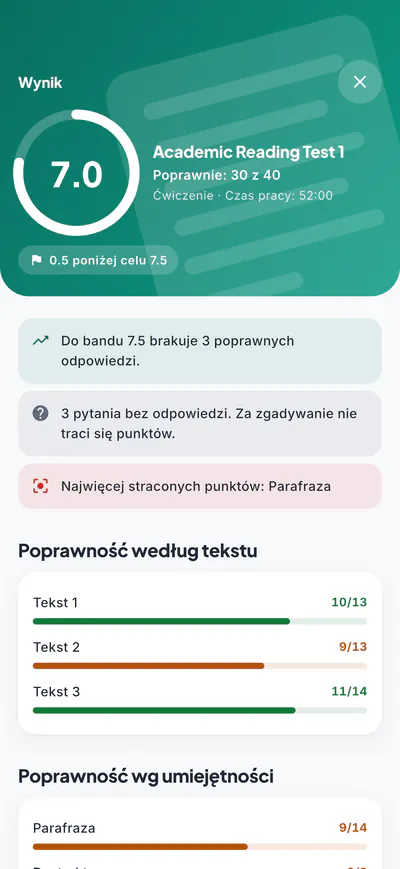
Wynik testu próbnego IELTS w aplikacji Fleydo: Przygotowanie do IELTS: szacowany band i poprawność w każdej części
Bezpłatna lekcja próbna

Poznaj swój prawdziwy wynik IELTS, zanim zrobi to egzamin

Bezpłatna indywidualna lekcja online z nauczycielem native speakerem, certyfikowanym specjalistą IELTS z wynikiem Band 8.5+. Otrzymasz diagnozę Speaking w prawdziwym formacie, uczciwą ocenę szacowanego wyniku i plan pracy nad dokładnie tymi kryteriami, które kosztują Cię punkty. Bez płatności, bez zobowiązań.

Online · Indywidualnie · Academic i General Training

IELTS jest zastrzeżonym znakiem towarowym British Council, IDP: IELTS Australia oraz Cambridge University Press & Assessment. Te testy próbne zostały przygotowane przez Fleydo i nie są przez te organizacje zatwierdzone ani rekomendowane.

Aplikacja mobilna

Fleydo English School w Twojej kieszeni

Lekcje, prace domowe, wiadomości i gry dla uczniów Fleydo i ich rodziców. Bezpłatna na iPhone’a i Androida.

Pobierz w App StorePobierz z Google Play
Więcej o aplikacji
Kod QR otwierający aplikację Fleydo English School w App Store lub Google PlayZeskanuj i pobierzOtwiera właściwy sklep dla Twojego telefonu.fleydo.com/app
Ikona aplikacji Fleydo IELTS
Fleydo: Przygotowanie do IELTS

Przygotowujesz się do IELTS?

Fleydo: Przygotowanie do IELTS to osobna aplikacja z testami próbnymi ze wszystkich czterech umiejętności. Nie potrzebujesz konta Fleydo, żeby z niej korzystać.

Zobacz aplikację IELTS
Pobierz w App StorePobierz z Google Play
Testy próbne IELTS

Ćwicz wszystkie cztery umiejętności IELTS

Wybieraj spośród 311 testów z natychmiastowym wynikiem band, wyjaśnieniami i wzorcowymi odpowiedziami. Bez rejestracji.

Wszystkie testy próbne
FleyPath

Osobista mapa drogowa Twojego dziecka — 3, 6 lub 12 miesięcy

🚀Start
👋Hello
😊Body
🦁Animals
🔢Numbers
🏆Pewny angielski
Zgrywalizowane ćwiczenie angielskiego

Jak gra — tylko że naprawdę się uczą