1. Головна
  2. IELTS
  3. Пробні тести
  4. Reading
  5. Reading Multiple Choice: тренування 2

IELTS Reading · Вибір відповіді

IELTS Reading Multiple Choice: тренування 2

The Braille system

  • 9 запитань
  • 15 хв
  • Academic

Що в цьому тесті

  1. PassageЗапитання 1–9Six dots and a long wait

Типи запитань

  • Вибір відповіді
ReadingIELTS Reading Multiple Choice: тренування 2
Залишилося часу15:00

Passage

Six dots and a long wait

A On 22 February 1844, at the opening of a new building for the Royal Institute for Blind Youth in Paris, one pupil was sent out of the room while another took down a poem dictated by a visitor. The first child then came back and read the poem from the page. The page bore raised dots in a code devised by Louis Braille, once a pupil at the school and later a teacher there. That code had been in print for 15 years, and only four years earlier the school's own director had banned it.

B Earlier attempts show why a new code was needed. The school's founder, Valentin Haüy, had taught with books printed in raised letters. Copying the sighted alphabet in this way was, as the blind French scholar Pierre Villey put it, "talking to the fingers the language of the eye". Haüy also gave his pupils tablets for writing. They could form letters with these, according to one historical review, yet had no way of reading back their work and correcting mistakes.

C Dots reached the school from outside. Charles Barbier, a former artillery officer, published a raised-point method in 1815, and in 1821 sent the school instructions and tools for using it. Many accounts call his system "night writing" and claim it was meant to let soldiers read orders in the dark. Philippa Campsie, whose 2021 study drew on Barbier's own correspondence and publications, argues instead that he designed it for blind people. Pupils could take notes with it, but a sign might need as many as twelve dots, in two tall columns, too large for one fingertip, and there were no capital letters, punctuation or mathematical symbols.

D Braille was 12 when the method arrived, and over about eight years he turned it into something far more compact. His basic unit, or cell, held just six dots, in two columns of three, so that a fingertip could take in a whole sign at one touch. Those six dots gave 63 patterns, enough for letters, numbers, punctuation and music, and blind users could produce the code themselves as well as read it. The first published version, of 1829, also included dashes. These proved hard to recognise by touch and had gone by the second edition in 1837.

E From 1830, encouraged by the director, Alexandre-René Pignier, pupils used the code for notes and homework. Teachers were another matter. Because the dots looked nothing like print, sighted staff could not easily check a pupil's work by eye, and one American history of blindness suggests a further motive, since a code that blind teachers could teach threatened sighted teachers' jobs. When Pierre-Armand Dufau replaced Pignier in 1840, he banned the code and tried to return to ordinary letters, although pupils went on using it in secret.

F Dufau's assistant, Joseph Guadet, persuaded him of the code's value, and it was Guadet who ran the 1844 demonstration. Even then, the institute adopted the system definitively only in 1854, two years after Braille's death, and it was 1878 before an international congress in Paris approved it by a large majority. Elsewhere the argument ran on. In the United States, where a rival dot code called New York Point had its own supporters, the dispute lasted for decades; American schools settled on a revised form of braille in 1917, and a common standard for English came only in 1932, more than a century after that first publication.

Глосарій
tablet
here, a board with guides on it, used for writing
raised-point
made of small marks that stand up from the page, so that they can be felt
artillery
the part of an army that uses large guns
PassageЗапитання 1–9
Запитання 1–9

Choose the correct letter, A, B, C or D.

1Why was one pupil sent out of the room during the 1844 ceremony?
2What problem with Haüy's writing tablets does the historical review mention?
3What does Campsie dispute?
4Which limitation of Barbier's system is mentioned in paragraph C?
5What was one benefit of Braille's six-dot cell?
6Why had the dashes gone from Braille's code by 1837?
7Which reason for the teachers' opposition does the writer present as one source's suggestion?
8What happened after Dufau banned the code?
9What is the main point of paragraph F?

Відповіді й пояснення

Спершу пройдіть тест: ключі корисніші, коли ви вже відповіли.

Показати ключі й пояснення
  1. 1
    B

    The returning child had not heard the poem, so reading it 'from the page' proved the dots carried the words. Option D is tempting, but it does not explain why this child then read the poem.

  2. 2
    D

    Pupils had 'no way of reading back their work', so they could not check it. Option B reverses the text, which says they 'could form letters' with the tablets.

  3. 3
    A

    Many accounts link the method to soldiers, but Campsie 'argues instead that he designed it for blind people'. Option C is in the paragraph, but it is the writer's own information, and nothing shows Campsie disputing it.

  4. 4
    D

    The paragraph says there were no 'mathematical symbols'. Option A reverses the text, because pupils 'could take notes with it'. Option C goes too far: the text says only that capital letters were missing.

  5. 5
    C

    The six dots meant 'a fingertip could take in a whole sign at one touch'. Option A is tempting because tools are mentioned in paragraph C, but nothing says Braille's code needed none.

  6. 6
    B

    The dashes 'proved hard to recognise by touch'. Option A is tempting because teachers' dislike of non-print signs appears in paragraph E, but that concerns the dots and is not the reason given for dropping the dashes.

  7. 7
    A

    Only the job threat is introduced by 'suggests', so it is one source's view. Option B is a real reason in the same sentence, but the writer states it as fact, not as somebody's suggestion.

  8. 8
    C

    Pupils 'went on using it in secret', meaning without permission. Option D is tempting because notes and homework are mentioned earlier, but that was before the ban, under Pignier, and the ban allowed no such use.

  9. 9
    A

    The paragraph moves through 1854, 1878, 1917 and 1932, showing slow, step-by-step acceptance. Option B fails because 'Even then' introduces a further ten-year wait at the school itself, and the argument continued elsewhere.

Ключові слова з цього тесту

Passage

devised
invented or planned
compact
taking up little space
definitively
in a final way that will not change
motive
a reason for doing something
dispute
a serious disagreement
Як відповідати на запитання типу «Вибір відповіді»Choose one answer or several, and find out why each wrong option fails.

What the task looks like

You get a question or an unfinished sentence, with lettered options. It may test a specific point or a main idea.

In our papers, a one-answer question has four options, and the questions follow the order of the text.

Some tasks ask you to choose more than one letter, such as two letters from five, with wording such as 'Which TWO ...?'. In our papers, each letter you choose has its own question number and its own mark, and the order of your letters does not matter.

A method to try

1. Read the question before the options. Mark what it asks for: a 'why' question needs a reason, not just a true fact.

2. Find the part of the text that deals with it, and read it carefully.

3. Say your own answer before you look at the options, so that they do not lead you.

4. Check every option. For each one you reject, find the reason.

5. If two remain, compare them word by word against the text. One word is often the difference.

The traps

True, but not what is asked: the option says something the text does say, but it does not answer the question.

In the text, but about something else: the words are there, but they describe another person or thing.

Too strong: the option says 'all', 'never' or 'only', and the text says 'some', 'often' or 'may'.

Reversal: the option turns a cause and a result round, or says the opposite of the text.

Length: do not choose an option because it is the longest or the most detailed.

Worked example: one answer

Text: The village school moved its sports day from June to September. Parents had asked for the change because many families were away in June. September also proved cooler, which pleased the younger children.

Question: Why did the school move its sports day? A September is cooler for the younger children. B Many families were absent at the earlier date. C All parents refused to come in June. D The school had no free dates in June.

СлабшеA. The text says September proved cooler and the younger children liked it, so this looks like the reason.
КращеB. 'Because' in the second sentence gives the reason. 'Proved' shows that the cooler weather was only discovered afterwards, so it cannot explain the decision.

An option can be true and still be wrong, because it must answer the question asked. C is too strong ('all'), and D is not in the text.

Worked example: two answers

Text: The community hall's new heating system costs less to run than the old boiler. It also takes up less room, which has made space for a small kitchen. Some users complain that the hall now takes longer to warm up in the morning.

Question: Which TWO benefits of the new system are mentioned? A lower running costs B quicker warming in the morning C quieter operation D more usable space in the hall E a lower purchase price

СлабшеA and E. The text says the system 'costs less', so both options about money look right.
КращеA and D. 'Costs less to run' supports A, but the text says nothing about the price of buying it, so E fails. 'Takes up less room' supports D. B reverses a complaint, and C is not mentioned.

Judge each option on its own against the text. Two options can sound alike when only one is supported. If you are sure of just one letter, still give a second.

Значок застосунку Fleydo IELTS Fleydo: підготовка до IELTS

Ці тести завжди з вами — у телефоні

Усі тести з цих сторінок є й у застосунку «Fleydo: підготовка до IELTS» для iPhone, iPad і Android, а разом із ними — 2 000 слів для IELTS з озвученням.

  • Працює офлайн, коли тест уже завантажено на телефон
  • 2 000 слів для IELTS з озвученням, інтервальним повторенням і короткими вправами
  • Записуйте відповіді Speaking і прослуховуйте їх
  • План на кожен день під ваш цільовий band і дату іспиту
Завантажте в App StoreЗавантажити з Google Play
Відскануйте, щоб завантажитиВідкриє App Store або Google Play залежно від вашого телефона.

Акаунт не потрібен. Про застосунок

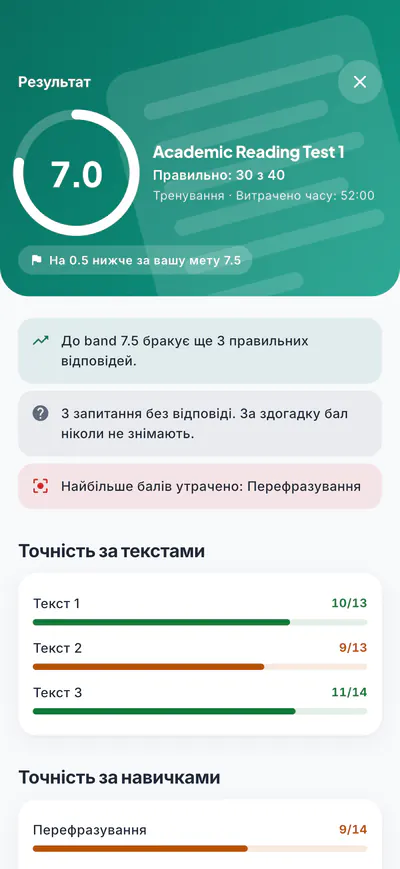
Результат пробного тесту IELTS у застосунку «Fleydo: підготовка до IELTS»: орієнтовний band і точність за кожною частиною
Безкоштовний пробний урок

Дізнайтеся свій реальний бал IELTS раніше, ніж це зробить іспит

Безкоштовний індивідуальний онлайн-урок з учителем — носієм англійської, сертифікованим фахівцем з IELTS із балом 8.5+. Ви отримаєте діагностику Speaking у реальному форматі, чесну оцінку балу та план роботи над саме тими критеріями, які коштують вам балів. Без оплати, без зобов'язань.

Онлайн · Індивідуально · Academic і General Training

IELTS — зареєстрована торговельна марка British Council, IDP: IELTS Australia та Cambridge University Press & Assessment. Ці пробні тести склала команда Fleydo; зазначені організації їх не затверджували й не схвалювали.

Мобільний застосунок

Fleydo English School у вашій кишені

Уроки, домашні завдання, повідомлення та ігри для учнів Fleydo та їхніх батьків. Безкоштовно на iPhone та Android.

Завантажте в App StoreЗавантажити з Google Play
Докладніше про застосунок
QR-код, що відкриває застосунок Fleydo English School в App Store або Google PlayСкануйте й завантажуйтеВідкриє потрібний магазин для вашого телефона.fleydo.com/app
Значок застосунку Fleydo IELTS
Fleydo: підготовка до IELTS

Готуєтеся до IELTS?

«Fleydo: підготовка до IELTS» — окремий застосунок із пробними тестами з усіх чотирьох навичок. Акаунт Fleydo для нього не потрібен.

Детальніше про застосунок IELTS
Завантажте в App StoreЗавантажити з Google Play
Пробні тести IELTS

Тренуйте всі чотири навички IELTS

Усього тестів: 311. Бал одразу після тесту, розбір кожної відповіді та зразки для Writing і Speaking. Без реєстрації.

Усі пробні тести
FleyPath

Персональна дорожня карта вашої дитини — 3, 6 або 12 місяців

🚀Старт
👋Hello
😊Body
🦁Animals
🔢Numbers
🏆Упевнена англійська
Гейміфікована практика англійської

Як гра — тільки вони справді вчаться