1. Головна
  2. IELTS
  3. Пробні тести
  4. Reading
  5. Reading Multiple Choice: тренування 1

IELTS Reading · Вибір відповіді

IELTS Reading Multiple Choice: тренування 1

Archerfish

  • 9 запитань
  • 15 хв
  • Academic

Що в цьому тесті

  1. PassageЗапитання 1–9Taking aim from under the water

Типи запитань

  • Вибір відповіді
ReadingIELTS Reading Multiple Choice: тренування 1
Залишилося часу15:00

Passage

Taking aim from under the water

A In the mangrove swamps, estuaries and rivers from India through South-East Asia to northern Australia lives a small fish with an unusual way of feeding. When an archerfish spots an insect on a leaf or twig above the surface, it is generally thought to press its tongue against a groove in the roof of its mouth to form a narrow tube. It then closes its gill covers sharply, and the water driven along the tube leaves the mouth as a jet that can knock the insect into the water. The trick sounds simple, but it raises several hard problems.

B The first problem is optical. Light bends as it passes from air into water, and how large an insect appears depends on where the fish is in relation to it. In 2004 Stefan Schuster and colleagues reported that archerfish could learn to judge the true size of a target with remarkable precision, despite these distortions. The fish had not simply stored how each target looked from familiar spots, the team argued, since they judged sizes correctly even from completely new viewpoints. Instead, they seemed to have learned the rules that link apparent size to their own position.

C Power is the second problem. Because the back of the jet leaves the mouth faster than the front, the trailing water catches up with the tip and gathers into one large drop that strikes abruptly. In 2014 Peggy Gerullis and Schuster, at the University of Bayreuth, showed that archerfish control when this happens. Trained on targets 20 to 60 centimetres above the water, the fish varied how their mouth opening changed during each shot, so that the drop formed just before impact at every height. Engineers often alter a jet's properties by changing the pressure behind it, Schuster noted; the fish use their mouths more like a nozzle whose shape alters as it fires.

D The force must also suit the prey. Thomas Schlegel, Christine Schmid and Schuster reported in 2006 that the fish strike larger prey harder, with about ten times the force that the adhesive organs of an animal that size could resist. They do so by firing more water, not by firing it faster: doubling the mass of a shot doubles its force and its energy cost, whereas doubling its speed would quadruple the cost. The researchers also concluded that this tuning was less open to learning than expected. Fish kept for two years in conditions where it brought no benefit still showed it, and would not lower their power even when a far weaker shot was consistently rewarded.

E Hitting the insect is only half the job, since the prey goes to whichever fish reaches it first. In 2002 Rossel, Corlija and Schuster reported that about a tenth of a second after prey is dislodged, an archerfish turns rapidly to point not at the falling insect but at the spot where it will land, then swims straight there without needing to keep watching. Field work in Thai mangroves, published in 2015, suggests why such speed matters: halfbeaks, surface-feeding fish that usually outnumber archerfish there, also respond to falling prey, yet in tests, over 98 per cent of the prey went to an archerfish.

F Moving targets revealed how much the fish can learn. In a 2006 study from Schuster's group, adults that were excellent at hitting stationary targets at first failed with even slowly moving ones, but training changed that, and fish trained only on targets moving horizontally then succeeded with targets that also rose or fell. More striking still, every fish in one group learned the skill by watching a group member perform it, without practising. Another group, which saw only the targets moving, failed when tested afterwards. The researchers suggested that the observers might have translated what a distant companion did into the angles and distances they would need themselves.

Глосарій
gill covers
the hard flaps on each side of a fish's head that protect its gills
nozzle
the narrow end of a pipe or hose, which controls how a liquid comes out
adhesive organs
parts of an animal's body, such as sticky foot pads, that help it cling to a surface
PassageЗапитання 1–9
Запитання 1–9

Choose the correct letter, A, B, C or D.

1According to paragraph A, what does closing the gill covers do?
2What did Schuster and colleagues conclude from their 2004 study?
3What did Gerullis and Schuster show about the large drop at the front of the jet?
4How do archerfish strike larger prey with greater force?
5What did the study by Schlegel, Schmid and Schuster suggest about the way the fish adjust their force?
6According to Rossel, Corlija and Schuster, what does an archerfish do very soon after its prey has been knocked off?
7What did the field work in Thailand show?
8What does the writer say about fish that were trained with targets moving horizontally?
9What did the researchers suggest about the fish that learned by watching?

Відповіді й пояснення

Спершу пройдіть тест: ключі корисніші, коли ви вже відповіли.

Показати ключі й пояснення
  1. 1
    B

    Closing the gill covers sends water 'along the tube' and out of the mouth as a jet. Option A is tempting, but the tube is formed earlier, when the tongue presses against a groove in the roof of the mouth.

  2. 2
    D

    The fish 'seemed to have learned the rules' linking apparent size and position, since they coped with new viewpoints. Option A is the idea the team rejected, and option B goes further than 'remarkable precision'.

  3. 3
    A

    The fish changed their mouth opening 'so that the drop formed just before impact at every height', so they time it to the target. Option C is tempting, but the passage links changing the pressure to engineers; the fish change how their mouth opening alters.

  4. 4
    B

    The fish manage it 'by firing more water, not by firing it faster'. Option A is the reverse, as extra speed would quadruple the energy cost. Option C borrows 'adhesive organs', which describe how prey grips, not where the fish aim.

  5. 5
    D

    The tuning was 'less open to learning than expected': fish kept for two years without benefit still showed it. Option B reverses this, and option C fails because the fish 'would not lower their power' even when weaker shots were rewarded.

  6. 6
    C

    Within about a tenth of a second, the fish points 'at the spot where it will land' rather than at the insect. Option A is the reverse, because it swims there 'without needing to keep watching'.

  7. 7
    C

    In tests, over 98 per cent of the prey 'went to an archerfish', which is almost all of it. Option A is too strong, because halfbeaks 'also respond to falling prey', and option B is reversed: halfbeaks 'usually outnumber archerfish there'.

  8. 8
    A

    These fish 'then succeeded with targets that also rose or fell', so up-and-down movement needed no extra training. Option D reverses this, and option C adds a condition the passage never mentions.

  9. 9
    D

    The observers may have 'translated' a distant companion's actions into the angles and distances they themselves would need. Option A fails because they needed their own angles, and option C because the companion was 'distant'.

Ключові слова з цього тесту

Passage

abruptly
suddenly, without any gradual build-up
apparent
as something seems or looks, which may differ from what is real
dislodged
knocked or pushed out of its position
stationary
not moving
consistently
in the same way every time
Як відповідати на запитання типу «Вибір відповіді»Choose one answer or several, and find out why each wrong option fails.

What the task looks like

You get a question or an unfinished sentence, with lettered options. It may test a specific point or a main idea.

In our papers, a one-answer question has four options, and the questions follow the order of the text.

Some tasks ask you to choose more than one letter, such as two letters from five, with wording such as 'Which TWO ...?'. In our papers, each letter you choose has its own question number and its own mark, and the order of your letters does not matter.

A method to try

1. Read the question before the options. Mark what it asks for: a 'why' question needs a reason, not just a true fact.

2. Find the part of the text that deals with it, and read it carefully.

3. Say your own answer before you look at the options, so that they do not lead you.

4. Check every option. For each one you reject, find the reason.

5. If two remain, compare them word by word against the text. One word is often the difference.

The traps

True, but not what is asked: the option says something the text does say, but it does not answer the question.

In the text, but about something else: the words are there, but they describe another person or thing.

Too strong: the option says 'all', 'never' or 'only', and the text says 'some', 'often' or 'may'.

Reversal: the option turns a cause and a result round, or says the opposite of the text.

Length: do not choose an option because it is the longest or the most detailed.

Worked example: one answer

Text: The village school moved its sports day from June to September. Parents had asked for the change because many families were away in June. September also proved cooler, which pleased the younger children.

Question: Why did the school move its sports day? A September is cooler for the younger children. B Many families were absent at the earlier date. C All parents refused to come in June. D The school had no free dates in June.

СлабшеA. The text says September proved cooler and the younger children liked it, so this looks like the reason.
КращеB. 'Because' in the second sentence gives the reason. 'Proved' shows that the cooler weather was only discovered afterwards, so it cannot explain the decision.

An option can be true and still be wrong, because it must answer the question asked. C is too strong ('all'), and D is not in the text.

Worked example: two answers

Text: The community hall's new heating system costs less to run than the old boiler. It also takes up less room, which has made space for a small kitchen. Some users complain that the hall now takes longer to warm up in the morning.

Question: Which TWO benefits of the new system are mentioned? A lower running costs B quicker warming in the morning C quieter operation D more usable space in the hall E a lower purchase price

СлабшеA and E. The text says the system 'costs less', so both options about money look right.
КращеA and D. 'Costs less to run' supports A, but the text says nothing about the price of buying it, so E fails. 'Takes up less room' supports D. B reverses a complaint, and C is not mentioned.

Judge each option on its own against the text. Two options can sound alike when only one is supported. If you are sure of just one letter, still give a second.

Значок застосунку Fleydo IELTS Fleydo: підготовка до IELTS

Ці тести завжди з вами — у телефоні

Усі тести з цих сторінок є й у застосунку «Fleydo: підготовка до IELTS» для iPhone, iPad і Android, а разом із ними — 2 000 слів для IELTS з озвученням.

  • Працює офлайн, коли тест уже завантажено на телефон
  • 2 000 слів для IELTS з озвученням, інтервальним повторенням і короткими вправами
  • Записуйте відповіді Speaking і прослуховуйте їх
  • План на кожен день під ваш цільовий band і дату іспиту
Завантажте в App StoreЗавантажити з Google Play
Відскануйте, щоб завантажитиВідкриє App Store або Google Play залежно від вашого телефона.

Акаунт не потрібен. Про застосунок

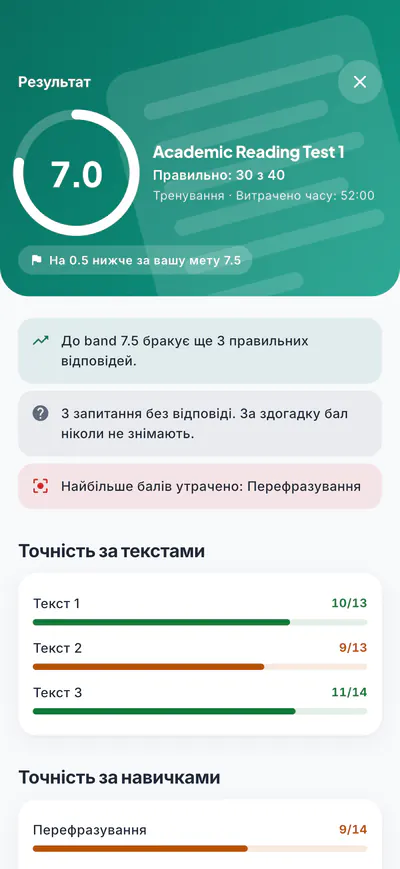
Результат пробного тесту IELTS у застосунку «Fleydo: підготовка до IELTS»: орієнтовний band і точність за кожною частиною
Безкоштовний пробний урок

Дізнайтеся свій реальний бал IELTS раніше, ніж це зробить іспит

Безкоштовний індивідуальний онлайн-урок з учителем — носієм англійської, сертифікованим фахівцем з IELTS із балом 8.5+. Ви отримаєте діагностику Speaking у реальному форматі, чесну оцінку балу та план роботи над саме тими критеріями, які коштують вам балів. Без оплати, без зобов'язань.

Онлайн · Індивідуально · Academic і General Training

IELTS — зареєстрована торговельна марка British Council, IDP: IELTS Australia та Cambridge University Press & Assessment. Ці пробні тести склала команда Fleydo; зазначені організації їх не затверджували й не схвалювали.

Мобільний застосунок

Fleydo English School у вашій кишені

Уроки, домашні завдання, повідомлення та ігри для учнів Fleydo та їхніх батьків. Безкоштовно на iPhone та Android.

Завантажте в App StoreЗавантажити з Google Play
Докладніше про застосунок
QR-код, що відкриває застосунок Fleydo English School в App Store або Google PlayСкануйте й завантажуйтеВідкриє потрібний магазин для вашого телефона.fleydo.com/app
Значок застосунку Fleydo IELTS
Fleydo: підготовка до IELTS

Готуєтеся до IELTS?

«Fleydo: підготовка до IELTS» — окремий застосунок із пробними тестами з усіх чотирьох навичок. Акаунт Fleydo для нього не потрібен.

Детальніше про застосунок IELTS
Завантажте в App StoreЗавантажити з Google Play
Пробні тести IELTS

Тренуйте всі чотири навички IELTS

Усього тестів: 311. Бал одразу після тесту, розбір кожної відповіді та зразки для Writing і Speaking. Без реєстрації.

Усі пробні тести
FleyPath

Персональна дорожня карта вашої дитини — 3, 6 або 12 місяців

🚀Старт
👋Hello
😊Body
🦁Animals
🔢Numbers
🏆Упевнена англійська
Гейміфікована практика англійської

Як гра — тільки вони справді вчаться