1. Головна
  2. IELTS
  3. Пробні тести
  4. Reading
  5. Reading Matching Information: тренування 2

IELTS Reading · Зіставлення інформації

IELTS Reading Matching Information: тренування 2

Forecasting avalanches

  • 12 запитань
  • 15 хв
  • Academic

Що в цьому тесті

  1. PassageЗапитання 1–12Reading a winter in layers

Типи запитань

  • Зіставлення інформації
ReadingIELTS Reading Matching Information: тренування 2
Залишилося часу15:00

Passage

Reading a winter in layers

A A mountain snowpack is less a single mass than a diary of the season, built up in layers and altered by whatever weather follows. In that record forecasters hunt for a particular arrangement: a slab of snow resting on a weak layer that may collapse and fracture under its weight. Layers made of certain crystal types can stay fragile for weeks or months after burial, so a slope may remain hazardous long after a storm has gone.

B To inspect the layers, observers dig. In a snow pit they record the type and size of the grains in each layer and judge its hardness by hand. On a slope they may add a rutschblock test: a block measuring 1.5 by 2 metres is cut away from the surrounding snow, ideally where the gradient exceeds 30 degrees, and a person loads it in six stages. The stage at which it fails, and how much of the block gives way, decide the result.

C A pit, though, may say little about ground beyond the place it was dug. Snow can vary widely across terrain, and observers generally carry out only one test. Among 4,439 Swiss tests analysed in 2020, the share rated "very poor" rose with the danger level assessed locally that day, from 2 per cent at level 1 to 38 per cent at level 4. Yet a tenth of results at level 4 were rated good. The level 4 figures rest on only 21 tests, and the local level often came from the person testing.

D Pits are only part of the evidence. The first bulletin from Switzerland's snow and avalanche institute appeared in December 1945, and its early forecasts rested on about 20 observers; it now has some 200, plus around 180 automatic stations, and those that measure snow feed a model of its structure. Since the winter of 2024/25, machine learning has also been part of routine forecasting there. In a 2022 study, two such models for dry snow predicted the danger level correctly between 72 and 78 per cent of the time, close to the estimated 76 per cent agreement between human forecasts and later assessments. In a live test, one matched published levels about 70 per cent of the time. The institute nevertheless expects human experience to remain essential.

E All of this ends in a number. European warning services use five levels, from 1, low, to 5, very high, and each combines three things: how stable the snow is, how widespread the unstable spots are and how large any avalanches might be. One level may therefore cover quite different situations. Issued only for areas of a certain size, a regional forecast, as researchers have pointed out, gives no information on individual slopes.

F Level 2, "moderate", is forecast for around half of the winter, and the services warn that it often brings no danger signs, which does not necessarily mean safety. Level 3, "considerable", applies for about 30 per cent of the season, and its signs include cracking, recent avalanches and "whumpfs", the sounds of air escaping as a buried layer collapses. Level 4 is forecast on only a few days each winter, level 5 very rarely.

G Even the scale is not applied identically everywhere. Researchers comparing neighbouring Alpine regions, over four winters to 2014/15 and with data from 23 centres, found that levels matched about 90 per cent of the time within one centre's territory but only about 60 per cent across a boundary between centres or countries; chance alone would give 36 to 40 per cent. Snow and climate were not the whole story, they argued. Operational constraints and local interpretations of the scale may also play a part, and they urged further harmonisation of how forecasts are produced. Twenty-six European services have since adopted a shared decision tool, and a 2026 study found its use largely consistent, though less so for wet snow.

Глосарій
snowpack
all the snow lying on the ground in one place, including its layers
slab
a layer of snow whose grains hold together, so that it can break away as one piece
rutschblock
a stability test in which a person puts weight on a large, cut-out block of snow to see when it breaks
machine learning
computer methods that find patterns in large amounts of data
PassageЗапитання 1–12
Запитання 1–12

The text has seven paragraphs, A-G. Which paragraph contains the following information? Choose the correct letter, A-G. NB You may use any letter more than once.

Варіанти
  • AParagraph A
  • BParagraph B
  • CParagraph C
  • DParagraph D
  • EParagraph E
  • FParagraph F
  • GParagraph G
1a comparison of how many people supplied information at two different periods
2the level of agreement that luck might produce
3the size of the piece of snow used in one kind of test
4a warning that an absence of obvious clues is not reassuring
5why a hazard may continue well after bad weather has ended
6why a finding from one location should be treated with caution
7why a published warning cannot guide a reader on one specific hillside
8how an automated approach compares with human judgement
9how often particular points on a scale are used during a season
10figures showing that bad results in snow tests become more common as danger rises
11the factors weighed together to reach a point on a warning scale
12possible causes of disagreement that have nothing to do with the snow

Відповіді й пояснення

Спершу пройдіть тест: ключі корисніші, коли ви вже відповіли.

Показати ключі й пояснення
  1. 1
    D

    Paragraph D gives 'about 20 observers' in the early years and 'some 200' today, so it compares numbers of people. Paragraph G also has figures, but those show how often forecasts agreed.

  2. 2
    G

    Paragraph G says 'chance alone would give 36 to 40 per cent', which is agreement caused by luck. Paragraph D has a figure of 76 per cent, but that compares human forecasts with later assessments.

  3. 3
    B

    Paragraph B gives the measurements: 'a block measuring 1.5 by 2 metres'. Loading this block to see when it fails is the test. Paragraph C reports test results, but not the size of the block.

  4. 4
    F

    Paragraph F says level 2 'often brings no danger signs, which does not necessarily mean safety'. So seeing no clues proves nothing. Paragraph C warns about relying on one test, which is a different limit.

  5. 5
    A

    Paragraph A says some layers 'can stay fragile for weeks or months', so a slope stays hazardous after a storm. Paragraph F lists signs of danger, but it does not explain why danger lasts.

  6. 6
    C

    Paragraph C says a pit 'may say little about ground beyond the place it was dug', as snow varies. Paragraph B explains how the test is done, but it does not discuss its limits.

  7. 7
    E

    Paragraph E says a regional forecast 'gives no information on individual slopes'. A hillside is a slope. Paragraph C is also about limits, but it discusses what a pit shows, not a published warning.

  8. 8
    D

    Paragraph D sets results of 72 to 78 per cent from computer models beside the 'estimated 76 per cent' for human forecasts. Paragraph G compares forecasting centres with one another, and no machines are involved.

  9. 9
    F

    Paragraph F says level 2 'is forecast for around half of the winter' and level 4 'on only a few days'. The percentages in paragraph G show agreement between regions, not how often a level is used.

  10. 10
    C

    Paragraph C says the share of tests rated very poor rose 'from 2 per cent at level 1 to 38 per cent at level 4'. Paragraph B only explains how a score is reached; paragraph D's test concerns a computer model.

  11. 11
    E

    Paragraph E says each level 'combines three things', then lists stability, how widespread the unstable spots are and avalanche size. Paragraph F describes what the levels mean, and paragraph B's two factors decide a test result, not a warning level.

  12. 12
    G

    Paragraph G names 'Operational constraints and local interpretations of the scale' as well as snow and climate. These could explain why neighbouring forecasts differ. Paragraph D mentions no disagreement between forecasters.

Ключові слова з цього тесту

Passage

fragile
easily broken or damaged
gradient
how steep a slope is
terrain
an area of land and its physical features
constraints
things that limit what can be done
harmonisation
making systems or methods agree with one another
Як відповідати на запитання типу «Зіставлення інформації»Find which paragraph holds a particular detail, example, reason or comparison.

What the task looks like

You get a list of items, and you say which lettered paragraph contains each one. An item might be 'a reason for ...', 'an example of ...' or 'a comparison between ...'. In General Training, the letters may mark separate short texts.

The task tests whether you can locate specific information: details, examples, reasons and comparisons.

This is not the same as matching headings. You are not looking for the main idea. The answer may be one small part of a paragraph that is mainly about something else.

In our papers, the items do not follow the order of the text, and there may be more letters than items. If a letter can be used more than once, the instructions will say so.

A method to try

1. Consider leaving this task until after the other questions on the same text. By then you may know where things are.

2. Read the items. For each one, mark the kind of information it asks for, such as a reason or an example, and then its topic.

3. Think of other ways to say the topic words.

4. Read one paragraph at a time and check it against all the items you have left. This can be quicker than searching the whole text for one item at a time.

5. Before you choose a letter, point to the exact words that match. If you cannot, keep reading.

The traps

The right topic, the wrong kind: several paragraphs may mention a topic, but only one gives the reason or the example that the item asks for.

The matching word: a word from the item may appear in a paragraph that says something quite different about it.

Small words in the item: 'a failed attempt' is not just any attempt, and 'a recent change' is not just any change. These words decide the match.

Worked example

Text: [A] Ticket sales at the town theatre were lower last year than the year before. [B] The main cause was the closed footbridge from the station, which left people arriving by train with a long walk. [C] The bridge reopened in March, and the theatre has since added an extra weekday performance.

Item: an explanation for a fall in audience numbers. Which paragraph contains this?

СлабшеA. It talks about lower ticket sales, and that is the fall in audience numbers.
КращеB. Paragraph A only reports the fall. Paragraph B gives the reason: the closed footbridge made the theatre harder to reach.

The item asks for an explanation, so finding the topic is not enough. Mark the kind of information first, then look for that kind.

Значок застосунку Fleydo IELTS Fleydo: підготовка до IELTS

Ці тести завжди з вами — у телефоні

Усі тести з цих сторінок є й у застосунку «Fleydo: підготовка до IELTS» для iPhone, iPad і Android, а разом із ними — 2 000 слів для IELTS з озвученням.

  • Працює офлайн, коли тест уже завантажено на телефон
  • 2 000 слів для IELTS з озвученням, інтервальним повторенням і короткими вправами
  • Записуйте відповіді Speaking і прослуховуйте їх
  • План на кожен день під ваш цільовий band і дату іспиту
Завантажте в App StoreЗавантажити з Google Play
Відскануйте, щоб завантажитиВідкриє App Store або Google Play залежно від вашого телефона.

Акаунт не потрібен. Про застосунок

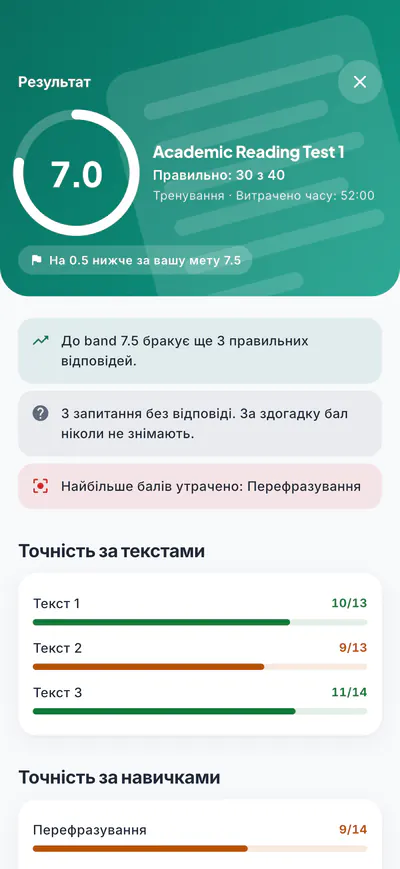
Результат пробного тесту IELTS у застосунку «Fleydo: підготовка до IELTS»: орієнтовний band і точність за кожною частиною
Безкоштовний пробний урок

Дізнайтеся свій реальний бал IELTS раніше, ніж це зробить іспит

Безкоштовний індивідуальний онлайн-урок з учителем — носієм англійської, сертифікованим фахівцем з IELTS із балом 8.5+. Ви отримаєте діагностику Speaking у реальному форматі, чесну оцінку балу та план роботи над саме тими критеріями, які коштують вам балів. Без оплати, без зобов'язань.

Онлайн · Індивідуально · Academic і General Training

IELTS — зареєстрована торговельна марка British Council, IDP: IELTS Australia та Cambridge University Press & Assessment. Ці пробні тести склала команда Fleydo; зазначені організації їх не затверджували й не схвалювали.

Мобільний застосунок

Fleydo English School у вашій кишені

Уроки, домашні завдання, повідомлення та ігри для учнів Fleydo та їхніх батьків. Безкоштовно на iPhone та Android.

Завантажте в App StoreЗавантажити з Google Play
Докладніше про застосунок
QR-код, що відкриває застосунок Fleydo English School в App Store або Google PlayСкануйте й завантажуйтеВідкриє потрібний магазин для вашого телефона.fleydo.com/app
Значок застосунку Fleydo IELTS
Fleydo: підготовка до IELTS

Готуєтеся до IELTS?

«Fleydo: підготовка до IELTS» — окремий застосунок із пробними тестами з усіх чотирьох навичок. Акаунт Fleydo для нього не потрібен.

Детальніше про застосунок IELTS
Завантажте в App StoreЗавантажити з Google Play
Пробні тести IELTS

Тренуйте всі чотири навички IELTS

Усього тестів: 311. Бал одразу після тесту, розбір кожної відповіді та зразки для Writing і Speaking. Без реєстрації.

Усі пробні тести
FleyPath

Персональна дорожня карта вашої дитини — 3, 6 або 12 місяців

🚀Старт
👋Hello
😊Body
🦁Animals
🔢Numbers
🏆Упевнена англійська
Гейміфікована практика англійської

Як гра — тільки вони справді вчаться