1. Strona główna
  2. IELTS
  3. Testy próbne
  4. Reading
  5. Reading Matching Information: ćwiczenie 2

IELTS Reading · Dopasowanie informacji

IELTS Reading Matching Information: ćwiczenie 2

Forecasting avalanches

  • 12 pytań
  • 15 min
  • Academic

Co jest w tym teście

  1. PassagePytania 1–12Reading a winter in layers

Typy pytań

  • Dopasowanie informacji
ReadingIELTS Reading Matching Information: ćwiczenie 2
Pozostały czas15:00

Passage

Reading a winter in layers

A A mountain snowpack is less a single mass than a diary of the season, built up in layers and altered by whatever weather follows. In that record forecasters hunt for a particular arrangement: a slab of snow resting on a weak layer that may collapse and fracture under its weight. Layers made of certain crystal types can stay fragile for weeks or months after burial, so a slope may remain hazardous long after a storm has gone.

B To inspect the layers, observers dig. In a snow pit they record the type and size of the grains in each layer and judge its hardness by hand. On a slope they may add a rutschblock test: a block measuring 1.5 by 2 metres is cut away from the surrounding snow, ideally where the gradient exceeds 30 degrees, and a person loads it in six stages. The stage at which it fails, and how much of the block gives way, decide the result.

C A pit, though, may say little about ground beyond the place it was dug. Snow can vary widely across terrain, and observers generally carry out only one test. Among 4,439 Swiss tests analysed in 2020, the share rated "very poor" rose with the danger level assessed locally that day, from 2 per cent at level 1 to 38 per cent at level 4. Yet a tenth of results at level 4 were rated good. The level 4 figures rest on only 21 tests, and the local level often came from the person testing.

D Pits are only part of the evidence. The first bulletin from Switzerland's snow and avalanche institute appeared in December 1945, and its early forecasts rested on about 20 observers; it now has some 200, plus around 180 automatic stations, and those that measure snow feed a model of its structure. Since the winter of 2024/25, machine learning has also been part of routine forecasting there. In a 2022 study, two such models for dry snow predicted the danger level correctly between 72 and 78 per cent of the time, close to the estimated 76 per cent agreement between human forecasts and later assessments. In a live test, one matched published levels about 70 per cent of the time. The institute nevertheless expects human experience to remain essential.

E All of this ends in a number. European warning services use five levels, from 1, low, to 5, very high, and each combines three things: how stable the snow is, how widespread the unstable spots are and how large any avalanches might be. One level may therefore cover quite different situations. Issued only for areas of a certain size, a regional forecast, as researchers have pointed out, gives no information on individual slopes.

F Level 2, "moderate", is forecast for around half of the winter, and the services warn that it often brings no danger signs, which does not necessarily mean safety. Level 3, "considerable", applies for about 30 per cent of the season, and its signs include cracking, recent avalanches and "whumpfs", the sounds of air escaping as a buried layer collapses. Level 4 is forecast on only a few days each winter, level 5 very rarely.

G Even the scale is not applied identically everywhere. Researchers comparing neighbouring Alpine regions, over four winters to 2014/15 and with data from 23 centres, found that levels matched about 90 per cent of the time within one centre's territory but only about 60 per cent across a boundary between centres or countries; chance alone would give 36 to 40 per cent. Snow and climate were not the whole story, they argued. Operational constraints and local interpretations of the scale may also play a part, and they urged further harmonisation of how forecasts are produced. Twenty-six European services have since adopted a shared decision tool, and a 2026 study found its use largely consistent, though less so for wet snow.

Słowniczek
snowpack
all the snow lying on the ground in one place, including its layers
slab
a layer of snow whose grains hold together, so that it can break away as one piece
rutschblock
a stability test in which a person puts weight on a large, cut-out block of snow to see when it breaks
machine learning
computer methods that find patterns in large amounts of data
PassagePytania 1–12
Pytania 1–12

The text has seven paragraphs, A-G. Which paragraph contains the following information? Choose the correct letter, A-G. NB You may use any letter more than once.

Opcje
  • AParagraph A
  • BParagraph B
  • CParagraph C
  • DParagraph D
  • EParagraph E
  • FParagraph F
  • GParagraph G
1a comparison of how many people supplied information at two different periods
2the level of agreement that luck might produce
3the size of the piece of snow used in one kind of test
4a warning that an absence of obvious clues is not reassuring
5why a hazard may continue well after bad weather has ended
6why a finding from one location should be treated with caution
7why a published warning cannot guide a reader on one specific hillside
8how an automated approach compares with human judgement
9how often particular points on a scale are used during a season
10figures showing that bad results in snow tests become more common as danger rises
11the factors weighed together to reach a point on a warning scale
12possible causes of disagreement that have nothing to do with the snow

Odpowiedzi i wyjaśnienia

Najpierw rozwiąż test: klucz bardziej się przyda, gdy masz już swoje odpowiedzi.

Pokaż klucz odpowiedzi i wyjaśnienia
  1. 1
    D

    Paragraph D gives 'about 20 observers' in the early years and 'some 200' today, so it compares numbers of people. Paragraph G also has figures, but those show how often forecasts agreed.

  2. 2
    G

    Paragraph G says 'chance alone would give 36 to 40 per cent', which is agreement caused by luck. Paragraph D has a figure of 76 per cent, but that compares human forecasts with later assessments.

  3. 3
    B

    Paragraph B gives the measurements: 'a block measuring 1.5 by 2 metres'. Loading this block to see when it fails is the test. Paragraph C reports test results, but not the size of the block.

  4. 4
    F

    Paragraph F says level 2 'often brings no danger signs, which does not necessarily mean safety'. So seeing no clues proves nothing. Paragraph C warns about relying on one test, which is a different limit.

  5. 5
    A

    Paragraph A says some layers 'can stay fragile for weeks or months', so a slope stays hazardous after a storm. Paragraph F lists signs of danger, but it does not explain why danger lasts.

  6. 6
    C

    Paragraph C says a pit 'may say little about ground beyond the place it was dug', as snow varies. Paragraph B explains how the test is done, but it does not discuss its limits.

  7. 7
    E

    Paragraph E says a regional forecast 'gives no information on individual slopes'. A hillside is a slope. Paragraph C is also about limits, but it discusses what a pit shows, not a published warning.

  8. 8
    D

    Paragraph D sets results of 72 to 78 per cent from computer models beside the 'estimated 76 per cent' for human forecasts. Paragraph G compares forecasting centres with one another, and no machines are involved.

  9. 9
    F

    Paragraph F says level 2 'is forecast for around half of the winter' and level 4 'on only a few days'. The percentages in paragraph G show agreement between regions, not how often a level is used.

  10. 10
    C

    Paragraph C says the share of tests rated very poor rose 'from 2 per cent at level 1 to 38 per cent at level 4'. Paragraph B only explains how a score is reached; paragraph D's test concerns a computer model.

  11. 11
    E

    Paragraph E says each level 'combines three things', then lists stability, how widespread the unstable spots are and avalanche size. Paragraph F describes what the levels mean, and paragraph B's two factors decide a test result, not a warning level.

  12. 12
    G

    Paragraph G names 'Operational constraints and local interpretations of the scale' as well as snow and climate. These could explain why neighbouring forecasts differ. Paragraph D mentions no disagreement between forecasters.

Słowa kluczowe z tego testu

Passage

fragile
easily broken or damaged
gradient
how steep a slope is
terrain
an area of land and its physical features
constraints
things that limit what can be done
harmonisation
making systems or methods agree with one another
Dopasowanie informacji: jak odpowiadać na te pytaniaFind which paragraph holds a particular detail, example, reason or comparison.

What the task looks like

You get a list of items, and you say which lettered paragraph contains each one. An item might be 'a reason for ...', 'an example of ...' or 'a comparison between ...'. In General Training, the letters may mark separate short texts.

The task tests whether you can locate specific information: details, examples, reasons and comparisons.

This is not the same as matching headings. You are not looking for the main idea. The answer may be one small part of a paragraph that is mainly about something else.

In our papers, the items do not follow the order of the text, and there may be more letters than items. If a letter can be used more than once, the instructions will say so.

A method to try

1. Consider leaving this task until after the other questions on the same text. By then you may know where things are.

2. Read the items. For each one, mark the kind of information it asks for, such as a reason or an example, and then its topic.

3. Think of other ways to say the topic words.

4. Read one paragraph at a time and check it against all the items you have left. This can be quicker than searching the whole text for one item at a time.

5. Before you choose a letter, point to the exact words that match. If you cannot, keep reading.

The traps

The right topic, the wrong kind: several paragraphs may mention a topic, but only one gives the reason or the example that the item asks for.

The matching word: a word from the item may appear in a paragraph that says something quite different about it.

Small words in the item: 'a failed attempt' is not just any attempt, and 'a recent change' is not just any change. These words decide the match.

Worked example

Text: [A] Ticket sales at the town theatre were lower last year than the year before. [B] The main cause was the closed footbridge from the station, which left people arriving by train with a long walk. [C] The bridge reopened in March, and the theatre has since added an extra weekday performance.

Item: an explanation for a fall in audience numbers. Which paragraph contains this?

SłaboA. It talks about lower ticket sales, and that is the fall in audience numbers.
LepiejB. Paragraph A only reports the fall. Paragraph B gives the reason: the closed footbridge made the theatre harder to reach.

The item asks for an explanation, so finding the topic is not enough. Mark the kind of information first, then look for that kind.

Ikona aplikacji Fleydo IELTS Fleydo: Przygotowanie do IELTS

Zabierz te testy ze sobą na telefon

Każdy test z tych stron jest też w aplikacji Fleydo: Przygotowanie do IELTS na iPhone’a, iPada i Androida, razem z 2 000 słówek IELTS z nagraniami.

  • Działa offline, gdy test jest już na telefonie
  • 2 000 słówek IELTS z nagraniami, powtórki rozłożone w czasie i krótkie ćwiczenia
  • Nagrywaj swoje odpowiedzi w Speaking i odsłuchuj je
  • Plan na każdy dzień pod Twój docelowy band i datę egzaminu
Pobierz w App StorePobierz z Google Play
Zeskanuj, aby pobraćOtwiera App Store lub Google Play, zależnie od Twojego telefonu.

Konto nie jest potrzebne. O aplikacji

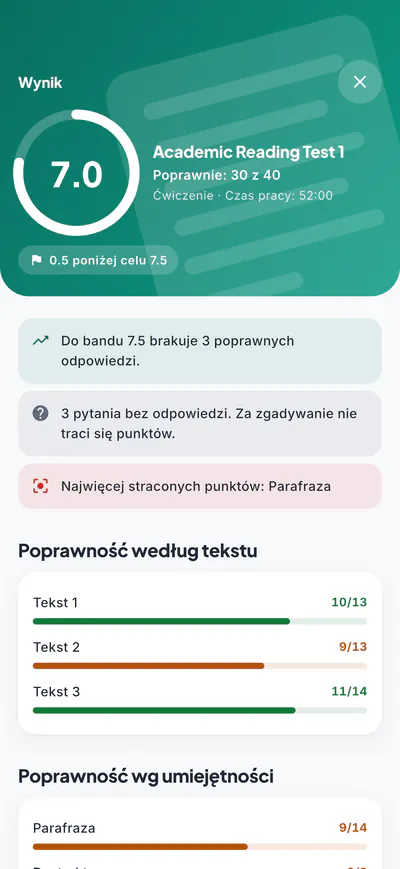
Wynik testu próbnego IELTS w aplikacji Fleydo: Przygotowanie do IELTS: szacowany band i poprawność w każdej części
Bezpłatna lekcja próbna

Poznaj swój prawdziwy wynik IELTS, zanim zrobi to egzamin

Bezpłatna indywidualna lekcja online z nauczycielem native speakerem, certyfikowanym specjalistą IELTS z wynikiem Band 8.5+. Otrzymasz diagnozę Speaking w prawdziwym formacie, uczciwą ocenę szacowanego wyniku i plan pracy nad dokładnie tymi kryteriami, które kosztują Cię punkty. Bez płatności, bez zobowiązań.

Online · Indywidualnie · Academic i General Training

IELTS jest zastrzeżonym znakiem towarowym British Council, IDP: IELTS Australia oraz Cambridge University Press & Assessment. Te testy próbne zostały przygotowane przez Fleydo i nie są przez te organizacje zatwierdzone ani rekomendowane.

Aplikacja mobilna

Fleydo English School w Twojej kieszeni

Lekcje, prace domowe, wiadomości i gry dla uczniów Fleydo i ich rodziców. Bezpłatna na iPhone’a i Androida.

Pobierz w App StorePobierz z Google Play
Więcej o aplikacji
Kod QR otwierający aplikację Fleydo English School w App Store lub Google PlayZeskanuj i pobierzOtwiera właściwy sklep dla Twojego telefonu.fleydo.com/app
Ikona aplikacji Fleydo IELTS
Fleydo: Przygotowanie do IELTS

Przygotowujesz się do IELTS?

Fleydo: Przygotowanie do IELTS to osobna aplikacja z testami próbnymi ze wszystkich czterech umiejętności. Nie potrzebujesz konta Fleydo, żeby z niej korzystać.

Zobacz aplikację IELTS
Pobierz w App StorePobierz z Google Play
Testy próbne IELTS

Ćwicz wszystkie cztery umiejętności IELTS

Wybieraj spośród 311 testów z natychmiastowym wynikiem band, wyjaśnieniami i wzorcowymi odpowiedziami. Bez rejestracji.

Wszystkie testy próbne
FleyPath

Osobista mapa drogowa Twojego dziecka — 3, 6 lub 12 miesięcy

🚀Start
👋Hello
😊Body
🦁Animals
🔢Numbers
🏆Pewny angielski
Zgrywalizowane ćwiczenie angielskiego

Jak gra — tylko że naprawdę się uczą