1. Главная
  2. IELTS
  3. Пробные тесты
  4. Speaking
  5. Пробный тест IELTS Speaking 21: Made by hand

IELTS Speaking

Пробный тест IELTS Speaking 21: Made by hand

Describe something made by hand that you own or use, and the person who made it.

  • Частей: 3
  • 11–14 мин
  • Экзаменатор
  • Четыре кандидата, один тест

Пройдите тест

Вопросы экзаменатора звучат по одному. Отвечайте вслух, как на экзамене. Запись необязательна и остаётся только в этой вкладке браузера.

Ваши записи хранятся только в этой вкладке. На сервер ничего не загружается. Скачайте их, если хотите сохранить.

Оцените своё выступление

Сравните свои ответы с ответами кандидатов, а затем по каждому критерию выберите band, который вам соответствует.

6,0Ваш примерный band
Fluency and coherence

Lexical resource

Grammatical range and accuracy

Pronunciation

Каждый кандидат — отдельный человек, поэтому истории и мнения различаются. Указанные band — наша оценка по открытым критериям, а не официальные оценки экзаменаторов. Расшифровка не передаёт произношение. Эти band исходят из того, что оно на том же уровне, что и три других критерия.

Вопросы, карточка с заданием и примеры ответов

Часть 1: интервью

Home town

  • Where is your home town?
  • Is it a busy place, or fairly quiet?
  • What's the easiest way to get around there?
  • What did you use to do there in your free time as a teenager?

Television

  • Do you watch much television these days?
  • Were there any rules about watching TV in your house when you were a child?
  • Do you prefer watching TV on your own or with other people?
  • Would you ever like to appear on television? (Why?/Why not?)

Cold weather

  • Does it get very cold where you live?
  • What do you usually do to keep warm?
  • Is there anything you enjoy about cold weather?

Советы

  • Home town questions are about what it is like to live there, not facts and figures. If you have moved away, say so and compare: 'In my home town everyone walks, but here ...'. That gives you more to say than a population or a famous building.
  • Many people now watch programmes on a laptop or phone rather than a television. Say so honestly; the examiner wants natural English about your real habits, not a yes or no. The question about rules is in the past, so use 'we weren't allowed to', 'my father used to' or 'we had to'.
  • If you come from a warm country, 'cold' still means something to you. Describe the coldest time of year you know and what people do then: 'Cold for us means ...'.

Часть 2: монолог (карточка с заданием)

Describe something made by hand that you own or use, and the person who made it.

You should say:

  • what it is and how it came to you
  • what you know about the person who made it
  • how long you have had it and how you use it

and explain whether knowing who made it changes the way you feel about it.

Уточняющий вопрос

  • Have you ever tried to make something like that yourself?
  • Do you own many other things that were made by hand?

Заметки, которые мог бы сделать сильный кандидат

  • wool hat, winter market, three years ago
  • maker: retired cook, knits at her stall
  • one hat = two evenings' work
  • wear it every cold morning
  • stitch came loose, mended it myself
  • feel: careful, won't lose it
  • shop hats: forgotten on buses

Советы

  • You do not need to know the maker well. If you bought the thing at a market or were given it, say what the seller told you, what you can guess from the object itself, or what you wish you knew. 'I never met her, but I imagine ...' still answers the second point.
  • The trap is spending the whole talk on what the object looks like. The card is about the link between the thing and the person, so leave time for the explain line: does knowing them make you more careful with it, prouder of it, a little guilty, or make no difference at all? 'No difference' is a fine answer if you say why.
  • If nothing handmade comes to mind, think wider: a piece of clothing a tailor made or altered, something knitted or sewn by someone in your family, a wooden or clay object from a market, even a drawing a child gave you that is on your wall.

Часть 3: обсуждение

Handmade and factory-made goods

  • What kinds of things do people still prefer to have made by hand, and why? Объяснение
  • How is buying something from the person who made it different from buying it in a shop? Сравнение
  • Do you think people will still be able to make a living from traditional crafts in the future? Предположения о будущем

Creativity at school

  • Are art and craft lessons as important as subjects like maths and science? Выражение мнения
  • Can creativity be taught, or are some children simply born creative? Взвешивание доводов
  • What could teachers do to make room for creativity in maths and science lessons? Предложение идей

Советы

  • For the comparison question, think about what actually changes when you buy from the maker: the price, the conversation, trust, what happens if it breaks. Choose two of these and develop them, rather than listing five in a sentence each.
  • For the future question, use the language of possibility (I doubt, it may well, I can imagine) and base your guess on something you can see happening now, such as people selling crafts online or young people choosing other work.
  • You can start the questions about school from your own lessons, but then widen out to children in general. It helps to say briefly what you mean by creativity, because people use the word in different ways.

Четыре кандидата, один тест

Как кандидаты с четырьмя разными band ответили на каждый вопрос.

Часть 1Where is your home town?

Bhopal. It's in Madhya Pradesh, in the middle of India. But I'm not living there now, er, I'm in Delhi from three years, for my job. My parents and my younger sister are still in Bhopal.

Часть 1Is it a busy place, or fairly quiet?

Very busy. Too much traffic, and everybody is, er, pressing horn all the time. But where my parents live is a bit quiet. It's old area, small houses, er, and all the families know each other from many years.

Часть 1What's the easiest way to get around there?

Er... auto-rickshaw. You can get one anywhere, any time. Or motorbike, if you have. I had my father's old bike in Bhopal, but I didn't bring it to Delhi. Here I go by metro, it's more easy.

Часть 1What did you use to do there in your free time as a teenager?

Cricket, every evening... in the ground near our house, with the boys from our street. We were playing until it gets dark, and then everybody run home, because – er, our fathers wanted us home before eight.

Часть 1Do you watch much television these days?

Not much. In Delhi we don't have TV in our room, only phone. But when I go home, my mother watches her serials every night, so I also sit and, er, watch with her.

Часть 1Were there any rules about watching TV in your house when you were a child?

Yes, my father was very strict. TV only after homework, and only... one hour. In exam time, no TV at all. One time he took out the cable wire and kept in his cupboard, er, for full one month.

Часть 1Do you prefer watching TV on your own or with other people?

With other people. Cricket alone is, er, boring. When India is playing, all the boys from our building, we sit together and watch on my friend's laptop, and everybody is shouting... it's more fun like that.

Часть 1Would you ever like to appear on television? (Why?/Why not?)

No, no. I will feel very shy, my hands will start – they will shake. Talking on TV, no, not for me.

Часть 1Does it get very cold where you live?

In Delhi, yes, in December and January. Not snow, but in the morning it's very cold, and there is fog also, very... very thick, you can't see the road properly. Sometimes the trains are late because of the fog.

Часть 1What do you usually do to keep warm?

Tea, many times in a day. And I wear jacket, cap, gloves, everything. In the night we use one small heater in our room, but the electricity bill is coming very high, so... not every night.

Часть 1Is there anything you enjoy about cold weather?

Yes, the food. My mother makes one, er, sweet dish with carrot, in winter only. I like it very much.

Часть 2Describe something made by hand that you own or use, and the person who made it.

My razai. Er, razai is like a blanket, but very thick, with cotton inside, for winter. My mother gave me when I was coming to Delhi, er, three years back. She said, in Delhi the winter is very bad, you will feel cold. The man who made it, he is old man, very old now, and he comes in our street every year before the winter. He has one big... I don't know the name, it's like a bow, with a string, and he hits the string and the old cotton becomes soft, er, same like new. When I was small I was sitting and watching him for long time, because the sound, it was – er, I liked the sound. Then he fill the cotton in the cover and he stitch it all by hand, um, big stitches, so the cotton is not moving inside. Now I am using it every night in winter. My roommates laugh, they say it's very heavy. But it's warmer than the heater. And because I know him from my childhood, I feel... it's not only a blanket. My mother told me his son is not doing this work, he drives auto now. So I take care of it. Er... yes, so it's very special for me, the razai.

Часть 2Have you ever tried to make something like that yourself?

No, never. I can't even, er, put a button on my shirt. My roommate does it for me.

Часть 2Do you own many other things that were made by hand?

Not many. In Delhi only this razai. At home, er, some baskets, my mother buys from the market.

Часть 3What kinds of things do people still prefer to have made by hand, and why?

Clothes, I think. Er, in India many people still go to the tailor. You buy the cloth from the shop and the tailor make the shirt or kurta in your size. It's more cheap than the readymade, and it's fitting... fitting better. My father, he never buy readymade shirt, only from tailor... from thirty years the same tailor.

Часть 3How is buying something from the person who made it different from buying it in a shop?

From the person, er, you can talk to him. You can say, make it like this, little bit bigger, and he will do. The price also, you can do bargaining. And if some problem comes later, you can go back to him, because he knows you. In the shop the price is fixed, er, the thing is fixed, you take it or leave it. But shop is quick, er, you don't wait for anything.

Часть 3Do you think people will still be able to make a living from traditional crafts in the future?

I think very difficult. The young people don't want this work, because money is less and it's, er, hard work, whole day sitting in one place. Like the razai man, his son is driving auto now. Machines make everything fast and cheap. Maybe some people will make for the tourists, or they sell on internet... but less, very less.

Часть 3Are art and craft lessons as important as subjects like maths and science?

No, I don't think so. Maths and science is more important, because for job you – you need it. Nobody will give you job for drawing, er, only if you are artist. But for small children it's good, they – they enjoy, they relax a little bit. In my school we had drawing one time in a week, and I was always getting very low marks, so... I didn't like it.

Часть 3Can creativity be taught, or are some children simply born creative?

Some children are born like that, I think. Er, my uncle's son, he is ten years old and he draws very nice, nobody teach him, he just... he sees something and he draws. Er, but if you practise, you can improve also, little bit. But the talent from birth, er... school cannot give this. So both, but born is more.

Часть 3What could teachers do to make room for creativity in maths and science lessons?

Erm... maybe projects. Like in science, er, they can make a model, the volcano, or the sun and all the planets going – moving around it. When students make something with their hand, they understand better and they remember. In maths, I don't know... maths is only numbers. Maybe some games with numbers, er, competition in the class.

Слова для этого теста

handmade
made by a person using their hands or simple tools, not by a machine
mass-produced
made in very large numbers in a factory, all the same
one of a kind
the only one like it; there is no other exactly the same
a craftsman / a craftswoman
a person who is skilled at making things by hand
a workshop
a room or small building where things are made or repaired
made to order
made specially for one customer after they ask for it
hold up well
stay in good condition after a lot of use or a long time
make a living (from something)
earn enough money from your work to live on
hands-on
learning by doing something yourself rather than reading or watching
wrap up warm
put on enough warm clothes before going out in the cold
bitterly cold
extremely cold, often with a wind
binge-watch
watch many episodes of a series one after another

Полезные фразы

  • It was made by ___, who ___.
  • All I really know about the person who made it is that ___.
  • I've had it for ___, and I still ___.
  • You can tell it's handmade because ___.
  • Knowing who made it makes me ___.
  • When I was a child, we weren't allowed to ___ until ___.
  • The main difference between ___ and ___ is that ___.
  • I doubt that ___ will ___, unless ___.
  • If schools gave children more chances to ___, they would ___.
  • It's not that ___, it's more that ___.

Значок приложения Fleydo IELTS Fleydo: подготовка к IELTS

Эти тесты всегда с вами — в телефоне

Все тесты с этих страниц есть и в приложении «Fleydo: подготовка к IELTS» для iPhone, iPad и Android, а вместе с ними — 2 000 слов для IELTS с озвучкой.

  • Работает офлайн, когда тест уже загружен на телефон
  • 2 000 слов для IELTS с озвучкой, интервальным повторением и короткими упражнениями
  • Записывайте ответы Speaking и прослушивайте их
  • План на каждый день под ваш целевой band и дату экзамена
Загрузите в App StoreСкачать из Google Play
Отсканируйте, чтобы скачатьОткроет App Store или Google Play в зависимости от вашего телефона.

Аккаунт не нужен. О приложении

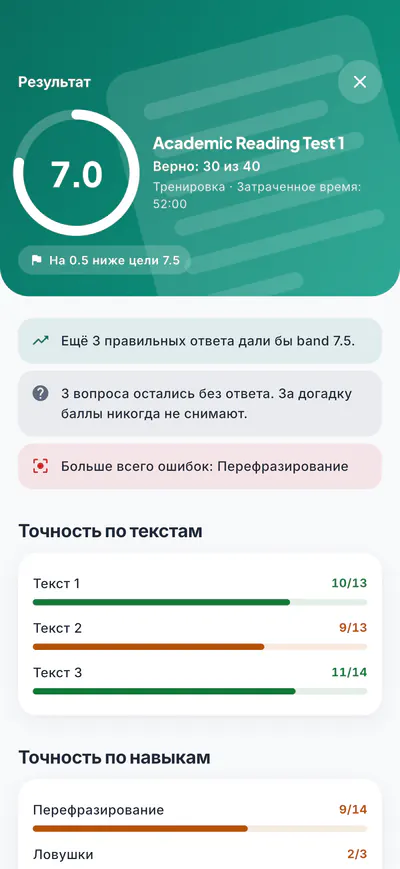
Результат пробного теста IELTS в приложении «Fleydo: подготовка к IELTS»: примерный band и точность по каждой части
Бесплатный пробный урок

Узнайте свой реальный балл IELTS до экзамена

Бесплатный индивидуальный онлайн-урок с преподавателем — носителем английского, сертифицированным специалистом по IELTS с баллом 8.5+. Вы получите диагностику Speaking в реальном формате экзамена, честную оценку вашего band и план работы именно над теми критериями, которые отнимают у вас баллы. Без оплаты и обязательств.

Онлайн · Индивидуально · Academic и General Training

IELTS — зарегистрированный товарный знак British Council, IDP: IELTS Australia и Cambridge University Press & Assessment. Эти пробные тесты составлены командой Fleydo; названные организации их не утверждали и не одобряли.

Мобильное приложение

Fleydo English School у вас в кармане

Уроки, домашние задания, сообщения и игры для учеников Fleydo и их родителей. Бесплатно на iPhone и Android.

Загрузите в App StoreСкачать из Google Play
Подробнее о приложении
QR-код, открывающий приложение Fleydo English School в App Store или Google PlayОтсканируйте и скачайтеОткроет нужный магазин для вашего телефона.fleydo.com/app
Значок приложения Fleydo IELTS
Fleydo: подготовка к IELTS

Готовитесь к IELTS?

«Fleydo: подготовка к IELTS» — отдельное приложение с пробными тестами по всем четырём навыкам. Аккаунт Fleydo для него не нужен.

Подробнее о приложении IELTS
Загрузите в App StoreСкачать из Google Play
Пробные тесты IELTS

Тренируйте все четыре навыка IELTS

Всего тестов: 311. Балл сразу после теста, разбор каждого ответа и образцы для Writing и Speaking. Без регистрации.

Все пробные тесты
FleyPath

Персональная карта вашего ребёнка — 3, 6 или 12 месяцев

🚀Старт
👋Hello
😊Body
🦁Animals
🔢Numbers
🏆Уверенный английский
Геймифицированная практика английского

Как игра — только они действительно учатся