1. Главная
  2. IELTS
  3. Пробные тесты
  4. Reading
  5. Reading Yes/No/Not Given: тренировка 3

IELTS Reading · Yes / No / Not Given

IELTS Reading Yes/No/Not Given: тренировка 3

Parking rules

  • 13 вопросов
  • 15 мин
  • Academic

Что в этом тесте

  1. PassageВопросы 1–13Who should count the spaces?

Типы вопросов

  • Yes / No / Not Given
ReadingIELTS Reading Yes/No/Not Given: тренировка 3
Осталось времени15:00

Passage

Who should count the spaces?

A Most American cities still tell developers how many parking spaces a new building must contain, and such rules go back about a century. They were not a foolish idea. Cars were multiplying, kerbs were overcrowded, and the rules often eased those problems. Even so, I believe cities should stop imposing them. My quarrel is with the remedy, not with the worry behind it.

B Consider how the numbers were reached. In 1999 the planning scholar Donald Shoup examined a manual from which cities commonly drew their ratios. Half of its parking rates rested on four surveys or fewer, and 22 per cent on a single survey. Since nearly all parking is free, the figures also showed only what drivers would use at no charge. I would hesitate to base a recommendation on evidence so thin, let alone a law.

C The remedy is also expensive. One analysis of 17 American cities put the average cost of a space, excluding land, at about $52,000 in an above-ground structure and $73,000 underground. Residents appear to bear much of this: in 2011 survey data, American renters with a garage space were estimated to pay about 17 per cent more in rent, and most renter households without a car had a space bundled into their housing. Nor is the burden evenly shared. In seven cities, the same analysis put required underground parking at 27 per cent of construction costs for a small studio flat but 17 per cent for a two-bedroom flat, which strikes me as exactly the wrong way round. When Los Angeles lifted the requirement in 1999 for converting empty buildings into homes, over 6,000 units appeared downtown in under a decade, more than in the previous thirty years. The same law relaxed other rules too, and a housing boom helped, so parking cannot claim all the credit.

D Critics reply that developers, once released, would abandon parking and leave residents fighting over the street. That fear has been overstated. After Seattle cut or removed its requirements in parts of the city in 2012, developers built about 40 per cent less parking than would otherwise have been required, yet 70 per cent of projects in areas with no requirement still provided some. In Buffalo, which scrapped its minimums citywide, the overall fall among the 36 projects studied in the first two years was not statistically significant; only mixed-use schemes cut back sharply. To me this unevenness is the best argument for repeal. Builders are judging each site for themselves, and lenders have a say too: in Los Angeles, they were reluctant to finance homes with no parking at all.

E Parking also changes behaviour. San Francisco offers unusually clean evidence, because its lotteries for below-market homes place households in buildings essentially at random, so researchers need not worry that keen drivers simply chose homes with garages. They found that 38 per cent of households owned a car in buildings with no on-site parking, against more than 81 per cent where there was at least one space per home. More parking also meant more driving and less use of public transport, with no detectable effect on employment. I would not assume that those figures would hold in a small town with few buses. The direction of the effect, though, is hard to dismiss.

F Crowded kerbs remain a real cost. The authors of a study of London, which replaced minimums with maximums in 2004, found that parking in new housing fell by about 40 per cent, yet they concluded that such reform often needs support from measures such as on-street controls. I agree: a city that drops the rule must be ready to manage its streets. Nor should anyone promise a quick transformation. A 2026 University of California review calls the early effects of repeal modest rather than dramatic, and the spaces already built will be with us for many years.

Глоссарий
kerbs
the edges of a road, where the street meets the pavement; drivers often park beside them
bundled
included in one price with something else, not charged separately
mixed-use
combining different purposes in one project, such as homes and shops
below-market homes
homes sold or rented for less than the usual price in that area
PassageВопросы 1–13
Вопросы 1–13

Do the following statements agree with the claims of the writer in the text? YES if the statement agrees with the claims of the writer NO if the statement contradicts the claims of the writer NOT GIVEN if it is impossible to say what the writer thinks about this

1Parking requirements were misguided from the very beginning.
2The authors of the manual intended cities to treat its figures as legal standards.
3The figures in the manual were a sound basis for legal requirements.
4Landlords ought to be obliged to charge for parking separately from rent.
5It is wrong that required parking adds proportionally more to the cost of smaller homes.
6The growth of housing in downtown Los Angeles was due only to the change in parking rules.
7Worries that developers would stop providing parking have been exaggerated.
8The differing results after repeal weaken the argument for ending requirements.
9Lenders are wrong to be cautious about homes without parking.
10The method of allocating homes in San Francisco makes the study there especially reliable.
11The San Francisco percentages can be expected to apply in a small community with a limited bus service.
12Charging drivers for street parking is the most effective way of dealing with crowded kerbs.
13Cities that abolish requirements should not expect rapid results.

Ответы и объяснения

Сначала пройдите тест: ключи полезнее, когда вы уже ответили.

Показать ключи и объяснения
  1. 1
    NO

    Paragraph A says the rules 'were not a foolish idea' and often eased real problems. The writer wants them ended now but does not call them a mistake from the start, so the statement contradicts the writer: NO.

  2. 2
    NOT GIVEN

    Paragraph B criticises how cities used the manual and how thin its evidence was, but it does not say what its authors wanted. We cannot tell what the writer thinks about this, so NOT GIVEN, not YES.

  3. 3
    NO

    The writer calls the evidence 'so thin' and would hesitate to use it even for a recommendation, 'let alone a law'. Thin evidence is not a sound basis, so the statement contradicts the writer.

  4. 4
    NOT GIVEN

    The writer notes that a space is often bundled into housing, even for people without cars, but never proposes a rule about separate charges. The writer's view on this is unknown, so NOT GIVEN, not YES.

  5. 5
    YES

    Paragraph C shows parking takes a larger share of costs for a studio flat than for a two-bedroom flat. 'Exactly the wrong way round' shows the writer disapproves, so the statement agrees with the writer.

  6. 6
    NO

    The writer says the law relaxed other rules too and a housing boom helped, 'so parking cannot claim all the credit'. Saying the growth was due only to parking rules contradicts this, so the answer is NO, not NOT GIVEN.

  7. 7
    YES

    The fear in paragraph D is that developers 'would abandon parking'. 'Overstated' means exaggerated, and the writer supports this with figures from Seattle. The statement says the same thing in other words, so YES.

  8. 8
    NO

    'Unevenness' refers to the differing results in paragraph D. The writer calls this 'the best argument for repeal', so it strengthens the case in the writer's view. The statement says the opposite, so NO.

  9. 9
    NOT GIVEN

    Paragraph D reports that lenders in Los Angeles were reluctant to finance homes with no parking, but the writer does not say whether they are right or wrong. Mentioning a fact is not judging it, so NOT GIVEN.

  10. 10
    YES

    The writer calls the evidence 'unusually clean' because lotteries place households essentially at random. Allocating homes by lottery is the method in the statement, and clean evidence is reliable evidence, so the answer is YES.

  11. 11
    NO

    The writer would not assume the figures hold in a small town with few buses, so they cannot be expected to apply there. The writer does give a view and accepts only the direction of the effect, so NO, not NOT GIVEN.

  12. 12
    NOT GIVEN

    Paragraph F says cities must manage their streets and mentions on-street controls, but it does not mention charging drivers or say which measure works best. The writer's view is unknown, so NOT GIVEN, not YES.

  13. 13
    YES

    The writer warns against promising 'a quick transformation' and cites early effects described as 'modest rather than dramatic'. Not expecting rapid results says the same thing in other words, so the answer is YES.

Ключевые слова из этого теста

Passage

remedy
a way of dealing with a problem
burden
a heavy cost or duty that someone has to carry
overstated
described as bigger or more serious than it really is
repeal
the official ending of a law or rule
dismiss
to decide that something is not worth considering
Как отвечать на вопросы типа «Yes / No / Not Given»Work out what the writer claims, and keep it apart from what others say.

What the task looks like

You get a list of statements and this instruction:

Do the following statements agree with the claims of the writer in Reading Passage 2? YES if the statement agrees with the claims of the writer NO if the statement contradicts the claims of the writer NOT GIVEN if it is impossible to say what the writer thinks about this

The task tests whether you can identify the writer's views and claims, so it suits a text that argues a case. In our papers, the statements follow the order of the text.

Preparing for General Training? Our General Training papers do not include this type. Official sources do not all agree on whether the real General Training test can include it, so it is still worth knowing how it works.

Information or claims?

True/False/Not Given is about information: what does the text report? Yes/No/Not Given is about the writer: what does the writer claim or believe? So the question changes from 'Does the text mention this?' to 'Would the writer agree with this?'

Take this sentence: Some visitors say that museums should remove written labels, but this idea is misguided.

In a True/False task, 'Some visitors want labels removed' is TRUE, because the text reports it. In a Yes/No task, 'Museums should remove written labels' is NO, because the writer rejects it.

A claim is not only an opinion. If the writer states that something is so, that is a claim too, even when it sounds like a plain fact.

NO or NOT GIVEN: three questions

NO works like FALSE, except that the clash is with the writer's position. Ask these questions in order:

1. Does the writer say this, or clearly show this view? If so, the answer is YES.

2. Imagine the writer reading the statement. Would it go against what the writer has claimed? If so, the answer is NO.

3. Is the writer's view on this exact point impossible to tell? Perhaps the writer does not deal with it, or only reports what other people think. Then the answer is NOT GIVEN.

In short: NO means the writer has taken the opposite position. NOT GIVEN means the writer has not shown a position.

Делайте
  • Before you answer YES or NO, point to the words that show the writer's own position.

Worked example 1: who is speaking?

Text: Some visitors say that museums should remove written labels so that people can simply look. This is an appealing idea, but it is misguided. A label takes seconds to read, and without one an object can remain a mystery.

Statement: Museums ought to take away their written labels.

СлабееYES. The first sentence says museums should remove labels, so the statement agrees with the text.
ЛучшеNO. Those are the words of 'some visitors'. The writer then calls the idea 'misguided', so the writer's own claim goes against the statement.

Words in the text are not always the writer's own view. First find out who is speaking.

Worked example 2: do not build a view for the writer

Same text. Statement: Museums with written labels attract more visitors.

СлабееYES. The writer is clearly in favour of labels, so the writer must believe they bring in more people.
ЛучшеNOT GIVEN. The writer's reasons are about how quickly a label can be read and how it helps people understand an object. Nothing shows what the writer thinks about visitor numbers.

Knowing the writer's general attitude is not enough. The writer's view on this exact point must be clear.

Worked example 3: reporting without taking sides

Text: Some visitors enjoy audio guides, while others find them distracting. The museum now offers both audio guides and printed maps.

Statement: Audio guides are distracting.

СлабееYES. The text says that people find them distracting.
ЛучшеNOT GIVEN. The writer reports two groups with opposite feelings and does not side with either. It is impossible to say what the writer thinks.

A reported view is not the writer's view. In a True/False task, 'Some visitors find audio guides distracting' would be TRUE. Here the question is about the writer, and the writer has not said.

A method to try

1. Skim the text for the writer's overall position. What is the writer arguing for or against?

2. Take a statement and find the part of the text that deals with its idea.

3. Sort the voices. 'Some argue', 'critics say' and 'it is often claimed' introduce other people's ideas. 'I believe', 'in fact', 'should' and 'this is mistaken' may show the writer's own.

4. Read on after a reported view. A word such as 'but' or 'however' may mean the writer is about to reply.

5. Ask the three questions.

The traps

A view rejected later: the writer may set out an idea fairly in one sentence and reject it in the next.

Your own opinion: you may agree strongly with a statement, but only the writer's view counts.

Attitude words: 'sadly', 'surprisingly', 'so-called' and 'merely' can show what the writer feels, even in a sentence that looks like plain information.

Half agreement: the writer may accept part of an idea. 'Labels help in small museums, but not in large ones' goes against a statement about all museums, so compare the whole statement.

Значок приложения Fleydo IELTS Fleydo: подготовка к IELTS

Эти тесты всегда с вами — в телефоне

Все тесты с этих страниц есть и в приложении «Fleydo: подготовка к IELTS» для iPhone, iPad и Android, а вместе с ними — 2 000 слов для IELTS с озвучкой.

  • Работает офлайн, когда тест уже загружен на телефон
  • 2 000 слов для IELTS с озвучкой, интервальным повторением и короткими упражнениями
  • Записывайте ответы Speaking и прослушивайте их
  • План на каждый день под ваш целевой band и дату экзамена
Загрузите в App StoreСкачать из Google Play
Отсканируйте, чтобы скачатьОткроет App Store или Google Play в зависимости от вашего телефона.

Аккаунт не нужен. О приложении

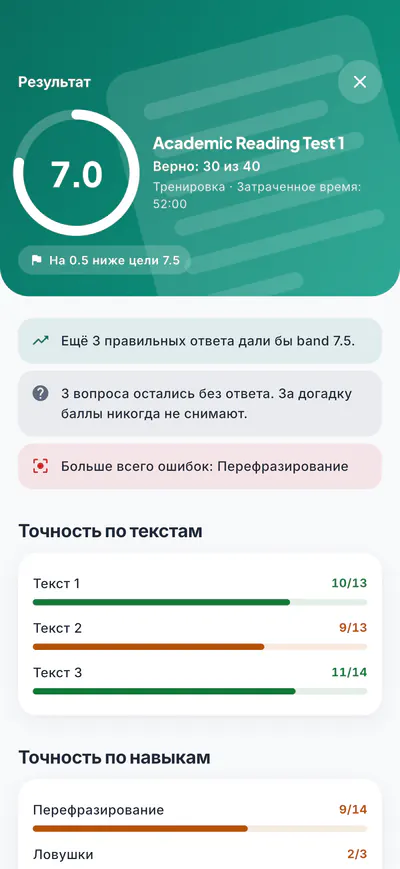
Результат пробного теста IELTS в приложении «Fleydo: подготовка к IELTS»: примерный band и точность по каждой части
Бесплатный пробный урок

Узнайте свой реальный балл IELTS до экзамена

Бесплатный индивидуальный онлайн-урок с преподавателем — носителем английского, сертифицированным специалистом по IELTS с баллом 8.5+. Вы получите диагностику Speaking в реальном формате экзамена, честную оценку вашего band и план работы именно над теми критериями, которые отнимают у вас баллы. Без оплаты и обязательств.

Онлайн · Индивидуально · Academic и General Training

IELTS — зарегистрированный товарный знак British Council, IDP: IELTS Australia и Cambridge University Press & Assessment. Эти пробные тесты составлены командой Fleydo; названные организации их не утверждали и не одобряли.

Мобильное приложение

Fleydo English School у вас в кармане

Уроки, домашние задания, сообщения и игры для учеников Fleydo и их родителей. Бесплатно на iPhone и Android.

Загрузите в App StoreСкачать из Google Play
Подробнее о приложении
QR-код, открывающий приложение Fleydo English School в App Store или Google PlayОтсканируйте и скачайтеОткроет нужный магазин для вашего телефона.fleydo.com/app
Значок приложения Fleydo IELTS
Fleydo: подготовка к IELTS

Готовитесь к IELTS?

«Fleydo: подготовка к IELTS» — отдельное приложение с пробными тестами по всем четырём навыкам. Аккаунт Fleydo для него не нужен.

Подробнее о приложении IELTS
Загрузите в App StoreСкачать из Google Play
Пробные тесты IELTS

Тренируйте все четыре навыка IELTS

Всего тестов: 311. Балл сразу после теста, разбор каждого ответа и образцы для Writing и Speaking. Без регистрации.

Все пробные тесты
FleyPath

Персональная карта вашего ребёнка — 3, 6 или 12 месяцев

🚀Старт
👋Hello
😊Body
🦁Animals
🔢Numbers
🏆Уверенный английский
Геймифицированная практика английского

Как игра — только они действительно учатся