1. Главная
  2. IELTS
  3. Пробные тесты
  4. Reading
  5. Reading Sentence Endings: тренировка 2

IELTS Reading · Соотнесение окончаний предложений

IELTS Reading Sentence Endings: тренировка 2

The first traffic lights

  • 8 вопросов
  • 15 мин
  • Academic

Что в этом тесте

  1. PassageВопросы 1–8Who changes the lights?

Типы вопросов

  • Соотнесение окончаний предложений
ReadingIELTS Reading Sentence Endings: тренировка 2
Осталось времени15:00

Passage

Who changes the lights?

A What is usually described as the world's first traffic signal went up outside the Houses of Parliament in London in December 1868. It was proposed by John Peake Knight, a railway superintendent, and looked like a railway signal: by day, moving arms told traffic to stop or to go on with caution, while after dark a gas lamp showed red and green. A police constable worked it by hand. In January 1869 a gas leak caused an explosion that injured the officer operating it, and no successor appeared in the capital until the 1920s.

B Much of the later development took place in the United States, and it used electricity. In Salt Lake City in 1912, a policeman named Lester Wire is credited with building an electric light: red and green lamps in a box on a pole, which an officer switched by hand. In Cleveland, in August 1914, the American Traffic Signal Company put four pairs of red and green lights at one junction. An officer in a booth beside the road operated them, using a switch designed to prevent conflicting signals, and a buzzer warned that the colours were about to change.

C Each of these still needed a person at the controls, but one person could now do more. In 1917 Salt Lake City connected six junctions to one manual switch. In Detroit in 1920 a traffic officer, William Potts, designed a signal that faced four ways, with an amber light between green and red to warn drivers of a change. Three-colour signals had become the American standard by the mid-1930s.

D In the 1920s machines began to take over from people. Los Angeles installed automated signals at five places on Broadway in 1920, and by 1924 the company Crouse-Hinds was selling a signal with an automatic timing switch in its base. Fewer officers would be needed at junctions: in June 1925 Washington's traffic director said that Detroit was installing signals that would release 150 traffic policemen for other traffic duties. Timing also allowed signals to be coordinated. Where the changes were staggered along a street, drivers holding a steady speed would meet nothing but green. In January 1926 Washington, D.C., switched on synchronised automatic lights along Sixteenth Street. Britain's automatic lights began with a trial in Wolverhampton in 1927.

E A fixed timer has its own flaw, as it can hold a driver at a red light when nothing is crossing. Charles Adler Jr, a Baltimore inventor who later said he had disliked being stopped by a clock, responded with a signal that reacted to sound. Put up in Baltimore in February 1928, and designed for places where a lightly used road met a major one, it changed when a driver waiting at the red light sounded the horn. According to Adler, it also blinked wildly when cows mooed nearby. The device had only minor success, and a rival soon overtook it: a pair of metal plates set in the road surface, which could tell when a vehicle was there.

F Computers extended the same idea. In 1952 Denver put all the signals in its downtown under one electronic controller, which kept count of the traffic, worked out the direction of the heaviest flow and lengthened the green lights for it. By the 1960s, better computers could watch the traffic and adjust the lights to suit it.

Глоссарий
superintendent
a person who manages part of an organisation
constable
a police officer of the lowest rank
staggered
arranged to happen one after another rather than all at once
controller
a device that directs how a machine or system works
PassageВопросы 1–8
Вопросы 1–8

Complete each sentence with the correct ending, A-K, below.

Варианты
  • Aoffered an unbroken run of green to motorists keeping a constant speed.
  • Bkept its coloured lights inside a case mounted on a post.
  • Cwas designed to stop drivers receiving contradictory instructions.
  • Dcounted vehicles in order to time the lights across a whole district.
  • Eresembled equipment from a different form of transport.
  • Fwas abandoned because drivers ignored it.
  • Gwas expected to free police officers for other duties.
  • Hgave motorists advance notice of a new colour.
  • Iwas intended for junctions between a quiet road and a busy one.
  • Jdepended on an officer listening out for vehicles.
  • Kallowed one hand-operated control to serve several crossings.
1The design put forward by Knight
2The switch used in Cleveland
3The 1917 arrangement in Salt Lake City
4The amber light on Potts's signal
5The installation of new signals in Detroit
6Setting signals along a street to change one after another
7The sound-activated signal devised by Adler
8The 1952 system in Denver

Ответы и объяснения

Сначала пройдите тест: ключи полезнее, когда вы уже ответили.

Показать ключи и объяснения
  1. 1
    E

    Paragraph A says Knight's street signal 'looked like a railway signal'. A railway is a different form of transport from a road. Ending F fails: the paragraph mentions an explosion and never says that drivers ignored the signal.

  2. 2
    C

    Paragraph B says the switch was 'designed to prevent conflicting signals'. Conflicting signals are contradictory instructions. Ending H is the trap: the warning of a change in Cleveland came from the buzzer, not the switch.

  3. 3
    K

    Paragraph C says Salt Lake City 'connected six junctions to one manual switch'. Six junctions are several crossings, and a manual switch is operated by hand. Ending B describes the city's earlier signal of 1912 in paragraph B, not this arrangement.

  4. 4
    H

    Paragraph C says the amber light came between green and red 'to warn drivers of a change'. A warning before a change is advance notice. Ending C belongs to the Cleveland switch, which prevented conflicting signals.

  5. 5
    G

    Paragraph D says Detroit's new signals 'would release 150 traffic policemen for other traffic duties'. That frees officers for other work. Ending D fails, because nothing says these signals counted traffic.

  6. 6
    A

    Paragraph D says that where changes were staggered, coming one after another, drivers holding a steady speed 'would meet nothing but green'. That is an unbroken run of green. Ending K fails, because this paragraph mentions no hand-operated control.

  7. 7
    I

    Paragraph E says the signal was 'designed for places where a lightly used road met a major one'. Those are a quiet road and a busy one. Ending J is the trap: the signal reacted to horns, and no officer listened.

  8. 8
    D

    Paragraph F says one controller ran all the downtown signals, kept count of the traffic and lengthened the green for the heaviest flow. Ending K also describes shared control, but it says hand-operated, which fits the switch in Salt Lake City, not an electronic controller.

Ключевые слова из этого теста

Passage

proposed
suggested an idea or plan for others to consider
conflicting
saying opposite things, so that both cannot be followed
flaw
a weakness that stops something working well
coordinated
organised so that the parts work well together
overtook
passed something and became more successful than it
Как отвечать на вопросы типа «Соотнесение окончаний предложений»Join each sentence beginning to the ending that says what the text says.

What the task looks like

You get some sentence beginnings and a longer list of lettered endings. You join each beginning to one ending, to make a sentence that agrees with the text.

The task tests whether you understand the main ideas, not only whether two halves make good English. In our papers there are spare endings, so some are not used.

Preparing for General Training? Our General Training papers do not include this type. Official sources do not all agree on whether the real General Training test can include it, so it is still worth knowing how it works.

A method to try

1. Read one beginning, mark its main words, and find the part of the text that deals with this idea. The beginnings follow the order of the text, so each answer comes after the last one.

2. Before you look at the endings, say in your own words how the text would finish this sentence.

3. Look for the ending closest to your version. Rule out any that cannot follow the beginning grammatically.

4. Read the whole sentence and check it against the text. Good English is not enough.

The traps

Good grammar, wrong meaning: several endings may join the beginning neatly, so grammar alone may not decide.

True, but about something else: an ending may state something from the text that has nothing to do with this beginning.

Reversal: an ending may turn the text round, so that the cause becomes the result.

Borrowed words: an ending that repeats words from the text is not more likely to be right. The right one often says the idea in new words.

Worked example

Text: The town's ferry used to run only in summer. Demand from commuters led the operator to add a winter service, although rough weather still cancels some crossings. A larger boat, due next year, should reduce these cancellations.

Beginning: The winter ferry service began ... A because people travelling to work wanted it. B because a bigger boat had been delivered. C so that fewer crossings would be cancelled. D after the rough weather had come to an end.

СлабееC. The text talks about reducing cancellations, and 'The winter ferry service began so that fewer crossings would be cancelled' reads well.
ЛучшеA. 'Demand from commuters led the operator to add a winter service.' Commuters are people travelling to work. C is what the larger boat should do, not why the service began.

All four endings are good English. Check the complete sentence against what the text says about this beginning.

Значок приложения Fleydo IELTS Fleydo: подготовка к IELTS

Эти тесты всегда с вами — в телефоне

Все тесты с этих страниц есть и в приложении «Fleydo: подготовка к IELTS» для iPhone, iPad и Android, а вместе с ними — 2 000 слов для IELTS с озвучкой.

  • Работает офлайн, когда тест уже загружен на телефон
  • 2 000 слов для IELTS с озвучкой, интервальным повторением и короткими упражнениями
  • Записывайте ответы Speaking и прослушивайте их
  • План на каждый день под ваш целевой band и дату экзамена
Загрузите в App StoreСкачать из Google Play
Отсканируйте, чтобы скачатьОткроет App Store или Google Play в зависимости от вашего телефона.

Аккаунт не нужен. О приложении

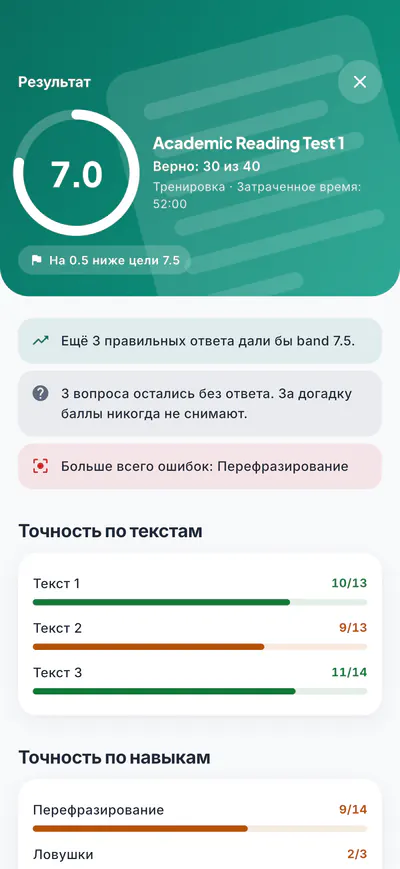
Результат пробного теста IELTS в приложении «Fleydo: подготовка к IELTS»: примерный band и точность по каждой части
Бесплатный пробный урок

Узнайте свой реальный балл IELTS до экзамена

Бесплатный индивидуальный онлайн-урок с преподавателем — носителем английского, сертифицированным специалистом по IELTS с баллом 8.5+. Вы получите диагностику Speaking в реальном формате экзамена, честную оценку вашего band и план работы именно над теми критериями, которые отнимают у вас баллы. Без оплаты и обязательств.

Онлайн · Индивидуально · Academic и General Training

IELTS — зарегистрированный товарный знак British Council, IDP: IELTS Australia и Cambridge University Press & Assessment. Эти пробные тесты составлены командой Fleydo; названные организации их не утверждали и не одобряли.

Мобильное приложение

Fleydo English School у вас в кармане

Уроки, домашние задания, сообщения и игры для учеников Fleydo и их родителей. Бесплатно на iPhone и Android.

Загрузите в App StoreСкачать из Google Play
Подробнее о приложении
QR-код, открывающий приложение Fleydo English School в App Store или Google PlayОтсканируйте и скачайтеОткроет нужный магазин для вашего телефона.fleydo.com/app
Значок приложения Fleydo IELTS
Fleydo: подготовка к IELTS

Готовитесь к IELTS?

«Fleydo: подготовка к IELTS» — отдельное приложение с пробными тестами по всем четырём навыкам. Аккаунт Fleydo для него не нужен.

Подробнее о приложении IELTS
Загрузите в App StoreСкачать из Google Play
Пробные тесты IELTS

Тренируйте все четыре навыка IELTS

Всего тестов: 311. Балл сразу после теста, разбор каждого ответа и образцы для Writing и Speaking. Без регистрации.

Все пробные тесты
FleyPath

Персональная карта вашего ребёнка — 3, 6 или 12 месяцев

🚀Старт
👋Hello
😊Body
🦁Animals
🔢Numbers
🏆Уверенный английский
Геймифицированная практика английского

Как игра — только они действительно учатся