1. Strona główna
  2. IELTS
  3. Testy próbne
  4. Writing
  5. Loud headphones

IELTS Writing · Task 2

IELTS Writing Task 2: Loud headphones

  • Problem i rozwiązanie
  • 40 min
  • Słowa: 250
  • Academic i General Training

WRITING TASK 2

You should spend about 40 minutes on this task.

Many young people listen to music and videos through headphones for hours each day, often so loudly that it may harm their hearing. What problems could this cause, and what solutions can you suggest? Give reasons for your answer and include any relevant examples from your own knowledge or experience.

Write at least 250 words.

40:00
0 / 250 słów

Oceń swoją odpowiedź

Najpierw przeczytaj wzorcowe odpowiedzi. Potem w każdym kryterium wybierz band, który pasuje do Twojej odpowiedzi. Twój wynik to średnia zaokrąglona do najbliższej połowy band.

6,0Twój szacowany band
Task response

Coherence and cohesion

Lexical resource

Grammatical range and accuracy

Każdy wzór jest napisany tak, jak napisałby go inny kandydat, więc szczegóły i opinie się różnią. Bandy to nasz szacunek według publicznych deskryptorów, a nie oficjalne oceny egzaminatora.

Wzorcowe odpowiedzi na czterech poziomach band

Każdy wzór jest napisany tak, jak napisałby go inny kandydat. Wyniki band to nasz szacunek według publicznych deskryptorów band.

Wzór na band 5,5Słowa: 259

Nowadays every teenager have headphones and they use them all day, on bus, at school and at home. They listen music very loud and this is dengerous for their ears. There are some problems about this and also some solutions.

The main problem is hearing. If a student listen loud music many hours, his ears can become bad after some years. Then in the class he can't hear the teacher very well and his marks go down. Also he asks his friends to repeat every sentense, after some time they feel tired and they don't want to talk with him. Maybe he will feel alone.

Another problem is the traffic. When you wear headphones with loud sound you can't hear cars or motorbikes, so you can have acident on the street. In big cities the traffic is very much, so it is more dangerous. Some jobs also want good hearing, so in the future it can be hard to find work.

There are some solutions for this. Firstly, parents must control their children and tell them to make the sound lower. But teenagers don't always listen to parents so it is not enough. Secondly, schools can teach this subject in lessons and show films about ears. Thirdly, the companies which produce phones should put a limit for sound, so nobody can't go over this limit.

To sum up, loud headphones are bad for young people's ears and also for their life. Families, schools and companies should work together and then young people can listen music without danger in future.

Dlaczego ten band

  • Both parts are covered, and the writer notices a weakness in one solution: 'But teenagers don't always listen to parents'.
  • Some points are simply named and left, such as 'Some jobs also want good hearing' and 'Maybe he will feel alone'.
  • The habits are articles and verb patterns: 'on bus', 'listen music', 'have acident'. Spelling follows the sound in 'dengerous' and 'sentense'.

Kryterium po kryterium

Task response
Problems and solutions are both answered, and the classroom example is explained. The jobs and traffic points get little development, and the phone limit is not explained.
Coherence and cohesion
A plain plan: 'The main problem', 'Another problem', then 'Firstly', 'Secondly', 'Thirdly'. 'problem' and 'young people' are repeated, and the last line adds nothing new.
Lexical resource
Simple words, mostly enough. 'his ears can become bad' stands in for a word this writer does not have, and 'parents must control their children' is too strong for what is meant.
Grammatical range and accuracy
Mostly short sentences, with errors in nearly half. 'every teenager have', 'nobody can't' and 'the traffic is very much' are typical, and 'every sentense, after some time they feel tired' is a comma splice.

Jak osiągnąć kolejny band

Learn the pattern 'listen to something' and check 'a' and 'the' before nouns. Then give each solution one more sentence explaining how it would change what a teenager actually does.

Zaplanuj, zanim zaczniesz pisać

Czego wymaga polecenie

The question has two parts: the problems that could follow from the habit, and what could be done. You are not expected to know any medicine, and you should not pretend to. The trap is making up medical facts, or drifting into screen time and loneliness, when this question is about loud sound. Another is ending with 'parents should tell them', with no thought about why a teenager would listen.

Twoja główna myśl

Say what the habit could cost a young person in ordinary life, and offer a solution that works even when nobody is watching. One workable message: loud listening is private and its possible effects feel far away, so warnings alone are weak, and changing the settings on the devices would help more.

Akapit po akapicie

  1. IntroductionDescribe the habit in your own words and say in one line that it could cause real difficulties but can be reduced.
  2. ProblemsChoose two or three practical effects and explain each with 'could' or 'may': following a teacher, some kinds of work, safety when you cannot hear what is around you.
  3. SolutionsMatch each solution to a problem and say who would act: phone makers, parents, schools, or people young listeners already respect. Say why it would work with teenagers.
  4. ConclusionBring the main risk and your best solution together in a fresh sentence or two.

Częste błędy

  • Inventing medical facts, such as a safe number of hours or a percentage of teenagers affected. Say 'may' and 'could', and use reasons from ordinary life.
  • Writing about too much screen time, poor sleep or social isolation. The question is about loud sound and what it could do.
  • Stopping at 'they will have hearing problems'. Say what that would mean in a classroom, at work or among friends.
  • Telling teenagers to stop using headphones. It is not realistic, and the problem is the volume, not the headphones.
  • Solutions that depend only on adults checking. Nobody else can hear how loud someone's headphones are.

Słownictwo tematyczne

volume
how loud a sound is
to turn up / to turn down
to make a sound louder or quieter
hearing aid
a small device worn to help someone hear better
default setting
how a device works unless the user changes it
manufacturer
a company that makes a product
to dismiss
to decide that something is not worth thinking about
awareness
knowing that something exists or matters
safety standard
an official rule that a product must meet before it is sold

Przydatne zwroty

  • One possible consequence is that ...
  • This could make it harder for ... to ...
  • Because the effects may not appear until ..., many ... do not ...
  • A warning is unlikely to work unless ...
  • ... could be required to ..., so that ...
  • Rather than relying on ..., it would be better to ...
  • This would make ... the easy option.

Ikona aplikacji Fleydo IELTS Fleydo: Przygotowanie do IELTS

Zabierz te testy ze sobą na telefon

Każdy test z tych stron jest też w aplikacji Fleydo: Przygotowanie do IELTS na iPhone’a, iPada i Androida, razem z 2 000 słówek IELTS z nagraniami.

  • Działa offline, gdy test jest już na telefonie
  • 2 000 słówek IELTS z nagraniami, powtórki rozłożone w czasie i krótkie ćwiczenia
  • Nagrywaj swoje odpowiedzi w Speaking i odsłuchuj je
  • Plan na każdy dzień pod Twój docelowy band i datę egzaminu
Pobierz w App StorePobierz z Google Play
Zeskanuj, aby pobraćOtwiera App Store lub Google Play, zależnie od Twojego telefonu.

Konto nie jest potrzebne. O aplikacji

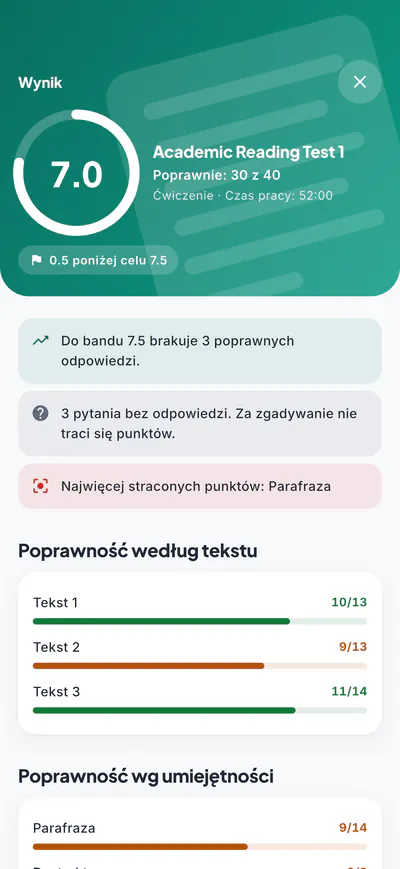
Wynik testu próbnego IELTS w aplikacji Fleydo: Przygotowanie do IELTS: szacowany band i poprawność w każdej części
Bezpłatna lekcja próbna

Poznaj swój prawdziwy wynik IELTS, zanim zrobi to egzamin

Bezpłatna indywidualna lekcja online z nauczycielem native speakerem, certyfikowanym specjalistą IELTS z wynikiem Band 8.5+. Otrzymasz diagnozę Speaking w prawdziwym formacie, uczciwą ocenę szacowanego wyniku i plan pracy nad dokładnie tymi kryteriami, które kosztują Cię punkty. Bez płatności, bez zobowiązań.

Online · Indywidualnie · Academic i General Training

IELTS jest zastrzeżonym znakiem towarowym British Council, IDP: IELTS Australia oraz Cambridge University Press & Assessment. Te testy próbne zostały przygotowane przez Fleydo i nie są przez te organizacje zatwierdzone ani rekomendowane.

Aplikacja mobilna

Fleydo English School w Twojej kieszeni

Lekcje, prace domowe, wiadomości i gry dla uczniów Fleydo i ich rodziców. Bezpłatna na iPhone’a i Androida.

Pobierz w App StorePobierz z Google Play
Więcej o aplikacji
Kod QR otwierający aplikację Fleydo English School w App Store lub Google PlayZeskanuj i pobierzOtwiera właściwy sklep dla Twojego telefonu.fleydo.com/app
Ikona aplikacji Fleydo IELTS
Fleydo: Przygotowanie do IELTS

Przygotowujesz się do IELTS?

Fleydo: Przygotowanie do IELTS to osobna aplikacja z testami próbnymi ze wszystkich czterech umiejętności. Nie potrzebujesz konta Fleydo, żeby z niej korzystać.

Zobacz aplikację IELTS
Pobierz w App StorePobierz z Google Play
Testy próbne IELTS

Ćwicz wszystkie cztery umiejętności IELTS

Wybieraj spośród 311 testów z natychmiastowym wynikiem band, wyjaśnieniami i wzorcowymi odpowiedziami. Bez rejestracji.

Wszystkie testy próbne
FleyPath

Osobista mapa drogowa Twojego dziecka — 3, 6 lub 12 miesięcy

🚀Start
👋Hello
😊Body
🦁Animals
🔢Numbers
🏆Pewny angielski
Zgrywalizowane ćwiczenie angielskiego

Jak gra — tylko że naprawdę się uczą