1. Home
  2. IELTS
  3. Test di esercitazione
  4. Writing
  5. Loud headphones

IELTS Writing · Task 2

IELTS Writing Task 2: Loud headphones

  • Problema e soluzione
  • 40 min
  • 250 parole
  • Academic e General Training

WRITING TASK 2

You should spend about 40 minutes on this task.

Many young people listen to music and videos through headphones for hours each day, often so loudly that it may harm their hearing. What problems could this cause, and what solutions can you suggest? Give reasons for your answer and include any relevant examples from your own knowledge or experience.

Write at least 250 words.

40:00
0 / 250 parole

Valuta la tua risposta

Leggi prima le risposte modello. Poi, per ogni criterio, scegli la band che corrisponde alla tua risposta. La tua band è la media, arrotondata alla mezza band più vicina.

6,0La tua band stimata
Task response

Coherence and cohesion

Lexical resource

Grammatical range and accuracy

Ogni modello è scritto come lo scriverebbe un candidato diverso, quindi dettagli e opinioni cambiano. Le band sono una nostra stima basata sui descrittori pubblici, non voti ufficiali di un esaminatore.

Risposte modello a quattro livelli di band

Ogni modello è scritto come lo scriverebbe un candidato diverso. Le band sono una nostra stima basata sui descrittori pubblici delle band.

Modello da band 5,5259 parole

Nowadays every teenager have headphones and they use them all day, on bus, at school and at home. They listen music very loud and this is dengerous for their ears. There are some problems about this and also some solutions.

The main problem is hearing. If a student listen loud music many hours, his ears can become bad after some years. Then in the class he can't hear the teacher very well and his marks go down. Also he asks his friends to repeat every sentense, after some time they feel tired and they don't want to talk with him. Maybe he will feel alone.

Another problem is the traffic. When you wear headphones with loud sound you can't hear cars or motorbikes, so you can have acident on the street. In big cities the traffic is very much, so it is more dangerous. Some jobs also want good hearing, so in the future it can be hard to find work.

There are some solutions for this. Firstly, parents must control their children and tell them to make the sound lower. But teenagers don't always listen to parents so it is not enough. Secondly, schools can teach this subject in lessons and show films about ears. Thirdly, the companies which produce phones should put a limit for sound, so nobody can't go over this limit.

To sum up, loud headphones are bad for young people's ears and also for their life. Families, schools and companies should work together and then young people can listen music without danger in future.

Perché questa band

  • Both parts are covered, and the writer notices a weakness in one solution: 'But teenagers don't always listen to parents'.
  • Some points are simply named and left, such as 'Some jobs also want good hearing' and 'Maybe he will feel alone'.
  • The habits are articles and verb patterns: 'on bus', 'listen music', 'have acident'. Spelling follows the sound in 'dengerous' and 'sentense'.

Criterio per criterio

Task response
Problems and solutions are both answered, and the classroom example is explained. The jobs and traffic points get little development, and the phone limit is not explained.
Coherence and cohesion
A plain plan: 'The main problem', 'Another problem', then 'Firstly', 'Secondly', 'Thirdly'. 'problem' and 'young people' are repeated, and the last line adds nothing new.
Lexical resource
Simple words, mostly enough. 'his ears can become bad' stands in for a word this writer does not have, and 'parents must control their children' is too strong for what is meant.
Grammatical range and accuracy
Mostly short sentences, with errors in nearly half. 'every teenager have', 'nobody can't' and 'the traffic is very much' are typical, and 'every sentense, after some time they feel tired' is a comma splice.

Per arrivare alla band successiva

Learn the pattern 'listen to something' and check 'a' and 'the' before nouns. Then give each solution one more sentence explaining how it would change what a teenager actually does.

Fai una scaletta prima di scrivere

Cosa chiede la traccia

The question has two parts: the problems that could follow from the habit, and what could be done. You are not expected to know any medicine, and you should not pretend to. The trap is making up medical facts, or drifting into screen time and loneliness, when this question is about loud sound. Another is ending with 'parents should tell them', with no thought about why a teenager would listen.

Il tuo messaggio principale

Say what the habit could cost a young person in ordinary life, and offer a solution that works even when nobody is watching. One workable message: loud listening is private and its possible effects feel far away, so warnings alone are weak, and changing the settings on the devices would help more.

Paragrafo per paragrafo

  1. IntroductionDescribe the habit in your own words and say in one line that it could cause real difficulties but can be reduced.
  2. ProblemsChoose two or three practical effects and explain each with 'could' or 'may': following a teacher, some kinds of work, safety when you cannot hear what is around you.
  3. SolutionsMatch each solution to a problem and say who would act: phone makers, parents, schools, or people young listeners already respect. Say why it would work with teenagers.
  4. ConclusionBring the main risk and your best solution together in a fresh sentence or two.

Errori comuni

  • Inventing medical facts, such as a safe number of hours or a percentage of teenagers affected. Say 'may' and 'could', and use reasons from ordinary life.
  • Writing about too much screen time, poor sleep or social isolation. The question is about loud sound and what it could do.
  • Stopping at 'they will have hearing problems'. Say what that would mean in a classroom, at work or among friends.
  • Telling teenagers to stop using headphones. It is not realistic, and the problem is the volume, not the headphones.
  • Solutions that depend only on adults checking. Nobody else can hear how loud someone's headphones are.

Lessico dell'argomento

volume
how loud a sound is
to turn up / to turn down
to make a sound louder or quieter
hearing aid
a small device worn to help someone hear better
default setting
how a device works unless the user changes it
manufacturer
a company that makes a product
to dismiss
to decide that something is not worth thinking about
awareness
knowing that something exists or matters
safety standard
an official rule that a product must meet before it is sold

Espressioni utili

  • One possible consequence is that ...
  • This could make it harder for ... to ...
  • Because the effects may not appear until ..., many ... do not ...
  • A warning is unlikely to work unless ...
  • ... could be required to ..., so that ...
  • Rather than relying on ..., it would be better to ...
  • This would make ... the easy option.

Icona dell'app Fleydo IELTS Fleydo: Preparazione IELTS

Porta questi test con te sul telefono

Tutti i test di queste pagine sono anche nell'app Fleydo: Preparazione IELTS per iPhone, iPad e Android, insieme a 2.000 parole IELTS con audio.

  • Funziona offline una volta scaricato il test sul telefono
  • 2.000 parole IELTS con audio, ripetizione spaziata ed esercizi brevi
  • Registra le tue risposte di Speaking e riascoltale
  • Un piano giornaliero per la tua band obiettivo e la data dell'esame
Scarica su App StoreDisponibile su Google Play
Inquadra per scaricareApre App Store o Google Play, a seconda del telefono.

Non serve un account. Scopri l'app

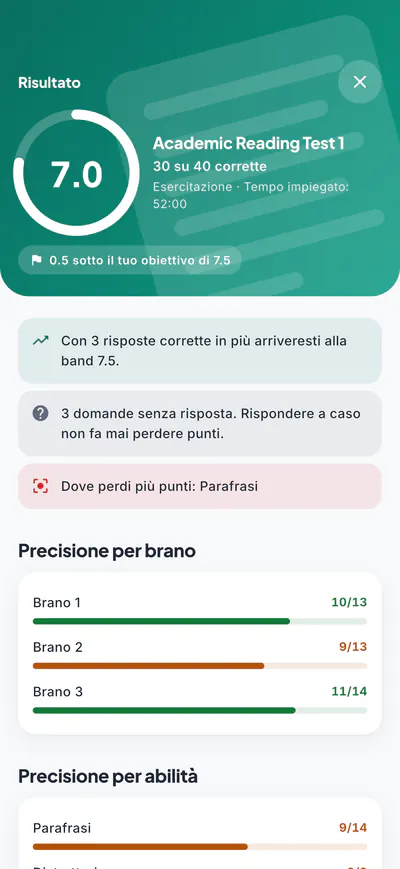
Risultato di un test di esercitazione IELTS nell'app Fleydo: Preparazione IELTS: band stimata e precisione per ogni parte
Lezione di prova gratuita

Scopri il tuo vero band IELTS prima dell'esame

Una lezione individuale online gratuita con un insegnante madrelingua inglese, specialista IELTS certificato Band 8.5+. Ricevi una diagnosi dello Speaking nel formato reale, una stima onesta del tuo band e un piano mirato ai criteri che ti costano punti. Nessun pagamento, nessun impegno.

Online · Individuale · Academic e General Training

IELTS è un marchio registrato del British Council, di IDP: IELTS Australia e di Cambridge University Press & Assessment. Questi test di esercitazione sono scritti da Fleydo e non sono approvati né sostenuti da queste organizzazioni.

App mobile

Fleydo English School in tasca

Lezioni, compiti, messaggi e giochi per gli studenti Fleydo e i loro genitori. Gratuita su iPhone e Android.

Scarica su App StoreDisponibile su Google Play
Scopri di più sull'app
Codice QR che apre l'app Fleydo English School su App Store o Google PlayInquadra per scaricareApre lo store giusto per il tuo telefono.fleydo.com/app
Icona dell'app Fleydo IELTS
Fleydo: Preparazione IELTS

Ti prepari all'IELTS?

Fleydo: Preparazione IELTS è un'app separata con simulazioni per tutte e quattro le abilità. Per usarla non ti serve un account Fleydo.

Scopri l'app IELTS
Scarica su App StoreDisponibile su Google Play
Test di esercitazione IELTS

Esercitati in tutte e quattro le abilità IELTS

311 test con band immediata, soluzioni spiegate e risposte modello. Senza registrazione.

Tutti i test di esercitazione
Il FleyPath

La roadmap personale di tuo figlio — 3, 6 o 12 mesi

🚀Partenza
👋Hello
😊Body
🦁Animals
🔢Numbers
🏆Inglese sicuro
Pratica di inglese gamificata

Come un gioco — solo che stanno davvero imparando