1. Strona główna
  2. IELTS
  3. Testy próbne
  4. Writing
  5. Children's photos online

IELTS Writing · Task 2

IELTS Writing Task 2: Children's photos online

  • Opinia
  • 40 min
  • Słowa: 250
  • Academic i General Training

WRITING TASK 2

You should spend about 40 minutes on this task.

Parents should not share photographs of their young children online, because children of that age are too young to agree to it. To what extent do you agree or disagree? Give reasons for your answer and include any relevant examples from your own knowledge or experience.

Write at least 250 words.

40:00
0 / 250 słów

Oceń swoją odpowiedź

Najpierw przeczytaj wzorcowe odpowiedzi. Potem w każdym kryterium wybierz band, który pasuje do Twojej odpowiedzi. Twój wynik to średnia zaokrąglona do najbliższej połowy band.

6,0Twój szacowany band
Task response

Coherence and cohesion

Lexical resource

Grammatical range and accuracy

Każdy wzór jest napisany tak, jak napisałby go inny kandydat, więc szczegóły i opinie się różnią. Bandy to nasz szacunek według publicznych deskryptorów, a nie oficjalne oceny egzaminatora.

Wzorcowe odpowiedzi na czterech poziomach band

Każdy wzór jest napisany tak, jak napisałby go inny kandydat. Wyniki band to nasz szacunek według publicznych deskryptorów band.

Wzór na band 5,5Słowa: 266

Today everybody has a phone with camera, so many families put pictures of their baby on the internet every day. I agree that they should stop this, because it is dangerous for the child and a baby cannot say yes or no.

Firstly, the internet is not a brivate place. When you put one picture, strengers can see it and they can save it in their phone. We don't know who is this person and what he wants to do with the picture. In the news we see many bad stories about kids, it is very scary. Also the picture can show the name of the school or the street of the family, so these people can know where the child lives.

Secondly, the child will grow up one day. When he become a teenager he will not happy if his friends find an old picture of him, for example with his face dirty from food. Friends will laugh on him at school and he will feel shy. A small child cannot say no to his father, but after ten years he can be angry because his parents did this without asking him.

Some people say the grandmother and the family want to see the baby, especially if they live far away. This is true, but the parents can send the picture only to them, or they can visit.

For these reasons I think the mother and father must keep the pictures for themselves. They love their baby and they want to show him to everybody, but the safty of the child more important than this.

Dlaczego ten band

  • It agrees clearly and gives two reasons, but they stay thin: the danger point stops at 'it is very scary'.
  • The reply to the other side is short but real: 'the parents can send the picture only to them'.
  • Verbs and word order are the main habits: 'who is this person', 'he become', 'he will not happy'. Spelling follows the sound in 'brivate', 'strengers' and 'safty'.

Kryterium po kryterium

Task response
The position is clear and both reasons concern the child. What a stranger might actually do is never said, and the child not agreeing is named in the first paragraph but explained only at the end of the second reason, in 'without asking him'.
Coherence and cohesion
A simple plan marked by 'Firstly' and 'Secondly'. 'picture' and 'the child' return in nearly every sentence, and 'these people' has no clear partner, since only one person has been mentioned.
Lexical resource
Everyday words throughout, which limit the argument: 'bad stories', 'scary', 'kids'. 'feel shy' is too weak for being laughed at, and 'laugh on him' has the wrong preposition.
Grammatical range and accuracy
Mostly short simple sentences, about half with an error. 'who is this person' has the wrong word order, 'he become' lacks its ending, and 'bad stories about kids, it is very scary' joins two sentences with a comma.

Jak osiągnąć kolejny band

Put 'is' or 'are' in every sentence that describes something, and check the verb after 'he'. Then say what a stranger could really do with a photograph, because that is the heart of your first reason.

Zaplanuj, zanim zaczniesz pisać

Czego wymaga polecenie

The statement gives a rule, that parents should not do this, and a reason, that young children cannot agree. Answer both. The first trap is writing about children using phones or social media themselves, when the question is about what adults put online. The second is treating a picture sent to a grandmother and a picture on a public page as the same thing.

Twoja główna myśl

Say how far you accept the rule and what decides it. One workable message: the child's lack of a say matters most when an image is public and cannot be taken back, so sharing with people the family knows is acceptable and public posting is not. A firm yes or no can do just as well if you deal with the point about agreeing; the 5.5 answer mostly agrees and the 6.5 answer mostly disagrees.

Akapit po akapicie

  1. IntroductionPut the claim in your own words and say how far you agree. If you accept part of it, say which part.
  2. Main reasonsChoose what you can explain: what a stranger could do with an image, how the child may feel at twelve or thirteen, or whether a parent's right to decide reaches this far.
  3. The other sideAnswer the strongest reply, such as relatives living far away or parents who are careful. Say why it does or does not change your view.
  4. JudgementFinish with your decision. A practical line is welcome, such as who may see the pictures or when the child should be asked.

Częste błędy

  • Writing about screen time or children's own accounts. The question is about what parents post.
  • Stopping at 'strangers are dangerous' without saying what could actually happen to a photograph once it is online.
  • Ignoring the reason in the statement. Say whether being too young to agree really matters, given that parents decide many other things for small children.
  • Treating all sharing as one act. A closed family group, a public page and a paid advert raise very different concerns.
  • Inventing figures about how many parents post or how many images are misused. Argue from reasons and common experience instead.

Słownictwo tematyczne

consent
permission given by the person affected by something
to upload
to put a file such as a photograph on the internet
audience
the people who can see or read something
privacy
the right to keep your personal life away from other people
permanent
lasting for a very long time or for ever
to embarrass
to make someone feel ashamed or awkward in front of others
to misuse
to use something in a wrong or harmful way
digital footprint
the record of a person that builds up online over time

Przydatne zwroty

  • A child of this age cannot ..., so ...
  • What a parent sees as ... may later feel like ... to the child.
  • Once ... is online, ...
  • There is a clear difference between ... and ...
  • This would be acceptable if ..., but not if ...
  • It is true that ..., yet ...
  • Parents could ... without ...

Ikona aplikacji Fleydo IELTS Fleydo: Przygotowanie do IELTS

Zabierz te testy ze sobą na telefon

Każdy test z tych stron jest też w aplikacji Fleydo: Przygotowanie do IELTS na iPhone’a, iPada i Androida, razem z 2 000 słówek IELTS z nagraniami.

  • Działa offline, gdy test jest już na telefonie
  • 2 000 słówek IELTS z nagraniami, powtórki rozłożone w czasie i krótkie ćwiczenia
  • Nagrywaj swoje odpowiedzi w Speaking i odsłuchuj je
  • Plan na każdy dzień pod Twój docelowy band i datę egzaminu
Pobierz w App StorePobierz z Google Play
Zeskanuj, aby pobraćOtwiera App Store lub Google Play, zależnie od Twojego telefonu.

Konto nie jest potrzebne. O aplikacji

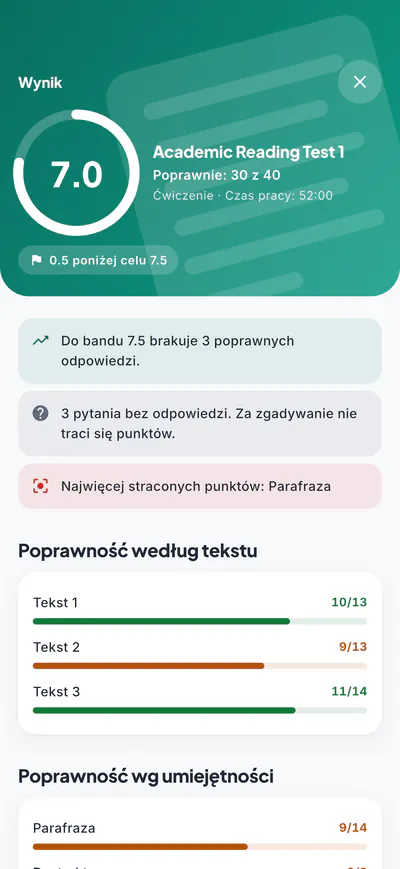
Wynik testu próbnego IELTS w aplikacji Fleydo: Przygotowanie do IELTS: szacowany band i poprawność w każdej części
Bezpłatna lekcja próbna

Poznaj swój prawdziwy wynik IELTS, zanim zrobi to egzamin

Bezpłatna indywidualna lekcja online z nauczycielem native speakerem, certyfikowanym specjalistą IELTS z wynikiem Band 8.5+. Otrzymasz diagnozę Speaking w prawdziwym formacie, uczciwą ocenę szacowanego wyniku i plan pracy nad dokładnie tymi kryteriami, które kosztują Cię punkty. Bez płatności, bez zobowiązań.

Online · Indywidualnie · Academic i General Training

IELTS jest zastrzeżonym znakiem towarowym British Council, IDP: IELTS Australia oraz Cambridge University Press & Assessment. Te testy próbne zostały przygotowane przez Fleydo i nie są przez te organizacje zatwierdzone ani rekomendowane.

Aplikacja mobilna

Fleydo English School w Twojej kieszeni

Lekcje, prace domowe, wiadomości i gry dla uczniów Fleydo i ich rodziców. Bezpłatna na iPhone’a i Androida.

Pobierz w App StorePobierz z Google Play
Więcej o aplikacji
Kod QR otwierający aplikację Fleydo English School w App Store lub Google PlayZeskanuj i pobierzOtwiera właściwy sklep dla Twojego telefonu.fleydo.com/app
Ikona aplikacji Fleydo IELTS
Fleydo: Przygotowanie do IELTS

Przygotowujesz się do IELTS?

Fleydo: Przygotowanie do IELTS to osobna aplikacja z testami próbnymi ze wszystkich czterech umiejętności. Nie potrzebujesz konta Fleydo, żeby z niej korzystać.

Zobacz aplikację IELTS
Pobierz w App StorePobierz z Google Play
Testy próbne IELTS

Ćwicz wszystkie cztery umiejętności IELTS

Wybieraj spośród 311 testów z natychmiastowym wynikiem band, wyjaśnieniami i wzorcowymi odpowiedziami. Bez rejestracji.

Wszystkie testy próbne
FleyPath

Osobista mapa drogowa Twojego dziecka — 3, 6 lub 12 miesięcy

🚀Start
👋Hello
😊Body
🦁Animals
🔢Numbers
🏆Pewny angielski
Zgrywalizowane ćwiczenie angielskiego

Jak gra — tylko że naprawdę się uczą