1. Home
  2. IELTS
  3. Test di esercitazione
  4. Writing
  5. Children's photos online

IELTS Writing · Task 2

IELTS Writing Task 2: Children's photos online

  • Opinione
  • 40 min
  • 250 parole
  • Academic e General Training

WRITING TASK 2

You should spend about 40 minutes on this task.

Parents should not share photographs of their young children online, because children of that age are too young to agree to it. To what extent do you agree or disagree? Give reasons for your answer and include any relevant examples from your own knowledge or experience.

Write at least 250 words.

40:00
0 / 250 parole

Valuta la tua risposta

Leggi prima le risposte modello. Poi, per ogni criterio, scegli la band che corrisponde alla tua risposta. La tua band è la media, arrotondata alla mezza band più vicina.

6,0La tua band stimata
Task response

Coherence and cohesion

Lexical resource

Grammatical range and accuracy

Ogni modello è scritto come lo scriverebbe un candidato diverso, quindi dettagli e opinioni cambiano. Le band sono una nostra stima basata sui descrittori pubblici, non voti ufficiali di un esaminatore.

Risposte modello a quattro livelli di band

Ogni modello è scritto come lo scriverebbe un candidato diverso. Le band sono una nostra stima basata sui descrittori pubblici delle band.

Modello da band 5,5266 parole

Today everybody has a phone with camera, so many families put pictures of their baby on the internet every day. I agree that they should stop this, because it is dangerous for the child and a baby cannot say yes or no.

Firstly, the internet is not a brivate place. When you put one picture, strengers can see it and they can save it in their phone. We don't know who is this person and what he wants to do with the picture. In the news we see many bad stories about kids, it is very scary. Also the picture can show the name of the school or the street of the family, so these people can know where the child lives.

Secondly, the child will grow up one day. When he become a teenager he will not happy if his friends find an old picture of him, for example with his face dirty from food. Friends will laugh on him at school and he will feel shy. A small child cannot say no to his father, but after ten years he can be angry because his parents did this without asking him.

Some people say the grandmother and the family want to see the baby, especially if they live far away. This is true, but the parents can send the picture only to them, or they can visit.

For these reasons I think the mother and father must keep the pictures for themselves. They love their baby and they want to show him to everybody, but the safty of the child more important than this.

Perché questa band

  • It agrees clearly and gives two reasons, but they stay thin: the danger point stops at 'it is very scary'.
  • The reply to the other side is short but real: 'the parents can send the picture only to them'.
  • Verbs and word order are the main habits: 'who is this person', 'he become', 'he will not happy'. Spelling follows the sound in 'brivate', 'strengers' and 'safty'.

Criterio per criterio

Task response
The position is clear and both reasons concern the child. What a stranger might actually do is never said, and the child not agreeing is named in the first paragraph but explained only at the end of the second reason, in 'without asking him'.
Coherence and cohesion
A simple plan marked by 'Firstly' and 'Secondly'. 'picture' and 'the child' return in nearly every sentence, and 'these people' has no clear partner, since only one person has been mentioned.
Lexical resource
Everyday words throughout, which limit the argument: 'bad stories', 'scary', 'kids'. 'feel shy' is too weak for being laughed at, and 'laugh on him' has the wrong preposition.
Grammatical range and accuracy
Mostly short simple sentences, about half with an error. 'who is this person' has the wrong word order, 'he become' lacks its ending, and 'bad stories about kids, it is very scary' joins two sentences with a comma.

Per arrivare alla band successiva

Put 'is' or 'are' in every sentence that describes something, and check the verb after 'he'. Then say what a stranger could really do with a photograph, because that is the heart of your first reason.

Fai una scaletta prima di scrivere

Cosa chiede la traccia

The statement gives a rule, that parents should not do this, and a reason, that young children cannot agree. Answer both. The first trap is writing about children using phones or social media themselves, when the question is about what adults put online. The second is treating a picture sent to a grandmother and a picture on a public page as the same thing.

Il tuo messaggio principale

Say how far you accept the rule and what decides it. One workable message: the child's lack of a say matters most when an image is public and cannot be taken back, so sharing with people the family knows is acceptable and public posting is not. A firm yes or no can do just as well if you deal with the point about agreeing; the 5.5 answer mostly agrees and the 6.5 answer mostly disagrees.

Paragrafo per paragrafo

  1. IntroductionPut the claim in your own words and say how far you agree. If you accept part of it, say which part.
  2. Main reasonsChoose what you can explain: what a stranger could do with an image, how the child may feel at twelve or thirteen, or whether a parent's right to decide reaches this far.
  3. The other sideAnswer the strongest reply, such as relatives living far away or parents who are careful. Say why it does or does not change your view.
  4. JudgementFinish with your decision. A practical line is welcome, such as who may see the pictures or when the child should be asked.

Errori comuni

  • Writing about screen time or children's own accounts. The question is about what parents post.
  • Stopping at 'strangers are dangerous' without saying what could actually happen to a photograph once it is online.
  • Ignoring the reason in the statement. Say whether being too young to agree really matters, given that parents decide many other things for small children.
  • Treating all sharing as one act. A closed family group, a public page and a paid advert raise very different concerns.
  • Inventing figures about how many parents post or how many images are misused. Argue from reasons and common experience instead.

Lessico dell'argomento

consent
permission given by the person affected by something
to upload
to put a file such as a photograph on the internet
audience
the people who can see or read something
privacy
the right to keep your personal life away from other people
permanent
lasting for a very long time or for ever
to embarrass
to make someone feel ashamed or awkward in front of others
to misuse
to use something in a wrong or harmful way
digital footprint
the record of a person that builds up online over time

Espressioni utili

  • A child of this age cannot ..., so ...
  • What a parent sees as ... may later feel like ... to the child.
  • Once ... is online, ...
  • There is a clear difference between ... and ...
  • This would be acceptable if ..., but not if ...
  • It is true that ..., yet ...
  • Parents could ... without ...

Icona dell'app Fleydo IELTS Fleydo: Preparazione IELTS

Porta questi test con te sul telefono

Tutti i test di queste pagine sono anche nell'app Fleydo: Preparazione IELTS per iPhone, iPad e Android, insieme a 2.000 parole IELTS con audio.

  • Funziona offline una volta scaricato il test sul telefono
  • 2.000 parole IELTS con audio, ripetizione spaziata ed esercizi brevi
  • Registra le tue risposte di Speaking e riascoltale
  • Un piano giornaliero per la tua band obiettivo e la data dell'esame
Scarica su App StoreDisponibile su Google Play
Inquadra per scaricareApre App Store o Google Play, a seconda del telefono.

Non serve un account. Scopri l'app

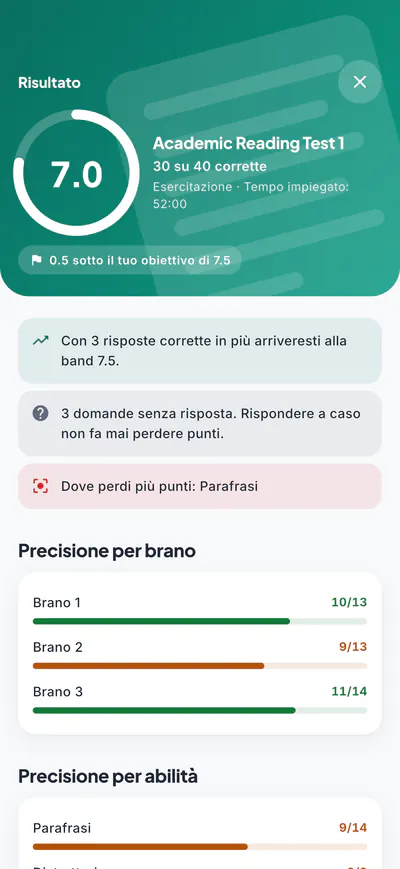
Risultato di un test di esercitazione IELTS nell'app Fleydo: Preparazione IELTS: band stimata e precisione per ogni parte
Lezione di prova gratuita

Scopri il tuo vero band IELTS prima dell'esame

Una lezione individuale online gratuita con un insegnante madrelingua inglese, specialista IELTS certificato Band 8.5+. Ricevi una diagnosi dello Speaking nel formato reale, una stima onesta del tuo band e un piano mirato ai criteri che ti costano punti. Nessun pagamento, nessun impegno.

Online · Individuale · Academic e General Training

IELTS è un marchio registrato del British Council, di IDP: IELTS Australia e di Cambridge University Press & Assessment. Questi test di esercitazione sono scritti da Fleydo e non sono approvati né sostenuti da queste organizzazioni.

App mobile

Fleydo English School in tasca

Lezioni, compiti, messaggi e giochi per gli studenti Fleydo e i loro genitori. Gratuita su iPhone e Android.

Scarica su App StoreDisponibile su Google Play
Scopri di più sull'app
Codice QR che apre l'app Fleydo English School su App Store o Google PlayInquadra per scaricareApre lo store giusto per il tuo telefono.fleydo.com/app
Icona dell'app Fleydo IELTS
Fleydo: Preparazione IELTS

Ti prepari all'IELTS?

Fleydo: Preparazione IELTS è un'app separata con simulazioni per tutte e quattro le abilità. Per usarla non ti serve un account Fleydo.

Scopri l'app IELTS
Scarica su App StoreDisponibile su Google Play
Test di esercitazione IELTS

Esercitati in tutte e quattro le abilità IELTS

311 test con band immediata, soluzioni spiegate e risposte modello. Senza registrazione.

Tutti i test di esercitazione
Il FleyPath

La roadmap personale di tuo figlio — 3, 6 o 12 mesi

🚀Partenza
👋Hello
😊Body
🦁Animals
🔢Numbers
🏆Inglese sicuro
Pratica di inglese gamificata

Come un gioco — solo che stanno davvero imparando