1. Strona główna
  2. IELTS
  3. Testy próbne
  4. Speaking
  5. Test próbny IELTS Speaking 39: Art in public

IELTS Speaking

Test próbny IELTS Speaking 39: Art in public

Describe a piece of art in a public place, such as a statue, a mural or a sculpture, that you have noticed.

  • 3 części
  • 11–14 min
  • Egzaminator
  • Czterech kandydatów, jeden test

Przystąp do testu

Pytania egzaminatora są odtwarzane jedno po drugim. Odpowiadaj na głos, tak jak na egzaminie. Nagrywanie jest opcjonalne i zostaje w tej karcie przeglądarki.

Twoje nagrania są przechowywane tylko w tej karcie. Nic nie jest wysyłane. Pobierz je, jeśli chcesz je zachować.

Oceń swoją wypowiedź

Porównaj swoje odpowiedzi z odpowiedziami kandydatów, a potem w każdym kryterium wybierz band, który do Ciebie pasuje.

6,0Twój szacowany band
Fluency and coherence

Lexical resource

Grammatical range and accuracy

Pronunciation

Każdy kandydat to inna osoba, więc historie i opinie się różnią. Bandy to nasz szacunek według publicznych deskryptorów, a nie oficjalne oceny egzaminatora. Transkrypcja nie pokazuje wymowy. Te bandy zakładają, że jest ona na tym samym poziomie co pozostałe trzy kryteria.

Pytania, karta zadania i przykładowe odpowiedzi

Part 1: wywiad

Work or studies

  • Do you work or are you a student?
  • What do you enjoy most about it?
  • Who do you spend most of your time with there?
  • Would you recommend it to a younger friend or relative?

Homework

  • Did you get a lot of homework when you were at school?
  • Where did you usually do it?
  • Did you ever leave it until the last minute?
  • Do you think children these days get too much homework?

Pets

  • Did your family have any pets when you were growing up?
  • Which animals do people usually keep as pets where you live?
  • If you could have any animal as a pet, what would you choose? (Why?)

Wskazówki

  • Three of the homework questions are about your school days, so this frame is mostly past tense: we had to, I used to, my mother would. Add one real detail, such as the table you worked at or the subject you always left until last, and stop.
  • You do not need to have had a pet. 'No, we lived in a small flat and my father didn't like animals' is a full answer, and you can talk about an animal a relative or neighbour had.
  • After you say what you do, the examiner calls it 'it'. Keep your details the same all the way through: if you said you are a student, you are still a student when you talk about the people you spend time with.

Part 2: dłuższa wypowiedź (karta zadania)

Describe a piece of art in a public place, such as a statue, a mural or a sculpture, that you have noticed.

You should say:

  • where it is and what it looks like
  • how you came to notice it
  • what other people seem to think of it

and explain whether you think the place is better with it there.

Pytanie dodatkowe

  • Have you ever taken a photo of it?
  • Do you usually notice art when you're walking around a town?

Notatki, które mógłby zrobić mocny kandydat

  • bronze woman on bench, reading, park
  • pass it going to the gym
  • noticed when someone put a scarf on her
  • kids sit on her lap, tourists
  • council paid, neighbours complained at first
  • now people sit next to her
  • better? yes, park feels less empty

Wskazówki

  • It does not have to be famous or beautiful. A painted wall, a sculpture outside an office or a shopping centre, a decorated bridge or painted electricity boxes all count. If nothing comes to mind, walk your daily route in your head.
  • The third point is about other people. You can report what someone said to you, describe what people do near it, or say that nobody seems to notice it at all. That last answer is interesting too, if you say why.
  • The explain line is about the place, not only the art. Picture the spot without it: what would be missing, or would it look better empty?

Part 3: dyskusja

Paying for art in public places

  • Why do some people feel that public money shouldn't be spent on art? Wyjaśnianie
  • Is it better for public art to be paid for by the town or by private companies? Porównywanie
  • What kind of public art do you think people will want to see in the future? Spekulowanie o przyszłości

Art at school

  • Should children's drawings and paintings be given marks, like work in other subjects? Wyrażanie opinii
  • Is it a good idea for schoolchildren to help paint murals on school walls or in their neighbourhood? Ważenie argumentów
  • How could art lessons be made more useful for children who aren't going to be artists? Proponowanie

Wskazówki

  • Nobody expects you to know what a statue costs. Argue from what you have seen: a street that needs repairs, a sculpture nobody looks at, a wall that made a corner feel safer.
  • For the question about the future, start from something you can already see beginning, such as screens, art built into bus stops, or statues of new kinds of people, and say why it might spread.
  • The school questions invite a story from your own school days. Tell it briefly, then say whether you think it is true for children in general.

Czterech kandydatów, jeden test

Jak na każde pytanie odpowiadały osoby z czterema różnymi bandami.

Part 1Do you work or are you a student?

I work. I'm working in a shop for wedding dresses, and soiree dresses also, for the engagement and the parties. It's in Tanta, ten minutes walking from my house.

Part 1What do you enjoy most about it?

When the bride tries the dress and she sees herself in the mirror, her face changes, completely. Sometimes her mother cry also. This moment, I like it very much.

Part 1Who do you spend most of your time with there?

Two people, mostly. The owner, she's a woman around fifty, very strict but kind. And another girl who working with me, er, we are friends now. We eat lunch together in the small room behind the shop.

Part 1Would you recommend it to a younger friend or relative?

Hmm... for a girl, yes, maybe. But the salary is not – is not so good, and you stand all the day. My cousin asked me last month for work there, and I told her, no, first finish your study.

Part 1Did you get a lot of homework when you were at school?

Yes, a lot. Every teacher gave us homework, every day, and the copybooks... my bag was so heavy, um, my back was hurting. Especially in preparatory school.

Part 1Where did you usually do it?

In the living room, all of us, me and my two brothers, around the small table. And the TV was open, er, my father was watching the news, so it was not easy to... to concentrate.

Part 1Did you ever leave it until the last minute?

Sometimes, yes. The maps for geography, um, you have to colour the map and write the cities. I hated it, so I leave it to the end, and in the morning I do it very fast, at breakfast.

Part 1Do you think children these days get too much homework?

Yes, I think. My little brother, he's thirteen, he finishes school at two, and after that private lessons, and homework... until eleven in the night sometimes. It's too much for a child.

Part 1Did your family have any pets when you were growing up?

Not really pets. My grandmother in the village, she has ducks and chickens on the roof, but this is for eating. When I was small I gave them names, er, and she was laughing at me.

Part 1Which animals do people usually keep as pets where you live?

Cats, many cats. In the street also, the people put food for them outside the door. Dogs are not so common, some young people have now. I'm afraid of dogs, all of them, even small.

Part 1If you could have any animal as a pet, what would you choose? (Why?)

A bird, I think. A small yellow bird, the one that sings... I forget the name. Because it's easy, not need to take it outside, and the sound is nice in the morning.

Part 2Describe a piece of art in a public place, such as a statue, a mural or a sculpture, that you have noticed.

OK. Er, there is a wall in my street, the wall of a primary school, and last year some students from the university, art students, they came and painted it. Before, it was very ugly, grey, with old papers and, er... writing on it, bad words sometimes. Now it's full of colours. There is a big tree in the middle, and, um, children sitting under it, and a girl reading a book. And on the side there is a river with a boat, the small boat with the... the white cloth, for the wind. I noticed it because I pass there every day to my work, so one day I see the students with the paint and the ladders, and I stopped to watch. They work there maybe... two weeks. The people in my street, I think they like it. The old man who has the kiosk, he says now the street is more clean, because nobody throws rubbish near the wall. But my mother say it's for children, it's not real art. And after one summer, the sun made the colours... weak, especially the blue, and nobody come to paint it again. But for me, er, the street is better now. Before it was only grey, and the papers, so...

Part 2Have you ever taken a photo of it?

Yes, one time, with my friend, in front of the tree. I have it still on my phone.

Part 2Do you usually notice art when you're walking around a town?

Not really. I'm always walking fast to the work, so... I look at the shops more.

Part 3Why do some people feel that public money shouldn't be spent on art?

Because, er, there is more important things. The streets – in my city some streets are very bad, with holes, and the hospitals need money also. So the people say, er, why you spend on a statue? Fix the street first. I understand them, I think the same, a little.

Part 3Is it better for public art to be paid for by the town or by private companies?

The town, I think. Because the street is for everybody, so... everybody pay, er, with the taxes. If a company pays, er, they want something back, they don't give the money for – just for nothing. Maybe they put their name, or, um, the art is about their product. I don't like this.

Part 3What kind of public art do you think people will want to see in the future?

Hmm, I don't know. Maybe, um, statues of the famous people now, like the football players, or singers. Not only the old kings, the... the history people. The young people want to see somebody they know, er, somebody from now.

Part 3Should children's drawings and paintings be given marks, like work in other subjects?

Er... no, I don't think so. In my school the drawing – we have marks for drawing, but very small, and the teacher give everybody almost the full mark. If it's like maths, er, the children who can't draw, they will feel bad, and maybe they start to hate the school. Drawing is for enjoy, not for exam.

Part 3Is it a good idea for schoolchildren to help paint murals on school walls or in their neighbourhood?

Yes, it's good idea. Er, the children will be proud, they will say to everybody, this is my painting, I did it. And they learn to work together, er, in a group. But the small ones, maybe they make a mess... so the teacher must stay with them all the time.

Part 3How could art lessons be made more useful for children who aren't going to be artists?

Um... this is difficult question. Maybe they learn things for the life, er, like which colours go together, for the clothes, for the house, how to make a room look nice. In my work, the bride, er, we always think which colour is good with her skin, with her hair... so this is useful, for anybody, not only artist.

Słówka do tego testu

a mural
a large painting made directly on a wall
a sculpture
a work of art shaped from metal, stone, wood or another material
put up
build or place something in a public place, as in 'they put up a statue in the square'
a landmark
something easy to see and recognise that helps people find their way
an eyesore
something ugly that spoils the look of a place
grow on you
become more likeable the longer you know it
brighten up
make a place look more cheerful
fade
lose colour slowly, often because of the sun
public money
money that comes from taxes and is spent by a town or government
walk past something
go by it without stopping, often without really looking at it

Przydatne zwroty

  • I must have walked past it ___ times before I ___.
  • What first caught my eye was ___.
  • Some people say it's ___, but personally I ___.
  • Without it, the place would feel ___.
  • It's not really my taste, but I can see why ___.
  • If it were up to me, ___ would decide what goes there.
  • When I was at school, art lessons were mostly ___.
  • I can imagine more towns ___ in the future, because ___.
  • The money could have gone on ___, but ___.

Ikona aplikacji Fleydo IELTS Fleydo: Przygotowanie do IELTS

Zabierz te testy ze sobą na telefon

Każdy test z tych stron jest też w aplikacji Fleydo: Przygotowanie do IELTS na iPhone’a, iPada i Androida, razem z 2 000 słówek IELTS z nagraniami.

  • Działa offline, gdy test jest już na telefonie
  • 2 000 słówek IELTS z nagraniami, powtórki rozłożone w czasie i krótkie ćwiczenia
  • Nagrywaj swoje odpowiedzi w Speaking i odsłuchuj je
  • Plan na każdy dzień pod Twój docelowy band i datę egzaminu
Pobierz w App StorePobierz z Google Play
Zeskanuj, aby pobraćOtwiera App Store lub Google Play, zależnie od Twojego telefonu.

Konto nie jest potrzebne. O aplikacji

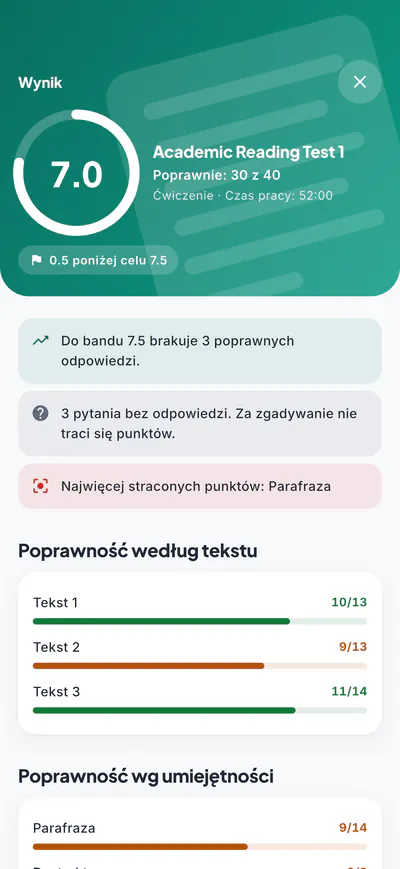
Wynik testu próbnego IELTS w aplikacji Fleydo: Przygotowanie do IELTS: szacowany band i poprawność w każdej części
Bezpłatna lekcja próbna

Poznaj swój prawdziwy wynik IELTS, zanim zrobi to egzamin

Bezpłatna indywidualna lekcja online z nauczycielem native speakerem, certyfikowanym specjalistą IELTS z wynikiem Band 8.5+. Otrzymasz diagnozę Speaking w prawdziwym formacie, uczciwą ocenę szacowanego wyniku i plan pracy nad dokładnie tymi kryteriami, które kosztują Cię punkty. Bez płatności, bez zobowiązań.

Online · Indywidualnie · Academic i General Training

IELTS jest zastrzeżonym znakiem towarowym British Council, IDP: IELTS Australia oraz Cambridge University Press & Assessment. Te testy próbne zostały przygotowane przez Fleydo i nie są przez te organizacje zatwierdzone ani rekomendowane.

Aplikacja mobilna

Fleydo English School w Twojej kieszeni

Lekcje, prace domowe, wiadomości i gry dla uczniów Fleydo i ich rodziców. Bezpłatna na iPhone’a i Androida.

Pobierz w App StorePobierz z Google Play
Więcej o aplikacji
Kod QR otwierający aplikację Fleydo English School w App Store lub Google PlayZeskanuj i pobierzOtwiera właściwy sklep dla Twojego telefonu.fleydo.com/app
Ikona aplikacji Fleydo IELTS
Fleydo: Przygotowanie do IELTS

Przygotowujesz się do IELTS?

Fleydo: Przygotowanie do IELTS to osobna aplikacja z testami próbnymi ze wszystkich czterech umiejętności. Nie potrzebujesz konta Fleydo, żeby z niej korzystać.

Zobacz aplikację IELTS
Pobierz w App StorePobierz z Google Play
Testy próbne IELTS

Ćwicz wszystkie cztery umiejętności IELTS

Wybieraj spośród 311 testów z natychmiastowym wynikiem band, wyjaśnieniami i wzorcowymi odpowiedziami. Bez rejestracji.

Wszystkie testy próbne
FleyPath

Osobista mapa drogowa Twojego dziecka — 3, 6 lub 12 miesięcy

🚀Start
👋Hello
😊Body
🦁Animals
🔢Numbers
🏆Pewny angielski
Zgrywalizowane ćwiczenie angielskiego

Jak gra — tylko że naprawdę się uczą