1. الرئيسية
  2. IELTS
  3. الاختبارات التجريبية
  4. Speaking
  5. اختبار IELTS Speaking التجريبي 5: Local businesses

IELTS Speaking

اختبار IELTS Speaking التجريبي 5: Local businesses

Describe a small local business that has changed the way it works in recent years.

  • 3 أجزاء
  • 11–14 دقيقة
  • الممتحن
  • أربعة مرشحين واختبار واحد

أدِّ الاختبار

تُسمَع أسئلة الممتحن واحداً تلو الآخر. أجب بصوت مسموع كما في الامتحان. التسجيل اختياري ويبقى في علامة التبويب هذه في متصفحك.

تُحفظ تسجيلاتك في علامة التبويب هذه فقط، ولا يُرفع أي شيء. نزّلها إن أردت الاحتفاظ بها.

قيّم أداءك

قارن إجاباتك بإجابات المرشحين، ثم اختر لكل معيار الدرجة التي تناسبك.

6.0درجتك التقديرية
Fluency and coherence

Lexical resource

Grammatical range and accuracy

Pronunciation

كل مرشح متحدث مختلف، لذا تختلف القصص والآراء. المستويات تقديرنا وفق الواصفات المنشورة، وليست درجات رسمية من ممتحن. لا يُظهر النص المكتوب النطق. تفترض هذه المستويات أنه في مستوى المعايير الثلاثة الأخرى نفسه.

الأسئلة وبطاقة الموضوع والإجابات النموذجية

الجزء 1: المقابلة

The area where you live

  • What kind of area do you live in?
  • How long have you lived there?
  • Is it easy to get around your area?
  • Is it a good area for young people? (Why?)

Haircuts

  • How often do you get your hair cut?
  • Who cut your hair when you were a child?
  • Would you ever let a friend cut your hair?

Neighbours

  • Do you know many of your neighbours?
  • What were your neighbours like when you were a child?
  • Have you ever helped a neighbour with something?
  • Would you like to have more contact with your neighbours than you do now?

نصائح

  • The area where you live means your street and the people and places around it, not the history or size of your city. One thing you can see or hear there, such as a busy road, a courtyard or a neighbour, does more for an answer than a list of facts.
  • Haircuts is a small topic, and some answers will be short. That is fine: answer, add one detail or reason, and stop. 'Who cut your hair when you were a child?' needs past forms (cut, took, used to), and 'Would you ever ...?' needs would.
  • Neighbours questions are about real people near you. If you hardly know yours, say so and say why: shift work, a building where people change every year. 'What were your neighbours like when you were a child?' needs past forms (lived, knew, used to, would).

الجزء 2: الحديث الطويل (بطاقة الموضوع)

Describe a small local business that has changed the way it works in recent years.

You should say:

  • what kind of business it is
  • how it used to work
  • what it does differently now

and explain why you think it made this change.

سؤال متابعة

  • Do you use this business more or less than you used to?
  • Do you think it will still be there in ten years?

ملاحظات قد يدوّنها مرشح قوي

  • laundrette, end of my street
  • before: coins only, nobody working there
  • now: pay and book with an app
  • drop-off service, folded by evening
  • owner's daughter took over
  • why? new flats have own machines
  • wanted students, busy people

نصائح

  • The card is about a change, so the before and the after matter more than a description of the shop. Use 'it used to ...', 'before, ...' and 'now ...' or 'these days ...' to make the contrast clear, and keep the first point short.
  • If no shop comes to mind, think wider: a hairdresser, a café, a tailor, a market stall, a taxi driver or someone who sells food from home. Small changes count, such as new opening hours, delivery, a website or paying by phone.
  • Nobody can know for certain why a business changed, so the explain line asks you to guess. Show that it is your view ('I imagine ...', 'my guess is ...'). If the owner told you a reason, give theirs and then add your own.

الجزء 3: النقاش

Small shops and large chains

  • Why do you think some people prefer small local shops to large chain stores? الشرح
  • Are small shops more important to people in villages than to people in big cities? المقارنة
  • Do you think there will still be many small shops in towns twenty years from now? التكهن بالمستقبل

Working for yourself

  • What qualities does someone need to work for themselves successfully? إبداء الرأي
  • Is it a good idea for young people to start their own business straight after leaving school or university? الموازنة والتقييم
  • What could be done to make it easier for people to start a small business? تقديم الاقتراحات

نصائح

  • These questions are about shops and work in general. One example from your own area helps, but do not build every answer on your Part 2 story: give reasons that would make sense to someone from another country.
  • The question about villages and cities invites a comparison, and you do not have to agree with it. Say where you think the real difference is, and give a reason for each side before you decide.
  • For 'What could be done ...?', one or two suggestions explained well are better than a list. Say who could do it and how it would help, with could, would and might.

أربعة مرشحين واختبار واحد

كيف أجاب متحدثون في أربعة مستويات عن كل سؤال.

Part 1What kind of area do you live in?

It's a city area. I live in Sylhet with my family, in a flat. Around us there is many buildings and, er, one big road next to us, so all day the buses are... making horn. Very busy.

Part 1How long have you lived there?

From when I was six. Before that we lived in my father's village, but my father got a job in the city, so we move here. So, er... sixteen years, I think.

Part 1Is it easy to get around your area?

Yes, quite easy. There are many rickshaws and, er, the small taxi with three wheels, everywhere. Only problem is the traffic. In the evening sometimes one hour for a very short way.

Part 1Is it a good area for young people? (Why?)

Not so much. There is no field for... for playing cricket, only the road. So the boys, er, they just sit in the tea stall in the evening and talk, talk... nothing to do. For young people it's a little boring.

Part 1How often do you get your hair cut?

Every month, I think, or... one and half month. When the hair become long it's very hot, er, because of the weather. So I go to the barber near my house, he is cheap.

Part 1Who cut your hair when you were a child?

My father. He cut it at home, on the roof, with the, er, normal scissors. It was not very good... one side short, one side long, and my friends in the school laughed at me.

Part 1Would you ever let a friend cut your hair?

No, never. My friends don't know how to use scissors, er, they will make a joke with my hair. I don't want to go to my class like that.

Part 1Do you know many of your neighbours?

Yes, most of them. In our building there is, um, eight families, and we know each other very well. If one family has a wedding, er, everybody is invited, the whole building.

Part 1What were your neighbours like when you were a child?

In the village, before we moved, our neighbours was my uncles, my cousins, my father's friends also. Every door was open. In the city, er, first it was strange for me, nobody come in our house without asking.

Part 1Have you ever helped a neighbour with something?

Yes, many times. There is one old man on the top floor, he can't carry heavy things, so sometimes I bring his rice bag from the shop, er, up the stairs. Five floors, no lift.

Part 1Would you like to have more contact with your neighbours than you do now?

No, I think it's enough. We see them every day, on the stairs, on the roof. Sometimes it's too much, er, they ask about my exam result, my job...

Part 2Describe a small local business that has changed the way it works in recent years.

Er, I will talk about a small shop near my house. It's a grocery shop, you can get rice, oil, biscuit, soap... everything for the house. The man who runs the shop, everybody call him uncle, but he's not my real uncle. Before, the system was very simple. You go to the shop, you tell him what you need, and he gives you. And my family, er, we don't pay every time. He write everything in a big notebook, and at the end of the month my father pays him. Now it's change a lot. Two years ago his son finished his study and he start to help in the shop. Now you can send your list on WhatsApp, and the son brings it to your house by bicycle. Also you can pay by mobile, um, no need cash. My mother uses it, she don't go to the shop now. Why they change... I think because a big supermarket opened near the main road, er, a chain shop, and many people start to go there. So uncle was afraid to lose his... his customers. And the son is young, he know the technology. So, um, I think it was a good idea. Yes, the change is good for them... and for us also.

Part 2Do you use this business more or less than you used to?

Less, er, because now my mother order on the phone. Before, I go there every day.

Part 2Do you think it will still be there in ten years?

I hope. If the son continue, yes. But the supermarket is very strong, so... I don't know.

Part 3Why do you think some people prefer small local shops to large chain stores?

Because they know the shopkeeper, er, it's like a relation. If you don't have money today, you can pay next week, the supermarket will never do this. And also the small shop is near, er, you don't need to dress up, you can go in your home clothes.

Part 3Are small shops more important to people in villages than to people in big cities?

Yes, I think in village it's more important. In my father's village there is no supermarket, nothing, only two, three small shop. If they close, people have to go to the town by, er, by bus, more than one hour. In the city you have many... many option. So for village people the small shop is very necessary.

Part 3Do you think there will still be many small shops in towns twenty years from now?

Er... less, I think. Young people like to order everything from phone, and the big companies have more money, so they can give, um, discount, offer. The small shop cannot do this. But some will stay, I think, the tea stall, the medicine shop near the house. People will need them always.

Part 3What qualities does someone need to work for themselves successfully?

Er, he need to be hard-working, because nobody tell him what to do, he is the boss. And good with people, talking with the customer nicely. And patience also, because first one year, two year, maybe no profit. My friend's father open a clothes shop and he close it after one year, because, er... no patience.

Part 3Is it a good idea for young people to start their own business straight after leaving school or university?

I think it's not a good idea. First they need experience. If they do a job for some years, they learn how the business is working, how to talk with the, er, clients, everything. And also they can save money. Without money how they will start the... the business?

Part 3What could be done to make it easier for people to start a small business?

The bank can give loan with low interest, er, for the young people. Because money is the main problem. And maybe some training, short course, how to do the accounts, the marketing... In our country many people want to do business, but they don't know from where to start, um, what is the first step.

كلمات لهذا الاختبار

run a business
own and manage a business, as in 'she runs a small shop'
an independent shop
a shop that is not part of a chain
a chain
a group of shops with the same name and the same owner, as in 'a supermarket chain'
a regular
a customer who goes to the same shop or café often
a pick-up point
a shop or locker where you collect parcels you ordered online
adapt
change to suit new conditions, as in 'the shop had to adapt'
keep up with
change as quickly as something else is changing
be your own boss
work for yourself, with no manager above you
self-employed
working for yourself rather than for an employer
overheads
the regular costs of running a business, such as rent and electricity
a trim
a small haircut that only tidies your hair
be on good terms with
have a friendly relationship with someone, as in 'we're on good terms with our neighbours'

عبارات مفيدة

  • When I first ___, it was ___. These days ___.
  • The biggest difference is that ___.
  • I imagine they did it because ___, but that's only my guess.
  • I've lived there for ___, and in that time ___.
  • What I like about ___ is ___, but the downside is ___.
  • It's not so much ___ as ___.
  • You'd think ___, but actually ___.
  • For some people ___, but for others ___.
  • Twenty years from now, ___ will probably ___, although ___.
  • If I were starting a business, I'd ___, because ___.

أيقونة تطبيق Fleydo IELTS Fleydo: التحضير لـ IELTS

خذ هذه الاختبارات معك على هاتفك

كل اختبار في هذه الصفحات موجود أيضاً في تطبيق Fleydo: التحضير لـ IELTS على iPhone و iPad و Android، ومعه 2,000 كلمة لاختبار IELTS مع الصوت.

  • يعمل دون اتصال بعد تنزيل الاختبار على هاتفك
  • 2,000 كلمة لاختبار IELTS مع الصوت، وتكرار متباعد وتدريبات قصيرة
  • سجّل إجاباتك في Speaking واستمع إليها من جديد
  • خطة يومية بحسب درجتك المستهدفة وتاريخ امتحانك
نزّله من App Storeاحصل عليه من Google Play
امسح الرمز للتنزيليفتح App Store أو Google Play بحسب نوع هاتفك.

لا حاجة إلى حساب. عن التطبيق

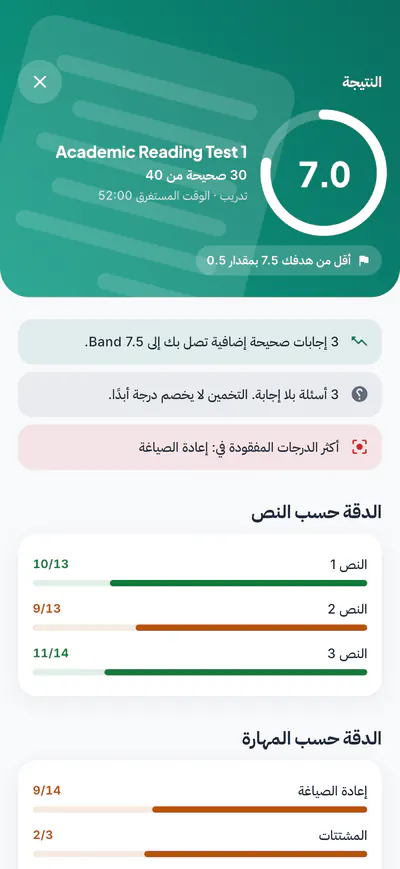
نتيجة اختبار IELTS تجريبي في تطبيق Fleydo: التحضير لـ IELTS: الدرجة التقديرية والدقة في كل جزء
درس تجريبي مجاني

اعرف درجتك الحقيقية في IELTS قبل الامتحان

درس فردي مجاني عبر الإنترنت مع معلم متحدث أصلي للإنجليزية، متخصص معتمد في IELTS بدرجة 8.5+. تحصل على تشخيص لقسم Speaking بالصيغة الحقيقية للامتحان، وتقدير صادق لدرجتك، وخطة تركز على المعايير التي تخسرك العلامات بالضبط. بدون دفع وبدون التزام.

عبر الإنترنت · فردي · Academic وGeneral Training

IELTS علامة تجارية مسجّلة لكل من British Council و IDP: IELTS Australia و Cambridge University Press & Assessment. هذه الاختبارات التجريبية من إعداد Fleydo، ولم تعتمدها هذه الجهات ولم تؤيدها.

تطبيق الهاتف

Fleydo English School في جيبكم

الدروس والواجبات والرسائل والألعاب لطلاب Fleydo وأولياء أمورهم. مجاني على iPhone وAndroid.

نزّله من App Storeاحصل عليه من Google Play
المزيد عن التطبيق
رمز QR يفتح تطبيق Fleydo English School في App Store أو Google Playامسحوا الرمز للتحميليفتح المتجر المناسب لهاتفكم.fleydo.com/app
أيقونة تطبيق Fleydo IELTS
Fleydo: التحضير لـ IELTS

هل تستعدون لاختبار IELTS؟

«Fleydo: التحضير لـ IELTS» تطبيق منفصل يضم اختبارات تجريبية في المهارات الأربع، ولا يتطلب استخدامه حساب Fleydo.

المزيد عن تطبيق IELTS
نزّله من App Storeاحصل عليه من Google Play
اختبارات IELTS تجريبية

تدريب على مهارات IELTS الأربع كلها

اختبارات عددها 311، مع درجة فورية وشرح للإجابات وإجابات نموذجية. بلا تسجيل.

كل الاختبارات التجريبية
FleyPath

خريطة طريق شخصية لطفلك — 3 أو 6 أو 12 شهرًا

🚀البداية
👋Hello
😊Body
🦁Animals
🔢Numbers
🏆إنجليزية واثقة
تدريب على الإنجليزية بأسلوب الألعاب

مثل اللعبة — لكنهم يتعلمون فعلًا