1. الرئيسية
  2. IELTS
  3. الاختبارات التجريبية
  4. Speaking
  5. اختبار IELTS Speaking التجريبي 19: Getting around

IELTS Speaking

اختبار IELTS Speaking التجريبي 19: Getting around

Describe a journey you make often, even a short one, that could be made better with one small change.

  • 3 أجزاء
  • 11–14 دقيقة
  • الممتحن
  • أربعة مرشحين واختبار واحد

أدِّ الاختبار

تُسمَع أسئلة الممتحن واحداً تلو الآخر. أجب بصوت مسموع كما في الامتحان. التسجيل اختياري ويبقى في علامة التبويب هذه في متصفحك.

تُحفظ تسجيلاتك في علامة التبويب هذه فقط، ولا يُرفع أي شيء. نزّلها إن أردت الاحتفاظ بها.

قيّم أداءك

قارن إجاباتك بإجابات المرشحين، ثم اختر لكل معيار الدرجة التي تناسبك.

6.0درجتك التقديرية
Fluency and coherence

Lexical resource

Grammatical range and accuracy

Pronunciation

كل مرشح متحدث مختلف، لذا تختلف القصص والآراء. المستويات تقديرنا وفق الواصفات المنشورة، وليست درجات رسمية من ممتحن. لا يُظهر النص المكتوب النطق. تفترض هذه المستويات أنه في مستوى المعايير الثلاثة الأخرى نفسه.

الأسئلة وبطاقة الموضوع والإجابات النموذجية

الجزء 1: المقابلة

Work or studies

  • Do you work or are you a student?
  • Where do you usually do most of it?
  • What's the busiest time of year for you?
  • Is there anything about it you'd like to get better at?

Libraries

  • How often do you go to a library?
  • Did you use a library much when you were at school?
  • Do you prefer to borrow books or to buy them? (Why?)
  • If a new library opened near your home, what would you like it to have?

Sunglasses

  • Do you wear sunglasses much?
  • Have you ever lost or broken a pair of sunglasses?
  • Do you think sunglasses are more about fashion or about protecting your eyes?

نصائح

  • The work or studies questions are about your real routine. Say where you actually spend the day and what makes a busy month busy, with one concrete detail such as a season, a deadline or a kind of customer, rather than describing the job in general terms.
  • Libraries and sunglasses can be answered with 'never' or 'not really'. That is fine as long as you add the reason: a short, true reason such as 'I read on my phone now' or 'I lose them too easily' is better than an invented habit.
  • Listen for the time in each question. The new library question is hypothetical, so answer with I'd like or it would be nice to have, not will. The school library question is about the past, so use past forms such as we had, I used to go or I hardly ever went.

الجزء 2: الحديث الطويل (بطاقة الموضوع)

Describe a journey you make often, even a short one, that could be made better with one small change.

You should say:

  • where you go, and why you make this journey
  • how you travel and what the journey is usually like
  • what the change would be

and explain whether you think it will ever happen.

سؤال متابعة

  • Do other people you know make the same journey?
  • Have you ever tried a different way of getting there?

ملاحظات قد يدوّنها مرشح قوي

  • evening class, Tue + Thu
  • two buses, change in centre
  • first bus late, miss connection
  • 25 min wait, cold, nowhere to sit
  • change: match the timetables
  • who? bus company, cheap fix
  • happen? doubt it, two companies

نصائح

  • The card has three jobs: the journey, the change and whether it will happen. Keep the description of the journey to about forty seconds, so that the change and your judgement get real time. Many candidates describe every street and never reach the change.
  • The change can be small and personal: a shelter at a stop, a later start time, a safe place to lock a bike, a way across a busy road. It does not have to be a new metro line, and it does not even have to be about transport. If you do not commute, any regular journey works: to the shops, to a class, to visit family.
  • For the explain line, give a reason, not only yes or no: it would cost too much, nobody is responsible for it, someone has already promised it, or it will only happen when someone more powerful needs it.

الجزء 3: النقاش

Public transport

  • Why do some people prefer not to use public transport, even when it's available? الشرح
  • Should public transport be cheaper, or even free, for everyone? الموازنة والتقييم
  • How do you think the way people get around cities will change in the next twenty years? التكهن بالمستقبل

Commuting and working life

  • Why are some people willing to spend a long time travelling to work every day? الشرح
  • Is it better to live close to work in a smaller home, or further away in a bigger one? المقارنة
  • What could employers do to make the journey to work easier for their staff? تقديم الاقتراحات

نصائح

  • Part 3 is about people in general. Your own journey can be one example, but then widen it: who else has the same problem, and would it be different in a bigger or smaller place?
  • For the question about the next twenty years, say what you expect and base it on something you can already see. 'Maybe flying cars' is not an answer; 'more electric bikes, because I already see them everywhere' is.
  • Two questions offer a choice: cheaper or free, close and small or far and big. You can pick one, find a middle way or say what it depends on, but give the reason that decides it for you.

أربعة مرشحين واختبار واحد

كيف أجاب متحدثون في أربعة مستويات عن كل سؤال.

Part 1Do you work or are you a student?

I'm working. I'm hairdresser, in a salon for women in Rabat. Before, I was studying the economy at the university, but I stop after one year, er, it was not for me.

Part 1Where do you usually do most of it?

In the salon. I'm standing from ten in the morning until eight, sometimes nine in the evening. The salon is small, we are four girls and the boss, so it's, er... very full, especially Saturday.

Part 1What's the busiest time of year for you?

Summer, because of the weddings. Every weekend there is a wedding, and the bride wants hair, make-up, but also her sisters, her mother, the cousins... everybody. Some Saturday we start at seven in the morning and we don't stop.

Part 1Is there anything about it you'd like to get better at?

Yes, the colour. To make the colour of the hair, er, mixing the products. My boss does it very well, but me... I'm still afraid. If I make mistake, the client will be very angry with me.

Part 1How often do you go to a library?

Now, never. I don't have time. When I was at the university I went sometimes before the exams, because in my house it's noisy, my little sister watches TV all the time, very loud.

Part 1Did you use a library much when you were at school?

Not really. In my school the library was, um... it was a small room, and it was closed always. I don't remember I take a book from there. Maybe one time, er, for a homework.

Part 1Do you prefer to borrow books or to buy them? (Why?)

Buy, I think. Because I read slow, one book maybe two months, er, so if I borrow I have to bring it back quickly. And I like to keep the book, to put it in my room.

Part 1If a new library opened near your home, what would you like it to have?

Er... good internet, and some computers, because not everybody has a computer at home. And a small café inside, to drink something when you read... it would be nice.

Part 1Do you wear sunglasses much?

Yes, a lot, in summer. The sun here is very strong, er, and every morning I wait outside for the taxi, so I need them. In winter, less.

Part 1Have you ever lost or broken a pair of sunglasses?

Yes, many times! Last month I put them on a chair in the salon, and a client, she sit on them. Er... finish, broken. But they was cheap, from the market, so it's not a big problem.

Part 1Do you think sunglasses are more about fashion or about protecting your eyes?

For the young people it's the fashion, I think. They buy the big ones, like the singers on Instagram. For me, er... both. I want nice ones, but I need also for the sun.

Part 2Describe a journey you make often, even a short one, that could be made better with one small change.

OK, so... the journey is from my house to my work. I live in Salé with my parents, and the salon is in Rabat, across the river. I make this journey six days a week. First I walk to the station of taxis, ten minutes, and I take the big taxi, you share it with other people. The problem is the waiting. The driver doesn't go until the taxi is full, so sometimes you wait five minutes, sometimes twenty-five, and you are standing in the street. In summer in the sun, in winter, er, in the rain. And there is no line. People they push, and the man who is more – the strongest one, he take the place. When I start in the salon, the first month, I was late a lot. So the change, er... I want a roof, small roof, for the shadow, and a line, like in the bank with the numbers, so it's more fair. It's a small thing, it don't cost a lot. But I don't think it will happen. Because who will do it? The drivers say it's the city, and the city, um... I don't know. Nobody care about this. So... every day the same.

Part 2Do other people you know make the same journey?

Yes, a lot. My neighbour, she works in a bank in Rabat, so sometimes we go together.

Part 2Have you ever tried a different way of getting there?

The tram, yes, two times. But it's far from my house, twenty minutes walking, so the taxi is more quick.

Part 3Why do some people prefer not to use public transport, even when it's available?

Because it's very crowded, er, you cannot sit, and sometimes it's not clean. And the people who have a car, they prefer the car, the car is more comfortable, with your music... Also, er, some people think the bus is for poor people. If you have car, the people look at you, um, different. My father never takes the bus, he says it's too slow.

Part 3Should public transport be cheaper, or even free, for everyone?

Cheaper, yes. For the students and the old people, especially. But free for everyone, no, I don't think. Who will pay the driver, the petrol? It's not possible. And maybe the people will use it too much, for nothing, er, for one stop only.

Part 3How do you think the way people get around cities will change in the next twenty years?

Er, I think more electric cars. Now you see some, not a lot, but in twenty years maybe everybody has one. And maybe the car without driver, I see this in videos, in America. But in my city... I'm not sure. Twenty years is not long. Maybe it's the same, but more cars, more traffic.

Part 3Why are some people willing to spend a long time travelling to work every day?

Because they don't have a choice. The work is in the big city, but to live in the big city is very expensive, so they live outside, er, where it's more cheap. My cousin, he take the train every day from Kenitra to Rabat. He leaves the house at six o'clock in the morning. He is tired, but... what he can do?

Part 3Is it better to live close to work in a smaller home, or further away in a bigger one?

Close, for me. Because the time is very important, you can rest more, and you don't wait for the taxi every day. And the big house, er... who will clean it? Our house is not – it's not very big, but my mother she is cleaning every day, all the morning. So for me, small and close is better.

Part 3What could employers do to make the journey to work easier for their staff?

Maybe they can pay the transport, or a part of it. And, er, not be angry when you are late five or ten minutes, because sometimes it's not your fault, it's the taxi, the traffic. My boss now, she understands, but the first month... um, she was not happy. And maybe a small room to rest, er, because some people come from very far, they wake up at five, so they arrive already tired.

كلمات لهذا الاختبار

commute
the regular journey between home and work; also a verb, as in 'I commute by train'
rush hour
the times of day when roads and public transport are busiest
packed
so full of people that there is hardly any room
a connection
a second bus or train you change to during a journey
door to door
the whole journey, from leaving home to arriving, as in 'forty minutes door to door'
the last stretch
the final part of a journey
a shelter
a covered place at a stop where you can wait out of the rain or sun
off-peak
outside the busiest times, often cheaper and quieter
flexible hours
being allowed to choose, within limits, when you start and finish work
put up with
accept something unpleasant because you have to
run late
be behind the expected time, as in 'the bus was running late'
a taxi rank
a place where taxis wait for passengers

عبارات مفيدة

  • The journey itself is fine, it's the ___ that causes the problems.
  • It takes about ___ door to door, depending on ___.
  • What would make the biggest difference is ___.
  • If they ___, it would save me ___.
  • I doubt it'll happen any time soon, because ___.
  • A lot of people put up with ___ because ___.
  • It depends on whether you ___ or ___.
  • Twenty years from now I'd expect ___, mainly because ___.
  • I'd rather ___ than ___.

أيقونة تطبيق Fleydo IELTS Fleydo: التحضير لـ IELTS

خذ هذه الاختبارات معك على هاتفك

كل اختبار في هذه الصفحات موجود أيضاً في تطبيق Fleydo: التحضير لـ IELTS على iPhone و iPad و Android، ومعه 2,000 كلمة لاختبار IELTS مع الصوت.

  • يعمل دون اتصال بعد تنزيل الاختبار على هاتفك
  • 2,000 كلمة لاختبار IELTS مع الصوت، وتكرار متباعد وتدريبات قصيرة
  • سجّل إجاباتك في Speaking واستمع إليها من جديد
  • خطة يومية بحسب درجتك المستهدفة وتاريخ امتحانك
نزّله من App Storeاحصل عليه من Google Play
امسح الرمز للتنزيليفتح App Store أو Google Play بحسب نوع هاتفك.

لا حاجة إلى حساب. عن التطبيق

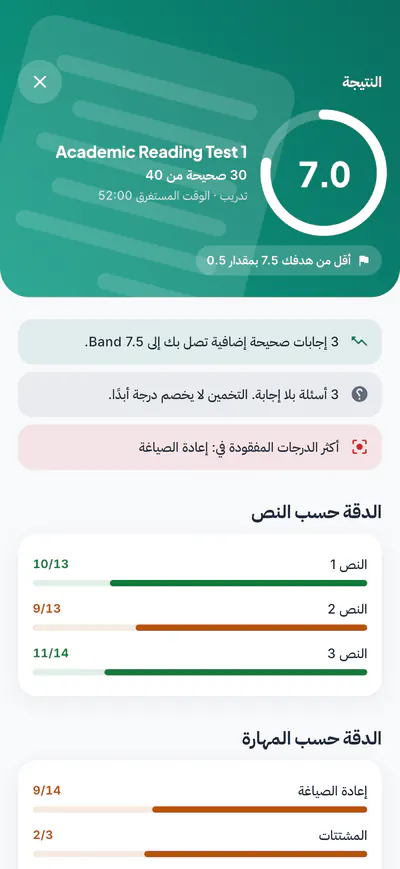
نتيجة اختبار IELTS تجريبي في تطبيق Fleydo: التحضير لـ IELTS: الدرجة التقديرية والدقة في كل جزء
درس تجريبي مجاني

اعرف درجتك الحقيقية في IELTS قبل الامتحان

درس فردي مجاني عبر الإنترنت مع معلم متحدث أصلي للإنجليزية، متخصص معتمد في IELTS بدرجة 8.5+. تحصل على تشخيص لقسم Speaking بالصيغة الحقيقية للامتحان، وتقدير صادق لدرجتك، وخطة تركز على المعايير التي تخسرك العلامات بالضبط. بدون دفع وبدون التزام.

عبر الإنترنت · فردي · Academic وGeneral Training

IELTS علامة تجارية مسجّلة لكل من British Council و IDP: IELTS Australia و Cambridge University Press & Assessment. هذه الاختبارات التجريبية من إعداد Fleydo، ولم تعتمدها هذه الجهات ولم تؤيدها.

تطبيق الهاتف

Fleydo English School في جيبكم

الدروس والواجبات والرسائل والألعاب لطلاب Fleydo وأولياء أمورهم. مجاني على iPhone وAndroid.

نزّله من App Storeاحصل عليه من Google Play
المزيد عن التطبيق
رمز QR يفتح تطبيق Fleydo English School في App Store أو Google Playامسحوا الرمز للتحميليفتح المتجر المناسب لهاتفكم.fleydo.com/app
أيقونة تطبيق Fleydo IELTS
Fleydo: التحضير لـ IELTS

هل تستعدون لاختبار IELTS؟

«Fleydo: التحضير لـ IELTS» تطبيق منفصل يضم اختبارات تجريبية في المهارات الأربع، ولا يتطلب استخدامه حساب Fleydo.

المزيد عن تطبيق IELTS
نزّله من App Storeاحصل عليه من Google Play
اختبارات IELTS تجريبية

تدريب على مهارات IELTS الأربع كلها

اختبارات عددها 311، مع درجة فورية وشرح للإجابات وإجابات نموذجية. بلا تسجيل.

كل الاختبارات التجريبية
FleyPath

خريطة طريق شخصية لطفلك — 3 أو 6 أو 12 شهرًا

🚀البداية
👋Hello
😊Body
🦁Animals
🔢Numbers
🏆إنجليزية واثقة
تدريب على الإنجليزية بأسلوب الألعاب

مثل اللعبة — لكنهم يتعلمون فعلًا