1. الرئيسية
  2. IELTS
  3. الاختبارات التجريبية
  4. Reading
  5. تدريب IELTS Reading على True/False/Not Given رقم 2

IELTS Reading · True / False / Not Given

تدريب IELTS Reading على True/False/Not Given رقم 2

How bowerbirds build an illusion

  • 12 سؤالًا
  • 15 دقيقة
  • Academic

ما يضمه هذا الاختبار

  1. Passageالأسئلة 1–12A trick of perspective

أنواع الأسئلة

  • True / False / Not Given
Readingتدريب IELTS Reading على True/False/Not Given رقم 2
الوقت المتبقي15:00

Passage

A trick of perspective

A In New Guinea and Australia, the males of many bowerbird species build structures known as bowers. A bower is not a nest. It serves only to attract females, which visit several bowers before choosing a mate and then go off to build nests and raise their young alone. Not every member of the family behaves this way: in the ten species of catbird, the male takes part in most aspects of rearing the chicks.

B The great bowerbird builds what is called an avenue: two parallel walls of densely thatched sticks, up to about a metre long, opening at each end onto a display court. The court is covered with tens to hundreds of grey and white objects such as stones, shells and bones, and coloured objects are added as decorations. A visiting female stands inside the avenue while the male displays over the court, showing off the lilac-pink crest at the back of his neck and holding coloured objects in his bill.

C The grey and white objects are not scattered at random. In 2010, researchers led by John Endler reported that males arrange them so that size increases with distance from the avenue entrance, with small objects near the female and larger ones further away. Seen from inside the avenue, this gradient makes the objects look more even in size than if they were randomly placed, an effect known as forced perspective, which can create a false impression of size and distance. When the researchers reversed the gradient, males restored it within three days, and after two weeks it differed little from the original.

D Does the illusion matter to females? In a 2012 study, Laura Kelley and Endler found that a male's mating success was significantly related to the female's view of the gradient, and that this view explained substantially more of the variation in success than the strength of the gradient itself. Other biologists disputed the result. They argued that the statistical support was inadequate, that important data had been excluded and that other display traits could explain which males mated most, and they offered another explanation for the pattern of objects. Kelley and Endler also found that each male keeps his own level of illusion. When they improved the forced perspective on a court, the owner returned it to its original quality within three days, and the differences between males held across two breeding seasons.

E To see how the courts are built, the same pair cleared every object from a number of courts in Queensland. The males recreated the size gradient almost at once, within the first ten objects they put down, starting at the centre of the court and working outwards, a technique commonly used by people laying mosaics. After three days about half of the objects had been replaced. The number of objects then on a court was unrelated either to its owner's mating success or to the quality of the illusion. To the authors, this suggested that skill in arranging objects matters more than their number, but an earlier study co-written by Endler had concluded that illusions vary because of the kinds of objects at a bower, not the male's skill.

F Bowers elsewhere invite comparisons with human art too. A study published in 1986 found that the bowers of another species differed between two mountain ranges. In one, they were tall towers of sticks on a mat of moss painted black, decorated with dull objects such as snail shells and stones; in the other, they were stick huts on green moss, decorated with colourful fruits, flowers and butterfly wings. When the author offered the birds poker chips in seven colours, individual birds preferred some colours to others, and they stole chips from their neighbours. The study suggested that bower styles may be partly learned, and so passed on culturally, like styles of human art.

مسرد المصطلحات
bowers
structures built by male bowerbirds to attract females
avenue
here, a short passage between two walls of sticks
thatched
made from sticks or plant material packed closely together
forced perspective
a way of arranging things so that they look larger, smaller, nearer or further away than they really are
mosaics
pictures or patterns made from many small pieces of stone, glass or tile
Passageالأسئلة 1–12
الأسئلة 1–12

Do the following statements agree with the information given in the text? TRUE if the statement agrees with the information FALSE if the statement contradicts the information NOT GIVEN if there is no information on this

1Female bowerbirds raise their young in the bower that the male has built.
2In some species of the bowerbird family, males help to bring up the chicks.
3The walls of the avenue may reach a height of around one metre.
4The biggest grey and white objects on a court are placed nearest to the avenue.
5Males put back a reversed gradient in a matter of days.
6The 2012 study found that the gradient as the female saw it explained more of the differences in mating success than the gradient's actual strength did.
7The criticism led Kelley and Endler to withdraw their findings.
8A male whose court had been improved by the researchers kept it at the higher level.
9When rebuilding their courts, males began by placing objects in the middle.
10Males with more objects on their courts after three days mated more often.
11Young great bowerbirds take several years to learn how to build a good illusion.
12The poker chips that the birds in the 1986 study stole were mostly of the colours they preferred.

الإجابات والشروح

جرّب الاختبار أولاً: مفتاح الإجابات أنفع بعد أن تجيب.

اعرض مفتاح الإجابات والشروح
  1. 1
    FALSE

    Paragraph A says 'A bower is not a nest' and that females 'go off to build nests and raise their young alone'. So they do not raise young in the bower. FALSE, not NOT GIVEN.

  2. 2
    TRUE

    Paragraph A says that in catbirds 'the male takes part in most aspects of rearing the chicks'. Catbirds belong to the family, so some males do help. The statement is TRUE.

  3. 3
    NOT GIVEN

    Paragraph B gives a length, 'up to about a metre long', but says nothing about how high the walls are. A length is not a height, so there is no information: NOT GIVEN, not TRUE.

  4. 4
    FALSE

    Paragraph C says size increases with distance from the avenue, 'with small objects near the female and larger ones further away'. The biggest objects are furthest from the avenue, so the text contradicts the statement: FALSE, not NOT GIVEN.

  5. 5
    TRUE

    Paragraph C says that when the gradient was reversed, 'males restored it within three days'. Three days is a matter of days, so the statement is TRUE. The two weeks mentioned next is when it was almost the same as the original.

  6. 6
    TRUE

    Paragraph D says the female's view of the gradient 'explained substantially more of the variation in success than the strength of the gradient itself'. The statement only reports what the study found, so the later criticism does not change the answer: TRUE.

  7. 7
    NOT GIVEN

    Paragraph D says other biologists disputed the result, but not how Kelley and Endler responded. Their later studies are described, but nothing says whether they kept or withdrew the 2012 findings, so the answer is NOT GIVEN, not FALSE.

  8. 8
    FALSE

    Paragraph D says the owner 'returned it to its original quality within three days'. So he did not keep the improvement. The text contradicts the statement: FALSE, not NOT GIVEN.

  9. 9
    TRUE

    Paragraph E says the males rebuilt the gradient 'starting at the centre of the court and working outwards'. The centre is the middle, so the statement agrees with the text: TRUE.

  10. 10
    FALSE

    Paragraph E says the number of objects after three days 'was unrelated' to mating success. So more objects did not mean more matings, and the text contradicts the statement: FALSE.

  11. 11
    NOT GIVEN

    Paragraph E discusses whether skill matters, but the passage never mentions young birds or how long learning takes. Paragraph F says bower styles 'may be partly learned', but that is another species and no time is given. So NOT GIVEN, not TRUE.

  12. 12
    NOT GIVEN

    Paragraph F says birds preferred some colours and stole chips from neighbours, but it does not say which colours were stolen. The two facts are never linked, so the answer is NOT GIVEN, not TRUE.

الكلمات الأساسية في هذا الاختبار

Passage

gradient
a steady increase or decrease, here in size
illusion
something that tricks the eye, so it looks different from how it really is
disputed
argued that something was not correct
variation
differences between things of the same kind
culturally
here, through learning from others rather than through genes
كيف تجيب عن أسئلة True / False / Not GivenCompare each statement with the text, and tell a real clash from simple silence.

What the task looks like

You get a list of statements and this instruction:

Do the following statements agree with the information given in Reading Passage 1? TRUE if the statement agrees with the information FALSE if the statement contradicts the information NOT GIVEN if there is no information on this

In General Training, the instruction says 'the text' instead of naming a passage.

'Contradicts' means the text says something that cannot be true at the same time as the statement.

The task tests whether you can compare a statement with what the text says, using the text alone. What you know about the subject does not count. In our papers, the statements follow the order of the text.

FALSE or NOT GIVEN: three questions

FALSE and NOT GIVEN can both feel like 'the text does not say this'. So use a sharper test. Ask these questions in order:

1. Does the text say the same thing, perhaps in different words? If so, the answer is TRUE.

2. Imagine the statement is true. Would the text then be wrong? If so, there is a clash, and the answer is FALSE.

3. Could the statement be true or untrue, and the text still be right either way? Then the text is silent on this point, and the answer is NOT GIVEN.

In short: FALSE means the text tells you otherwise. NOT GIVEN means the text does not tell you.

افعل
  • Answer FALSE only when you can point to the words that clash with the statement.
تجنّب
  • Do not answer FALSE only because the text fails to mention something.

Worked example 1: silence is not a clash

Text: The town library moved to the old post office in spring. The new building has twice as many seats as the old one, but fewer shelves, so some rarely borrowed books are now kept in a store room. Visitors must ask staff to fetch them.

Statement: Visitors have to pay when a book is brought from the store room.

ضعيفFALSE. Visitors only have to ask staff. The text does not mention money, so the service must be free.
أفضلNOT GIVEN. The text does not say whether there is a charge. With a fee or without one, every sentence in the text would still be right.

Not mentioning something is not the same as denying it. FALSE needs words in the text that clash with the statement.

Worked example 2: a clash in different words

Same text. Statement: Every book in the library can be collected without help from staff.

ضعيفNOT GIVEN. I cannot find 'every book' or 'without help' anywhere in the text.
أفضلFALSE. Some books are in a store room, and visitors must ask staff to fetch them. If every book could be collected without help, the text would be wrong.

A clash does not have to use the statement's words. Compare the meanings, not the wording.

Worked example 3: do not join the dots

Same text. Statement: The library moved because it needed more seats.

ضعيفTRUE. The new building has twice as many seats, so that must be the reason.
أفضلNOT GIVEN. The text gives the move and it gives the seats, but it never says why the library moved. The reason could be something else.

Two facts side by side do not make a cause. A 'because' in the statement needs a reason in the text.

A method to try

1. Read the statement and find its main point. Mark the small words that limit it, such as 'only', 'all', 'most', 'before' or 'more than'.

2. Find the place. Choose a word that is easy to spot, such as a name or a number, and start looking after the last place you used.

3. Read the whole sentence, and the sentences on each side of it.

4. Ask the three questions, and answer from the text alone.

5. If you have read the likely part of the text closely and found neither agreement nor a clash, choose NOT GIVEN and move on. You cannot find what is not there.

The traps

Your own knowledge: a statement can be true in real life and still be NOT GIVEN, if the text does not say it.

Limiting words: if the text says 'some' and the statement says 'all', that is a clash. 'Usually' against 'always' works the same way.

Comparisons: the text may describe two things without comparing them. 'A is more popular than B' needs the text to make that comparison.

Same topic, different point: a NOT GIVEN statement can use the text's topic and even its words. Finding the topic is not the same as finding the answer.

Information, not opinion

This task is about the information in the text. Yes/No/Not Given is about what the writer claims. The difference matters.

Take this sentence: Some shop owners want the market moved, but I think this would be a mistake.

In a True/False task, 'Some shop owners want the market moved' is TRUE, because the text gives that information. In a Yes/No task, 'The market should be moved' is NO, because the writer argues against it.

أيقونة تطبيق Fleydo IELTS Fleydo: التحضير لـ IELTS

خذ هذه الاختبارات معك على هاتفك

كل اختبار في هذه الصفحات موجود أيضاً في تطبيق Fleydo: التحضير لـ IELTS على iPhone و iPad و Android، ومعه 2,000 كلمة لاختبار IELTS مع الصوت.

  • يعمل دون اتصال بعد تنزيل الاختبار على هاتفك
  • 2,000 كلمة لاختبار IELTS مع الصوت، وتكرار متباعد وتدريبات قصيرة
  • سجّل إجاباتك في Speaking واستمع إليها من جديد
  • خطة يومية بحسب درجتك المستهدفة وتاريخ امتحانك
نزّله من App Storeاحصل عليه من Google Play
امسح الرمز للتنزيليفتح App Store أو Google Play بحسب نوع هاتفك.

لا حاجة إلى حساب. عن التطبيق

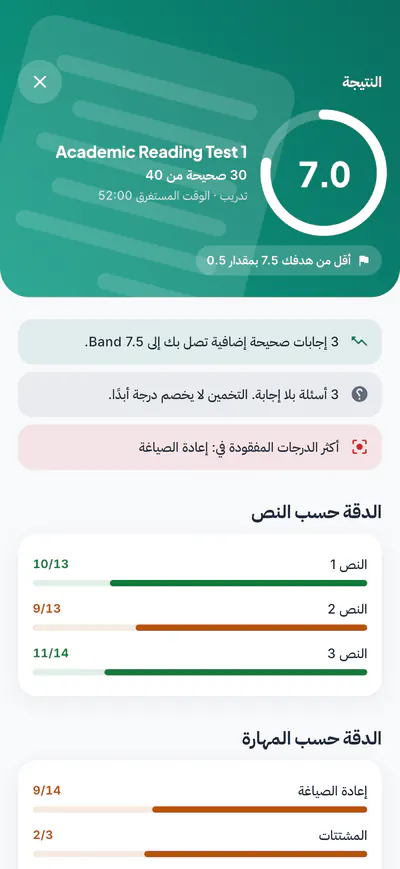
نتيجة اختبار IELTS تجريبي في تطبيق Fleydo: التحضير لـ IELTS: الدرجة التقديرية والدقة في كل جزء
درس تجريبي مجاني

اعرف درجتك الحقيقية في IELTS قبل الامتحان

درس فردي مجاني عبر الإنترنت مع معلم متحدث أصلي للإنجليزية، متخصص معتمد في IELTS بدرجة 8.5+. تحصل على تشخيص لقسم Speaking بالصيغة الحقيقية للامتحان، وتقدير صادق لدرجتك، وخطة تركز على المعايير التي تخسرك العلامات بالضبط. بدون دفع وبدون التزام.

عبر الإنترنت · فردي · Academic وGeneral Training

IELTS علامة تجارية مسجّلة لكل من British Council و IDP: IELTS Australia و Cambridge University Press & Assessment. هذه الاختبارات التجريبية من إعداد Fleydo، ولم تعتمدها هذه الجهات ولم تؤيدها.

تطبيق الهاتف

Fleydo English School في جيبكم

الدروس والواجبات والرسائل والألعاب لطلاب Fleydo وأولياء أمورهم. مجاني على iPhone وAndroid.

نزّله من App Storeاحصل عليه من Google Play
المزيد عن التطبيق
رمز QR يفتح تطبيق Fleydo English School في App Store أو Google Playامسحوا الرمز للتحميليفتح المتجر المناسب لهاتفكم.fleydo.com/app
أيقونة تطبيق Fleydo IELTS
Fleydo: التحضير لـ IELTS

هل تستعدون لاختبار IELTS؟

«Fleydo: التحضير لـ IELTS» تطبيق منفصل يضم اختبارات تجريبية في المهارات الأربع، ولا يتطلب استخدامه حساب Fleydo.

المزيد عن تطبيق IELTS
نزّله من App Storeاحصل عليه من Google Play
اختبارات IELTS تجريبية

تدريب على مهارات IELTS الأربع كلها

اختبارات عددها 311، مع درجة فورية وشرح للإجابات وإجابات نموذجية. بلا تسجيل.

كل الاختبارات التجريبية
FleyPath

خريطة طريق شخصية لطفلك — 3 أو 6 أو 12 شهرًا

🚀البداية
👋Hello
😊Body
🦁Animals
🔢Numbers
🏆إنجليزية واثقة
تدريب على الإنجليزية بأسلوب الألعاب

مثل اللعبة — لكنهم يتعلمون فعلًا