1. الرئيسية
  2. IELTS
  3. الاختبارات التجريبية
  4. Reading
  5. تدريب IELTS Reading على Sentence Completion رقم 2

IELTS Reading · إكمال الجمل

تدريب IELTS Reading على Sentence Completion رقم 2

Synchronised fireflies

  • 10 سؤالًا
  • 15 دقيقة
  • Academic

ما يضمه هذا الاختبار

  1. Passageالأسئلة 1–10Keeping time in the dark

أنواع الأسئلة

  • إكمال الجمل
Readingتدريب IELTS Reading على Sentence Completion رقم 2
الوقت المتبقي15:00

Passage

Keeping time in the dark

A Reports of fireflies flashing in unison were slow to win over Western science. A British diplomat's book on Thailand described the sight in 1857, and boatmen in the region's mangrove swamps had long known it. Yet a letter to the journal Science in 1917 rejected the idea as against natural law and blamed the involuntary blinking of the observer. By the 1960s visiting researchers had confirmed the effect with measurements. The talent remains a rare one, documented in just a handful of the roughly 2,200 firefly species.

B In 1991 a magazine article reported that the Western Hemisphere had no synchronised fireflies. Lynn Faust of Knoxville, Tennessee, whose family had enjoyed just such a display at their Elkmont cabin for decades, read it and contacted the scientists it named, and her report reached the researcher Jonathan Copeland. Sceptical, he asked her to send the flashes drawn as notes on sheet music, and the sketch seemed right. Over the following summers he and his colleague Andrew Moiseff set up cameras and light detectors at Elkmont, in the Great Smoky Mountains, and confirmed the behaviour in the species Photinus carolinus.

C Why should males, which flash to attract females, coordinate at all? In a laboratory test, Moiseff programmed eight small lights to imitate male fireflies and showed them to females collected in the mountains. Females answered more than 80 per cent of the time when the lights flashed together or almost together, but 10 per cent of the time at most when they were out of step. The pair's suggestion is that a female scanning many moving males would otherwise face a confusing clutter of flashes, in which she might be unable to recognise her own species' flash pattern. Whether she truly cannot separate the flashes, or simply chooses not to, was left open.

D Field recordings have since traced how the coordination moves through a real swarm. In June 2020 Raphaël Sarfati, Julie Hayes and Orit Peleg, of the University of Colorado Boulder, set up two cameras about four metres apart near Elkmont, facing a steep ridge. Because a flash captured from two angles can be located in space by calculation, one night could yield up to half a million data points. At low density the timing of flashes looked random. In a dense swarm it fell into a shared pattern: each insect gave up to eight flashes about half a second apart, with the burst returning roughly every 12 seconds.

E Such bursts do not erupt everywhere at once. Each opens and closes with just a few insects flashing, and the two ends tend to lie many metres apart, often at the top and bottom of the ridge. In between, the burst spreads at about half a metre a second. No significant stream of insects follows that route, so the authors describe the process as a relay, in which information moves while the carriers largely do not. Vegetation and the ground block many lines of sight, and the team proposes that fireflies respond to those they can see, through a shifting network of connections.

F Without a crowd, the rhythm disappears. A male placed alone in a black fabric tent still flashed, with regular gaps between flashes, but the gaps between bursts followed no regular pattern and varied widely. Bursts became periodic only with about 15 males together. That makes the 12-second beat look like a property of the group, and it sits awkwardly with classic mathematical models, in which every firefly has its own internal rhythm. A model published by the team and colleagues in 2023 drops that assumption: after a burst each firefly waits a random time, and the first to flash sets off the others.

مسرد المصطلحات
mangrove
a tree that grows in salty water along tropical coasts
periodic
happening again and again at regular times
Passageالأسئلة 1–10
الأسئلة 1–10 2 كلمات كحد أقصى

Complete the sentences below. Choose NO MORE THAN TWO WORDS AND/OR A NUMBER from the passage for each answer.

1A letter written in 1917 claimed that reports of synchronised flashing resulted from the of the people watching.
2Measurements by scientists from elsewhere had shown the flashing to be real by the .
3Doubting Faust's report, Copeland asked for the flashes to be set out on .
4Moiseff and Copeland think that unsynchronised flashes could leave females unable to identify the flash of their own species.
5The position of a flash could be worked out because it was recorded from two .
6When few fireflies were active, the timing of their flashes seemed .
7In a dense swarm, bursts of flashes come back at intervals of about seconds.
8The authors liken the way a burst passes through the swarm to a .
9The fireflies that an insect can respond to may be limited by the ground and by .
10In the tent, bursts came at regular intervals only when there were about males.

الإجابات والشروح

جرّب الاختبار أولاً: مفتاح الإجابات أنفع بعد أن تجيب.

اعرض مفتاح الإجابات والشروح
  1. 1
    involuntary blinking / blinking

    Paragraph A says the letter 'blamed the involuntary blinking of the observer'. Blamed means it gave this as the cause, and the observer is the person watching. Blinking or involuntary blinking is correct.

  2. 2
    1960s / 1960's

    Paragraph A says 'By the 1960s visiting researchers had confirmed the effect'. The years 1857 and 1917 are in the same paragraph, but they are the dates of a diplomat's account and a sceptical letter.

  3. 3
    sheet music

    Paragraph B says he 'asked her to send the flashes drawn as notes on sheet music'. Notes are what she drew, but sheet music is what they were set out on. The cameras came in later summers, so they do not fit.

  4. 4
    pattern

    Paragraph C says that without synchrony she 'might be unable to recognise her own species' flash pattern'. The clutter is what she would see, not the thing she needs to recognise, so pattern is the word that fits.

  5. 5
    angles / cameras

    Paragraph D says a flash 'captured from two angles can be located in space by calculation'. The same paragraph says there were two cameras, so cameras is also accepted.

  6. 6
    random

    Paragraph D says 'At low density the timing of flashes looked random'. Low density means few fireflies in the space. In a dense swarm the flashes follow a shared pattern, which is the opposite case.

  7. 7
    12 / twelve

    Paragraph D says the burst returns 'roughly every 12 seconds'. The half second is the gap between single flashes inside a burst, not between bursts, so it is the tempting wrong answer here.

  8. 8
    relay

    Paragraph E says 'the authors describe the process as a relay', since information moves on while the insects largely do not. 'Network' describes the links between fireflies, not how a burst moves.

  9. 9
    vegetation

    Paragraph E says 'Vegetation and the ground block many lines of sight', and that fireflies respond to those they can see. So plants and the ground limit which others a firefly can respond to.

  10. 10
    15 / fifteen

    Paragraph F says 'Bursts became periodic only with about 15 males together'. Periodic means at regular intervals. A single male's bursts followed no regular pattern, so a group of about 15 was needed.

الكلمات الأساسية في هذا الاختبار

Passage

sceptical
doubting that something is true
synchronised
happening at exactly the same moment
clutter
many things crowded together in an untidy way
property
a typical quality of something
assumption
something accepted as true without proof
كيف تجيب عن أسئلة إكمال الجملComplete a sentence with exact words from the text, and read the result.

What the task looks like

You get sentences with a gap in each, and an instruction such as: Choose NO MORE THAN TWO WORDS from the passage for each answer.

The sentence rewords the text, and your answer is the missing word or words, taken from the text. The task tests whether you can find a specific detail.

In our papers, the sentences follow the order of the text, and the answer appears word for word in the text.

A method to try

1. Check the limit. NO MORE THAN TWO WORDS allows one word or two. It is a limit, not a target.

2. Read the whole sentence and decide what the gap needs. A noun, a verb, an adjective or a number? Singular or plural? The words on each side of the gap are your clues.

3. Work out what the sentence means, then find the same idea in the text. Expect different words.

4. Copy the answer as it is written in the text. You should not need to change its form. If you feel you must, for example from 'decided' to 'decision', you may be reading the wrong sentence.

5. Read the finished sentence. It should be correct English, and it should say what the text says.

The traps

Too many words: you copy a whole phrase when the sentence needs only part of it.

Good grammar, wrong meaning: a word from the right paragraph can fit the gap and still make the sentence untrue.

The nearest word: the word next to your clue may not be the answer. Read to the end of the sentence in the text.

Words already printed: do not repeat a word that is already there just before or after the gap.

Worked example

Text: The bakery began as a market stall selling only bread. Its owners later opened a small café in the same street, and the profits paid for a second oven. Today, customers often queue for its cakes.

Sentence: Money earned by the café allowed the owners to buy an additional ____. (NO MORE THAN TWO WORDS)

ضعيفsecond oven. These words come straight after 'paid for a', and the limit allows two words.
أفضلoven. 'Additional' already does the work of 'second', so the gap needs only one word. 'An additional oven' is correct English and says what the text says.

'An additional second oven' repeats itself. Reading the finished sentence shows you this, and you do not have to use every word the limit allows.

أيقونة تطبيق Fleydo IELTS Fleydo: التحضير لـ IELTS

خذ هذه الاختبارات معك على هاتفك

كل اختبار في هذه الصفحات موجود أيضاً في تطبيق Fleydo: التحضير لـ IELTS على iPhone و iPad و Android، ومعه 2,000 كلمة لاختبار IELTS مع الصوت.

  • يعمل دون اتصال بعد تنزيل الاختبار على هاتفك
  • 2,000 كلمة لاختبار IELTS مع الصوت، وتكرار متباعد وتدريبات قصيرة
  • سجّل إجاباتك في Speaking واستمع إليها من جديد
  • خطة يومية بحسب درجتك المستهدفة وتاريخ امتحانك
نزّله من App Storeاحصل عليه من Google Play
امسح الرمز للتنزيليفتح App Store أو Google Play بحسب نوع هاتفك.

لا حاجة إلى حساب. عن التطبيق

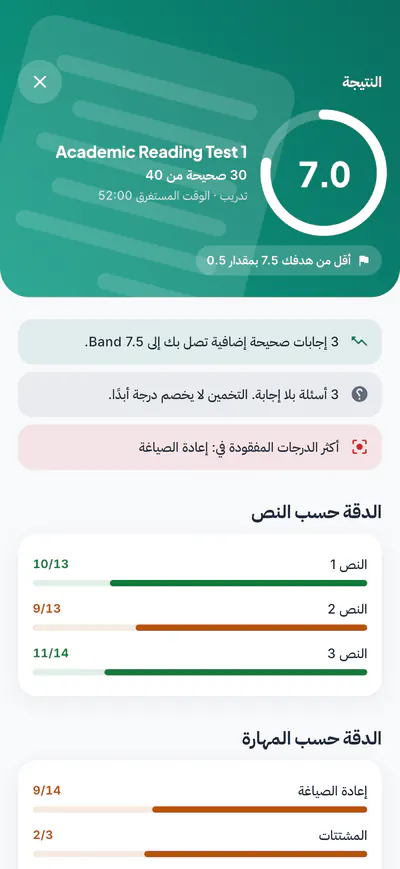
نتيجة اختبار IELTS تجريبي في تطبيق Fleydo: التحضير لـ IELTS: الدرجة التقديرية والدقة في كل جزء
درس تجريبي مجاني

اعرف درجتك الحقيقية في IELTS قبل الامتحان

درس فردي مجاني عبر الإنترنت مع معلم متحدث أصلي للإنجليزية، متخصص معتمد في IELTS بدرجة 8.5+. تحصل على تشخيص لقسم Speaking بالصيغة الحقيقية للامتحان، وتقدير صادق لدرجتك، وخطة تركز على المعايير التي تخسرك العلامات بالضبط. بدون دفع وبدون التزام.

عبر الإنترنت · فردي · Academic وGeneral Training

IELTS علامة تجارية مسجّلة لكل من British Council و IDP: IELTS Australia و Cambridge University Press & Assessment. هذه الاختبارات التجريبية من إعداد Fleydo، ولم تعتمدها هذه الجهات ولم تؤيدها.

تطبيق الهاتف

Fleydo English School في جيبكم

الدروس والواجبات والرسائل والألعاب لطلاب Fleydo وأولياء أمورهم. مجاني على iPhone وAndroid.

نزّله من App Storeاحصل عليه من Google Play
المزيد عن التطبيق
رمز QR يفتح تطبيق Fleydo English School في App Store أو Google Playامسحوا الرمز للتحميليفتح المتجر المناسب لهاتفكم.fleydo.com/app
أيقونة تطبيق Fleydo IELTS
Fleydo: التحضير لـ IELTS

هل تستعدون لاختبار IELTS؟

«Fleydo: التحضير لـ IELTS» تطبيق منفصل يضم اختبارات تجريبية في المهارات الأربع، ولا يتطلب استخدامه حساب Fleydo.

المزيد عن تطبيق IELTS
نزّله من App Storeاحصل عليه من Google Play
اختبارات IELTS تجريبية

تدريب على مهارات IELTS الأربع كلها

اختبارات عددها 311، مع درجة فورية وشرح للإجابات وإجابات نموذجية. بلا تسجيل.

كل الاختبارات التجريبية
FleyPath

خريطة طريق شخصية لطفلك — 3 أو 6 أو 12 شهرًا

🚀البداية
👋Hello
😊Body
🦁Animals
🔢Numbers
🏆إنجليزية واثقة
تدريب على الإنجليزية بأسلوب الألعاب

مثل اللعبة — لكنهم يتعلمون فعلًا