1. الرئيسية
  2. IELTS
  3. الاختبارات التجريبية
  4. Reading
  5. تدريب IELTS Reading على Note Completion رقم 5

IELTS Reading · إكمال الملاحظات

تدريب IELTS Reading على Note Completion رقم 5

Tracing obsidian

  • 13 سؤالًا
  • 15 دقيقة
  • Academic

ما يضمه هذا الاختبار

  1. Passageالأسئلة 1–13What the glass remembers

أنواع الأسئلة

  • إكمال الملاحظات
Readingتدريب IELTS Reading على Note Completion رقم 5
الوقت المتبقي15:00

Passage

What the glass remembers

A Obsidian is a natural glass that breaks along smooth, curved surfaces, leaving very sharp edges, and people have shaped it into blades and arrowheads. It comes from volcanoes that erupt silica-rich lava, usually 70 per cent silica or more by weight, and newly formed obsidian typically holds less than 1 per cent water. So much silica makes the lava extremely viscous, which hinders the movement of atoms that crystals need in order to form.

B Just how quickly the lava must cool is now disputed. The usual account, given by a United States Geological Survey scientist in 2020, is that fast cooling and very thick magma between them stop crystals from growing. A paper published in Nature Communications in 2026 argues otherwise: for leftover gas bubbles to dissolve back into the melt, cooling has to be slow, and X-ray images taken at magmatic temperatures showed bubbles shrinking during cooling. Either way, the glass does not last indefinitely. At the Earth's surface it is unstable and gradually turns into fine-grained crystals, a change speeded up by water, and for that reason obsidian of great age is rare.

C Archaeologists have another reason to study the rock: it can often be matched to the place it came from. Its chemistry varies from volcano to volcano, so that sources are often distinguishable, though not reliably by eye. In a 1966 paper, Colin Renfrew, J. E. Dixon and J. R. Cann warned that appearance could mislead, since red and black mottling, for instance, turned up occasionally at many sources. An important factor for their approach was that samples from different parts of a single source should be closely alike, as they were at the sources tested most fully. Even so, the authors admitted, one chemical group might contain material from more than one source.

D Their method dated from the early 1960s. Renfrew, then a doctoral researcher working on the Cycladic islands of Greece, later recalled that measuring the refractive index, a figure for how strongly a material bends light, showed little difference between samples. His friend Joe Cann suggested measuring trace elements by optical emission spectroscopy instead. A graph of barium against zirconium then separated obsidian from Melos, in the Cyclades, from that of Lipari, although, he said, on that graph obsidian from Italy's Pontine Islands differed little from the Lipari material until caesium was measured too. Pieces from Malta matched mainly with Lipari, Renfrew recalled, so an earlier suggestion of contact between the Cyclades and Malta proved unwarranted. Finds from the Maltese site of Skorba also show most obsidian coming from Lipari, with a smaller share from Pantelleria.

E Applied to the Near East, the analyses showed that obsidian's share of chipped stone tended to fall with distance from the nearest source. At Çatalhöyük, some 200 kilometres away, it made up over 90 per cent. At Ali Kosh, 1,000 kilometres from Lake Van, the figure was no more than 2 per cent, and at Beidha in Jordan, about 800 kilometres from its sources, one Neolithic level produced just three pieces among some 30,000. The authors warned against reading too much into such finds. At the earliest sites the quantities were too small to justify talk of organised trade, since nomadic hunters could have picked up a little obsidian in the course of their normal movements. For the early farming villages, however, they argued that such wandering could not explain finds so consistent.

F Researchers now also use X-ray fluorescence, which leaves the artefact undamaged. Handheld versions have spread widely and prompted debate among archaeologists. The technique is comparative, so its results depend on calibration. One response, published in 2019 by the Yale archaeologist Ellery Frahm, was a series of matched reference sets, each of 35 obsidian specimens: 20 for calibration and 15 for evaluation.

مسرد المصطلحات
silica
a hard natural substance made of silicon and oxygen, found in many rocks
viscous
thick and slow to flow
melt
rock that has become liquid through heat
magmatic temperatures
the very high temperatures of molten rock
trace elements
chemical elements present in very small amounts
optical emission spectroscopy
a way to measure elements from the light a heated sample gives off
Neolithic
the later part of the Stone Age, when people began farming
X-ray fluorescence
a way to measure elements from the X-rays a sample gives off when X-rays strike it
Passageالأسئلة 1–13
الأسئلة 1–13 2 كلمات كحد أقصى

Complete the notes below. Choose NO MORE THAN TWO WORDS AND/OR A NUMBER from the passage for each answer.

TRACING OBSIDIAN
THE GLASS
silica content: normally at least 1 by weight
2026 paper: slow cooling gives leftover 2 time to disappear
later change into crystals happens faster in the presence of 3
TELLING SOURCES APART
looks can deceive: red and black 4 occurs at many sources
test that revealed little: measuring the 5
results plotted: barium against 6
needed to tell Lipari obsidian from Pontine Islands obsidian: 7
pieces found on Malta came chiefly from 8
NEAR EASTERN SITES
Beidha: only 9 pieces among about 30,000
Ali Kosh: obsidian formed at most 10 of chipped stone
earliest finds: amounts too small to suggest 11 trade
PRESENT-DAY ANALYSIS
X-ray fluorescence: object remains 12
handheld instruments: findings rely on 13

الإجابات والشروح

جرّب الاختبار أولاً: مفتاح الإجابات أنفع بعد أن تجيب.

اعرض مفتاح الإجابات والشروح
  1. 1
    70 per cent / 70% / seventy per cent / 70 percent / seventy percent

    Paragraph A gives silica as 'usually 70 per cent silica or more by weight'. The 1 per cent in the same sentence is the water content, not the silica, so it does not fit. The unit must be included.

  2. 2
    gas bubbles / bubbles

    Paragraph B says slow cooling is needed 'for leftover gas bubbles to dissolve'. Disappear means dissolve here. Crystals are also discussed, but the 2026 paper's argument concerns bubbles, and the notes already give the word leftover.

  3. 3
    water

    Paragraph B says the glass turns into crystals, 'a change speeded up by water'. Happening faster means speeded up. Silica is mentioned earlier as making lava thick, but the text does not link silica with this later change.

  4. 4
    mottling

    Paragraph C says 'red and black mottling' turned up at many sources, so appearance could mislead. Occurs means turned up. The word means patches of colour. Spell it with two t's, as a spelling mistake loses the mark.

  5. 5
    refractive index

    Paragraph D says measuring 'the refractive index' showed little difference between samples, so it revealed little. Trace-element measurement is what Cann suggested instead, and it did separate the sources, so it cannot be the answer here.

  6. 6
    zirconium

    Paragraph D describes 'A graph of barium against zirconium'. The notes give barium, so the second element is needed. Caesium is another element in the text, but it was measured later for a different purpose, not on this graph.

  7. 7
    caesium / cesium

    Paragraph D says Pontine Islands obsidian differed little from Lipari material 'until caesium was measured too'. Barium and zirconium are tempting, but that graph separated Melos from Lipari, not these two sources.

  8. 8
    Lipari

    Paragraph D says pieces from Malta 'matched mainly with Lipari'. Chiefly means mainly. Pantelleria supplied only a smaller share, and Melos is ruled out, since the suggested contact between the Cyclades and Malta proved unwarranted.

  9. 9
    three / 3

    Paragraph E says one level at Beidha 'produced just three pieces among some 30,000'. The notes give pieces and the 30,000, so the number of obsidian pieces is needed. The 800 kilometres is a distance, not a count.

  10. 10
    2 per cent / 2% / two per cent / 2 percent / two percent

    Paragraph E says that at Ali Kosh 'the figure was no more than 2 per cent'. At most means no more than. The 90 per cent belongs to Çatalhöyük, and the 1,000 kilometres is the distance to Lake Van. Write the unit too.

  11. 11
    organised / organized

    Paragraph E says the quantities were 'too small to justify talk of organised trade'. Amounts means quantities. Hunters could have picked up small amounts on their normal movements, so the finds did not suggest organised trade. Normal describes the movements, not trade.

  12. 12
    undamaged

    Paragraph F says X-ray fluorescence 'leaves the artefact undamaged'. Object means artefact, and remains matches leaves. The notes need an adjective describing the object after remains, so undamaged is the word that fits.

  13. 13
    calibration

    Paragraph F says 'its results depend on calibration'. Findings means results, and rely on means depend on. Evaluation appears nearby but is one use of the reference sets, not what the text says the results depend on.

الكلمات الأساسية في هذا الاختبار

Passage

hinders
makes something difficult
unstable
likely to change
distinguishable
clearly different and able to be told apart
nomadic
moving from place to place, with no permanent home
comparative
judged by comparing one thing with another
كيف تجيب عن أسئلة إكمال الملاحظاتUse the headings and labels in a set of notes to find the text's own word.

What the task looks like

The instruction says 'Complete the notes below.' You get short lines under headings, with gaps in them, and a limit such as ONE WORD ONLY.

Notes leave out small words such as 'the' and 'is', so you get fewer grammar clues than in a full sentence. As with a summary, the task tests details, main ideas and word type.

A method to try

1. Read the headings. They show how the notes are organised and which parts of the text you need.

2. Read the line around each gap. What is the label asking for: a place, a reason, a material?

3. Turn the note into a full sentence in your head. 'Reason: lack of ____' becomes 'The reason is that there is not enough ____'. This often shows what is missing.

4. Find that idea in the text, and take the word from there.

5. Check the word against the label as well as the line. Does it really answer what the label asks?

The traps

Your own word: a word that means the same is not the same as the word in the text.

The wrong heading: a detail that looks right may belong under a different heading in the notes. Use the headings to stay in the right place.

Fuller than the note: notes are short, so a long phrase from the text probably contains more than the gap needs.

Worked example

Text: The town's repair café opens on the first Saturday of each month. Volunteers fix small electrical items and clothes, but they cannot take furniture because the hall has no room for it. Visitors pay nothing, although many leave a donation.

Notes: REPAIR CAFÉ Open: first Saturday of the month Will fix: small electrical items, clothes Furniture not accepted. Reason: lack of ____ at the hall Cost: free, donations welcome (ONE WORD ONLY)

ضعيفspace. It means the same as the word in the text, and it sounds natural after 'lack of'.
أفضلroom. The text says 'the hall has no room for it'. 'Lack of' rewords 'no', but the answer itself comes from the text.

Answers must be taken from words in the text, so a synonym of your own is not the answer, however close its meaning. Look back and find the text's word.

أيقونة تطبيق Fleydo IELTS Fleydo: التحضير لـ IELTS

خذ هذه الاختبارات معك على هاتفك

كل اختبار في هذه الصفحات موجود أيضاً في تطبيق Fleydo: التحضير لـ IELTS على iPhone و iPad و Android، ومعه 2,000 كلمة لاختبار IELTS مع الصوت.

  • يعمل دون اتصال بعد تنزيل الاختبار على هاتفك
  • 2,000 كلمة لاختبار IELTS مع الصوت، وتكرار متباعد وتدريبات قصيرة
  • سجّل إجاباتك في Speaking واستمع إليها من جديد
  • خطة يومية بحسب درجتك المستهدفة وتاريخ امتحانك
نزّله من App Storeاحصل عليه من Google Play
امسح الرمز للتنزيليفتح App Store أو Google Play بحسب نوع هاتفك.

لا حاجة إلى حساب. عن التطبيق

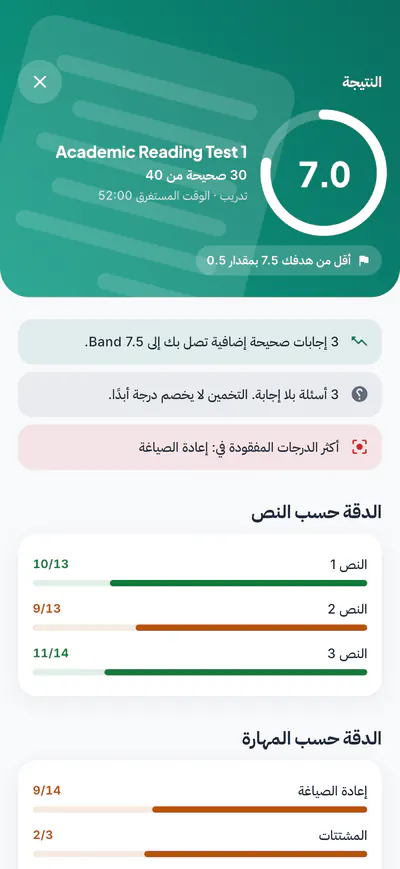
نتيجة اختبار IELTS تجريبي في تطبيق Fleydo: التحضير لـ IELTS: الدرجة التقديرية والدقة في كل جزء
درس تجريبي مجاني

اعرف درجتك الحقيقية في IELTS قبل الامتحان

درس فردي مجاني عبر الإنترنت مع معلم متحدث أصلي للإنجليزية، متخصص معتمد في IELTS بدرجة 8.5+. تحصل على تشخيص لقسم Speaking بالصيغة الحقيقية للامتحان، وتقدير صادق لدرجتك، وخطة تركز على المعايير التي تخسرك العلامات بالضبط. بدون دفع وبدون التزام.

عبر الإنترنت · فردي · Academic وGeneral Training

IELTS علامة تجارية مسجّلة لكل من British Council و IDP: IELTS Australia و Cambridge University Press & Assessment. هذه الاختبارات التجريبية من إعداد Fleydo، ولم تعتمدها هذه الجهات ولم تؤيدها.

تطبيق الهاتف

Fleydo English School في جيبكم

الدروس والواجبات والرسائل والألعاب لطلاب Fleydo وأولياء أمورهم. مجاني على iPhone وAndroid.

نزّله من App Storeاحصل عليه من Google Play
المزيد عن التطبيق
رمز QR يفتح تطبيق Fleydo English School في App Store أو Google Playامسحوا الرمز للتحميليفتح المتجر المناسب لهاتفكم.fleydo.com/app
أيقونة تطبيق Fleydo IELTS
Fleydo: التحضير لـ IELTS

هل تستعدون لاختبار IELTS؟

«Fleydo: التحضير لـ IELTS» تطبيق منفصل يضم اختبارات تجريبية في المهارات الأربع، ولا يتطلب استخدامه حساب Fleydo.

المزيد عن تطبيق IELTS
نزّله من App Storeاحصل عليه من Google Play
اختبارات IELTS تجريبية

تدريب على مهارات IELTS الأربع كلها

اختبارات عددها 311، مع درجة فورية وشرح للإجابات وإجابات نموذجية. بلا تسجيل.

كل الاختبارات التجريبية
FleyPath

خريطة طريق شخصية لطفلك — 3 أو 6 أو 12 شهرًا

🚀البداية
👋Hello
😊Body
🦁Animals
🔢Numbers
🏆إنجليزية واثقة
تدريب على الإنجليزية بأسلوب الألعاب

مثل اللعبة — لكنهم يتعلمون فعلًا