1. الرئيسية
  2. IELTS
  3. الاختبارات التجريبية
  4. Reading
  5. تدريب IELTS Reading على Matching Headings رقم 4

IELTS Reading · مطابقة العناوين

تدريب IELTS Reading على Matching Headings رقم 4

The first QR codes

  • 7 سؤالًا
  • 15 دقيقة
  • Academic

ما يضمه هذا الاختبار

  1. Passageالأسئلة 1–7From parts bin to pocket

أنواع الأسئلة

  • مطابقة العناوين
Readingتدريب IELTS Reading على Matching Headings رقم 4
الوقت المتبقي15:00

Passage

From parts bin to pocket

A By the early 1990s the barcode had become a bottleneck on some Japanese factory floors. Denso, a car-parts maker in the Toyota group, used barcodes to track parts, often several on a box. According to the company's later account, workers at manufacturing sites might have to scan as many as 1,000 a day; each barcode held only about 20 characters; and in 1992 such sites asked an engineer, Masahiro Hara, for faster scanners. He decided that a quicker reader would not cure the trouble, since the weakness lay in the symbol itself. What was needed was a compact code carrying far more data, including Japanese characters.

B Hara's team, two people at first, chose a two-dimensional pattern, storing data in both directions, which created a new difficulty. Before reading such a pattern a scanner must find it, and surrounding text got in the way. Hara has said the answer occurred to him on a train, when he noticed how one tall building stood out against its surroundings. The code needed a similar mark of its own. The team therefore studied black-and-white patterns in printed matter to find the proportions that appeared least often, which proved to be 1:1:3:1:1, and put squares with those proportions at three corners. A scanner could then pick out the code from any angle.

C Printing raised another problem. A 2023 university profile of Hara says early versions could not be read accurately because the ink blotted, and traces the remedy to his boyhood love of Go, in which a position remains clear even if a stone is missing or slightly misplaced. The finished design does not demand perfect marks. On the profile's account it is read roughly first and then refined, and, at its strongest setting, a code can survive damage to about 30 per cent of its area, because other parts make up for the loss.

D Denso Wave, then a division of Denso, announced the code in 1994 and named it for quick response. Its own history records what followed. Car makers took it up for electronic kanban, and it came into use from production to shipping and on transaction slips. Food, pharmaceutical and contact-lens companies then adopted it to keep track of their products, and tickets and advertisements followed. A tool designed around the needs of one industry had become a general means of labelling and tracing goods.

E Hara himself explains this spread by pointing to a legal choice. Patents were granted in the United States in 1998, Japan in 1999 and Europe in 2000, yet the company's history says it had decided from the start to keep those rights without exercising them, and it made the specifications public so that anyone could use the code. Asked why the code succeeded, Hara has replied that no licence is needed; in his view, even excellent technology means nothing unless many people use it.

F Ordinary people met the code through their telephones. Denso Wave dates its widespread public use in Japan to 2002, when handsets with built-in readers went on sale. Until about 2017, however, a smartphone owner generally needed a separate application to read one; in that year Apple's iOS 11 built the ability into the iPhone's camera, and Android software soon followed.

G Some later uses went far beyond what Hara expected: in a 2024 interview he said he had imagined mainly industrial applications, not so large a place in citizens' daily lives. In China, as Aaron Klein of the Brookings Institution explained in 2020, a shop using Alipay or WeChat Pay could accept money by displaying a code printed on paper, with the customer's phone doing the scanning and going online, which lowered merchants' costs compared with card terminals. During the Covid-19 pandemic, restaurants adopted codes so that diners need not touch shared menus, and New Zealand and the Australian state of New South Wales used them for tracing contacts.

مسرد المصطلحات
kanban
a system of signals used in factories to control the supply of parts
Go
a board game played with black and white stones on a grid
Alipay and WeChat Pay
Chinese services for paying by mobile phone
iOS 11
a version of the main software that runs iPhones
Android
the main software that runs most smartphones other than iPhones
Passageالأسئلة 1–7
الأسئلة 1–7

The text has seven paragraphs, A-G. Choose the correct heading for each paragraph from the list of headings below.

الخيارات
  • iA building seen from a railway carriage
  • iiApplications its creator had not anticipated
  • iiiMoving from car plants into other sectors
  • ivA fault traced to the symbol, not the machine
  • vA board game learned in childhood
  • viMaking the code easy for a scanner to locate
  • viiLegal rights held but left unused
  • viiiDisputes over who owned the invention
  • ixBuilt to cope with blots and damage
  • xReaching the general public through handsets
  • xiSavings for small shops in China
1Paragraph A
2Paragraph B
3Paragraph C
4Paragraph D
5Paragraph E
6Paragraph F
7Paragraph G

الإجابات والشروح

جرّب الاختبار أولاً: مفتاح الإجابات أنفع بعد أن تجيب.

اعرض مفتاح الإجابات والشروح
  1. 1
    iv

    Paragraph A explains that faster scanners would not help, because the problem was the barcode. Heading vi fails: finding a code on the page only becomes a difficulty in paragraph B.

  2. 2
    vi

    The whole paragraph is about helping a scanner to find the pattern, through the corner squares and their proportions. Heading i fails because the train and the building are one small detail in that story.

  3. 3
    ix

    Paragraph C moves from ink blots to a design that can still be read when part of it is damaged. Heading v fails because Go appears only as the source of one idea.

  4. 4
    iii

    Paragraph D follows the code from car makers to food, pharmaceutical and contact-lens companies, then tickets. Heading ii fails because this paragraph says nothing about what its creator had expected.

  5. 5
    vii

    Paragraph E explains that the company obtained patents but chose not to use them, and that Hara credits this for the code's success. Heading viii fails because the paragraph mentions no dispute.

  6. 6
    x

    Paragraph F traces public use from Japanese handsets in 2002 to the phone software of about 2017. Heading ii fails: the paragraph describes phones bringing the code to ordinary people, not what Hara had or had not expected.

  7. 7
    ii

    The opening sentence gives the main idea, and payments and the pandemic are its examples. Heading xi fails because Chinese shops are only one example, and heading x fails because the phones are not the main point here.

الكلمات الأساسية في هذا الاختبار

Passage

bottleneck
something that slows down a whole process
compact
small and using little space
proportions
the sizes of the parts of something compared with each other
specifications
exact details of how something is designed or made
merchants
people or businesses that sell goods
كيف تجيب عن أسئلة مطابقة العناوينFind each paragraph's main idea and choose the heading that covers all of it.

What the task looks like

You get a list of headings and a set of paragraphs or sections. You choose the right heading for each one.

The task tests whether you can tell a paragraph's main topic from its supporting ideas. A heading states the main idea of the whole paragraph.

In our papers, there are at least two spare headings, each heading is used only once, and the headings are not listed in the order of the text. Sometimes one paragraph is done for you as an example.

A method to try

1. Read the list of headings once, so that you know the choices. If there is an example, take its heading off your list.

2. Read one paragraph to the end. Before you look at the list again, say its main idea in a few words of your own.

3. Compare your words with the list. Look for the heading that is closest in meaning.

4. Test your choice. Go through the paragraph sentence by sentence and ask: does this sentence belong under that heading?

5. If two headings seem possible, note both beside the paragraph and move on. A later match may rule one out.

6. When you are sure of a match, take that heading off your list.

The traps

The detail: a wrong heading may fit one sentence or one example very well. It is still only a supporting idea.

The borrowed word: a wrong heading may repeat a striking word from the paragraph. A shared word does not make a match.

The first sentence: it may link back to the paragraph before, or the paragraph may change direction after a word such as 'however'. That is why you read to the end.

Two similar headings: look at the job each one describes. 'Causes' and 'effects' can share a topic, and so can 'a problem' and 'a solution'. Which job is this paragraph doing?

Worked example

Text: The market square floods after heavy rain because the old drains are too narrow. Last autumn, stall owners lost stock for the third time, and one bakery stall moved away for good. The council has now agreed to replace the drains next summer.

Headings: i. Why one trader left the market ii. A repeated problem and a plan to fix it iii. The early history of the square iv. How much new drains will cost

Which heading fits this paragraph?

ضعيفi. A bakery stall moved away, and that is the most striking thing in the paragraph.
أفضلii. The first sentence gives the problem, the second shows it has happened again and again, and the third gives the plan. Every sentence fits.

Check the heading against every sentence. Heading i fits only part of one sentence, so it is a detail. Heading iv borrows 'drains', but the paragraph gives no cost.

أيقونة تطبيق Fleydo IELTS Fleydo: التحضير لـ IELTS

خذ هذه الاختبارات معك على هاتفك

كل اختبار في هذه الصفحات موجود أيضاً في تطبيق Fleydo: التحضير لـ IELTS على iPhone و iPad و Android، ومعه 2,000 كلمة لاختبار IELTS مع الصوت.

  • يعمل دون اتصال بعد تنزيل الاختبار على هاتفك
  • 2,000 كلمة لاختبار IELTS مع الصوت، وتكرار متباعد وتدريبات قصيرة
  • سجّل إجاباتك في Speaking واستمع إليها من جديد
  • خطة يومية بحسب درجتك المستهدفة وتاريخ امتحانك
نزّله من App Storeاحصل عليه من Google Play
امسح الرمز للتنزيليفتح App Store أو Google Play بحسب نوع هاتفك.

لا حاجة إلى حساب. عن التطبيق

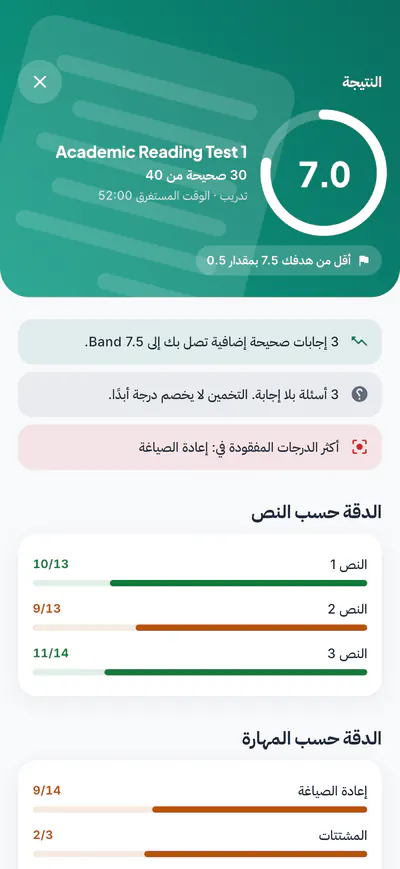
نتيجة اختبار IELTS تجريبي في تطبيق Fleydo: التحضير لـ IELTS: الدرجة التقديرية والدقة في كل جزء
درس تجريبي مجاني

اعرف درجتك الحقيقية في IELTS قبل الامتحان

درس فردي مجاني عبر الإنترنت مع معلم متحدث أصلي للإنجليزية، متخصص معتمد في IELTS بدرجة 8.5+. تحصل على تشخيص لقسم Speaking بالصيغة الحقيقية للامتحان، وتقدير صادق لدرجتك، وخطة تركز على المعايير التي تخسرك العلامات بالضبط. بدون دفع وبدون التزام.

عبر الإنترنت · فردي · Academic وGeneral Training

IELTS علامة تجارية مسجّلة لكل من British Council و IDP: IELTS Australia و Cambridge University Press & Assessment. هذه الاختبارات التجريبية من إعداد Fleydo، ولم تعتمدها هذه الجهات ولم تؤيدها.

تطبيق الهاتف

Fleydo English School في جيبكم

الدروس والواجبات والرسائل والألعاب لطلاب Fleydo وأولياء أمورهم. مجاني على iPhone وAndroid.

نزّله من App Storeاحصل عليه من Google Play
المزيد عن التطبيق
رمز QR يفتح تطبيق Fleydo English School في App Store أو Google Playامسحوا الرمز للتحميليفتح المتجر المناسب لهاتفكم.fleydo.com/app
أيقونة تطبيق Fleydo IELTS
Fleydo: التحضير لـ IELTS

هل تستعدون لاختبار IELTS؟

«Fleydo: التحضير لـ IELTS» تطبيق منفصل يضم اختبارات تجريبية في المهارات الأربع، ولا يتطلب استخدامه حساب Fleydo.

المزيد عن تطبيق IELTS
نزّله من App Storeاحصل عليه من Google Play
اختبارات IELTS تجريبية

تدريب على مهارات IELTS الأربع كلها

اختبارات عددها 311، مع درجة فورية وشرح للإجابات وإجابات نموذجية. بلا تسجيل.

كل الاختبارات التجريبية
FleyPath

خريطة طريق شخصية لطفلك — 3 أو 6 أو 12 شهرًا

🚀البداية
👋Hello
😊Body
🦁Animals
🔢Numbers
🏆إنجليزية واثقة
تدريب على الإنجليزية بأسلوب الألعاب

مثل اللعبة — لكنهم يتعلمون فعلًا