1. Головна
  2. IELTS
  3. Пробні тести
  4. Writing
  5. Skills for leaving home

IELTS Writing · Task 2

IELTS Writing Task 2: Skills for leaving home

  • Запитання з двох частин
  • 40 хв
  • Слів: 250
  • Academic і General Training

WRITING TASK 2

You should spend about 40 minutes on this task.

Many young adults who leave their parents' home for the first time, to study or to work, find that they cannot manage the ordinary tasks of daily life. Which everyday skills do they most often lack? What is the best way for them to learn these skills after they have left home? Give reasons for your answer and include any relevant examples from your own knowledge or experience.

Write at least 250 words.

40:00
0 / 250 слів

Оцініть свою відповідь

Спершу прочитайте зразкові відповіді. Потім за кожним критерієм оберіть band, який відповідає вашій відповіді. Ваш band — це середнє значення, округлене до найближчої половини балу.

6,0Ваш орієнтовний band
Task response

Coherence and cohesion

Lexical resource

Grammatical range and accuracy

Кожен зразок написано так, як написав би інший кандидат, тому деталі й думки різняться. Значення band — це наша оцінка за відкритими дескрипторами, а не офіційна оцінка екзаменатора.

Зразкові відповіді на чотирьох рівнях band

Кожен зразок написано так, як написав би інший кандидат. Band указано за нашою оцінкою на основі відкритих дескрипторів band.

Зразок на band 5,5Слів: 299

When young people go from home to other city, life is not easy for them. At home the mother does everything, so they do not know many simple things. I think they learn best by doing these things every day and asking when they have problem.

Firstly they cannot cook. They buy fast food or instant noodles every day, this is expensiv and not healthy. My brother went to university and after two months he was always tired and he eat only sausages and bread, no vegetabels. Secondly they do not know how to wash cloths and clean the room. Some boys wash all cloths together and white shirt becomes pink. The room is dirty and they do not care about it. Thirdly is money. They spend all the money in first week for coffee and going out and after that they have nothing and they call to parents.

How they can learn? In my opinion practise is the best teacher. Nobody learns cooking from book. When you burn the rice one or two times, next time you are more careful. Also they can phone to the mother and ask how to make soup, she is happy to explain. Video on internet is good too, it is free and you can watch it many times when you cook.

For money is more difficult, because if you make mistake you have no food for one week. So they must write what they spend in small notebook or in the phone. Friends in same flat can help also, maybe one friend knows cooking and other friend knows how to repair things.

So young people do not need special course for this. If they try every day and ask when they do not know, after few months they will not have problems.

Чому саме цей band

  • Both questions get an answer, and the examples are real if simple: 'white shirt becomes pink' and 'burn the rice one or two times'.
  • It stays with the obvious skills and treats them as a list with 'Firstly', 'Secondly' and 'Thirdly is money'. The harder point, money, stops at 'write what they spend'.
  • Articles are the main habit, as in 'to other city' and 'in small notebook', and commas join sentences that should be separate: 'ask how to make soup, she is happy to explain'.

Критерій за критерієм

Task response
Both questions are addressed. Skills get more room than learning, and the support for practice is thin: 'next time you are more careful' is the writer's main reason.
Coherence and cohesion
A simple, visible plan. Paragraphs are clear, but ideas are added one after another, and 'So' leads the reader on without always following from what came before.
Lexical resource
Everyday words only, which limits the writer: 'go from home' for moving out, 'knows cooking' for being able to cook. 'expensiv', 'vegetabels' and 'cloths' are misspellings that follow the sound.
Grammatical range and accuracy
Mostly short sentences, with an error in about half. Articles are often missing, 'call to parents' and 'phone to the mother' have an extra preposition, 'How they can learn?' has the wrong word order, and 'can help also' puts the adverb at the end.

Щоб досягти наступного band

Read each sentence for missing articles, and use a full stop where you now use a comma before 'this' or 'she'. Then take the point about money further: say what a young person should do with the notebook, and who can help when the money runs out.

Сплануйте, перш ніж писати

Чого вимагає завдання

Two direct questions, and both need a full answer: which skills are missing, and the best way to learn them once someone has already moved out. The trap is listing cooking, cleaning and money in one paragraph and then giving the learning one line. Another is arguing about what parents or schools should have done earlier. These people have already left home, so the question is what works for them now.

Ваша головна думка

Name the skills that cause real trouble and say how they are best learned. One workable message: chores are learned quickly by doing them, but with money and paperwork a mistake costs too much, so it is better to ask someone with experience before acting. Other answers here choose practice, a short course or experienced flatmates, and each of these can work.

Абзац за абзацом

  1. IntroductionSay in one sentence which skills you will focus on and how you think they are best learned.
  2. Which skillsChoose two or three and show what happens without each: eating badly, running out of money, signing something unread, not knowing whom to call when something breaks.
  3. The best way to learnGive a reason for your choice. Compare what practice, online videos, friends, family on the phone or a short course can and cannot do. You may choose different ways for different skills, as long as you say which goes with which.
  4. ConclusionAnswer both questions again in fresh words.

Типові помилки

  • Writing a long list of skills with no consequences. Two skills with real effects are better than six names.
  • Answering the second question in one line, such as 'they can watch videos'. Say why your way works, and what it cannot do.
  • Arguing about what parents or schools should have taught earlier. The question asks about people who have already left home.
  • Arguing about the best age to leave home, or whether living alone is good for people. That is a different question.
  • Using 'life skills' or 'basic skills' throughout without ever saying which ones.

Тематична лексика

budget
a plan for how to spend your money
to run out of
to have none of something left
household chores
regular jobs in the home, such as cleaning
flatmate
a person you share a flat with
trial and error
trying different ways until you find one that works
landlord
a person who owns a home and rents it out
lease
a legal agreement to rent a home
overdraft
money you owe the bank after spending more than you have
to put something off
to delay doing something

Корисні вирази

  • The skill most often missing is ..., as ...
  • Someone who has never ... tends to ...
  • ... may seem minor, but it can lead to ...
  • The quickest way to learn ... is ..., because ...
  • This works for ..., but not for ..., since ...
  • A mistake with ... costs little, whereas ...
  • Before ..., it is worth asking ...
  • ... can show a beginner how to ..., while ... could deal with ...

Значок застосунку Fleydo IELTS Fleydo: підготовка до IELTS

Ці тести завжди з вами — у телефоні

Усі тести з цих сторінок є й у застосунку «Fleydo: підготовка до IELTS» для iPhone, iPad і Android, а разом із ними — 2 000 слів для IELTS з озвученням.

  • Працює офлайн, коли тест уже завантажено на телефон
  • 2 000 слів для IELTS з озвученням, інтервальним повторенням і короткими вправами
  • Записуйте відповіді Speaking і прослуховуйте їх
  • План на кожен день під ваш цільовий band і дату іспиту
Завантажте в App StoreЗавантажити з Google Play
Відскануйте, щоб завантажитиВідкриє App Store або Google Play залежно від вашого телефона.

Акаунт не потрібен. Про застосунок

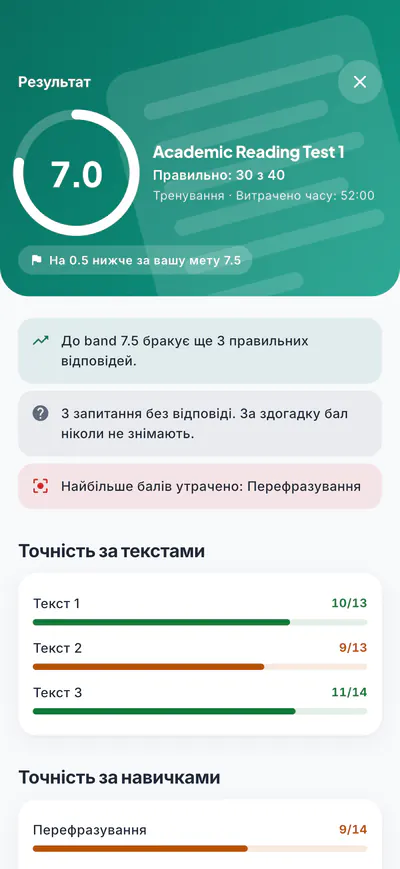
Результат пробного тесту IELTS у застосунку «Fleydo: підготовка до IELTS»: орієнтовний band і точність за кожною частиною
Безкоштовний пробний урок

Дізнайтеся свій реальний бал IELTS раніше, ніж це зробить іспит

Безкоштовний індивідуальний онлайн-урок з учителем — носієм англійської, сертифікованим фахівцем з IELTS із балом 8.5+. Ви отримаєте діагностику Speaking у реальному форматі, чесну оцінку балу та план роботи над саме тими критеріями, які коштують вам балів. Без оплати, без зобов'язань.

Онлайн · Індивідуально · Academic і General Training

IELTS — зареєстрована торговельна марка British Council, IDP: IELTS Australia та Cambridge University Press & Assessment. Ці пробні тести склала команда Fleydo; зазначені організації їх не затверджували й не схвалювали.

Мобільний застосунок

Fleydo English School у вашій кишені

Уроки, домашні завдання, повідомлення та ігри для учнів Fleydo та їхніх батьків. Безкоштовно на iPhone та Android.

Завантажте в App StoreЗавантажити з Google Play
Докладніше про застосунок
QR-код, що відкриває застосунок Fleydo English School в App Store або Google PlayСкануйте й завантажуйтеВідкриє потрібний магазин для вашого телефона.fleydo.com/app
Значок застосунку Fleydo IELTS
Fleydo: підготовка до IELTS

Готуєтеся до IELTS?

«Fleydo: підготовка до IELTS» — окремий застосунок із пробними тестами з усіх чотирьох навичок. Акаунт Fleydo для нього не потрібен.

Детальніше про застосунок IELTS
Завантажте в App StoreЗавантажити з Google Play
Пробні тести IELTS

Тренуйте всі чотири навички IELTS

Усього тестів: 311. Бал одразу після тесту, розбір кожної відповіді та зразки для Writing і Speaking. Без реєстрації.

Усі пробні тести
FleyPath

Персональна дорожня карта вашої дитини — 3, 6 або 12 місяців

🚀Старт
👋Hello
😊Body
🦁Animals
🔢Numbers
🏆Упевнена англійська
Гейміфікована практика англійської

Як гра — тільки вони справді вчаться