1. Головна
  2. IELTS
  3. Пробні тести
  4. Speaking
  5. Пробний тест IELTS Speaking 14: Lessons

IELTS Speaking

Пробний тест IELTS Speaking 14: Lessons

Describe a lesson you remember from school that did not go the way the teacher had planned.

  • Частин: 3
  • 11–14 хв
  • Екзаменатор
  • Чотири кандидати, один тест

Пройдіть тест

Запитання екзаменатора звучать по одному. Відповідайте вголос, як на іспиті. Запис необов'язковий і залишається лише в цій вкладці браузера.

Ваші записи зберігаються лише в цій вкладці. Нічого не надсилається на сервер. Збережіть записи на пристрій, якщо хочете їх залишити.

Оцініть свій виступ

Порівняйте свої відповіді з відповідями кандидатів, а потім за кожним критерієм оберіть band, який вам відповідає.

6,0Ваш орієнтовний band
Fluency and coherence

Lexical resource

Grammatical range and accuracy

Pronunciation

Кожен кандидат — інший мовець, тому історії й думки різняться. Значення band — це наша оцінка за відкритими дескрипторами, а не офіційна оцінка екзаменатора. Транскрипт не передає вимови. Ці оцінки band виходять із того, що вимова на тому ж рівні, що й інші три критерії.

Запитання, картка із завданням і приклади відповідей

Частина 1: інтерв'ю

Work or studies

  • Do you work or are you a student?
  • How long have you been doing that?
  • What's the most useful thing you've learned since you started?
  • Would you like to take a course in something completely different one day?

Maths

  • Did you like maths when you were at school?
  • Did anyone help you with your maths homework when you were a child?
  • How much do you use maths in your everyday life?
  • Do you enjoy puzzles or games with numbers, like sudoku? (Why?/Why not?)

Social media

  • How much time do you usually spend on social media?
  • Do you ever post things yourself, or do you mostly look at what other people post?
  • Has the way you use social media changed over the last few years?

Поради

  • The maths questions are about you, not about how clever you are. 'I was never good at it' is a perfectly good start, as long as you go on to say when it went wrong or who tried to help. For everyday maths, one real example, such as a bill or a measurement, says more than 'I use it a lot'.
  • The social media questions are about your own habits, not about whether social media is good or bad, so keep your opinions for Part 3. If you hardly use it, say so and say what you do instead: that is a complete answer. For 'Has the way you use social media changed?', give a then and a now: 'I used to ..., but these days I ...'.
  • For 'What's the most useful thing you've learned since you started?', choose one thing and say how you learned it. One concrete lesson is easier to talk about than a list of skills.

Частина 2: монолог (картка із завданням)

Describe a lesson you remember from school that did not go the way the teacher had planned.

You should say:

  • what subject it was and how old you were
  • what was supposed to happen
  • what happened instead

and explain whether you think the teacher handled it well.

Додаткове запитання

  • Was that teacher popular with the students?
  • Do you still use anything you learned in that subject?

Нотатки, які міг би зробити сильний кандидат

  • art class, about ten
  • plan: paint the trees outside
  • sudden wind, paper flying everywhere
  • paint on shoes, everyone laughing
  • teacher: paint the wind instead
  • handled well? yes, no shouting
  • remember: only lesson outdoors

Поради

  • The card is about the gap between the plan and what really happened, so say what was supposed to happen before you tell the story. One sentence is enough: 'We were supposed to ..., but ...'. Without it, the listener cannot tell what went wrong.
  • If no dramatic lesson comes to mind, small changes count: a fire drill in the middle of a test, a substitute teacher, a lesson moved outside, a question from one student that took over the whole class.
  • The explain line asks for a judgement about the teacher. You can say they handled it badly, or that you thought one thing at the time and see it differently now. Use past forms for then ('I thought she ...') and present forms for now ('Now I think ...').

Частина 3: дискусія

Good teachers

  • Apart from knowing their subject well, what does a person need to be a good teacher? Висловлення думки
  • Do children and teenagers want different things from a teacher? Порівняння
  • Should students be asked what they think of their teachers? Зважування аргументів

Learning outside school

  • Why do some people find it easier to learn outside a classroom? Пояснення
  • How can parents encourage children to keep learning outside school? Пропозиції
  • Do you think people will rely less on schools for learning in the future? Припущення про майбутнє

Поради

  • The first three questions are about teachers in general. You can use a teacher you had as an example, but then say what quality that teacher shows and whether it matters for most students.
  • For the question about schools in the future, split school into its parts: learning facts, getting a certificate, being with other people. Then say which part might change and which will not. 'I suspect' and 'it might' are useful here.
  • When you are asked how parents can help, describe something a parent would actually do on an ordinary evening, not a general aim such as 'support their children'.

Чотири кандидати, один тест

Як кандидати чотирьох різних band відповіли на кожне запитання.

Частина 1Do you work or are you a student?

I work, in a factory in Calamba, in Laguna. I'm electrician there. We make small parts for, er, printers, and my job is to fix the machines when they stop.

Частина 1How long have you been doing that?

In this factory, four years. Before that I worked in a construction company in Lucena, my home town, two years. But the salary there was very low, so I transfer here.

Частина 1What's the most useful thing you've learned since you started?

Er... safety, I think. Because before, I was not so careful, I touch the wires without checking. Here my supervisor is very strict, we have to... to turn off the power first and put a lock on the, er, the switch.

Частина 1Would you like to take a course in something completely different one day?

Yes, maybe cooking. Because every Sunday I'm the one who cook for my family, and they say my food is good. But now, er, no time, I work six days.

Частина 1Did you like maths when you were at school?

Not really. Math is my weak subject. The plus, minus, multiply, OK, I can do. But when we reach, um, algebra, the x and y... I'm lost.

Частина 1Did anyone help you with your maths homework when you were a child?

Yes, my older sister. She's the smart one in our family, now she's teaching in a high school. But she's not, er, patient. If I don't understand after two times, he get angry and close my notebook.

Частина 1How much do you use maths in your everyday life?

Every payday, for my budget. I compute, er, how much for the rent, how much I send to my parents in Lucena. At work, not so much, the meter does the computing for me.

Частина 1Do you enjoy puzzles or games with numbers, like sudoku? (Why?/Why not?)

Sudoku... the one with the small boxes? Er, I tried one time on my phone, but no, it's boring for me. After work I prefer to play basketball with my co-workers.

Частина 1How much time do you usually spend on social media?

Er, maybe two hours? Mostly at night, before sleeping, I'm scrolling Facebook in my bed. In the break time also, but inside the factory the signal is... very weak, so I go outside.

Частина 1Do you ever post things yourself, or do you mostly look at what other people post?

Only looking, mostly. Sometimes I post picture when there's a birthday in the family, but nobody comment except my mother. She likes everything I post, even the blurry one.

Частина 1Has the way you use social media changed over the last few years?

Yes. Before, when I'm still in Lucena, I post many things, every day, the food, my selfie... Now, er, I'm more busy, and my supervisor is my friend on Facebook, so I'm careful.

Частина 2Describe a lesson you remember from school that did not go the way the teacher had planned.

OK, so... the lesson is a math lesson, when I was in Grade 5, maybe ten years old. Our teacher, Ma'am Castillo, she's very strict, and that day we have a quiz about, er, fractions. She already wrote the questions on the board and she told us, keep your books, get one whole sheet of paper. Then a dog come inside our classroom. A brown dog, very thin, from the street, because our school is beside the market. And Ma'am is very afraid of dogs. She go up on her chair and she is shouting, get it out, get it out. All my classmates were laughing, nobody is answering the quiz anymore. Er... me, I'm not afraid, because we have three dogs in our house, so I hold it by the... the skin at the back of the neck, and I brought it outside. Ma'am gave me plus points for that, five points, I think. For me she didn't handle it good. Because a teacher should be calm in front of the children, and he was screaming. But, um, it's normal, she's afraid. We took the quiz the next day. And after that, every time a dog come near the gate, my classmates call me the... the dog boy, and Ma'am also, she –

Частина 2Was that teacher popular with the students?

Not so popular. Because she's strict, and she gives many homework. But she's fair, I think.

Частина 2Do you still use anything you learned in that subject?

Fractions? Er, yes, sometimes. At work the drill bits are in fraction, like three over eight.

Частина 3Apart from knowing their subject well, what does a person need to be a good teacher?

Er, patience, I think. Because not all students are fast, some are slow, like me in math. A good teacher explain again and again, and don't make the student feel stupid. And also, er... not always shouting. Some teachers, they shout every – they shout the whole day, so the students are, um, scared, not learning.

Частина 3Do children and teenagers want different things from a teacher?

Yes, I think so. The small children, they want a teacher like a mother, someone kind who take care of them. But the teenagers, er... they want a teacher who is cool, who understands them, like a, um, a friend. Because teenagers don't like when the teacher treats them like a baby.

Частина 3Should students be asked what they think of their teachers?

Asked by... the teacher? Or by the school? Er, I think both is OK. Yes, it's good, but no name. Because if the student write his name, he's afraid to say the truth, maybe the teacher will give him low grade. In our factory we have also a box for, er, what do you call it, suggestions, no name, and the managers read it every month.

Частина 3Why do some people find it easier to learn outside a classroom?

Because outside there is no exam, no pressure. Like me, I learned the electrical work from my uncle, not from school. He show me, I do it, and if I make mistake, he corrected me right away. In school I just read the book and, um... after the exam I forget everything. So for me, er, outside is better.

Частина 3How can parents encourage children to keep learning outside school?

Er... maybe they can bring the children to places where they can see the real thing, like museum, or a farm, not only in the book. And for the small ones, read story at night. But many parents are busy working, so it's difficult. When they come home they're tired, they just... they just want to rest.

Частина 3Do you think people will rely less on schools for learning in the future?

No, I think school is still important. Because the parents are working, so the children need a place to go in the daytime. And in school they have friends, they learn to share, to wait their – to wait for their turn, things like that. Internet can teach also, yes, but, er, it cannot replace the teacher.

Слова для цього тесту

go to plan
happen in the way that was planned, as in 'the lesson didn't go to plan'
improvise
do something without preparing it, using whatever you have
a substitute teacher
a teacher who takes a class for a short time when the usual teacher is away (in the UK also a supply teacher)
lose control of a class
no longer be able to make the students listen or behave
strict but fair
with firm rules that apply to everyone in the same way
fall behind
make slower progress than the rest of the class
learn something by heart
learn it so well that you can repeat it exactly from memory
pick something up
learn something informally, without really studying it
self-taught
having learned a skill without a teacher or a course
hands-on
learned by doing something yourself, not by watching or reading
mental arithmetic
doing sums in your head, without a calculator or paper
scroll through something
move down a page of posts or videos on a screen, often without really reading them

Корисні вирази

  • We were supposed to ___, but instead ___.
  • The plan was to ___. What actually happened was ___.
  • At the time I thought ___, but now I can see ___.
  • I'm not sure she handled it well, because ___.
  • What I remember most clearly is ___.
  • A good teacher doesn't just ___, they also ___.
  • Younger children tend to ___, whereas teenagers ___.
  • You can learn ___ online, but ___ is much harder to learn that way.
  • I've never been much good at ___, but I can ___.
  • I used to ___, but these days I mostly ___.

Значок застосунку Fleydo IELTS Fleydo: підготовка до IELTS

Ці тести завжди з вами — у телефоні

Усі тести з цих сторінок є й у застосунку «Fleydo: підготовка до IELTS» для iPhone, iPad і Android, а разом із ними — 2 000 слів для IELTS з озвученням.

  • Працює офлайн, коли тест уже завантажено на телефон
  • 2 000 слів для IELTS з озвученням, інтервальним повторенням і короткими вправами
  • Записуйте відповіді Speaking і прослуховуйте їх
  • План на кожен день під ваш цільовий band і дату іспиту
Завантажте в App StoreЗавантажити з Google Play
Відскануйте, щоб завантажитиВідкриє App Store або Google Play залежно від вашого телефона.

Акаунт не потрібен. Про застосунок

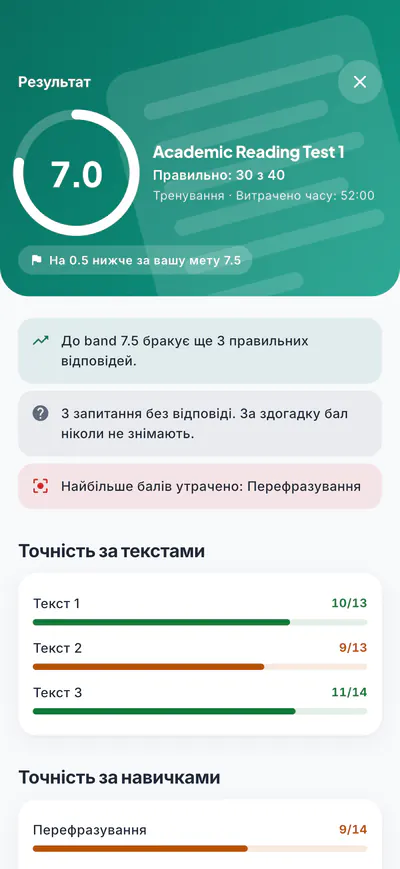
Результат пробного тесту IELTS у застосунку «Fleydo: підготовка до IELTS»: орієнтовний band і точність за кожною частиною
Безкоштовний пробний урок

Дізнайтеся свій реальний бал IELTS раніше, ніж це зробить іспит

Безкоштовний індивідуальний онлайн-урок з учителем — носієм англійської, сертифікованим фахівцем з IELTS із балом 8.5+. Ви отримаєте діагностику Speaking у реальному форматі, чесну оцінку балу та план роботи над саме тими критеріями, які коштують вам балів. Без оплати, без зобов'язань.

Онлайн · Індивідуально · Academic і General Training

IELTS — зареєстрована торговельна марка British Council, IDP: IELTS Australia та Cambridge University Press & Assessment. Ці пробні тести склала команда Fleydo; зазначені організації їх не затверджували й не схвалювали.

Мобільний застосунок

Fleydo English School у вашій кишені

Уроки, домашні завдання, повідомлення та ігри для учнів Fleydo та їхніх батьків. Безкоштовно на iPhone та Android.

Завантажте в App StoreЗавантажити з Google Play
Докладніше про застосунок
QR-код, що відкриває застосунок Fleydo English School в App Store або Google PlayСкануйте й завантажуйтеВідкриє потрібний магазин для вашого телефона.fleydo.com/app
Значок застосунку Fleydo IELTS
Fleydo: підготовка до IELTS

Готуєтеся до IELTS?

«Fleydo: підготовка до IELTS» — окремий застосунок із пробними тестами з усіх чотирьох навичок. Акаунт Fleydo для нього не потрібен.

Детальніше про застосунок IELTS
Завантажте в App StoreЗавантажити з Google Play
Пробні тести IELTS

Тренуйте всі чотири навички IELTS

Усього тестів: 311. Бал одразу після тесту, розбір кожної відповіді та зразки для Writing і Speaking. Без реєстрації.

Усі пробні тести
FleyPath

Персональна дорожня карта вашої дитини — 3, 6 або 12 місяців

🚀Старт
👋Hello
😊Body
🦁Animals
🔢Numbers
🏆Упевнена англійська
Гейміфікована практика англійської

Як гра — тільки вони справді вчаться