1. Головна
  2. IELTS
  3. Пробні тести
  4. Reading
  5. Reading Sentence Endings: тренування 4

IELTS Reading · Зіставлення закінчень речень

IELTS Reading Sentence Endings: тренування 4

Pink flamingos

  • 9 запитань
  • 15 хв
  • Academic

Що в цьому тесті

  1. PassageЗапитання 1–9The pink on the menu

Типи запитань

  • Зіставлення закінчень речень
ReadingIELTS Reading Sentence Endings: тренування 4
Залишилося часу15:00

Passage

The pink on the menu

A A flamingo does not begin life pink. The chick hatches in pale down, and years and a series of moults pass before it wears its adult colours. The pigments responsible, carotenoids, cannot be made by the bird itself and have to be swallowed, which in the wild means eating organisms such as brine shrimp and cyanobacteria.

B Digested pigment dissolves in fat, and growing feathers take it up. One museum curator of birds, quoted in a magazine in 2011, said that flamingos turn carotenoids into a red pigment, canthaxanthin, and store any surplus in the liver, ready to colour new feathers at the next moult. The six species do not all behave alike. Their blood chemistry varies and they target different carotenoids, which a wildlife magazine gives as the reason for their range of shades.

C Zoos made the link hard to overlook. Keepers had long known that captive flamingos tend to lose their bright colour, as a history of the Scripps Institution of Oceanography in California records. When its biochemist Denis Fox, who had a long association with the San Diego Zoological Society, began studying the zoo's flock in 1954, the birds were fading. Finely ground lobster shell was added to their food, and within a few months their colour returned. How pale a bird becomes is less settled: the same curator said that one lacking carotenoids turns white after its next moult, while a bird manager at a British zoo said in 2026 that it would probably be a very light pink.

D An educational website says that keepers first offered carrots, red peppers and dried shrimp, and that nesting and breeding became more successful when synthetic canthaxanthin was later added to the feed. In 2026 the diet officer for two British zoos, Whipsnade and London, described a specially made pellet containing the same pigment. She added that blue or green food colouring would make no difference, because dyes that are not carotenoids are digested and excreted and never reach the feathers.

E Food is not the whole story. Breeding uses up pigment: both parents feed their chicks a carotenoid-rich liquid from the throat, and by the end of the season they may look almost white. Greater flamingos also apply colour from outside. A team in Seville reported in 2010 that the birds rub their heads against the neck, chest and back, spreading pigmented oil from a gland. Plumage was brightest when birds displayed in groups and faded soon after breeding began, and this timing led the authors to suggest that the main function may relate to mate choice. In a 2021 study of the same species, neck feathers left in direct sun on a roof for 40 days lost over half their redness, while others kept in darkness lost about a tenth, which suggested that the birds must reapply their make-up regularly.

F Even that may not complete the picture. At a zoo in South Korea, where flamingos ate mainly artificial feed, researchers writing in 2015 grew living red microbes of a salt-loving kind from the birds' feathers, but not from the feed. A pigment in the microbes matched one found in the feathers. The authors suggested that such organisms may be an environmental influence on plumage colour, and they called for further studies.

Глосарій
moults
times when a bird loses its old feathers and grows new ones
carotenoids
natural yellow, orange and red colouring substances made by plants, algae and some microbes
brine shrimp
very small shrimp that live in very salty water
cyanobacteria
tiny water organisms, sometimes called blue-green algae, that make food from sunlight
canthaxanthin
an orange-red carotenoid
PassageЗапитання 1–9
Запитання 1–9

Complete each sentence with the correct ending, A-L, below.

Варіанти
  • Awas reported to bring better nesting and breeding.
  • Bwould pass through the body without reaching the feathers.
  • Ccould affect the colour of the plumage, the authors proposed, though more research was needed.
  • Dmust be eaten, since the bird cannot produce them itself.
  • Ecame mainly from the pellets the birds were given.
  • Fis saved for the next set of feathers the bird grows.
  • Gcan leave both parents looking nearly white by the close of the season.
  • Hshowed that vegetables gave a stronger colour than shrimp.
  • Ibrought back the colour of fading birds within a few months.
  • Jimplied that the birds must keep renewing their colour.
  • Kpointed the authors towards a possible link with choosing a partner.
  • Lis produced in the liver when food contains none.
1The pigments that colour a flamingo's feathers
2According to the curator, the extra pigment held in the liver
3The ground lobster shell added to the food of San Diego's flamingos
4The addition of a manufactured pigment to zoo feed
5Blue or green food colouring
6Feeding chicks with a liquid from the throat
7The seasonal pattern of colour in the Seville study
8The 2021 test on feathers left in the sun
9The red microbes found on feathers in South Korea

Відповіді й пояснення

Спершу пройдіть тест: ключі корисніші, коли ви вже відповіли.

Показати ключі й пояснення
  1. 1
    D

    Paragraph A says the pigments 'cannot be made by the bird itself and have to be swallowed'. Swallowing them means eating them. Ending L fails: the liver stores a surplus, and the text never says it creates the pigment when food has none.

  2. 2
    F

    Paragraph B reports the curator saying surplus pigment is stored 'ready to colour new feathers at the next moult'. Extra means surplus. Ending L is tempting because it also mentions the liver, but the liver stores this pigment; it does not replace what food supplies.

  3. 3
    I

    Paragraph C says the birds 'were fading' when lobster shell was added, and that 'within a few months their colour returned'. Brought back means returned. Ending A fails: better nesting and breeding is reported for synthetic canthaxanthin in paragraph D, not for the shell.

  4. 4
    A

    Paragraph D says that 'nesting and breeding became more successful' when synthetic canthaxanthin was added, according to one website. Ending H fails: carrots and peppers are mentioned, but the text compares no colours from them with shrimp.

  5. 5
    B

    Paragraph D says such dyes 'are digested and excreted and never reach the feathers'. That means they pass through the body. Ending G also concerns losing colour, but it is about parents who feed chicks, not about dye.

  6. 6
    G

    Paragraph E says breeding uses up pigment: both parents feed this liquid and 'by the end of the season they may look almost white'. Ending J also concerns colour fading, but it comes from the test on feathers in the sun, not from feeding.

  7. 7
    K

    Paragraph E says the timing 'led the authors to suggest that the main function may relate to mate choice'. Choosing a partner is mate choice. Ending J fails, because the need to reapply colour comes from the 2021 study.

  8. 8
    J

    Paragraph E says the result 'suggested that the birds must reapply their make-up regularly'. To reapply regularly is to keep renewing the colour. Ending K fails, because mate choice is the conclusion of the study from Seville, not this test.

  9. 9
    C

    Paragraph F says the organisms 'may be an environmental influence on plumage colour' and asks for further studies. Ending E reverses the text, as the microbes were grown from the feathers 'but not from the feed'.

Ключові слова з цього тесту

Passage

surplus
an amount that is more than is needed
captive
kept by people and not living in the wild
synthetic
made by people using chemicals, not taken from nature
excreted
passed out of the body as waste
plumage
a bird's feathers
Як відповідати на запитання типу «Зіставлення закінчень речень»Join each sentence beginning to the ending that says what the text says.

What the task looks like

You get some sentence beginnings and a longer list of lettered endings. You join each beginning to one ending, to make a sentence that agrees with the text.

The task tests whether you understand the main ideas, not only whether two halves make good English. In our papers there are spare endings, so some are not used.

Preparing for General Training? Our General Training papers do not include this type. Official sources do not all agree on whether the real General Training test can include it, so it is still worth knowing how it works.

A method to try

1. Read one beginning, mark its main words, and find the part of the text that deals with this idea. The beginnings follow the order of the text, so each answer comes after the last one.

2. Before you look at the endings, say in your own words how the text would finish this sentence.

3. Look for the ending closest to your version. Rule out any that cannot follow the beginning grammatically.

4. Read the whole sentence and check it against the text. Good English is not enough.

The traps

Good grammar, wrong meaning: several endings may join the beginning neatly, so grammar alone may not decide.

True, but about something else: an ending may state something from the text that has nothing to do with this beginning.

Reversal: an ending may turn the text round, so that the cause becomes the result.

Borrowed words: an ending that repeats words from the text is not more likely to be right. The right one often says the idea in new words.

Worked example

Text: The town's ferry used to run only in summer. Demand from commuters led the operator to add a winter service, although rough weather still cancels some crossings. A larger boat, due next year, should reduce these cancellations.

Beginning: The winter ferry service began ... A because people travelling to work wanted it. B because a bigger boat had been delivered. C so that fewer crossings would be cancelled. D after the rough weather had come to an end.

СлабшеC. The text talks about reducing cancellations, and 'The winter ferry service began so that fewer crossings would be cancelled' reads well.
КращеA. 'Demand from commuters led the operator to add a winter service.' Commuters are people travelling to work. C is what the larger boat should do, not why the service began.

All four endings are good English. Check the complete sentence against what the text says about this beginning.

Значок застосунку Fleydo IELTS Fleydo: підготовка до IELTS

Ці тести завжди з вами — у телефоні

Усі тести з цих сторінок є й у застосунку «Fleydo: підготовка до IELTS» для iPhone, iPad і Android, а разом із ними — 2 000 слів для IELTS з озвученням.

  • Працює офлайн, коли тест уже завантажено на телефон
  • 2 000 слів для IELTS з озвученням, інтервальним повторенням і короткими вправами
  • Записуйте відповіді Speaking і прослуховуйте їх
  • План на кожен день під ваш цільовий band і дату іспиту
Завантажте в App StoreЗавантажити з Google Play
Відскануйте, щоб завантажитиВідкриє App Store або Google Play залежно від вашого телефона.

Акаунт не потрібен. Про застосунок

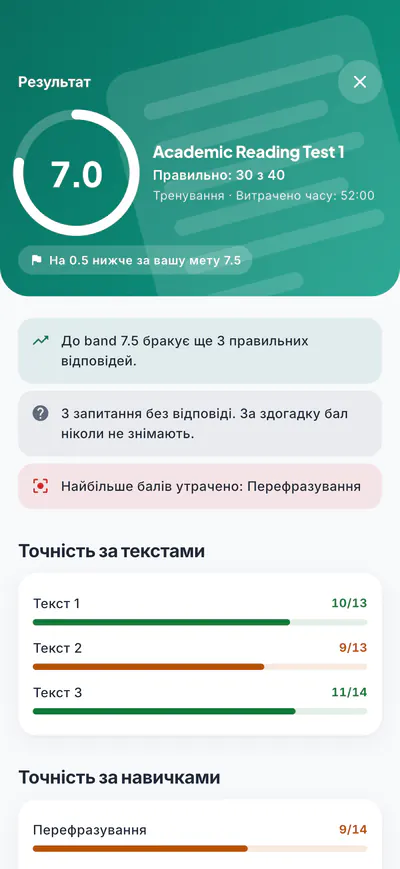
Результат пробного тесту IELTS у застосунку «Fleydo: підготовка до IELTS»: орієнтовний band і точність за кожною частиною
Безкоштовний пробний урок

Дізнайтеся свій реальний бал IELTS раніше, ніж це зробить іспит

Безкоштовний індивідуальний онлайн-урок з учителем — носієм англійської, сертифікованим фахівцем з IELTS із балом 8.5+. Ви отримаєте діагностику Speaking у реальному форматі, чесну оцінку балу та план роботи над саме тими критеріями, які коштують вам балів. Без оплати, без зобов'язань.

Онлайн · Індивідуально · Academic і General Training

IELTS — зареєстрована торговельна марка British Council, IDP: IELTS Australia та Cambridge University Press & Assessment. Ці пробні тести склала команда Fleydo; зазначені організації їх не затверджували й не схвалювали.

Мобільний застосунок

Fleydo English School у вашій кишені

Уроки, домашні завдання, повідомлення та ігри для учнів Fleydo та їхніх батьків. Безкоштовно на iPhone та Android.

Завантажте в App StoreЗавантажити з Google Play
Докладніше про застосунок
QR-код, що відкриває застосунок Fleydo English School в App Store або Google PlayСкануйте й завантажуйтеВідкриє потрібний магазин для вашого телефона.fleydo.com/app
Значок застосунку Fleydo IELTS
Fleydo: підготовка до IELTS

Готуєтеся до IELTS?

«Fleydo: підготовка до IELTS» — окремий застосунок із пробними тестами з усіх чотирьох навичок. Акаунт Fleydo для нього не потрібен.

Детальніше про застосунок IELTS
Завантажте в App StoreЗавантажити з Google Play
Пробні тести IELTS

Тренуйте всі чотири навички IELTS

Усього тестів: 311. Бал одразу після тесту, розбір кожної відповіді та зразки для Writing і Speaking. Без реєстрації.

Усі пробні тести
FleyPath

Персональна дорожня карта вашої дитини — 3, 6 або 12 місяців

🚀Старт
👋Hello
😊Body
🦁Animals
🔢Numbers
🏆Упевнена англійська
Гейміфікована практика англійської

Як гра — тільки вони справді вчаться