1. Головна
  2. IELTS
  3. Пробні тести
  4. Reading
  5. Reading Sentence Completion: тренування 5

IELTS Reading · Доповнення речень

IELTS Reading Sentence Completion: тренування 5

The first paper money

  • 12 запитань
  • 15 хв
  • Academic

Що в цьому тесті

  1. PassageЗапитання 1–12From deposit slip to currency

Типи запитань

  • Доповнення речень
ReadingIELTS Reading Sentence Completion: тренування 5
Залишилося часу15:00

Passage

From deposit slip to currency

A Throughout China's Northern Song period (960-1127), bronze coin was the standard money across most of the empire. In Sichuan, in the west, the mainstay at first was iron. The dynasty had found iron coinage in use when it conquered the region, and its early signal of a move to bronze sent the value of iron into free fall. Officials therefore allowed Sichuan a separate currency zone. Iron money was cumbersome, however. The twelfth-century scholar Lü Zuqian recorded that 1,000 large iron coins weighed 25 jin, and 1,000 medium ones 13 jin. The Tsinghua University historian Yuping Ni offers an illustration: a horse sold for 20,000 coins would have needed an ox cart to carry the payment.

B At the end of the tenth century, financial firms in Sichuan began to issue notes called jiaozi in exchange for deposits of coin, silk and other assets. In Ni's account, the amount was written on by hand, and withdrawing cost 30 coins per 1,000. Concealed marks, stamps in black and red and handwritten inscriptions made forgery difficult. Only later did the notes take on one format and denomination for use in the market, the step that turned a deposit slip into something closer to currency.

C Private issue proved fragile. Many firms made risky investments, went bankrupt and could not pay out on their notes. Early in the eleventh century, the Chengdu prefect Zhang Yong tried to strengthen the system by allowing only sixteen of the leading merchant houses to issue them. By 1020, however, the notes were losing value rapidly and were not always honoured. According to the historian Niv Horesh, the houses were ordered to shut, which caused popular protests.

D In 1023 the state took over the issue, a change that Horesh sees as the setting for the world's first fiduciary paper money. He describes new exchange bureaus that converted notes and metal for a commission of 3 per cent, although the historian Wang Shen writes that the state later stopped redeeming notes in Sichuan. Each issue was meant to last only two or three years and to reach no more than about 1.25 million strings of coin, with 360,000 strings held in metal, a reserve of less than a third. Because paper wore out quickly, the limited term was easy to justify. On expiry, holders had to exchange their notes for a new issue. Chinese scholars say this cost 30 coins per string, while Horesh writes of a considerable discount.

E Under the state, according to the historian Richard von Glahn, jiaozi soon became Sichuan's dominant money, largely displacing coin. Restraint weakened, however. From 1073, Horesh writes, under fiscal pressure along its northern frontier, the government began issuing unbacked notes, for which no matching coin had reached the treasury. By about 1105, jiaozi had lost so much value that they were declared void unless exchanged for a new type of note, at a rate of 4 to 1.

F In the twelfth century, paper money was extended to other regions. Von Glahn calls these bills inconvertible, but describes how the state supported them: most money taxes were collected half in coin and half in notes, and when the value of notes faltered, the state bought up the excess with its silver bullion. In the thirteenth century, heavy issues brought severe depreciation. Even so, von Glahn notes, paper became still more firmly established in private business.

Глосарій
jin
a traditional Chinese unit of weight
prefect
a senior local government official
fiduciary
of money: valued because people trust it, not for the metal in it
string
a unit of money, counted as a string of 1,000 coins
bullion
gold or silver in bars or blocks rather than as coins
depreciation
a fall in the value of something
inconvertible
of paper money: not able to be exchanged for coin or metal
PassageЗапитання 1–12
Запитання 1–12 Максимум 3 слова

Complete the sentences below. Choose NO MORE THAN THREE WORDS AND/OR A NUMBER from the passage for each answer.

1At first, money in Sichuan differed from the bronze used across most of the empire, as it was mainly made of .
2Lü Zuqian's record gives as the weight of 1,000 large iron coins.
3Forgers were hindered by secret marks, written inscriptions and stamps in .
4Zhang Yong tried to support the notes by limiting their issue to of the main merchant houses.
5According to Horesh, the order to close the issuing houses met with .
6According to Horesh, exchange bureaus in the new state system took a 3 per cent on converting between notes and metal.
7The plan for each issue included a reserve of strings in metal.
8Holders of notes that had expired had to exchange them for .
9Notes issued from 1073 with no matching coin at the treasury are described as .
10Most money were paid in equal shares of coin and paper.
11When notes weakened, the state used to buy up the surplus.
12Despite its heavy loss of value, paper money grew more firmly rooted in in the thirteenth century.

Відповіді й пояснення

Спершу пройдіть тест: ключі корисніші, коли ви вже відповіли.

Показати ключі й пояснення
  1. 1
    iron

    Paragraph A says bronze was the standard money 'across most of the empire', but in Sichuan 'the mainstay at first was iron'. Bronze is what the sentence contrasts it with, so bronze cannot be the answer.

  2. 2
    25 jin / twenty-five jin

    Paragraph A says '1,000 large iron coins weighed 25 jin', and the unit is part of the answer. The figure of 13 jin is for medium coins, and 20,000 is the price of the horse in Ni's illustration.

  3. 3
    black and red / red and black

    Paragraph B lists 'stamps in black and red' among the things that made forgery difficult. All three words are needed here, because the gap asks for the colours of the stamps. Concealed means secret.

  4. 4
    16 / sixteen

    Paragraph C says he allowed 'only sixteen of the leading merchant houses' to issue notes. Limiting means allowing only, and main means leading. The number 1020 in the same paragraph is a year.

  5. 5
    popular protests / protests

    Paragraph C says the order to shut 'caused popular protests'. Close means shut. Protests or popular protests is correct. 'Bankrupt' describes what happened to firms earlier, not how people responded to the order.

  6. 6
    commission

    Paragraph D says Horesh describes bureaus that converted notes and metal 'for a commission of 3 per cent'. The 30 coins per 1,000 in paragraph B belongs to the private firms, not to the state bureaus.

  7. 7
    360,000 / 360000 / three hundred and sixty thousand / three hundred sixty thousand

    Paragraph D says '360,000 strings' were 'held in metal', and calls this a reserve. The figure of about 1.25 million is the most that could be issued, so it limits the notes and is not the reserve.

  8. 8
    a new issue / new issue

    Paragraph D says that on expiry holders 'had to exchange their notes for a new issue'. New issue or a new issue is correct. 'Considerable discount' is what Horesh says the exchange cost them, not what they received.

  9. 9
    unbacked notes / unbacked

    Paragraph E calls these 'unbacked notes', and explains that no matching coin had reached the treasury. Unbacked or unbacked notes is correct. 'Void' is different: it describes the jiaozi of about 1105, which were cancelled unless exchanged for a new type.

  10. 10
    taxes

    Paragraph F says 'most money taxes were collected half in coin and half in notes'. Equal shares means half and half, and paper means notes. 'Money' is already in the sentence, so the answer is taxes alone.

  11. 11
    its silver bullion / its silver / silver bullion / silver / its bullion / bullion

    Paragraph F says the state bought up the excess 'with its silver bullion'. Silver, bullion or silver bullion is correct. Iron and bronze are coin metals mentioned earlier, but neither is what was used here.

  12. 12
    private business / business

    Paragraph F says paper 'became still more firmly established in private business' despite 'severe depreciation'. Rooted means established. Private business or business alone is correct.

Ключові слова з цього тесту

Passage

cumbersome
large or heavy and difficult to use
deposit
a sum of money or goods left somewhere for safe keeping
fragile
easily broken or damaged
reserve
a supply kept back for use when it is needed
discount
a reduction in price or value
Як відповідати на запитання типу «Доповнення речень»Complete a sentence with exact words from the text, and read the result.

What the task looks like

You get sentences with a gap in each, and an instruction such as: Choose NO MORE THAN TWO WORDS from the passage for each answer.

The sentence rewords the text, and your answer is the missing word or words, taken from the text. The task tests whether you can find a specific detail.

In our papers, the sentences follow the order of the text, and the answer appears word for word in the text.

A method to try

1. Check the limit. NO MORE THAN TWO WORDS allows one word or two. It is a limit, not a target.

2. Read the whole sentence and decide what the gap needs. A noun, a verb, an adjective or a number? Singular or plural? The words on each side of the gap are your clues.

3. Work out what the sentence means, then find the same idea in the text. Expect different words.

4. Copy the answer as it is written in the text. You should not need to change its form. If you feel you must, for example from 'decided' to 'decision', you may be reading the wrong sentence.

5. Read the finished sentence. It should be correct English, and it should say what the text says.

The traps

Too many words: you copy a whole phrase when the sentence needs only part of it.

Good grammar, wrong meaning: a word from the right paragraph can fit the gap and still make the sentence untrue.

The nearest word: the word next to your clue may not be the answer. Read to the end of the sentence in the text.

Words already printed: do not repeat a word that is already there just before or after the gap.

Worked example

Text: The bakery began as a market stall selling only bread. Its owners later opened a small café in the same street, and the profits paid for a second oven. Today, customers often queue for its cakes.

Sentence: Money earned by the café allowed the owners to buy an additional ____. (NO MORE THAN TWO WORDS)

Слабшеsecond oven. These words come straight after 'paid for a', and the limit allows two words.
Кращеoven. 'Additional' already does the work of 'second', so the gap needs only one word. 'An additional oven' is correct English and says what the text says.

'An additional second oven' repeats itself. Reading the finished sentence shows you this, and you do not have to use every word the limit allows.

Значок застосунку Fleydo IELTS Fleydo: підготовка до IELTS

Ці тести завжди з вами — у телефоні

Усі тести з цих сторінок є й у застосунку «Fleydo: підготовка до IELTS» для iPhone, iPad і Android, а разом із ними — 2 000 слів для IELTS з озвученням.

  • Працює офлайн, коли тест уже завантажено на телефон
  • 2 000 слів для IELTS з озвученням, інтервальним повторенням і короткими вправами
  • Записуйте відповіді Speaking і прослуховуйте їх
  • План на кожен день під ваш цільовий band і дату іспиту
Завантажте в App StoreЗавантажити з Google Play
Відскануйте, щоб завантажитиВідкриє App Store або Google Play залежно від вашого телефона.

Акаунт не потрібен. Про застосунок

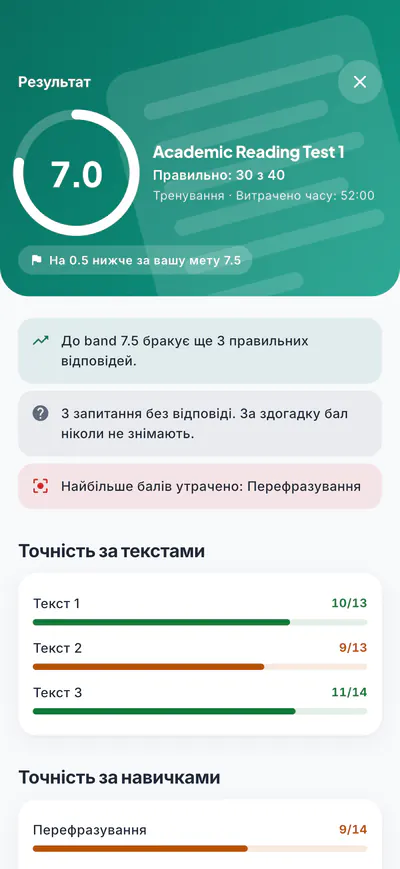
Результат пробного тесту IELTS у застосунку «Fleydo: підготовка до IELTS»: орієнтовний band і точність за кожною частиною
Безкоштовний пробний урок

Дізнайтеся свій реальний бал IELTS раніше, ніж це зробить іспит

Безкоштовний індивідуальний онлайн-урок з учителем — носієм англійської, сертифікованим фахівцем з IELTS із балом 8.5+. Ви отримаєте діагностику Speaking у реальному форматі, чесну оцінку балу та план роботи над саме тими критеріями, які коштують вам балів. Без оплати, без зобов'язань.

Онлайн · Індивідуально · Academic і General Training

IELTS — зареєстрована торговельна марка British Council, IDP: IELTS Australia та Cambridge University Press & Assessment. Ці пробні тести склала команда Fleydo; зазначені організації їх не затверджували й не схвалювали.

Мобільний застосунок

Fleydo English School у вашій кишені

Уроки, домашні завдання, повідомлення та ігри для учнів Fleydo та їхніх батьків. Безкоштовно на iPhone та Android.

Завантажте в App StoreЗавантажити з Google Play
Докладніше про застосунок
QR-код, що відкриває застосунок Fleydo English School в App Store або Google PlayСкануйте й завантажуйтеВідкриє потрібний магазин для вашого телефона.fleydo.com/app
Значок застосунку Fleydo IELTS
Fleydo: підготовка до IELTS

Готуєтеся до IELTS?

«Fleydo: підготовка до IELTS» — окремий застосунок із пробними тестами з усіх чотирьох навичок. Акаунт Fleydo для нього не потрібен.

Детальніше про застосунок IELTS
Завантажте в App StoreЗавантажити з Google Play
Пробні тести IELTS

Тренуйте всі чотири навички IELTS

Усього тестів: 311. Бал одразу після тесту, розбір кожної відповіді та зразки для Writing і Speaking. Без реєстрації.

Усі пробні тести
FleyPath

Персональна дорожня карта вашої дитини — 3, 6 або 12 місяців

🚀Старт
👋Hello
😊Body
🦁Animals
🔢Numbers
🏆Упевнена англійська
Гейміфікована практика англійської

Як гра — тільки вони справді вчаться