- Головна
- IELTS
- Пробні тести
- Listening
- Listening Sentence Completion: тренування 3
IELTS Listening · Доповнення речень
IELTS Listening Sentence Completion: тренування 3
The zip fastener
- 8 запитань
- 5 хв
- Listening
Що в цьому тесті
- Частина 1Запитання 1–8You will hear part of a lecture on the invention and development of the zip fastener.
Типи запитань
Хто говорить
Ви почуєтеYou will hear part of a lecture on the invention and development of the zip fastener.
Complete the sentences below. Write ONE WORD ONLY for each answer.
Відповіді й пояснення
Спершу пройдіть тест: ключі корисніші, коли ви вже відповіли.
Показати ключі й пояснення
- 1laces
Judson's patent drawing shows a shoe, and "his aim was to do away with long laces". The lecturer then says "it wasn't buttons he was trying to replace": buttons are what zips replace today, not what Judson had in mind. "Do away with" is paraphrased as "replace".
- 2Germany
Sundback "had been born on a farm in Sweden", but "he trained as an electrical engineer in Germany". The sentence asks where he was educated, not where he was born; "But" signals the change.
- 3teeth
Judson's fasteners used hooks, but "Sundback's new design had no hooks at all. Instead, each side carried a row of small metal teeth", which the slider pressed together. "Lock into one another" paraphrases "gripped each other". The metal clamps belong to the failed 1912 design.
- 4wire
The machine "took a special Y-shaped wire and sliced the teeth off it". The cloth tape comes after: it is what the finished teeth were clamped onto, not what they were cut from. "Cut each metal tooth from" paraphrases "sliced the teeth off"; "metal" is already in the sentence, so the gap asks for the form the metal came in.
- 5money
The first real success came "during the First World War, when a tailor in New York started making money belts with it": belts for holding money. Tobacco pouches come straight after as another early use, but they were pouches, not belts.
- 6boots / boot
Goodrich is mentioned as a firm known for car tyres, but its new rubber boots "were sold as Zipper Boots", so "the name belonged to the boots first" and passed to the fastener later.
- 7self-reliance
In the "Bye-Bye Buttons" campaign, "parents were told that zips encouraged self-reliance", because a child could dress without help. A hyphenated word counts as one word, so "self-reliance" fits ONE WORD ONLY. Write the hyphen: "self reliance" is two words and breaks the limit.
- 8advertising
The Duke of Windsor is the famous customer in the popular story, but Friedel argues that "the truth was more complicated". "Advertising played a big part", with a campaign in magazines such as Esquire. "Points to factors such as" paraphrases "played a big part".
Показати повний транскрипт
Частина 1
Narrator You will hear part of a lecture on the invention and development of the zip fastener. First, you have some time to look at questions 1 to 8.
Narrator Now listen carefully and answer questions 1 to 8.
Dr Fairley Good morning, everyone. In this series we've been looking at everyday objects that took far longer to get right than you might expect, and today it's the turn of the zip. It's the story of an idea that worked on paper long before it worked in practice.
Dr Fairley In the early 1890s, an American inventor called Whitcomb Judson patented a device he called a clasp locker. His patent drawing shows a high-top shoe, and his aim was to do away with long laces, which took an age to thread and tie.
Dr Fairley Notice that, in the patent at least, it wasn't buttons he was trying to replace. We tend to think of the zip as the button's great rival, but that contest came decades later. Judson showed his invention at the World's Fair in Chicago in 1893, but it was hardly a commercial success.
Dr Fairley He set up a company to make it and kept improving the design, but the fastener remained awkward and unreliable. One leaflet for a later version assured women that their skirts would never open without their knowledge. As the historian Robert Friedel points out, that rather suggests they often did.
Dr Fairley The breakthrough came from an engineer who joined the company in 1906, Gideon Sundback. Sundback had been born on a farm in Sweden. But he trained as an electrical engineer in Germany, and in 1905 he emigrated to the United States.
Dr Fairley His first hookless design, in 1912, didn't last long. A cloth tape with a beaded edge was pushed into metal clamps on the other side, and the cloth wore out after only a few uses.
Dr Fairley Then, at the end of 1913, he got it right. Judson's versions had all depended on hooks catching on eyes, a bit like the fastening on a dress. Sundback's new design had no hooks at all. Instead, each side carried a row of small metal teeth, more than twice as many to the inch as before, and the slider pressed the two rows together so that they gripped each other.
Dr Fairley The patent for this separable fastener, as he called it, was granted in 1917. But a good design is no use if you can't produce it in large numbers, so Sundback also built the machine to make it. It took a special Y-shaped wire and sliced the teeth off it, one after another. Then it punched a small dimple into each tooth and clamped them in a line onto a strip of cloth tape.
Dr Fairley Even so, sales were slow at first. Its first real success came during the First World War, when a tailor in New York started making money belts with it. Some twenty-four thousand were sold. It also found early uses in tobacco pouches.
Dr Fairley Now, where does the word zipper come from? In 1923, the B. F. Goodrich company, a rubber firm whose name you may know from car tyres, brought out a new line of rubber boots that closed with the fastener. They were sold as Zipper Boots. So the name belonged to the boots first, and only later passed to the fastener itself.
Dr Fairley In clothing, the zip was slow to catch on. In 1933 and 1934, there was a campaign for zips in children's clothes, built around a film called 'Bye-Bye Buttons'. Child psychologists were brought in, and parents were told that zips encouraged self-reliance, because a small child could get dressed without help. Not everyone was persuaded, though. A dress with a zip cost about twice as much as one with buttons.
Dr Fairley And what about men's trousers? There's a popular story that the fashionable Duke of Windsor chose a zip for his trousers and won everyone over at a stroke. But Friedel argues that the truth was more complicated. Advertising played a big part, with an intense campaign in magazines such as Esquire and The New Yorker. In 1936, only six per cent of summer suits had zips. By 1938, it was twenty per cent.
Dr Fairley So, getting from Judson's shoe fastener to the zip in a man's suit took more than forty years. Next week, we'll turn to another small fastening with a long history, the safety pin.
Narrator That is the end of the recording. You now have half a minute to check your answers.
Ключові слова з цього тесту
Частина 1
- do away with
- get rid of something or stop using it
- unreliable
- not able to be trusted to work properly every time
- emigrate
- leave your own country to go and live in another one
- catch on
- become popular or widely used
- at a stroke
- all at once, with a single action
- grip
- hold something tightly
Як відповідати на запитання типу «Доповнення речень»Complete each sentence with words you hear, keeping meaning and grammar right.
What the task looks like
The instruction says 'Complete the sentences below.' and gives a limit, such as 'Write NO MORE THAN TWO WORDS for each answer.' Each sentence rewords something a speaker says and leaves a gap.
The task tests whether you can pick out key information and see how ideas connect, for example a cause and its effect.
A method to try
Before you listen: 1. Read each sentence and decide what the gap needs: a noun, a verb, an adjective or a number. 2. Mark the words that show a relationship, such as 'because', 'so', 'in order to' or 'the main problem was'. 3. Think how a speaker might say the same idea in other words.
While you listen: 4. Listen for the idea of the sentence, not its exact words. 5. Write the word in the form the speaker uses. 6. Read the finished sentence. It must be correct English and true to what you heard.
The traps
Cause or result: if the sentence asks why something happened, the answer is the reason, not what happened next.
Ruled out: a speaker may mention a possible reason only to say that it was not the problem.
Extra words: 'the', 'a' and 'their' count towards the limit.
Worked example
Recording: Student: We've had to move our survey to next month. Our tutor didn't mind at all. The real problem was the lab: it's booked for exams all this week.
Sentence: The students moved their survey because the ____ was not available. (NO MORE THAN TWO WORDS)
The sentence asks for a cause. 'The real problem was' introduces it, and the tutor is mentioned only to be ruled out.
 Fleydo: підготовка до IELTS
Ці тести завжди з вами — у телефоні
Усі тести з цих сторінок є й у застосунку «Fleydo: підготовка до IELTS» для iPhone, iPad і Android, а разом із ними — 2 000 слів для IELTS з озвученням.
- Працює офлайн, коли тест уже завантажено на телефон
- 2 000 слів для IELTS з озвученням, інтервальним повторенням і короткими вправами
- Записуйте відповіді Speaking і прослуховуйте їх
- План на кожен день під ваш цільовий band і дату іспиту


 Відскануйте, щоб завантажитиВідкриє App Store або Google Play залежно від вашого телефона.
Акаунт не потрібен. Про застосунок
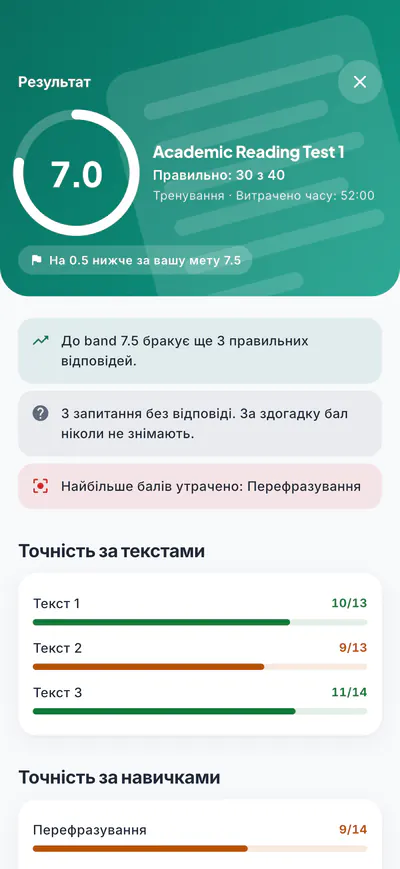
Дізнайтеся свій реальний бал IELTS раніше, ніж це зробить іспит
Безкоштовний індивідуальний онлайн-урок з учителем — носієм англійської, сертифікованим фахівцем з IELTS із балом 8.5+. Ви отримаєте діагностику Speaking у реальному форматі, чесну оцінку балу та план роботи над саме тими критеріями, які коштують вам балів. Без оплати, без зобов'язань.
Онлайн · Індивідуально · Academic і General TrainingIELTS — зареєстрована торговельна марка British Council, IDP: IELTS Australia та Cambridge University Press & Assessment. Ці пробні тести склала команда Fleydo; зазначені організації їх не затверджували й не схвалювали.

 Скануйте й завантажуйте
