1. Ana Sayfa
  2. IELTS
  3. Deneme sınavları
  4. Speaking
  5. Speaking Deneme Sınavı 37: Conversations

IELTS Speaking

IELTS Speaking Deneme Sınavı 37: Conversations

Describe a conversation with someone much older than you that taught you something.

  • 3 bölüm
  • 11–14 dk
  • Sınav görevlisi
  • Dört aday, tek test

Testi yapın

Sınav görevlisinin soruları tek tek çalar. Sınavdaki gibi sesli cevaplayın. Kayıt isteğe bağlıdır ve yalnızca bu tarayıcı sekmesinde kalır.

Kayıtlarınız yalnızca bu sekmede tutulur. Hiçbir şey yüklenmez. Saklamak isterseniz indirin.

Performansınızı puanlayın

Cevaplarınızı adaylarla karşılaştırın, sonra her kriter için size uyan bandı seçin.

6,0Tahmini bandınız
Fluency and coherence

Lexical resource

Grammatical range and accuracy

Pronunciation

Her aday farklı bir konuşmacı, bu yüzden hikâyeler ve görüşler farklı. Bantlar, herkese açık tanımlara göre bizim tahminimizdir; resmî sınav puanı değildir. Yazıya dökülmüş konuşma telaffuzu gösteremez. Bu bantlar telaffuzun diğer üç kriterle aynı düzeyde olduğunu varsayar.

Sorular, ipucu kartı ve örnek cevaplar

Bölüm 1: mülakat

Home town

  • Where is your home town?
  • Do you still live there?
  • Did you have a favourite place there when you were a child?
  • Is it the kind of place where people know their neighbours?

Snow

  • Does it ever snow where you live?
  • Can you remember the first time you saw snow?
  • Do you think snow is more fun for children than for adults?

Museums

  • How often do you go to museums?
  • Did you go to museums with your school when you were younger?
  • What kind of museum do you find most interesting?
  • Would you rather go round a museum on your own or with other people? (Why?)

İpuçları

  • 'Do you still live there?' can be answered in a few words. Say where you live now and why, then stop. Part 1 rewards a natural answer, not a speech.
  • If you have never seen snow, say so. That is a complete answer, and you can add where you have seen it (in films, in a friend's videos) or what you imagine it is like. Do not invent a trip to sound more interesting.
  • For the museum questions, one real visit, even a school trip you half remember, gives you more to say than general comments about culture and history.

Bölüm 2: uzun konuşma (ipucu kartı)

Describe a conversation with someone much older than you that taught you something.

You should say:

  • who the person was and where you were
  • how the conversation began
  • what they told you that was new to you

and explain why you think you could not have learned this from a book or the internet.

Ek soru

  • Do you still talk to this person?
  • Do you often talk to people who are much older than you?

Güçlü bir adayın alabileceği notlar

  • retired carpenter, 70s, hardware shop
  • me: wrong screws for a shelf
  • he: fifty years in a workshop
  • wood moves, wet and dry seasons
  • knocked on a board, listened
  • not online: he showed me, my shelf
  • shelf still straight

İpuçları

  • The person does not have to be a wise grandparent. An older colleague, a neighbour, a shopkeeper or a stranger on a bus all work, and the lesson can be small: how to choose fruit, how to stay calm with an angry customer, how a machine at work really behaves.
  • The explain line is the real question. Think about what made the lesson personal: they showed you with their hands, it came from their own life, or it was about a place or a person that only they knew. Say which, and why a search would not have found it.
  • Report some of what was said ('He told me that ...', 'She said, look, ...'). A story about a conversation with no words from the conversation sounds thin, and reporting speech lets you show a range of tenses.

Bölüm 3: tartışma

Different generations talking

  • Why do you think some young people find it hard to talk to older people? Açıklama
  • Do you think older people learn as much from younger people as younger people learn from them? Karşılaştırma
  • What could local communities do to bring younger and older people together? Öneri sunma

Talking online and face to face

  • Are there some conversations that should always happen face to face? Görüş bildirme
  • Has messaging made it easier or harder for people to stay close to their friends? Değerlendirme
  • How do you think the way people talk to each other will change in the future? Gelecek hakkında tahmin

İpuçları

  • The first three questions are about generations in general, not about your family. Start from something you have noticed, at a family lunch, at work, with a neighbour, and then say whether you think it is typical.
  • The question about who learns from whom goes in two directions. Listen to it carefully: an answer about what young people learn from old people covers only half of it. Say what each side learns before you decide.
  • For the future question, describe one or two concrete changes, such as how people will send messages or who they will talk to, rather than saying that technology will change everything.

Dört aday, tek test

Dört farklı banttaki adayların her soruya verdiği cevaplar.

Bölüm 1Where is your home town?

My home town is Kanpur. It's in Uttar Pradesh, in the north of India. Very big city, very crowded, er, and in summer it's so hot... in the afternoon nobody goes outside, the roads are empty.

Bölüm 1Do you still live there?

No. Two years before I came to Ahmedabad, for job. I work in a showroom, in the service section, er... for bikes and scooters. My parents and my sister are still in Kanpur.

Bölüm 1Did you have a favourite place there when you were a child?

Yes, er, the roof of our house. In the evening all the children from our – from the lane, we used to fly kites there. And my mother is shouting from down, come, food is ready, come... but nobody is coming.

Bölüm 1Is it the kind of place where people know their neighbours?

Yes, everybody know everybody. If there is a wedding in one house, er, the whole lane helps, chairs, cooking, everything. In Ahmedabad it's not... it's not like that. I don't know who is living next door to me.

Bölüm 1Does it ever snow where you live?

No, never. Ahmedabad is hot, Kanpur also hot. Snow is only in the mountains, er, in the north side, Shimla, Manali... these places.

Bölüm 1Can you remember the first time you saw snow?

Er, I never saw it in real. Only in films, and on the phone. Last year my friend went to Manali and he was sending me so many videos, er, I was feeling jealous.

Bölüm 1Do you think snow is more fun for children than for adults?

Yes, I think. Children can play, they make the snowman. But adults have to go to office, they – um, the roads are full of snow, and driving is dangerous. So for them it's a problem, I think.

Bölüm 1How often do you go to museums?

Not often. Here in Ahmedabad I didn't go even one time. Sunday is my only holiday, so... I wash clothes, I sleep, I call my mother. That's it.

Bölüm 1Did you go to museums with your school when you were younger?

Yes, one time. In class seven, I think, the school took us by bus to Lucknow, to one museum with old statues, coins, er... I don't remember much. In the bus we were singing songs, that I remember.

Bölüm 1What kind of museum do you find most interesting?

Er, maybe about vehicles. Old bikes, old cars. Because of my job also, I like to see the engine of old time, how they made it.

Bölüm 1Would you rather go round a museum on your own or with other people? (Why?)

With friends. Alone it's boring, there is nobody to talk to. With friends we make jokes, we take photos, and after we eat something.

Bölüm 2Describe a conversation with someone much older than you that taught you something.

So, this is about one old man, he sells vegetables near my flat in Ahmedabad. When I first came here, me and my two friends, we were cooking by ourself, and... the vegetables, every time we buy, er, they go bad in two days. One day I was choosing bhindi, er, lady finger, and he was watching me and laughing. He said, you are not from here, no? And then he showed me. You break the end, the small end, if it breaks with a sound, it's fresh. If it only bend, don't take. And he told come in the morning, in the evening only bad ones are left. He told me he is selling vegetables for forty years, from when he was a boy, first with his father, on a cart, street to street... Er, so. Why I can't learn this from internet... um, maybe it's there, on YouTube. But he showed me with his hand, I tried, and he was saying no, no, not that one. And he knows the other sellers, er, which one is honest, which one is putting water on the vegetables so they are... heavy. Internet don't know this. So now I buy only from him. And the bhindi, I check like... like he showed me.

Bölüm 2Do you still talk to this person?

Yes, every week, when I buy. Small talk only, er, how are you, how is the family.

Bölüm 2Do you often talk to people who are much older than you?

In my job, yes. Many customers are, er, old uncles, they bring the scooter for service and they talk, talk.

Bölüm 3Why do you think some young people find it hard to talk to older people?

Er... because they don't have the same topics. Young people talk about phone, games, cricket, and old people, they want to talk about, um, old times, the prices, their health. So young people get bored. And some old people always give advice, you should do this, you shouldn't do that, so the young people – they don't want to listen. They go to their room.

Bölüm 3Do you think older people learn as much from younger people as younger people learn from them?

No, I think young people learn more. Old people have more experience, they saw many things in the life. But old people also learn something, er, from us. Like my father, I teach him to pay on phone, UPI. In the start he was scared, er, he think the money will go... somewhere. Now he pays everything with phone, even for one tea.

Bölüm 3What could local communities do to bring younger and older people together?

Er, maybe they can make some programme. Like a function in the park, with food, music, so old and young both come. In my colony in Kanpur, in festival time we do like this, everybody come together, er, on the roofs, in the lane... it's very nice. Also some place for sitting, er, like a common room. In my building there is one room, but always it's locked. If it's open, people sit there, then they talk also.

Bölüm 3Are there some conversations that should always happen face to face?

Yes. When it's something serious... for example, if you want to say sorry, or, um, some bad news. In the message, the other person can't see your face, so he doesn't know if you are serious or you are joking. And in message people write things they will not say in front, er, because it's easy. So for important things, face to face is better. Small things... message is OK.

Bölüm 3Has messaging made it easier or harder for people to stay close to their friends?

Easier, I think. My school friends are all in different cities now, Pune, Delhi, one is in Dubai. Without WhatsApp we can't... we can't talk every day. We have a group, we send jokes, photos. But it's not same like before. Before we are sitting together on the roof, in the evening, talking, talking... that was more close.

Bölüm 3How do you think the way people talk to each other will change in the future?

Er, I think people will talk less face to face. Everything on the phone, video call. In offices also, um, many people are working from home now, so they don't meet. Even my... even in my building, nobody talks. So people will become more lonely, I think. Yes, more lonely.

Bu test için kelimeler

strike up a conversation
start talking to someone, often someone you do not know well
get talking (to someone)
start a conversation without planning to
small talk
polite, light conversation about everyday things
the generation gap
the differences in ideas and habits between older and younger people
first-hand
from your own experience, not from someone else or a book
pass something on
give knowledge or a skill to someone younger
keep in touch
continue to contact someone you do not see often
drift apart
slowly become less close to someone
in person
physically there, face to face
open up (to someone)
start talking about private thoughts or feelings
out of touch
not knowing about recent changes or ideas
slush
snow that has started to melt and become wet and dirty

İşe yarar kalıplar

  • I got talking to ___ while I was ___.
  • I didn't expect much from ___, but ___.
  • What really surprised me was that ___.
  • You can read about ___, but it's different when ___.
  • I'd never have found that out ___, because ___.
  • Older people tend to ___, whereas younger people ___.
  • It depends on the conversation. For ___, a message is fine, but for ___ you need ___.
  • I can imagine ___ becoming more ___, especially if ___.
  • When I was a child, ___ used to ___.

Fleydo IELTS uygulama simgesi Fleydo: IELTS Hazırlık

Bu testleri telefonunuzda yanınızda taşıyın

Bu sayfalardaki her test, iPhone, iPad ve Android için Fleydo: IELTS Hazırlık uygulamasında da var; yanında sesli 2.000 IELTS kelimesiyle birlikte.

  • Test telefonunuza indikten sonra çevrimdışı çalışır
  • Sesli 2.000 IELTS kelimesi, aralıklı tekrar ve kısa alıştırmalar
  • Speaking cevaplarınızı kaydedip geri dinleyin
  • Hedef bandınıza ve sınav tarihinize göre günlük plan
App Store'dan indirinGoogle Play'den indirin
İndirmek için tarayınTelefonunuza göre App Store'u veya Google Play'i açar.

Hesap gerekmez. Uygulama hakkında

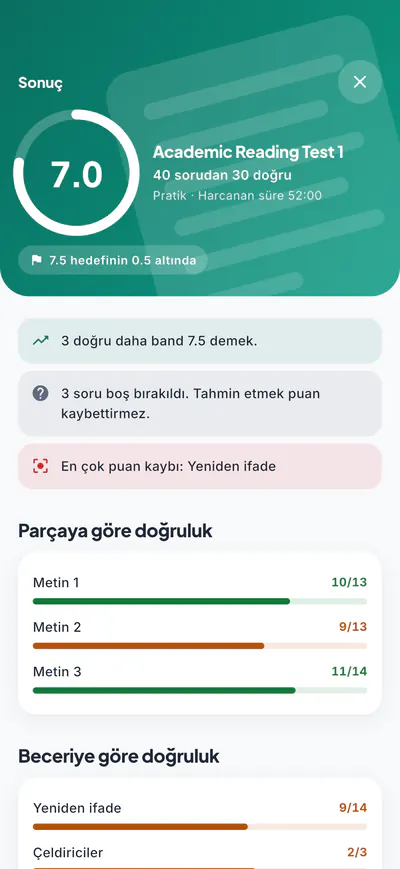
Fleydo: IELTS Hazırlık uygulamasında bir IELTS deneme sınavının sonucu: tahmini band ve her bölümün doğruluğu
Ücretsiz deneme dersi

Gerçek IELTS band puanınızı sınavdan önce öğrenin

Band 8.5+ sertifikalı IELTS uzmanı, anadili İngilizce bir öğretmenle ücretsiz bire bir online ders. Gerçek formatta bir Speaking tanılaması, dürüst bir band tahmini ve size puan kaybettiren ölçütlere yönelik bir plan alırsınız. Ödeme yok, taahhüt yok.

Online · Bire bir · Academic ve General Training

IELTS; British Council, IDP: IELTS Australia ve Cambridge University Press & Assessment kuruluşlarının tescilli markasıdır. Bu deneme sınavları Fleydo tarafından hazırlanmıştır; adı geçen kuruluşlarca onaylanmamış veya desteklenmemiştir.

Mobil Uygulama

Fleydo English School cebinizde

Fleydo öğrencileri ve velileri için dersler, ödevler, mesajlar ve oyunlar. iPhone ve Android'de ücretsiz.

App Store'dan indirinGoogle Play'den indirin
Uygulama hakkında daha fazlası
Fleydo English School uygulamasını App Store veya Google Play'de açan QR kodTaratın ve indirinTelefonunuza uygun mağazayı açar.fleydo.com/app
Fleydo IELTS uygulama simgesi
Fleydo: IELTS Hazırlık

IELTS'e mi hazırlanıyorsunuz?

Fleydo: IELTS Hazırlık, dört beceri için deneme sınavları sunan ayrı bir uygulamadır. Kullanmak için Fleydo hesabı gerekmez.

IELTS uygulamasını inceleyin
App Store'dan indirinGoogle Play'den indirin
IELTS deneme sınavları

Dört IELTS becerisini çalışın

Anında band puanı, açıklamalı cevaplar ve örnek cevaplarla 311 test. Üyelik gerekmez.

Tüm deneme sınavları
FleyPath

Çocuğunuzun kişisel yol haritası — 3, 6 veya 12 ay

🚀Başlangıç
👋Hello
😊Body
🦁Animals
🔢Numbers
🏆Özgüvenli İngilizce
Oyunlaştırılmış İngilizce pratiği

Tıpkı bir oyun gibi — ama gerçekten öğreniyorlar